
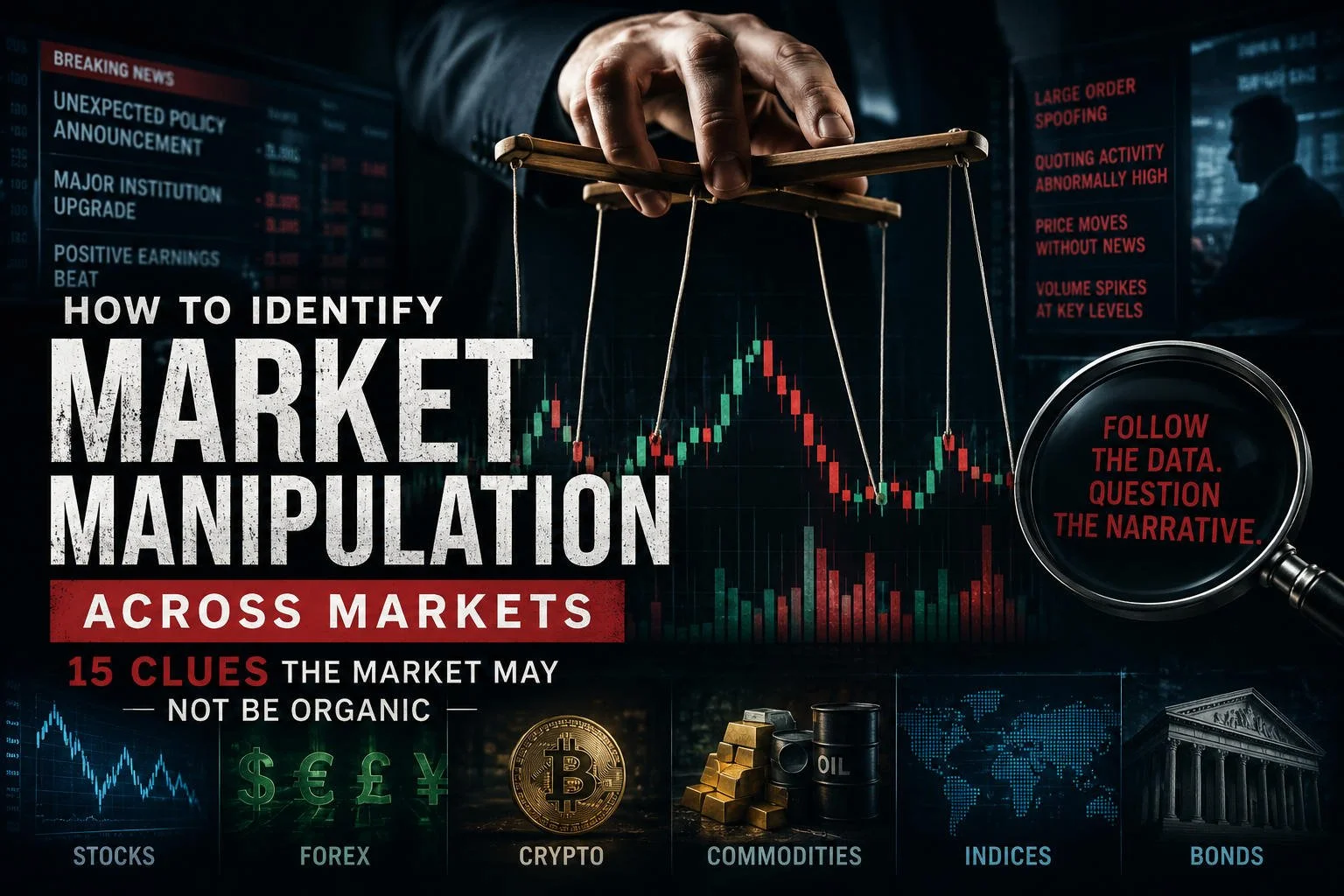
How to Identify Market Manipulation Across Markets: 15 Clues the Market May Not Be Organic
Markets are supposed to reflect real supply, real demand, real information, and real risk-taking.
But sometimes a market does not feel organic.
A stock rockets on no clear news. A crypto token shows massive volume, but nobody seems to know who is buying. A collectible suddenly becomes “the next big thing” after a wave of influencer posts. A thinly traded asset gets hyped in private chats. An order book looks deep until the big orders vanish the second price gets close.
None of those things proves manipulation by itself.
That is the most important rule.
A strange chart is not proof. A sudden spike is not proof. A heavily shorted stock is not proof. A suspicious social media campaign is not proof. Market manipulation is a serious legal and regulatory concept, and in regulated markets it usually requires evidence that someone artificially affected supply, demand, price, quotes, trades, or investor perception.
Investor.gov describes market manipulation as someone artificially affecting the supply or demand for a security. It says manipulation may involve spreading false or misleading information, using transactions to make a security appear more actively traded, or rigging quotes, prices, or trades to create a false impression of demand.
This guide is not here to accuse any specific company, stock, token, broker, fund, exchange, influencer, seller, buyer, or market participant.
It is here to help you recognize patterns that may be consistent with manipulation, organize your observations, avoid common false positives, and know what to check before jumping to conclusions.
This is not investment advice, legal advice, or trading advice.
It is a pattern-recognition guide.
The big idea
Market manipulation usually tries to create a false picture of one of four things.
First, false demand.
This makes people think:
“Everyone wants this.”
Second, false supply shortage.
This makes people think:
“There is not enough to go around.”
Third, false liquidity.
This makes people think:
“This market is active, healthy, and easy to trade.”
Fourth, false information.
This makes people think:
“Something big is about to happen.”
That false picture can appear in many places:
Stocks
Crypto
Commodities
Options
Bonds
Collectibles
Real estate
Private deals
Labor markets
Prediction markets
Online investment communities
The legal rules are different in each market. A regulated securities market is not the same as a collectibles market. A commodity futures contract is not the same as a local housing market. A crypto token is not the same as a public company.
So use the word manipulation carefully.
A better starting phrase is:
“This market may not be moving organically.”
That keeps the focus on evidence instead of accusations.
Quick checklist: 15 clues the market may not be organic
Use this as a starting point.
Not proof.
Not a trading signal.
Not a reason to accuse anyone.
Just a way to organize what you are seeing.
1. Heavy promotion appears before or during the price move
This matters because promotion can manufacture demand.
It becomes more concerning when:
Promoters are anonymous.
Promoters are paid but do not disclose it.
The same talking points appear across multiple accounts.
The hype is stronger than the evidence.
The promotion begins before any verifiable news appears.
A common false positive:
Legitimate companies, funds, projects, and sellers promote themselves all the time.
The key question:
Is the promotion informing people, or is it creating a misleading picture of demand?
2. The tip arrives unsolicited
This matters because many scams begin with an investment idea you did not ask for.
It becomes more concerning when:
A stranger texts you by “mistake.”
A social media ad sends you to a private investment group.
Someone claims to have exclusive recommendations.
A romantic or friendly conversation turns into an investment pitch.
The person tells you to buy before some supposed announcement.
The FBI warned in 2025 that it had seen at least a 300 percent increase in victim complaints referencing ramp-and-dump stock fraud compared with 2024. The warning signs included unsolicited investment tips, online investment clubs, pressure to act quickly, and urgent pitches for low-priced stocks with promises of dramatic gains.
A common false positive:
A friend sharing an article or opinion is not automatically suspicious.
The key question:
Did this opportunity find you because you researched it, or because someone is trying to steer you into it?
3. The asset is thinly traded or supply is concentrated
This matters because manipulation is easier when there is not much real liquidity.
Thin markets can include:
Microcap stocks
Low-float stocks
Small crypto tokens
New digital assets
Rare collectibles
Thin commodity contracts
Local real estate niches
Small overseas listings
Private marketplaces
Microcap stocks are more susceptible to market manipulation. The SEC also says accurate information about microcap stocks can be difficult to find, and that microcap stocks tend to be more volatile and less liquid than larger-company stocks.
It becomes more concerning when:
A few holders control much of the tradable supply.
A few wallets dominate the token supply.
Insiders, promoters, or related parties hold large positions.
Public float is small.
It takes very little buying to move the price.
It takes very little selling to crash the price.
A common false positive:
Small markets are naturally volatile.
The key question:
Is the market moving because broad demand changed, or because a small number of players can push it around?
4. Price and volume explode without verifiable news
This matters because activity can be manufactured or rumor-driven.
Ask:
Was there a filing?
Was there an official press release?
Did earnings come out?
Did a regulator approve something?
Was there a real contract?
Was there a confirmed partnership?
Did the move start before the news became public?
Did the move happen only on one venue?
Did vague explanations appear only after the price started moving?
It becomes more concerning when:
Price rises first.
Promotion appears second.
Explanations are vague.
No primary source confirms the story.
A common false positive:
Markets sometimes move before news because of legitimate speculation, analyst work, sector momentum, or rumors that later turn out to be true.
The key question:
Can the move be tied to verifiable information, or only to hype?

5. The story depends on vague catalysts
This matters because vague catalysts are easy to abuse.
Examples include:
“Major contract coming”
“Government approval soon”
“Big partnership imminent”
“Exchange listing any day”
“Shorts are trapped”
“Insiders know”
“Whales are accumulating”
“A buyout is coming”
“This will be the next Tesla”
“This will be the next Bitcoin”
“This will be the next Nvidia”
The problem is not optimism.
The problem is unverifiable certainty.
A useful test:
Can the claim be checked through a primary source?
For public companies, primary sources may include:
SEC filings
Audited financials
Press releases
Contracts
Patent records
Regulatory records
Exchange notices
Credible reporting
For crypto, primary sources may include:
Token contracts
Wallet data
Exchange notices
Vesting schedules
Governance records
Liquidity pool data
Audited disclosures
For real estate, primary sources may include:
Property records
Permits
Comparable sales
Inventory data
Financing terms
Local demographic data
It becomes more concerning when:
The catalyst is repeatedly teased but never documented.
The same vague promise keeps returning after every price move.
The story becomes more dramatic as the price rises.
A common false positive:
Early-stage developments can be real before they are fully public.
The key question:
Is the market reacting to evidence, or to a promise that never becomes evidence?
6. The pitch uses urgency and FOMO
This matters because urgency reduces skepticism.
The pitch may sound like:
“Last chance”
“You’ll never see this price again”
“Smart money is already in”
“Shorts are about to get destroyed”
“Do not miss the squeeze”
“Only idiots are selling”
“This is going to 100x”
“Buy before the announcement”
“The group is entering now”
“You have to act before everyone else sees it”
FINRA says pump-and-dump operators rely on fear of missing out and often include a time component in the pitch, stressing that people must act immediately or miss the opportunity.
It becomes more concerning when:
Urgency replaces evidence.
Questions are treated as weakness.
People are pressured to buy before they can verify anything.
The opportunity supposedly disappears if you hesitate.
A common false positive:
Some legitimate opportunities are time-sensitive.
The key question:
Would the thesis still make sense if you had 24 hours to verify it?
7. Volume looks high, but liquidity disappears
This matters because a market can look active until you try to exit.
This often happens in:
Microcap stocks
Low-float stocks
Thin crypto tokens
Small NFT or collectible markets
Private marketplaces
Illiquid commodities
Niche real estate
Newly listed assets
Signs include:
Wide bid-ask spreads
Small real bids
Sudden gaps down
Buyers vanish during sell pressure
Volume appears in short bursts
Price collapses when promotion stops
Market depth disappears during stress
FINRA describes classic pump-and-dump schemes in which fraudsters sell after the price rises. If there are not enough fresh buyers, sudden selling in an illiquid stock can make it difficult for remaining shareholders to sell and can cause the price to drop rapidly.
It becomes more concerning when:
The market looks active only while buyers are being recruited.
Exit liquidity vanishes when early holders sell.
The promoted “volume” does not translate into an ability to sell.
A common false positive:
Illiquid markets can behave this way even without fraud.
The key question:
Is there real two-sided liquidity, or only enough liquidity to get people in?
8. Orders appear and vanish near key levels
This matters because visible orders can influence other traders.
A suspicious pattern may look like this:
Large buy orders appear below the market.
Other traders interpret them as support.
Price moves upward.
The large buy orders disappear before execution.
Or the reverse:
Large sell orders appear above the market.
Other traders interpret them as resistance.
Price moves downward.
The large sell orders disappear before execution.
That kind of behavior may be consistent with spoofing or layering if the orders were not genuine.
In a 2024 spoofing case involving U.S. Treasury securities, the SEC said a trader entered orders on one side of the market with no intention of executing them so he could get better prices for real orders on the other side. The SEC said those non-bona fide orders were canceled after the genuine orders were filled.
It becomes more concerning when:
Large orders repeatedly appear near important levels.
The orders influence price.
The orders cancel before execution.
Real trades happen on the opposite side.
The pattern repeats over time.
A common false positive:
Traders legitimately cancel orders all the time.
The key question:
Are the displayed orders genuine trading interest, or are they there to influence other people’s decisions?
9. Trading looks circular or self-referential
This matters because activity can be faked.
A market can look active because independent buyers and sellers are meeting.
Or it can look active because the same parties are effectively trading with themselves or coordinating trades to create the appearance of demand.
That is the concern behind wash trading.
FINRA describes wash sales as trades involving no change in beneficial ownership that are intended to create the false appearance of trading.
In a 2024 crypto enforcement action, the SEC alleged that certain crypto asset schemes created the false appearance of active trading markets, including through self-trading, commonly called wash trading, and artificial trading volume.
It becomes more concerning when:
The same wallets appear repeatedly.
The same accounts appear on both sides.
The same trade sizes repeat.
Activity clusters around promotional moments.
Volume looks large, but ownership does not meaningfully change.
The trading does not look economically rational.
A common false positive:
Arbitrage, market making, hedging, liquidity provision, and high-frequency trading can create repetitive patterns.
The key question:
Is this market active because real ownership is changing, or because activity is being simulated?
10. One market is used to move another
This matters because the target is not always the market where the suspicious activity appears.
A trader or group might try to influence:
A stock to benefit options
Options to influence stock behavior
A futures contract to affect spot prices
A spot market to affect derivatives
A closing price to affect an index
A thin venue to influence a broader quoted price
A token price to affect perpetual futures
A commodity settlement to benefit a larger derivative position
In the SEC’s Lek Securities case, the agency described one scheme as cross-market manipulation involving buying or selling stocks to artificially affect options prices.
It becomes more concerning when:
The trading in one market makes little sense by itself.
The activity becomes logical only when you consider a related position somewhere else.
The suspicious market is smaller or easier to move than the market where the payoff occurs.
A common false positive:
Cross-market hedging is normal. Institutions often trade related instruments for legitimate risk management.
The key question:
Who benefits somewhere else if this price moves here?
11. The move happens around closes, settlements, or expirations
This matters because some prices matter more than others.
Important windows include:
Market closes
Settlement periods
Options expirations
Futures expirations
Index rebalancing windows
Benchmark fixes
Auction periods
Fund reporting dates
Margin calculation windows
Those moments can determine:
Payouts
Collateral values
Derivative values
Fund performance
Margin requirements
Reported prices
Index levels
The CFTC describes “marking the close” as a manipulative or disruptive trading practice where a trader buys or sells a large number of futures contracts during the closing period to benefit an even larger related position.
It becomes more concerning when:
Similar unusual moves repeatedly happen near important market windows.
The move benefits a related position.
The activity does not make sense outside the timing of the benchmark, close, or settlement.
A common false positive:
Closing auctions, options expirations, futures rolls, index rebalances, and ETF flows can all create legitimate end-of-day or settlement-related volatility.
The key question:
Does the timing create a payoff for someone?
12. The same asset has repeated pump-crash cycles
This matters because one spike may be noise, but repeated cycles may reveal a pattern.
Watch for this sequence:
Quiet accumulation or low activity.
Sudden promotion.
Rising price and volume.
More promotion using the price move as “proof.”
Retail attention increases.
Early holders, insiders, or promoters sell.
Price collapses.
Promotion disappears.
The same type of cycle returns later.
Pump-and-dump schemes are fraudsters spreading false or misleading information to create a buying frenzy, selling their own shares at inflated prices, and then leaving investors with losses after the hype stops and the price falls.
It becomes more concerning when:
The same promoters appear repeatedly.
The same message patterns repeat.
The same “big news coming” claims repeat.
The same accounts disappear after the crash.
The asset is revived with a new story after each collapse.
A common false positive:
Speculative assets naturally boom and bust.
The key question:
Is this volatility, or is it a repeatable promotion-and-exit pattern?
13. Critics are attacked instead of answered
This matters because manipulative narratives often try to isolate people from contradictory information.
Instead of answering questions, the community may say:
“Ignore the FUD.”
“Everyone skeptical is paid.”
“The media is corrupt.”
“Regulators are in on it.”
“Only insiders understand.”
“Do not read the filings.”
“Do not trust anyone outside the group.”
“Sellers are traitors.”
“Anyone asking questions is helping the enemy.”
Skepticism is not always correct.
But a healthy market thesis can handle questions.
It becomes more concerning when:
People are discouraged from checking primary sources.
All negative evidence is dismissed as enemy propaganda.
The community treats doubt as betrayal.
The thesis becomes unfalsifiable.
A common false positive:
Online communities are emotional. Defensive behavior is not proof of manipulation.
The key question:
Can the thesis survive honest questions?
14. The data is cherry-picked
This matters because manipulated narratives often depend on carefully selected data.
Examples include:
Showing only the last 24 hours of volume
Ignoring long-term dilution
Ignoring token unlocks
Ignoring insider selling
Ignoring debt
Ignoring inventory
Ignoring bid-ask spreads
Ignoring failed prior catalysts
Ignoring related-party transactions
Ignoring that the market is tiny
Ignoring that one venue is driving the move
Ignoring that volume collapses when promotion stops
FINRA warns that bad actors may use short-term upward-trending trading data to persuade investors to buy, and it recommends looking at price and volume trends over longer periods while researching the company’s financial health.
It becomes more concerning when:
The promoted thesis collapses when you widen the timeframe.
Long-term data contradicts the short-term narrative.
The most important risk factors are never mentioned.
A common false positive:
Short-term data can matter.
The key question:
What happens to the story if you zoom out?
15. The theory requires ignoring primary sources
This matters because the strongest market theories can survive contact with documents.
Weak theories require you to ignore them.
For stocks, check:
SEC filings
Insider transaction reports
Share count changes
Warrants
Convertible securities
Debt maturities
Auditor notes
Risk factors
Press releases
Exchange notices
Short interest
Fails-to-deliver data
For crypto, check:
Token contract
Wallet concentration
Unlock schedule
Governance records
Exchange listings
Liquidity pools
Bridge activity
Stablecoin flows
Developer activity
Audit reports
For commodities, check:
Exchange data
CFTC data
Warehouse data
Position limits
Inventory
Delivery data
Weather reports
Production reports
Shipping constraints
For real estate, check:
Comparable sales
Inventory
Days on market
Mortgage rates
Permits
Population growth
Property records
Rental yields
Builder incentives
It becomes more concerning when:
The story is contradicted by filings, data, or official records.
Promoters tell people not to read the documents.
Screenshots and rumors matter more than primary sources.
Every inconvenient document is dismissed as irrelevant.
A common false positive:
Primary sources can be delayed, incomplete, or hard to interpret.
The key question:
Does the theory get stronger or weaker when you check the documents?
Why market manipulation is hard to prove
Market manipulation is not just “price went up” or “price went down.”
A market can move violently for legitimate reasons.
Examples include:
Earnings
Macro news
Interest rates
Analyst upgrades
Analyst downgrades
Supply shocks
Short covering
Forced liquidations
Index rebalancing
ETF flows
Merger rumors
Regulatory decisions
Weather
Geopolitical events
Plain old speculation
Regulators look for stronger evidence.
That may include:
False statements
Deceptive orders
Artificial transactions
Hidden conflicts
Coordinated accounts
Undisclosed promotion
Spoofing
Wash trades
Cross-market pressure
Trading designed to distort supply and demand
The CFTC has described market abuse as including spoofing, disruptive trading during a closing period, and wash trading, noting that these practices can reduce efficiency and distort price signals.
So the question is not:
“Did the price move strangely?”
The better question is:
“Is there evidence that the price, volume, liquidity, information, or order flow was artificially shaped to mislead other participants?”

How manipulation can look different across markets
The same broad pattern can appear in different markets, but the evidence looks different.
Stocks
Possible signs include:
Pump-and-dump promotion
Spoofing
Layering
False rumors
Hidden paid promotion
Cross-market pressure between stock and options
Suspicious trading around closes or expirations
Sudden volume in thinly traded securities
Repeated spike-and-crash patterns
What to check:
SEC filings
Insider transactions
Short interest
Fails-to-deliver data
Exchange notices
FINRA data
Company press releases
Auditor changes
Share count changes
Warrants and convertible securities
Important caution:
Do not treat volatility, short selling, or a threshold-list appearance as automatic proof of wrongdoing.
The SEC says there are many reasons a stock may decline, and it warns that insiders or paid promoters may falsely blame “naked” short sellers for a stock-price decrease to move the price back up so they can sell.
Crypto
Possible signs include:
Wash trading
Fake volume
Pump groups
Influencer promotion
Token unlock manipulation
Liquidity-pool games
Anonymous teams
Artificial trading volume
Circular wallet activity
Sudden spikes after social media hype
What to check:
Wallet data
Token contracts
Liquidity pools
Exchange volume
Token unlock schedules
Vesting schedules
Governance records
Official project documents
Developer activity
Audit reports
Important caution:
Some crypto markets are fragmented, lightly supervised, or difficult for ordinary users to audit.
The CFTC warns customers not to buy digital coins or tokens based on social media tips or sudden price spikes, and says market manipulation is against the law.
Commodities and futures
Possible signs include:
Spoofing
Wash trades
Settlement pressure
Benchmark distortion
Disruptive trading during closing periods
Position-limit issues
Activity designed to influence related derivatives
What to check:
CFTC data
Exchange notices
Warehouse data
Inventory data
Open interest
Futures curves
Delivery data
Physical supply conditions
Weather and production reports
Important caution:
Hedging, supply shocks, weather, inventory changes, and physical delivery constraints can look suspicious even when they are legitimate.
Options and derivatives
Possible signs include:
Stock moves that benefit options positions
Expiration-related pressure
Pinning near key strike prices
Short bursts of buying or selling around important levels
Related-market activity that makes more sense when viewed through options exposure
What to check:
Options volume
Open interest
Expiration dates
Strike concentration
Related stock flow
Delta exposure
Settlement rules
Important caution:
Options hedging can create real price pressure without illegal manipulation.
Real estate
Possible signs include:
Artificial scarcity narratives
Selective comparable sales
Coordinated hype
Off-market inventory games
Misleading claims about buyer demand
Pressure to buy before checking fundamentals
What to check:
Local inventory
Comparable sales
Days on market
Mortgage rates
Rental yields
Permits
Population growth
Property records
Builder incentives
Important caution:
Local supply shortages can be real. A hot real estate market is not automatically manipulated.
Collectibles
Possible signs include:
Shill bidding
Circular sales
Fake scarcity
Influencer-driven hype
Repeat buyers and sellers creating artificial price history
Auction results that do not match broader demand
What to check:
Auction history
Seller identities
Buyer patterns
Provenance
Prior sale prices
Fee structures
Supply data
Comparable items
Important caution:
Genuine scarcity, fashion, nostalgia, and taste shifts can create real price moves.
Labor markets
Possible signs include:
Fake job postings
Misleading hiring signals
Wage suppression narratives
Coordinated claims about talent shortages
Companies posting roles they do not intend to fill
Public hiring claims that do not match actual staffing behavior
What to check:
Job posting history
Layoff history
Wage data
Company filings
Hiring manager statements
Employee reviews
Industry employment data
Important caution:
Hiring processes are messy. A stale job posting is not proof of labor-market manipulation.
Prediction markets
Possible signs include:
Thin order books
Sudden whale activity
Settlement ambiguity
Market moves driven by unclear information
Price pressure in a thin market that may influence perception elsewhere
What to check:
Market rules
Event definitions
Liquidity
Settlement criteria
Related news
Publicly available counterparty or wallet data, where available
Important caution:
Some traders may simply have better information or faster interpretation.
The manipulation evidence ladder
Not all evidence is equal.
Think of evidence in levels.
Level 1: Vibe
Example:
“This chart looks weird.”
“The price action feels fake.”
“Something seems off.”
Strength:
Weak.
A vibe can tell you to look closer. It cannot prove anything.
Level 2: Anecdote
Example:
“People online say it is manipulated.”
“Someone in a forum claims they saw suspicious trading.”
“A friend says the market is rigged.”
Strength:
Weak.
Anecdotes may point you toward questions. They are not enough by themselves.
Level 3: Pattern
Example:
Promotion appears.
Price spikes.
Volume surges.
Insiders or early holders sell.
Price collapses.
Promotion disappears.
Strength:
Moderate.
Patterns matter, but they still need documentation.
Level 4: Data anomaly
Example:
Unusual volume
Repeated order cancellations
Wallet concentration
Circular trading
Strange settlement-window activity
One venue driving the entire move
Strength:
Moderate.
Data anomalies are useful, but they can have benign explanations.
Level 5: Conflict evidence
Example:
Paid promoter
Undisclosed compensation
Insider selling
Hidden ownership
Related-party transactions
Promoter selling while telling others to buy
Strength:
Strong.
Conflicts do not automatically prove manipulation, but they increase the seriousness of the pattern.
Level 6: Primary document
Example:
SEC filing
Regulator notice
Exchange action
Court complaint
Company disclosure
Trading suspension
Official settlement document
Strength:
Strong.
Primary documents are much better than screenshots, rumors, and vibes.
Level 7: Regulatory finding, judgment, or admission
Example:
Court judgment
Jury finding
Regulatory settlement
Criminal conviction
Administrative order
Official enforcement finding
Strength:
Very strong.
This is where the language can become much firmer.
Most people jump from Level 1 to Level 7.
Do not do that.
A responsible way to phrase concerns is:
“These facts are consistent with a possible manipulation pattern, but they do not prove manipulation by themselves.”
What this does not prove
Seeing one or more clues does not prove that:
A company committed fraud.
A broker manipulated a stock.
A crypto exchange faked volume.
A short seller is attacking a company.
A market maker is cheating.
A real estate market is rigged.
A collectible auction is fake.
A hedge fund is trapped.
A squeeze is guaranteed.
A regulator is ignoring wrongdoing.
A price will rise.
A price will fall.
Someone should buy.
Someone should sell.
Someone should short.
Someone should hold.
This guide is an evidence-organizing framework.
It is not a verdict.
Common false positives
Volatility is not manipulation
Small markets move violently.
High-growth companies move violently.
Crypto moves violently.
Commodities move violently.
Thin markets move violently.
Panic and greed are real.
A sharp price move is a clue, not proof.
Short selling is not automatically manipulation
Short selling can be legitimate.
It can also be abused in certain contexts.
The SEC says selling stock short and failing to deliver shares with the purpose of driving down a security’s price may violate securities laws. But the SEC also explains that there are many reasons a stock can decline and warns investors to be cautious before assuming “naked” short selling explains a stock’s loss in value.
A threshold list is not automatic proof of fraud
Fails to deliver can occur for different reasons.
The presence of fails-to-deliver data may justify questions, but it does not automatically prove illegal naked short selling, counterfeit shares, or manipulation.
The SEC’s Regulation SHO guidance explains that failures to deliver may trigger close-out requirements and that some failure-to-deliver activity can violate rules, but it also warns that stock-price declines can have many causes.
A short squeeze is not automatically illegal
A short squeeze can happen naturally.
A short squeeze can also be part of an illegal scheme if people manipulate the price or availability of stock to cause one.
The key is evidence.
Not emotion.
Not message-board certainty.
A social media campaign is not always fake
Communities can form organically.
Retail investors can independently like the same asset.
Memes can spread without coordination.
The warning sign is not popularity.
The warning signs are things like:
Hidden compensation
False claims
Impersonation
Private pressure groups
Artificial trades
Insiders selling into hype
Pressure to ignore verification
High volume is not always real demand
High volume can reflect:
Real interest
Algorithmic trading
Arbitrage
Hedging
Market making
Wash trading
Circular transactions
Forced liquidations
Index or ETF flows
You need context.
A big holder is not automatically a manipulator
Founders, funds, whales, insiders, collectors, and early investors often hold large positions.
Concentrated ownership becomes more concerning when it appears alongside:
Aggressive promotion
Hidden selling
Undisclosed conflicts
Artificial liquidity
False statements
Pressure to buy quickly
The responsible way to analyze a suspicious market
Before accusing anyone, use a process.
Step 1: Write down only the facts
Bad version:
“They are manipulating it.”
Better version:
“The asset rose 80 percent in two days. Volume increased sharply. The move began before any official announcement. Promotion appeared in several private groups. I have not found a filing or official disclosure confirming the catalyst.”
Facts first.
Interpretation second.
Accusations last, and only if supported.
Step 2: Separate facts from interpretations
A fact might be:
Volume increased.
A promoter posted repeatedly.
A large order appeared and disappeared.
Price fell after promotion stopped.
A company filed a new share registration.
A token unlock is scheduled.
An interpretation might be:
The volume may be artificial.
The promoter may be conflicted.
The order behavior may be spoofing.
The price decline may be the dump phase.
The share registration may lead to dilution.
The unlock may create selling pressure.
Do not confuse the two.
Step 3: Look for the benign explanation
Ask:
Was there legitimate news?
Was the whole sector moving?
Did interest rates change?
Did earnings come out?
Did macro data change?
Did an index rebalance?
Did options hedging affect price?
Did liquidity dry up naturally?
Was there a supply shock?
Was there a real approval, contract, product launch, or listing?
A good theory should survive counterarguments.
Step 4: Check primary sources
Start with:
Filings
Exchange notices
Regulator pages
Official company statements
Court records
Transaction data
Wallet data
Audited reports
Market data
Property records
Contract terms
Screenshots are not primary sources.
Forum comments are not primary sources.
Anonymous “trust me” posts are not primary sources.
Step 5: Look for hidden incentives
Ask who benefits if other people believe the story.
Possible beneficiaries include:
Early holders
Paid promoters
Insiders
Short sellers
Market makers
Exchanges
Newsletter writers
Influencers
Auction houses
Real estate agents
Developers
Competing firms
Token teams
Large creditors
Derivative holders
Incentives do not prove wrongdoing.
They show where to look.
Step 6: Ask what would change your mind
This is the anti-overfitting question.
Ask:
“What evidence would convince me this is not manipulation?”
If the answer is “nothing,” you are no longer investigating.
You are defending a theory.
Step 7: Use careful language
Use words like:
“Possible”
“May indicate”
“Could be”
“Is consistent with”
“Worth checking”
“Does not prove”
“One explanation is”
“A benign explanation is”
Avoid words like:
“Proves”
“Guaranteed”
“Definitely”
“Criminal”
“Fraud”
“They are manipulating it”
“The regulator is complicit”
“Everyone who disagrees is paid”
Careful language is not weakness.
It is credibility.
What to do if you suspect manipulation
Do not trade solely because you think you have spotted manipulation.
That is how many people become exit liquidity.
A safer response:
Save evidence.
Record timestamps.
Save links.
Save screenshots, but do not rely only on screenshots.
Check primary sources.
Verify whether the promoter is registered or disclosed.
Look at long-term price and volume, not just the spike.
Avoid borrowing money to participate.
Do not join coordinated pump groups.
Do not post unsupported accusations about named people or companies.
Report credible evidence to the relevant regulator or enforcement channel.
FINRA tells investors who think they have been targeted by a pump-and-dump or stock manipulation scheme to submit a regulatory tip to FINRA.
The FBI asks investors who suspect investment fraud to report incidents to the FBI Internet Crime Complaint Center.
The CFTC says people who believe they may have been victims of fraud or who want to report suspicious activity can contact the CFTC or submit a complaint.
Examples of patterns regulators have described
These examples are not here so you can accuse similar-looking situations.
They are here to show the kinds of conduct regulators have identified.
Pump-and-dump promotion
FINRA describes pump-and-dump schemes as involving fraudsters who accumulate a large position, promote a low-priced security, generate demand, and then sell into that demand, often leaving later buyers stuck in an illiquid market.
Social media stock-tip scams
Investor.gov warns that while microcap stocks are more susceptible to manipulation, pump-and-dump schemes are not limited to microcap stocks. The warning specifically says not to let your guard down just because a company is listed on a major U.S. exchange.
Crypto pump-and-dumps
The CFTC warns against buying digital coins or tokens based on a single tip, especially one that comes through social media, and says market manipulation is against the law.
Fake active markets in crypto
In a 2024 enforcement action, the SEC alleged that certain crypto asset schemes were designed to induce retail investors to buy by creating the false appearance of an active trading market, including through artificial trading volume and wash trading.
Spoofing
The SEC has described spoofing as entering orders with no intention of execution to obtain better prices for real orders on the other side of the market.
Layering and cross-market manipulation
In the Lek Securities case, the SEC said a jury found defendants liable for layering or spoofing, described as placing and canceling orders to trick others into buying or selling stocks at artificial prices. The SEC also described a cross-market scheme involving stock trades designed to affect options prices.
Wash trading
FINRA describes wash sales as trades involving no change in beneficial ownership that are intended to create the false appearance of trading.
How to talk about suspected manipulation without being reckless
Bad version
“This company is definitely manipulating the stock.”
Better version:
“The move has several features that can appear in manipulation cases: unexplained volume, aggressive promotion, thin liquidity, and a lack of verifiable news. That does not prove manipulation, but it does justify checking filings, promoter disclosures, trading history, and regulator notices.”
Bad version
“The shorts are illegally naked shorting this.”
Better version:
“There are claims about short pressure, but the safer approach is to check official short interest, fails-to-deliver data, company filings, and SEC guidance before drawing conclusions.”
Bad version
“The order book proves spoofing.”
Better version:
“Repeated large orders that appear and cancel near key levels can be consistent with spoofing patterns, but order cancellation alone is not proof. You would need more data about intent, execution, timing, and related trades.”
Bad version
“The volume is fake.”
Better version:
“The volume may deserve scrutiny because liquidity disappears during selling and activity appears concentrated. To support a fake-volume claim, stronger evidence would be needed, such as wash-trading patterns, related accounts, wallet links, or regulator findings.”
FAQ
Does unusual price movement prove market manipulation?
No.
Unusual price movement is only a clue.
Markets move for many legitimate reasons, including news, speculation, liquidity changes, macro data, forced buying or selling, hedging, and index flows.
Are pump-and-dumps limited to penny stocks?
No.
Penny stocks and microcap stocks may be more vulnerable because information can be scarce and liquidity may be lower. Pump-and-dump schemes are not limited to microcap stocks, and that investors should not let their guard down just because a company is listed on a major U.S. exchange.
Is high short interest proof of manipulation?
No.
High short interest can reflect:
Legitimate bearish views
Hedging
Arbitrage
Market-making activity
Event-driven positioning
Speculation
It may create squeeze risk, but it is not proof of illegal conduct.
Do fails to deliver prove counterfeit shares?
No.
Fails to deliver can happen for different reasons.
They may be worth checking, but they do not automatically prove counterfeit shares, illegal naked short selling, or manipulation. The SEC’s Regulation SHO guidance explains close-out requirements and also warns that stock-price declines can have many causes.
Is spoofing easy to spot from a public chart?
Usually not.
Spoofing requires evidence about:
Order intent
Order placement
Order cancellation
Execution timing
Related trades
Benefit to the trader
A public chart rarely shows enough.
Is crypto easier to manipulate than stocks?
Some crypto markets may be more vulnerable because trading can occur across fragmented, lightly supervised, anonymous, or offshore venues.
The CFTC warns that virtual currency pump-and-dump schemes can occur in thinly traded or new alternative virtual currencies and tokens, and that buyers should not rely on social media tips or sudden price spikes.
Can social media communities move markets organically?
Yes.
A crowd can become excited about an asset without illegal coordination.
The red flags are things like:
Hidden compensation
False claims
Impersonation
Private pressure groups
Artificial trades
Coordinated deception
Insiders selling into hype
What is the safest conclusion when you see several clues?
The safest conclusion is:
“This deserves more investigation.”
Not:
“This proves manipulation.”
Should I trade based on suspected manipulation?
Be extremely careful.
If the market is being manipulated, you may become the exit liquidity.
If it is not being manipulated, your theory may still be wrong.
This article is not investment advice.
Good luck out there
Market manipulation is not a feeling.
It is not just a weird chart, a sudden spike, a hated short seller, a loud promoter, or a collapsing price.
The best way to identify possible manipulation is to look for clusters.
Watch for:
Artificial-looking demand
Artificial-looking supply pressure
Artificial-looking liquidity
False or unverifiable information
Hidden conflicts
Repeated promotion-and-dump cycles
Suspicious order behavior
Cross-market incentives
A refusal to engage with primary sources
One clue is noise.
Several clues are a pattern.
A pattern is still not proof.
But a well-documented pattern can help you ask better questions, avoid bad trades, protect yourself from scams, and discuss suspicious markets without making irresponsible accusations.