
How to Tell If a Housing Market Is Overheated: 15 Signs a Housing Market May Be Too Hot
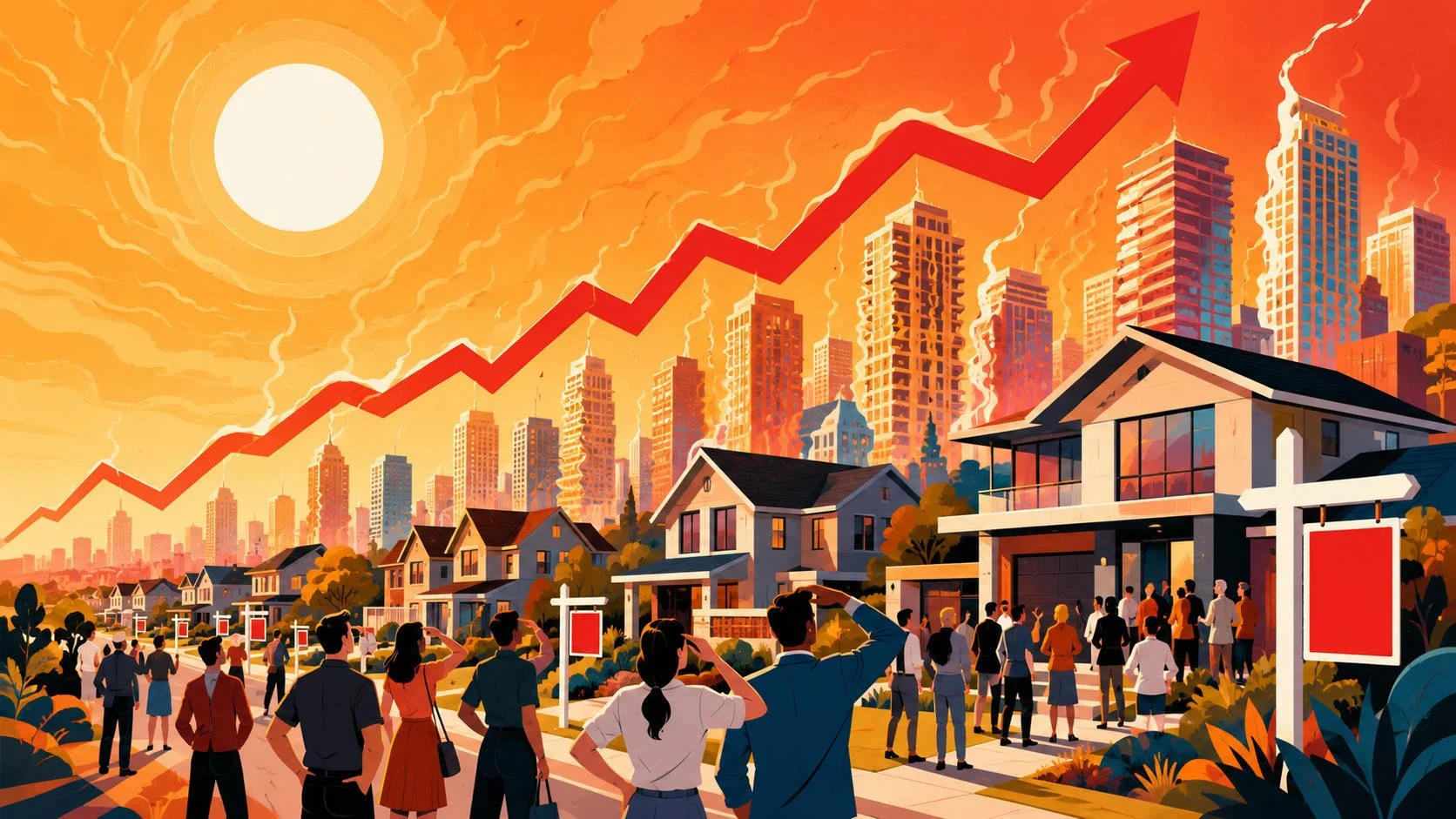
Housing markets do not usually overheat all at once.
At first, prices rise for understandable reasons. Mortgage rates fall. Inventory is tight. Jobs are strong. People move into the area. Builders cannot keep up. Rents climb. Buyers compete for homes because there are not enough of them.
Then the tone changes.
Buyers start stretching beyond what local incomes can support. Investors buy because they expect someone else to pay more later. Sellers price homes as if every buyer is desperate. People waive inspections, ignore repairs, bid above asking, and tell themselves they can always refinance later. Rent math stops working. Insurance, taxes, and HOA costs get treated like footnotes. Local wages no longer explain local prices.
That is when a housing market may be overheated.
But “overheated” does not mean “guaranteed crash.”
That is the most important rule.
A hot housing market can cool slowly. Prices can flatten instead of collapse. Rents can catch up. Wages can rise. Builders can slow down. Mortgage rates can fall. Migration can continue. A market can look expensive for years if supply is constrained and high-income buyers keep arriving.
This article is a pattern-recognition guide.
It is not financial advice, real estate advice, legal advice, or a prediction about any specific city, neighborhood, builder, landlord, investor, or property.
The goal is simple: to help buyers, sellers, renters, investors, agents, and local observers tell the difference between a housing market that is merely expensive and one that may be running too hot.
First, what does “overheated” mean?
A housing market is overheated when prices, buyer behavior, borrowing, and expectations move faster than the underlying fundamentals can reasonably support.
The key fundamentals are:
Local incomes
Local rents
Mortgage rates
Inventory
Job growth
Population growth
Construction
Household formation
Credit conditions
Property taxes
Insurance costs
Maintenance costs
Local economic resilience
A market can be expensive without being overheated.
A market becomes more concerning when buyers stop asking, “Can this property be supported by income, rent, and long-term demand?” and start asking, “How much higher will prices go before I miss out?”
The IMF says detecting housing bubbles starts with monitoring real house prices, because nominal price increases can be confused with general inflation. It also emphasizes affordability, price-to-income ratios, credit growth, and price-to-rent ratios as important ways to detect housing exuberance.
So the better question is not:
“Are homes expensive?”
The better question is:
“Are prices rising faster than the real forces that can support them?”
Overheated does not always mean bubble
People often use the words “overheated,” “expensive,” and “bubble” as if they mean the same thing.
They do not.
A market can be expensive because there is not enough housing, incomes are high, land is scarce, zoning is restrictive, or desirable jobs are concentrated nearby.
A market can be hot because demand is strong and inventory is low.
A market can be overheated when prices, bidding behavior, leverage, and expectations become stretched relative to local fundamentals.
A market may be in a bubble when prices become heavily driven by speculative expectations rather than income, rents, or sustainable demand.
The Dallas Fed has argued that expectations can be especially useful for spotting housing-market exuberance. In 2025, Dallas Fed researchers wrote that survey-based forecasts of home price growth can be a stronger indicator of housing-market exuberance than traditional ratios like price-to-income or price-to-rent, because expectations can reveal speculative dynamics earlier.
That distinction matters.
A housing market can cool without crashing.
A housing market can be unaffordable without being speculative.
A housing market can be supply-constrained and still overpriced.
And a housing market can look stable right up until buyers lose confidence.
Current context: why people are asking this question
Housing markets are giving mixed signals.
In the United States, the Federal Reserve’s May 2026 Financial Stability Report said residential real estate valuation pressures remained elevated, even though house-price growth had slowed. The same report said price-to-rent ratios stayed elevated across geographic areas, while borrower credit standards remained tighter than in the early 2000s.
That is exactly why this topic needs nuance.
High prices alone are not enough to call a market overheated. Credit quality, inventory, local income, mortgage rates, buyer expectations, investor activity, and carrying costs all matter.
National data can also hide local differences. NAR reported that U.S. existing-home sales increased only 0.2% month-over-month in April 2026, inventory rose to 4.4 months of supply, and the median existing-home price was $417,700, up 0.9% from a year earlier. But regional performance varied, with the West showing a year-over-year price decline while other regions still rose.
That is why you should never analyze “the housing market” as one thing.
You need to analyze your market.
A coastal supply-constrained city, a Sun Belt boomtown, a vacation-home market, a condo-heavy downtown, a new-construction suburb, and a small town near a new factory can all overheat in different ways.
Quick checklist: 15 signs a housing market may be overheated
Use this list as a starting point.
Not proof.
Not a prediction.
Not a reason to panic.
Just a way to organize what you are seeing.
A housing market may deserve closer scrutiny when several of these signs appear together:
Home prices rise much faster than local incomes.
Price-to-rent ratios stretch beyond local history.
Monthly payments become unaffordable even for solid earners.
Buyers depend on future appreciation to justify today’s price.
Bidding wars become normal, not exceptional.
Buyers waive inspections, appraisals, or basic protections.
Inventory looks tight, but demand is starting to weaken.
Investors, flippers, second-home buyers, or short-term-rental buyers dominate activity.
Rent math stops working for investors.
New construction surges while affordability deteriorates.
Sellers price homes as if the boom cannot end.
Price cuts rise, but asking prices remain unrealistic.
Local wages and job growth no longer explain prices.
Insurance, property taxes, HOA fees, and maintenance costs are ignored.
Market sentiment becomes one-way: “Real estate only goes up here.”
One sign is noise.
Several signs are a pattern.
A pattern is still not proof.
But it can help you ask better questions before buying, selling, renting, investing, or making claims about a local market.
1. Home prices rise much faster than local incomes
The first warning sign is simple.
Homes become expensive relative to the people who actually live and work in the area.
A rising price-to-income ratio means homes are becoming harder to buy with local wages. The IMF says the price-to-income ratio is a useful proxy for affordability and can help distinguish expectations-driven bubbles from other market dynamics.
Watch for:
Median home prices rising faster than median household income
Starter homes becoming unaffordable to local first-time buyers
Dual-income households struggling to qualify
Buyers needing unusually large down payments from family, stock gains, crypto gains, or previous home equity
More buyers relying on high debt-to-income ratios
Local workers moving farther away from job centers
“Drive until you qualify” behavior spreading outward
This does not automatically mean a crash is coming.
Some places are expensive because they attract high-income buyers from outside the local wage base. Others are expensive because housing supply is restricted. But when local incomes cannot support local prices, the market becomes more dependent on wealth transfers, outside buyers, investors, or continued appreciation.
The key question:
Can ordinary local buyers still afford ordinary local homes?
If the answer is no, ask what is supporting the gap.
2. Price-to-rent ratios stretch beyond local history
The price-to-rent ratio is one of the most important overheating signals.
It asks a basic question:
How much are buyers paying compared with what the same home could rent for?
The IMF compares the house-price-to-rent ratio to the price-to-earnings ratio for stocks. When house prices rise far beyond rents, buyers may eventually choose renting over buying, which can reduce demand and pressure prices. The IMF also notes that if price-to-rent ratios rise explosively, prices may be driven more by speculative expectations than by fundamentals.
Watch for:
Monthly ownership costs far above comparable rent
Investors accepting negative cash flow
Buyers saying rent does not matter because prices will keep rising
Landlords buying properties that only work if rents rise sharply
Cap rates falling below local history
Rent growth slowing while sale prices remain high
Home prices rising even as rental vacancy increases
A high price-to-rent ratio does not prove a bubble. Some cities have high ratios for long periods because people value ownership, tax treatment, scarcity, schools, location, or long-term appreciation.
But when the gap widens quickly, it deserves attention.
The key question:
Are buyers paying for housing utility, or mainly for expected future price gains?
3. Monthly payments become unaffordable even for solid earners
The sticker price is only part of the story.
A home that looked affordable at a 3% mortgage rate can become unaffordable at a 6% or 7% mortgage rate. Taxes, insurance, HOA fees, utilities, repairs, and maintenance can push the real monthly cost even higher.
Freddie Mac reported that the U.S. 30-year fixed mortgage rate averaged 6.37% as of May 7, 2026. It also noted that mortgage rates are based on loan applications submitted through Freddie Mac’s Loan Product Advisor from lenders across the country.
Watch for:
Buyers qualifying only at the edge of their budget
Monthly payments rising faster than wages
Buyers relying on future refinancing
People saying, “Marry the house, date the rate”
Borrowers ignoring insurance or tax increases
Buyers using adjustable-rate loans mainly because fixed payments are too high
First-time buyers disappearing from the market
This is not just about mortgage rates. A hot market can hide true affordability problems if buyers focus only on the purchase price.
The key question:
Can buyers afford the full carrying cost, or only the dream version of the payment?
4. Buyers depend on future appreciation to justify today’s price
This is one of the clearest psychological warning signs.
The home no longer makes sense based on today’s income, rent, or monthly cost. It only makes sense if prices keep rising.
Listen for phrases like:
“It’s expensive, but it will be worth more next year.”
“You can’t lose in this city.”
“They’re not making more land.”
“Foreign buyers will always support prices.”
“Remote workers will keep coming.”
“Rates will fall and prices will jump.”
“Buy now or be priced out forever.”
“The rent doesn’t cover the payment, but appreciation will.”
Some of these statements may contain partial truth.
Land can be scarce. Rates may fall. Migration may continue. High-income buyers may keep arriving.
The warning sign is when future appreciation becomes the main reason to buy.
Dallas Fed researchers have argued that expectations are central to housing-market exuberance. Their 2025 research found that during booms, household expectations can systematically trail actual price growth, creating forecast errors that act like a “fever reading” for speculative exuberance.
The key question:
Would the purchase still make sense if prices stayed flat for five years?
If the answer is no, the buyer may be relying on momentum rather than fundamentals.
5. Bidding wars become normal, not exceptional
Bidding wars can happen in healthy markets.
A great house in a great neighborhood will attract competition. A well-priced listing can sell quickly. A home with scarce features can receive multiple offers.
The warning sign is when bidding wars become routine across ordinary properties.
Watch for:
Homes selling far above asking
Multiple offers on mediocre properties
Buyers writing emotional letters
Buyers waiving contingencies
Homes selling before ordinary buyers can tour them
“Coming soon” listings generating offers before full exposure
Agents telling buyers to bid aggressively just to be considered
Buyers feeling that careful due diligence means losing
This kind of behavior can be caused by real scarcity. But it can also become self-reinforcing. Buyers rush because other buyers are rushing.
The key question:
Are people competing because the property is exceptional, or because fear has become the market’s default setting?
6. Buyers waive inspections, appraisals, or basic protections
A market may be overheated when buyers accept risks they would normally reject.
Examples include:
Waiving inspection contingencies
Waiving appraisal contingencies
Buying sight unseen
Accepting major repair uncertainty
Ignoring insurance availability
Ignoring HOA financials
Ignoring flood, fire, or climate risk
Skipping sewer, roof, foundation, or structural checks
Offering large nonrefundable deposits
Agreeing to seller-friendly terms that shift risk to the buyer
This does not mean every waived contingency is reckless. Experienced buyers sometimes know what they are doing. Cash buyers may have different risk tolerance. Competitive markets can require stronger offers.
But when ordinary buyers feel forced to remove basic protections just to participate, the market may be too hot.
The key question:
Are buyers making informed tradeoffs, or surrendering protections because they are afraid of missing out?
7. Inventory looks tight, but demand is starting to weaken
Low inventory can support high prices.
But a market can look tight on paper while buyer demand is already fading.
That is why inventory should be read alongside sales, days on market, price cuts, pending sales, and withdrawn listings.
NAR reported that U.S. total housing inventory was 1.47 million units at the end of April 2026, equal to 4.4 months of supply, up from both the prior month and the prior year. NAR also reported that median time on market was 32 days, up from 29 days one year earlier.
Watch for:
More homes sitting longer
More price reductions
Pending sales falling
Open houses getting quieter
Inventory rising from very low levels
Homes relisting after failed sales
Sellers withdrawing instead of cutting prices
Builders offering incentives
Agents saying buyers are “picky” again
Inventory rising in some segments but not others
A rising inventory number is not automatically bad. It may simply mean the market is normalizing.
The warning sign is when supply rises because demand is exhausted, not because healthy new listings are meeting healthy buyer demand.
The key question:
Is inventory rising because the market is balancing, or because buyers can no longer afford the prices sellers want?
8. Investors, flippers, second-home buyers, or short-term-rental buyers dominate activity
Investor activity can be healthy.
Landlords provide rental housing. Builders need buyers. Flippers can renovate neglected homes. Vacation-home buyers can support local economies.
But a housing market may be overheating when too much demand comes from buyers who are not primarily using the property as shelter.
Watch for:
Investors outbidding first-time buyers
Flippers buying homes that need only cosmetic changes
Short-term-rental buyers assuming high occupancy forever
Second-home buyers dominating desirable neighborhoods
New condo projects marketed mainly to investors
Local residents priced out by nonlocal buyers
Rental listings rising after investor purchases
Properties bought and resold quickly at higher prices
“Everyone is becoming a landlord” sentiment
Investor-heavy demand can reverse quickly. If rental income disappoints, financing tightens, regulations change, insurance rises, or tourism weakens, investors may become sellers.
The key question:
Is demand coming from households that need homes, or investors who need returns?
9. Rent math stops working for investors
An investor can overpay for a property and still rationalize it with appreciation.
That is dangerous.
For rental properties, watch whether the numbers work before appreciation.
Ask:
Does rent cover mortgage principal and interest?
Does rent cover property taxes?
Does rent cover insurance?
Does rent cover HOA fees?
Does rent cover repairs and maintenance?
Does rent cover vacancy?
Does rent cover property management?
Does rent cover capital expenditures?
Does rent produce a reasonable return after all costs?
If the answer is no, the investor is probably relying on one of three things:
Rent growth
Refinancing
Appreciation
All three can happen.
But none is guaranteed.
The BLS explains that shelter is one of the largest components of the CPI market basket, and that rent and owners’ equivalent rent measure most of the change in shelter costs consumers experience. That matters because housing costs do not affect only buyers; they also feed into broader affordability and inflation dynamics.
The key question:
Would this investment still make sense if rents stopped rising?
10. New construction surges while affordability deteriorates
Building more homes can solve a shortage.
But construction can also become a late-cycle warning sign if builders add supply into weakening demand.
Watch for:
Permits rising after prices already surged
New subdivisions expanding far from job centers
Builders offering rate buydowns
Builders offering closing-cost credits
Spec homes sitting unsold
Cancellations rising
New-home prices falling before resale prices adjust
Construction loans becoming harder to obtain
Too many similar units hitting at once
Condo projects marketed heavily to investors
The U.S. Census Bureau’s New Residential Construction data tracks permits, starts, units under construction, and completions for privately owned housing. In March 2026, the Census reported building permits at a seasonally adjusted annual rate of 1.372 million, housing starts at 1.502 million, and completions at 1.366 million.
Construction data is especially useful because it tells you what supply is coming, not just what is listed today.
The key question:
Is new supply arriving into strong end-user demand, or into a market already stretched by affordability?
11. Sellers price homes as if the boom cannot end
Overheated markets often have a lag between buyer reality and seller expectations.
Sellers remember what neighbors got six months ago. Buyers are dealing with today’s rates, today’s insurance costs, today’s taxes, and today’s credit conditions.
Watch for:
Sellers pricing above recent comparable sales
Listings sitting with no price cuts
Sellers refusing to negotiate
Agents using old peak comps
Homes relisted at the same unrealistic price
Sellers assuming every buyer has cash
“No lowball offers” language
Cosmetic flips priced like fully renovated homes
Homes with serious flaws priced like perfect homes
A market can remain sticky for a long time because sellers do not have to sell. That is especially true if many homeowners have low fixed mortgage rates.
But when sellers price for yesterday’s demand and buyers shop with today’s affordability, transactions can freeze.
The key question:
Are sellers responding to the current market, or anchoring to the peak?
12. Price cuts rise, but asking prices remain unrealistic
Price cuts do not always mean a crash is coming.
Sometimes price cuts simply mean sellers started too high.
But rising price cuts can reveal a market transition.
Watch for:
More listings cutting after two or three weeks
Larger reductions on homes that were clearly overpriced
Builders cutting prices indirectly through incentives
Sellers offering closing credits
Homes returning after failed contracts
Pending sales falling through because of financing or appraisal issues
Price cuts concentrated in investor-heavy, luxury, condo, or new-construction segments
The important detail is not just the number of price cuts.
It is whether sellers are cutting enough to meet buyers, or only making symbolic reductions.
The key question:
Are price cuts clearing inventory, or just revealing that sellers are still behind the market?
13. Local wages and job growth no longer explain prices
Housing demand depends heavily on local economic strength.
A city with rising wages, strong job creation, population growth, and diversified employers can support higher prices more easily than a city with flat wages and weak job growth.
Watch for:
Home prices rising while local wages stagnate
Housing costs rising faster than job quality
A market dependent on one employer or industry
Population growth slowing or reversing
Remote-worker inflows fading
Local layoffs rising
Tourism or seasonal employment weakening
New businesses arriving but not enough to support housing prices
High-income outsiders replacing local buyers
This is one reason national housing commentary can be misleading. A market can look overheated to local workers but affordable to incoming buyers from more expensive cities.
The key question:
Who is the marginal buyer, and can that buyer base keep growing?
If prices depend on a steady stream of wealthier newcomers, the market becomes vulnerable if that flow slows.
14. Insurance, property taxes, HOA fees, and maintenance costs are ignored
Many buyers focus on the mortgage payment and underestimate everything else.
That is becoming harder to ignore.
Dallas Fed researchers wrote in 2026 that rising homeowners insurance premiums are compounding the burden on households already dealing with high housing costs. They reported that national insurance premiums rose about 70% from 2019 to 2025 and that higher premiums can contribute to credit-card reliance, delayed mortgage payments, and potential home loss for some households.
Watch for:
Insurance premiums rising faster than incomes
Insurers withdrawing from risky areas
Buyers shocked by post-closing insurance costs
Property taxes resetting after sale
HOA fees rising sharply
Special assessments in condo buildings
Older homes needing expensive repairs
Climate, flood, fire, wind, or storm risk being underpriced
Investors ignoring maintenance reserves
This matters because overheating is not only about purchase prices.
A market can look stable on sale price but become unaffordable through carrying costs.
The key question:
Are buyers pricing the full cost of ownership, or only the sale price?
15. Market sentiment becomes one-way
The final sign is psychological.
People stop discussing risk.
They say:
“Real estate never falls here.”
“Everyone wants to live here.”
“There’s no more land.”
“Cash buyers will always support this market.”
“You can always refinance.”
“Just buy anything.”
“Waiting is stupid.”
“Renting is throwing money away.”
“This city is different.”
“Prices can only go up.”
Some of these claims may contain truth.
Supply may be limited. The city may be desirable. Renting may be expensive. Rates may fall. Long-term ownership may still make sense.
The warning sign is certainty.
Dallas Fed researchers have emphasized that sentiment and expectations matter in housing booms, and that expectation-based indicators can help identify speculative housing dynamics before they are obvious in traditional fundamentals.
The key question:
Can people still make a balanced argument, or has the market become a belief system?
How to measure whether your local market is overheated
You do not need to be an economist to analyze a housing market.
You need to compare prices with the forces that support prices.
Start with these categories.
1. Price growth
Check:
Median sale price
Repeat-sales price indexes
Price per square foot
Neighborhood-level price changes
Segment-level price changes
Real price growth after inflation
Price growth compared with the last five or ten years
For U.S. markets, the FHFA House Price Index is useful because it measures changes in single-family home values using repeat transactions from mortgages purchased or securitized by Fannie Mae and Freddie Mac. FHFA says the index covers all 50 states and more than 400 cities, with data extending back to the mid-1970s.
For global comparisons, the BIS residential property price data includes residential property indicators for around 60 economies and publishes nominal and real price indices and year-over-year growth rates.
Ask:
Are prices rising because fundamentals improved, or because buyers expect prices to keep rising?
2. Income and affordability
Check:
Median household income
Wage growth
Price-to-income ratio
Mortgage payment as a share of income
First-time buyer share
Down payment burden
Debt-to-income ratios
Local rent versus ownership cost
A market becomes more fragile when the average home requires a buyer who is far wealthier than the average local household.
Ask:
Can the local workforce still buy local homes?
3. Rent support
Check:
Median rent
Rent growth
Rental vacancy
Price-to-rent ratio
Investor cash flow
Cap rates
Rent concessions
Short-term-rental occupancy
New apartment supply
If home prices are rising but rents are flat or falling, the ownership premium may be expanding.
Ask:
Are prices supported by rent, or by resale expectations?
4. Inventory and sales
Check:
Active listings
New listings
Pending sales
Closed sales
Months of supply
Days on market
Share of homes selling above asking
Share of homes with price reductions
Listing withdrawals
Failed contracts
NAR’s April 2026 data shows why these measures must be read together: inventory rose, existing-home sales barely moved, prices still rose year-over-year, and days on market were longer than a year earlier. Mixed signals like that are common during market transitions.
Ask:
Is the market tight because supply is genuinely scarce, or because sellers and buyers are stuck in a standoff?
5. Credit and leverage
Check:
Mortgage approval quality
Down payment size
Loan-to-value ratios
Debt-to-income ratios
Adjustable-rate usage
Investor loan activity
HELOC growth
Delinquencies
Mortgage forbearance or modification trends
Local foreclosure starts
The Bank of Canada explains the basic risk clearly: when households carry high debt relative to income and have low home equity, they are more vulnerable to default after an income shock or rate increase.
The New York Fed reported that U.S. mortgage balances totaled $13.19 trillion at the end of Q1 2026, and that transitions into serious mortgage delinquency rose slightly from 1.4% to 1.5%. That does not mean the housing market is collapsing, but mortgage performance is one piece of the risk picture.
Ask:
Are buyers using strong balance sheets, or fragile leverage?
6. Construction and future supply
Check:
Building permits
Housing starts
Units under construction
Completions
New-home inventory
Builder incentives
Lot availability
Construction costs
Local zoning changes
Multifamily pipeline
Census construction data is helpful because it tracks units authorized by building permits, units started, units under construction, and units completed.
Ask:
Will new supply relieve pressure, or arrive after demand has already weakened?
7. Buyer psychology
Check:
Are buyers afraid of missing out?
Are buyers waiving protections?
Are buyers relying on refinancing?
Are investors accepting negative cash flow?
Are people dismissing all downside risk?
Are local discussions dominated by “buy now or be priced out forever” language?
Are agents, influencers, or developers using urgency as the main pitch?
Ask:
Is the market being driven by housing need, or by fear and momentum?
Different types of overheated housing markets
Housing markets overheat in different ways.
Here are the most common versions.
The supply-constrained expensive city
This market has real scarcity.
It may have:
Limited land
Restrictive zoning
High-income jobs
Desirable schools
Strong migration
Foreign or out-of-region demand
High construction costs
Slow permitting
This market can stay expensive for a long time.
The overheating risk appears when prices rise far beyond even high local incomes, ownership costs detach from rents, and buyers assume scarcity alone eliminates downside.
The false positive:
Scarcity may be real.
The key question:
Is scarcity enough to support the current price, or are buyers paying for permanent perfection?
The pandemic boomtown or migration boomtown
This market overheats when new demand arrives suddenly.
It may have:
Remote-worker inflows
Out-of-state buyers
Rapid population growth
Limited existing inventory
Builders rushing to catch up
Local wages lagging home prices
Political or lifestyle narratives driving demand
The risk appears when migration slows, remote-work patterns change, local wages cannot support prices, and new supply arrives late.
The false positive:
Some migration shifts are durable.
The key question:
Is the buyer inflow permanent, or was it a one-time shock?
The investor-heavy rental market
This market overheats when investors bid up homes faster than rents can justify.
It may have:
Low cap rates
Negative cash-flow rentals
Short-term-rental speculation
Investor seminars
Out-of-town landlords
Flippers competing with families
Rent-growth assumptions that look too aggressive
The risk appears when rents flatten, vacancies rise, financing costs increase, regulations change, or investors decide to sell at the same time.
The false positive:
Institutional or professional landlords may have longer-term strategies and lower financing costs.
The key question:
Do the numbers work without appreciation?
The vacation-home or second-home market
This market can overheat when discretionary buyers dominate.
It may have:
Wealthy second-home buyers
Short-term rental projections
Tourism-driven demand
Limited local wages
Seasonal employment
Climate or insurance risk
Heavy dependence on lifestyle sentiment
The risk appears when tourism weakens, regulations tighten, insurance rises, or wealthy buyers pull back.
The false positive:
Some vacation markets have genuine long-term scarcity and global demand.
The key question:
Can local fundamentals support the market if discretionary demand fades?
The condo market
Condo markets can overheat differently from single-family markets.
Warning signs include:
Investor-dominated presales
Rising HOA fees
Special assessments
Weak HOA reserves
Insurance problems
Too many similar units
High rental restrictions
Declining owner-occupancy
New towers competing with older buildings
Developers offering incentives
The false positive:
Condo prices can be more affordable than single-family homes, which may support demand.
The key question:
Are buyers pricing the unit only, or the building’s financial condition too?
The new-construction suburb
This market may look strong while builders are still selling into demand.
Warning signs include:
Rapid permit growth
Lots of similar homes
Heavy rate buydowns
Free upgrades
Closing-cost incentives
Spec inventory rising
Cancellations increasing
Builders cutting prices quietly
Resale homes competing with new homes
The false positive:
New supply may be badly needed and healthy.
The key question:
Are builders meeting real demand, or creating future oversupply?
The luxury market
Luxury markets can decouple from local incomes because buyers may use cash, stock wealth, business proceeds, inheritance, or international capital.
Warning signs include:
High-end listings piling up
Luxury price cuts
Trophy properties relisting repeatedly
Weakness in stock or bonus-driven industries
Rising carrying costs
Fewer foreign or out-of-region buyers
Sellers refusing to adjust
The false positive:
Wealthy buyers can support prices longer than expected.
The key question:
Is the luxury buyer pool expanding, or did sellers overestimate it?
The evidence ladder: from weak clues to strong evidence
Not all evidence is equal.
Level 1: Vibe
Examples:
“This feels crazy.”
“Everyone says prices are too high.”
“The market seems fake.”
“People are angry about affordability.”
Strength:
Weak.
A vibe can tell you to look closer. It cannot prove overheating.
Level 2: Anecdote
Examples:
A friend lost five bidding wars.
A house sold above asking.
A neighbor made a huge gain.
A buyer waived inspection.
A landlord raised rent sharply.
Strength:
Weak.
Anecdotes matter only when they fit a broader pattern.
Level 3: Market behavior
Examples:
Bidding wars are common.
Days on market are very low.
Price cuts are rising.
Inventory is changing quickly.
Buyers are waiving protections.
Sellers are anchoring to peak prices.
Strength:
Moderate.
This shows market temperature, but not necessarily valuation risk.
Level 4: Valuation strain
Examples:
Price-to-income ratios stretch.
Price-to-rent ratios stretch.
Monthly payments exceed local affordability.
Ownership costs detach from rent.
Local wages cannot support prices.
Strength:
Stronger.
This shows that prices may be moving away from fundamentals.
Level 5: Credit and leverage stress
Examples:
Borrowers stretch debt-to-income ratios.
Investors use aggressive financing.
Adjustable-rate or high-LTV borrowing rises.
Delinquencies start increasing.
HELOC use rises because households need cash.
Lenders tighten standards.
Strength:
Strong.
This shows the market may be vulnerable to income shocks, rate shocks, or price declines.
Level 6: Speculative expectation evidence
Examples:
Buyers rely mainly on appreciation.
Investors accept negative cash flow.
Local sentiment becomes one-way.
People dismiss all downside risk.
Survey or sentiment indicators show exuberance.
Price growth becomes self-reinforcing.
Strength:
Strong.
This suggests the market may be driven by expectations rather than fundamentals.
Level 7: Correction signals
Examples:
Sales fall sharply.
Inventory rises quickly.
Price cuts become widespread.
Builders cut prices or offer large incentives.
Appraisals miss contract prices.
Investors list multiple properties.
Forced selling appears.
Delinquencies and foreclosures rise.
Strength:
Very strong.
At this stage, you are no longer asking only whether the market is overheated. You are asking whether the overheating is already reversing.
What this does not prove
Even if several warning signs appear, that does not prove that:
Home prices will crash.
A specific city is in a bubble.
Buying is always a mistake.
Renting is always better.
Sellers are delusional.
Agents are misleading people.
Builders overbuilt.
Investors caused the entire problem.
A correction will happen soon.
A correction will be large.
A market cannot stay expensive for years.
A desirable neighborhood is doomed.
Every buyer is reckless.
Every investor is speculating.
Every high price is irrational.
Housing markets are slow, local, emotional, and supply-constrained.
A stretched market can stay stretched.
An unaffordable market can become more unaffordable.
A hot market can cool through flat prices and rising incomes rather than falling prices.
The point is not to declare a crash.
The point is to identify risk.
Common false positives
A housing shortage can make prices look overheated
Low inventory can be real.
If a city has strong job growth, limited land, slow permitting, and persistent household formation, high prices may reflect scarcity rather than speculation.
That does not mean prices are safe.
It means the cause matters.
High prices do not automatically mean a bubble
Some places are expensive because high-income households compete for limited housing.
Expensive is not the same as overheated.
The question is whether prices are justified by income, rent, supply, demand, and financing.
Rising inventory is not always bearish
Inventory can rise because the market is normalizing.
More listings can give buyers more choice without causing a collapse.
The warning sign is rising inventory combined with falling demand, increasing price cuts, weak affordability, and sellers refusing to adjust.
Falling sales do not always mean prices must fall
Sales can decline because homeowners refuse to sell, buyers are rate-sensitive, or both sides are waiting.
A frozen market can last a long time.
Prices usually fall faster when sellers are forced to sell.
Investor demand is not always bad
Investors can add rental supply, renovate properties, and take risk that owner-occupants do not want.
Investor demand becomes more concerning when it is highly leveraged, speculative, concentrated, or dependent on unrealistic rent growth.
New construction is not always oversupply
Many markets desperately need more housing.
Permits and starts are not automatically bearish.
They become risky when new supply arrives after demand has already weakened or when too much similar product targets the same buyer.
A high price-to-rent ratio can persist
Some places have high price-to-rent ratios for structural reasons.
Owners may pay a premium for stability, schools, tax treatment, status, appreciation potential, or scarce land.
The warning sign is a rapid increase that no longer fits local history.
Low delinquencies do not guarantee safety
Mortgage delinquencies can stay low while valuations are stretched.
The Fed’s May 2026 report noted that mortgage delinquency rates remained low by historical standards, even while residential real estate valuation pressures remained elevated.
That means credit stress and valuation stress are related, but not identical.
A market can be overpriced before borrowers start missing payments.
How to analyze your market responsibly
Use a process.
Do not start with the conclusion.
Step 1: Define the market correctly
Do not analyze “Florida,” “Texas,” “California,” “Canada,” or “the U.S.” as one market.
Narrow it down.
Use:
Metro area
City
Neighborhood
Property type
Price tier
Buyer type
School district
Commute pattern
New construction versus resale
Condo versus single-family
Primary residence versus vacation market
A downtown condo market can be weak while nearby single-family homes are strong.
A luxury market can be soft while starter homes are unaffordable.
A new-build suburb can be oversupplied while older neighborhoods stay tight.
Step 2: Compare prices with incomes
Ask:
What is the median home price?
What is the median household income?
How has the price-to-income ratio changed?
Can local first-time buyers still qualify?
Are buyers coming from outside the local wage base?
Are local workers moving farther away?
Do not rely only on national affordability headlines.
Local income matters.
Step 3: Compare prices with rents
Ask:
What would the same home rent for?
How much higher is ownership cost than rent?
Are investors cash-flow positive?
Are rents still rising?
Are rental vacancies rising?
Are landlords offering concessions?
Is short-term-rental demand weakening?
If rents cannot support prices, the market may be relying on appreciation.
Step 4: Calculate the real monthly cost
Include:
Mortgage principal
Mortgage interest
Property taxes
Homeowners insurance
Flood, fire, wind, or earthquake coverage where relevant
HOA fees
Utilities
Maintenance
Repairs
Vacancy if it is an investment
Property management if it is a rental
Special assessments if it is a condo
The monthly payment is where many overheated markets break.
Not the listing price.
The payment.
Step 5: Track inventory and days on market
Ask:
Are listings rising?
Are homes taking longer to sell?
Are price cuts increasing?
Are pending sales falling?
Are sellers withdrawing listings?
Are builders offering incentives?
Is inventory rising only in one segment?
Are starter homes still scarce while luxury homes sit?
Inventory without context can mislead.
Inventory plus affordability tells a better story.
Step 6: Watch credit and distress
Ask:
Are lenders tightening?
Are buyers stretching debt-to-income ratios?
Are delinquencies rising?
Are foreclosures increasing?
Are investors using short-term debt?
Are adjustable-rate borrowers exposed?
Are insurance costs creating payment stress?
Households with high debt relative to income and low equity are more vulnerable if income falls or rates rise.
Step 7: Look for speculative language
Ask:
Are people buying because they need housing?
Are people buying because they expect prices to rise?
Are buyers dismissing downside risk?
Are investors accepting negative cash flow?
Are local influencers using urgency?
Are agents saying waiting is always wrong?
Are skeptics mocked rather than answered?
Speculation is not always obvious.
Often it appears as certainty.
Step 8: Ask what would change your mind
This is the anti-overfitting question.
Ask:
“What evidence would convince me this market is not overheated?”
Possible answers:
Incomes are rising fast enough to support prices.
Rents are rising enough to support valuations.
Inventory remains tight despite slower sales.
Buyers have strong credit and large equity.
New supply is limited.
Population and job growth remain strong.
Ownership costs are still reasonable.
Price cuts remain rare.
Builders are not overproducing.
Investor demand is not dominant.
Then ask the opposite:
“What evidence would convince me the market is more overheated than I thought?”
Possible answers:
Price-to-income ratios keep rising.
Price-to-rent ratios keep rising.
First-time buyers disappear.
Inventory jumps.
Price cuts spread.
Investor listings rise.
Rents flatten.
Builder incentives increase.
Delinquencies rise.
Local job growth weakens.
Good analysis can change.
Bad analysis only looks for confirmation.
The strongest signs of a housing market correction
An overheated market does not always correct sharply.
But these signs suggest cooling may already be underway:
Sales volume falls before prices fall.
Days on market rises.
Price reductions become common.
Sellers offer concessions.
Builders offer rate buydowns or upgrades.
Appraisals come in below contract prices.
Pending sales fall through.
Inventory rises faster than seasonal norms.
Investors list multiple properties.
Rents flatten or decline.
Short-term rental revenue weakens.
Local layoffs rise.
Mortgage delinquencies increase.
Insurance or tax shocks hit monthly payments.
Local sentiment changes from “buy now” to “wait and see.”
Housing markets are usually sticky.
Sellers resist cutting prices.
Buyers wait.
Agents talk about “normalization.”
Builders use incentives before cutting list prices.
The first visible sign is often not a price crash.
It is transaction volume drying up.
What buyers should do in an overheated market
Buyers do not need to panic.
They need discipline.
Consider:
Compare monthly ownership cost with rent.
Do not rely on future refinancing.
Do not waive inspections unless you understand the risk.
Budget for insurance, taxes, repairs, HOA fees, and maintenance.
Check local inventory trends.
Check price cuts.
Check days on market.
Look at recent sold prices, not just asking prices.
Avoid bidding based on emotion.
Ask whether you could hold the home for seven to ten years if prices stagnate.
Make sure the payment still works if income falls or expenses rise.
The key buyer question:
Would I still be comfortable owning this home if it did not appreciate for several years?
If the answer is no, the purchase may depend too heavily on market momentum.
What sellers should do in an overheated market
Sellers can also misread the market.
In an overheated market, the danger is assuming yesterday’s buyer behavior will continue forever.
Consider:
Use recent comparable sales, not peak stories.
Watch active competition.
Watch price cuts.
Watch days on market.
Price based on today’s mortgage rates.
Understand buyer payment shock.
Do not assume every buyer has cash.
Be realistic about repairs.
Consider concessions if buyers are rate-sensitive.
Avoid chasing the market down with small cuts.
The key seller question:
Am I pricing for today’s buyers, or for the market I wish still existed?
What investors should do in an overheated market
Investors need to be especially careful because leverage can turn small mistakes into large losses.
Consider:
Run the numbers without appreciation.
Run the numbers with flat rents.
Run the numbers with higher insurance.
Run the numbers with higher taxes.
Include vacancy.
Include repairs.
Include property management.
Include capital expenditures.
Include HOA or special assessment risk.
Stress-test refinancing assumptions.
Watch local rental supply.
Watch short-term-rental regulation.
Watch investor concentration.
The key investor question:
Does this property make sense as an income-producing asset, or only as a bet on a higher resale price?
If the answer is resale price, call it what it is: speculation.
What renters should watch
Renters are not outside the housing market.
They are part of it.
An overheated ownership market can affect renters through:
Higher rents
More investor-owned homes
Condo conversions
Short-term-rental conversions
Landlord refinancing pressure
Higher insurance and tax pass-throughs
Reduced rental availability
More competition from would-be buyers who keep renting
But renters should also watch for signs that ownership demand is weakening:
More rentals listed
More concessions
Slower rent growth
Investors trying to lease former flips
New apartment supply arriving
Short-term rentals converting to long-term rentals
The key renter question:
Is renting becoming more expensive because housing is genuinely scarce, or because owners are trying to make overpriced purchases work?
FAQ
Does an overheated housing market mean prices will crash?
No.
An overheated market means risk is elevated. Prices can fall, flatten, or keep rising more slowly. A correction can happen through lower prices, higher incomes, rising rents, lower mortgage rates, more supply, or a long period of stagnation.
What is the best single sign of an overheated market?
There is no perfect single sign.
The strongest warning usually comes from a cluster:
Prices rising faster than incomes
Price-to-rent ratios stretching
Monthly payments becoming unaffordable
Buyers relying on future appreciation
Investor activity increasing
Inventory shifting
Sentiment becoming one-way
Is price-to-income more important than price-to-rent?
Both matter.
Price-to-income tells you whether local buyers can afford homes.
Price-to-rent tells you whether purchase prices are supported by housing-use value and rental economics.
The IMF emphasizes both affordability and price-to-rent measures when discussing housing exuberance.
Can a market be overheated because of low supply, not speculation?
Yes.
Low supply can make prices rise sharply even without a speculative bubble.
But low supply does not eliminate risk. If prices rise beyond what buyers can afford, demand can weaken even when inventory remains low.
Are high mortgage rates a sign of overheating?
Not by themselves.
High mortgage rates can cool a market. But if prices remain high despite higher rates, monthly payments may become stretched. That can reveal affordability pressure that was hidden when rates were lower.
Are bidding wars always a bad sign?
No.
Bidding wars can happen in healthy markets when a property is rare, desirable, or underpriced.
They become concerning when ordinary homes attract frantic bidding and buyers feel forced to waive basic protections.
Is investor activity always bad for a market?
No.
Investors can provide rental housing and improve properties.
Investor activity becomes risky when it is speculative, highly leveraged, concentrated, or dependent on unrealistic rent growth or future appreciation.
Can housing stay unaffordable for years?
Yes.
Housing can remain unaffordable for a long time if supply is restricted, incomes are high, wealth is concentrated, and buyers keep arriving from more expensive markets.
Unaffordable does not automatically mean imminent correction.
Are national housing headlines useful?
Only partly.
National data can show broad trends, but local markets differ by inventory, incomes, jobs, migration, property type, taxes, insurance, and construction.
Analyze the local market.
What should I check before buying in a hot market?
Check:
Full monthly payment
Comparable rents
Price-to-income trends
Price-to-rent trends
Inventory
Days on market
Price cuts
Insurance cost
Property taxes
HOA risk
Inspection issues
Local job growth
Your ability to hold through a flat or down market
Final takeaway
A housing market is not overheated just because homes are expensive.
It becomes overheated when prices, payments, buyer behavior, investor demand, and expectations move faster than local fundamentals can support.
The clearest warning signs are:
Prices rising faster than incomes
Prices rising faster than rents
Monthly payments stretching buyers
Buyers relying on future appreciation
Investors accepting weak cash flow
Bidding wars becoming normal
Buyers waiving protections
Inventory shifting while sellers stay unrealistic
Insurance, taxes, and HOA costs being ignored
Local wages no longer supporting local prices
Sentiment becoming one-way
One sign is not proof.
Several signs are a pattern.
A pattern is not a prediction.
The responsible conclusion is not:
“This market is definitely going to crash.”
The responsible conclusion is:
“This market may be overheated. Here are the facts, here are the possible benign explanations, and here is what would make the risk better or worse.”
That is how to analyze a housing market without panic, hype, or wishful thinking.