
How Much Oil Flows Through the Strait of Hormuz—and Why It’s a Chokepoint
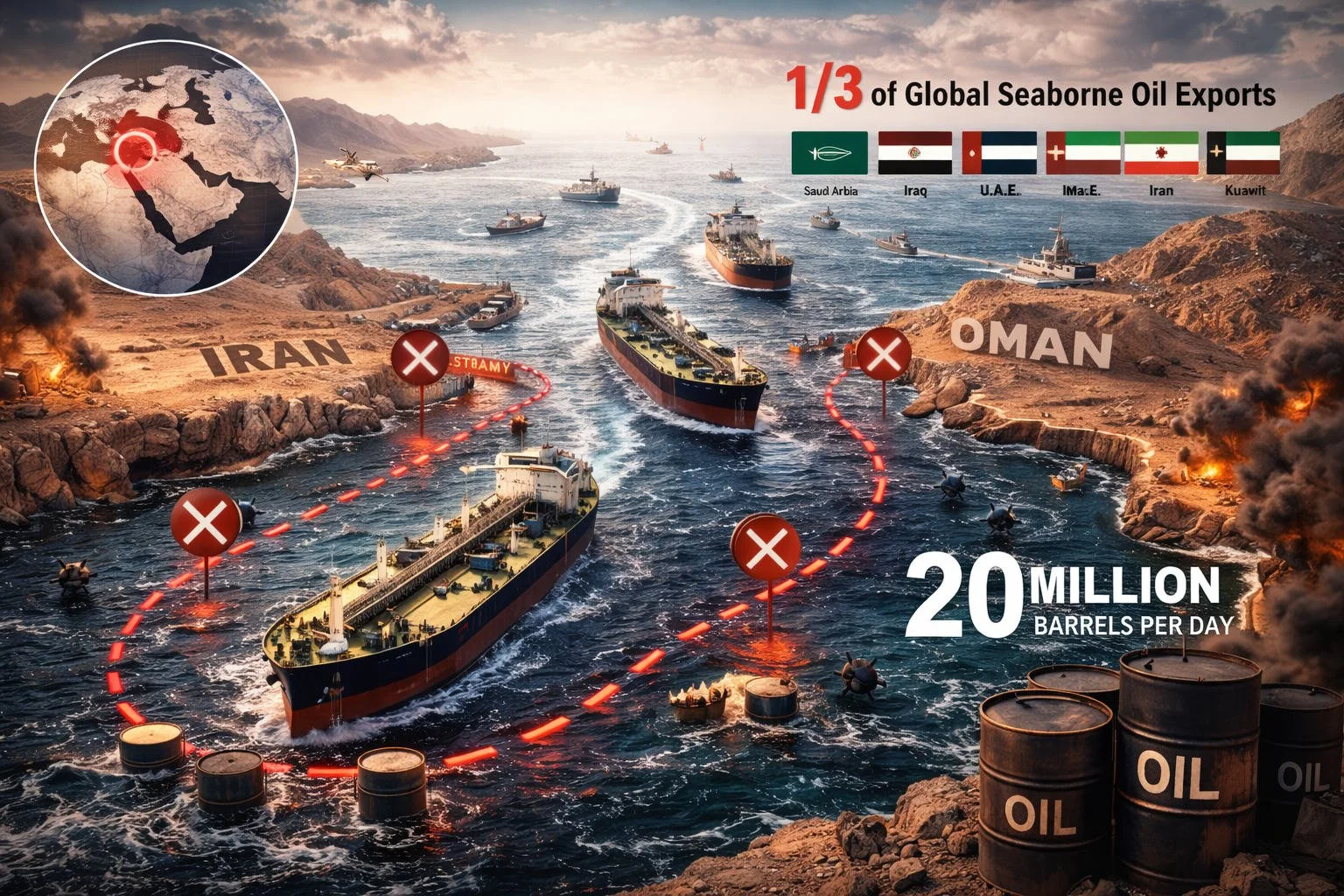
If you’re trying to understand why the Strait of Hormuz keeps showing up in war coverage and oil-price headlines, start with one fact:
A massive share of the world’s oil moves through one narrow passage. And right now, that passage is under extreme pressure.
How much oil flows through the Strait of Hormuz?
In 2024, oil flows through the Strait of Hormuz averaged about 20 million barrels per day.
That’s not a niche number. The U.S. Energy Information Administration (EIA) says that volume is roughly:
about 20% of global petroleum liquids consumption, and
more than one-quarter of total global seaborne oil trade (crude, condensate, and petroleum products combined).
Reuters adds that more than 20 million barrels per day of crude, condensate, and fuels passed through on average last year—consistent with the EIA range.
What counts as “oil flows” here?
When analysts talk about Hormuz volumes, they’re usually talking about a mix of:
Crude oil (the big headline driver)
Condensate (light hydrocarbons often shipped with crude)
Petroleum products (diesel, gasoline blendstocks, jet fuel components, etc.)
EIA notes that between 2022 and 2024, crude/condensate transits declined while product cargoes rose somewhat—meaning the composition can shift even if the chokepoint stays vital.
Why the Strait of Hormuz is considered a chokepoint
A “chokepoint” isn’t just a busy route. It’s a route where there are limited practical alternatives, so disruption creates immediate supply delays and cost spikes.
EIA’s wording is blunt: the Strait is one of the world’s most important oil chokepoints because large volumes flow through it and very few alternative options exist to move oil out if it’s closed or disrupted.
The geography problem: narrow water, narrower shipping lanes
The Strait of Hormuz lies between Iran and Oman, linking the Persian Gulf to the Gulf of Oman and the Arabian Sea.
Here’s the catch: it’s not “wide open ocean.”
At its narrowest, the Strait is about 21 miles (33 km) wide,
but the shipping lane is only about 2 miles (3 km) wide in each direction.
That’s why even a few incidents—missiles, drones, mines, insurer pullbacks, or just credible threats—can cause shipping to freeze or bottleneck. And in the current war, Reuters reports a major disruption and a “de facto” closure dynamic driven by attacks, stranded vessels, and insurers canceling war-risk coverage.
It’s not only oil: LNG also funnels through Hormuz
Oil gets the spotlight, but natural gas matters too.
EIA estimates that about 20% of global LNG trade transited the Strait of Hormuz in 2024, primarily from Qatar.
EIA also quantifies the scale:
Qatar exported ~9.3 Bcf/d of LNG through Hormuz in 2024
UAE exported ~0.7 Bcf/d
So Hormuz disruption can squeeze oil and gas markets at the same time, which is a big reason it’s treated as a global economic risk—not just a regional one.
Who depends on Hormuz the most?
A lot of the barrels moving through Hormuz are headed to Asia, not North America.
EIA estimates that in 2024:
84% of crude oil and condensate transiting Hormuz went to Asian markets
83% of LNG transiting Hormuz went to Asian markets
EIA also notes that China, India, Japan, and South Korea were the top destinations for crude/condensate, accounting for a large share of the total.
That matters because the more concentrated the dependency, the faster buyers scramble for replacement cargoes when disruption hits—pushing prices up globally.
“Why can’t they just ship it another way?”
There are some bypass options, but they’re limited compared to Hormuz-scale volumes.
EIA estimates that about 2.6 million barrels per day of capacity from Saudi and UAE pipelines could be available to bypass Hormuz in a disruption.
Helpful? Yes.
Enough to replace ~20 million b/d through the Strait? Not even close.
EIA describes major alternatives like:
Saudi Arabia’s East–West pipeline to the Red Sea (with historically expanded capacity)
The UAE pipeline to Fujairah (outside the Strait)
Iran’s Goreh–Jask route (with limited effective capacity and intermittent usage)
This is the chokepoint logic in plain language: a bypass exists, but not at the scale that keeps the world calm.
Why oil prices react so violently to Hormuz news
Oil pricing isn’t just about today’s barrels. It’s about expectations and risk.
When Hormuz is threatened, markets quickly price in:
Shipping delays and longer voyages
Higher war-risk insurance premiums
Fewer available tankers (because ships avoid the region or get stuck waiting)
Potential escalation that could reduce exports or damage infrastructure
The current crisis is a real-time example: Reuters reports attacks, stranded vessels, and insurers canceling war-risk coverage, driving higher shipping costs and oil price jumps.
The takeaway
So, how much oil flows through the Strait of Hormuz?
About 20 million barrels per day—roughly one-fifth of global petroleum liquids and more than one-quarter of global seaborne oil trade.
And why is it a chokepoint?
Because it’s narrow, high-volume, and hard to bypass at scale—meaning even partial disruption can trigger global price shocks fast, especially under wartime conditions.