
How Long Would a Hormuz Disruption Need to Last to Push Oil Above $100?
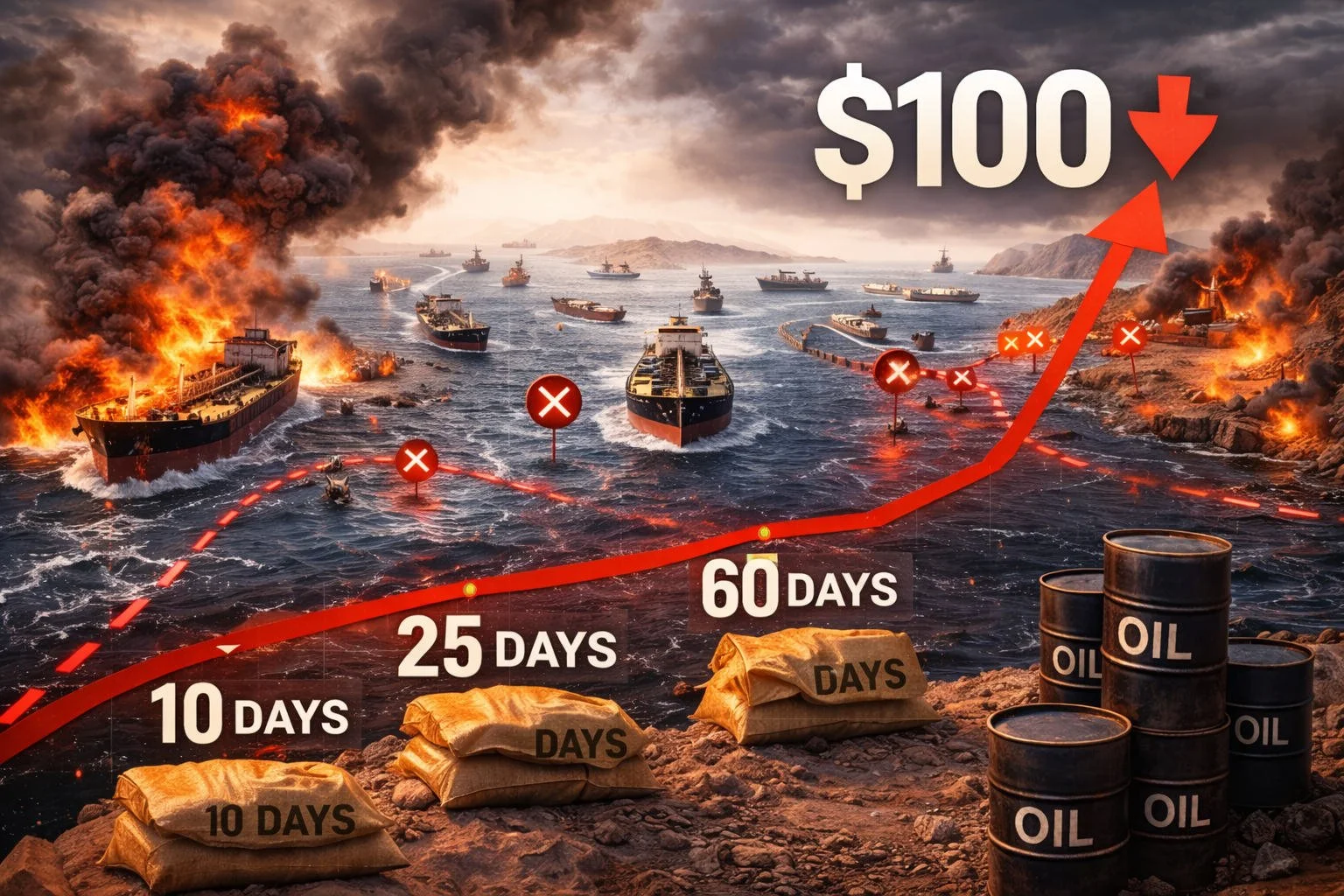
When people ask “How long would the Strait of Hormuz disruption need to last to push oil above $100?” they’re really asking a more brutal question:
How long until the market stops treating this as a scary headline—and starts treating it as a real supply crisis?
As of March 2, 2026, Brent crude has already shown how fast fear can move prices, spiking to a 12-month high above $82 in early trading.
From there, the jump to $100+ isn’t a distant fantasy. It’s a confidence threshold: once traders believe the disruption will last long enough to force rationing (or shutdowns), they price it in.
The simplest answer—based on current analyst expectations—is:
If Hormuz flows stay meaningfully restricted for about 3–4 weeks, oil above $100 becomes likely.
But it’s not just the calendar. It’s how bad the disruption is, and whether the market thinks it’s getting better or worse.
The core idea: duration matters more than the first shock
A one-day panic spike can be dramatic. But oil usually stays above major psychological levels (like $100) when the market believes the disruption is persistent—meaning:
ships aren’t moving normally,
insurers are still pricing war risk aggressively (or refusing cover),
exports can’t “catch up” later,
and the world’s usual balancing tools (spare capacity, stock releases) aren’t enough to calm things down.
A Reuters analysis literally frames it this way: the key issue isn’t symbolic production moves—it’s how long supplies are disrupted, especially with Hormuz effectively constrained by shipowners/insurers pulling back.
A practical timeline: when $100 becomes “on the table”
Think of it in phases.
Phase 1: 0–7 days (Shock week)
This is when oil prices often jump hard on fear—sometimes violently—because markets hate uncertainty more than bad news.
Right now, some banks see Brent in the $80–$90 range for at least the coming week, with a pullback possible if things de-escalate.
In this phase, oil can flirt with $100 briefly if headlines are intense enough—but sustained $100 usually needs the next phase.
What decides whether a “shock week” becomes a “crisis month”:
Do tanker flows normalize quickly?
Do shippers and insurers return?
Do attacks stop (or at least stop hitting commercial shipping)?
If the answer is yes, the spike can fade fast.
Phase 2: 1–2 weeks (The market tests reality)
A disruption lasting one or two weeks is the period where the world tries to “muscle through” with workarounds:
emergency logistics,
re-routing (where possible),
drawing on inventories,
and governments talking about strategic stock releases.
One strategist quoted by Reuters summed up the psychology bluntly: the world could handle a shutdown for one or two weeks, but the price impact escalates rapidly after that.
In this phase, oil often trades with a heavy “war premium,” but it’s still possible the market convinces itself: this will pass.
Phase 3: 3–4 weeks (The $100 danger zone)
This is where $100 becomes far more plausible—and not just as a momentary spike.
JPMorgan’s view cited by Reuters is essentially the tripwire: a 3–4 week restriction through Hormuz could lift Brent above $100.
And that makes intuitive sense: by week three, you’re no longer talking about “delays.” You’re talking about the world’s energy system running into hard constraints—especially if Gulf producers start facing the need for shut-ins.
This is also the point where companies stop assuming the backlog will clear quickly. They start behaving as if scarcity is real:
refiners chase replacement barrels,
importers pay up for cargoes from farther away,
and the market begins rationing demand through price.
Phase 4: 1–2 months (Structural stress, not just panic)
If major disruption drags into a month or more, you can get into truly ugly pricing—especially if flows are severely reduced rather than merely delayed.
Goldman Sachs, for example, described a large real-time “risk premium” already in the market and modeled scenarios based on how much flow is halted and for how long.
Meanwhile, Bernstein floated an “extreme case” range well above $100 if the conflict is prolonged.
This is where $100 can turn into $120… and where markets start whispering numbers they don’t like to print.
The missing piece: how “disrupted” is disrupted?
Duration alone isn’t enough. The severity matters.
Right now, Reuters reports JPMorgan estimating crude exports through Hormuz have slumped sharply—to about 4 million bpd from a usual ~16 million bpd—with flows largely limited to Iranian barrels as tanker traffic dries up.
That’s the kind of reduction that can push markets into “this is real” mode quickly—because it’s not just a price story. It’s a physical flow story.
And remember: the Strait typically handles enormous volumes—about 20 million barrels per day in 2024, roughly 20% of global petroleum liquids consumption.
If even part of that system stays jammed for weeks, the market starts acting like it’s staring at a supply cliff.
Why $100 could happen faster than people think
Oil doesn’t need to be “gone” for prices to move. It only needs to be uncertain long enough that buyers panic and sellers demand a premium.
Here are the accelerants that can push $100 sooner (or keep it there longer):
Insurance collapse: if war-risk cover remains unavailable or wildly expensive, shipping becomes a financial non-starter even without a declared blockade.
“Spare capacity is trapped” problem: Wood Mackenzie warned that while the Strait is effectively closed, the market can’t easily access what is normally the balancing lever—OPEC spare capacity and additional volumes.
Backlog becomes its own shortage: even if oil still exists, if it can’t move, refiners run short locally and bid up cargoes elsewhere.
What could prevent $100 (or pull it back quickly)?
Even in scary scenarios, there are brakes:
Strategic stock releases (especially if importing countries coordinate). Reuters notes strategic reserves could be released if constraints persist.
Demand response: high prices force consumption down, first through reduced discretionary use and later through economic slowdown.
Rapid restoration of transit: if shipping confidence returns quickly, the “risk premium” can evaporate faster than people expect.
But those brakes usually work best in week one and week two. Once you’re in week three and four with heavy disruption, markets tend to stop believing the easy off-ramps.
The bottom line
If Hormuz disruption is measured in days, $100 is possible but not guaranteed—and often not sustainable.
If it’s measured in 3–4 weeks, multiple analysts and banks now see $100+ as a realistic outcome, because the world starts running into hard logistics and supply constraints.
That’s the uncomfortable reality: oil doesn’t need a perfect “closure” to break $100. It just needs enough disruption—for long enough—that the market stops hoping and starts pricing a shortage.