
The Odyssey Date Night: Why Greek Food Makes You Seem Smarter Than You Are
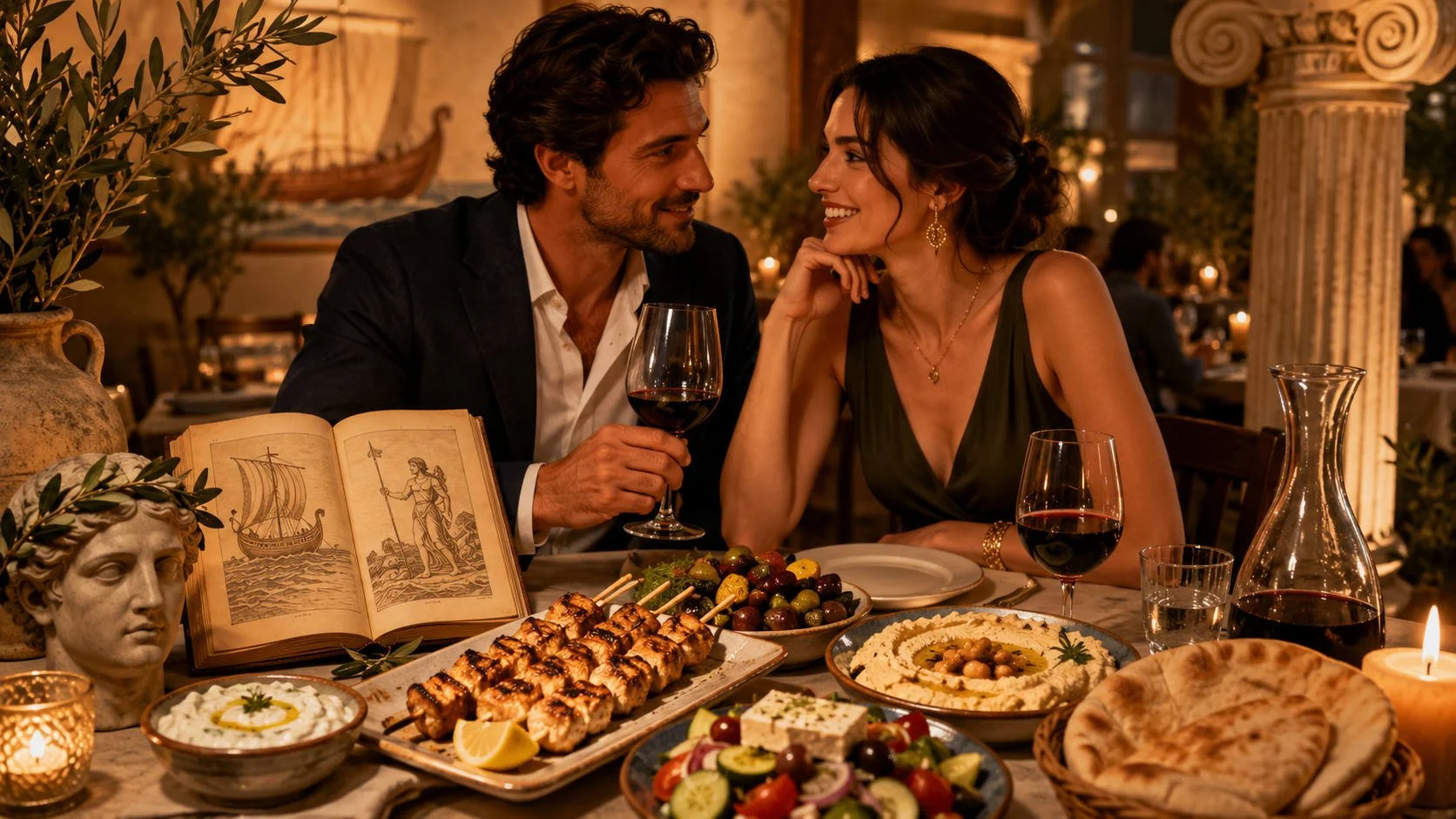
A Greek food date night is one of the easiest ways to seem cultured without doing the emotionally dangerous work of actually becoming cultured. You order olives, dip warm pita into tzatziki, say “hospitality was a major theme in The Odyssey,” and suddenly you are not just a person who panicked and booked the restaurant with blue chairs. You are an intellectual. A Mediterranean scholar. A soft-lit classics minor with access to grilled lamb.
This is the magic of The Odyssey Date Night. Greek food gives you ancient-world atmosphere, shareable plates, wine, mythological vocabulary, and enough lemon, oregano, olive oil, and feta to make you look like you made a thoughtful choice instead of simply Googling “romantic restaurant not too expensive.”
And to be fair, Greek food has earned the drama. The Odyssey is a 24-book epic traditionally attributed to Homer, following Odysseus as he tries to get home to Ithaca after the Trojan War. Britannica describes it as a story of adventure, longing, temptation, struggle, and hard-won return, which is also a solid description of trying to pick a restaurant where neither of you has to pretend to enjoy foam.
Why Greek Food Makes a Date Feel Smarter
Greek food comes with built-in intellectual accessories. Italy gives you romance. France gives you judgment. Japan gives you precision. Greece gives you dinner plus Western civilization homework, but in a flattering way.
You can say “meze” and sound like you understand communal dining. You can say “xenia” and sound like you read Homer voluntarily instead of just absorbing mythology from a cartoon Hercules with calves. You can talk about olive oil, island seafood, lamb, herbs, wine, honey, yogurt, and hospitality without sounding like you are reciting a menu written by a hedge fund.
Greek cuisine also has real cultural weight. Visit Greece lists olive oil, herbs such as oregano, rosemary, and thyme, tomatoes, cheese, lamb, fish, shrimp, wine, yogurt, honey, olives, and baklava among the staples and specialties of Greek cooking. So when you order grilled fish, Greek salad, dips, lamb, and honey-soaked dessert, you are not “just getting snacks.” You are participating in a culinary tradition with excellent lighting and dangerous amounts of feta.
The Secret Weapon: Xenia, or How to Sound Like You Took Notes
The smartest word you can bring to a Greek date night is xenia.
Xenia means hospitality or guest-friendship, and Princeton’s classics materials describe it as a fundamental Greek law or custom of offering protection and hospitality to strangers, associated with Zeus Xenios, the god who protects strangers. In The Odyssey, hospitality is not background decoration. It is basically the moral scoreboard. Good hosts feed and protect guests. Bad hosts trap them, exploit them, or, in the Cyclops’ case, eat them, because apparently Polyphemus missed the etiquette seminar.
Here is how to use this on a date without becoming unbearable:
When the server brings bread and dips, say, “Honestly, Greek food is perfect for a date because it is basically built around hospitality.”
Stop there.
Do not continue into a 12-minute explanation of guest-host reciprocity unless your date specifically says, “Please tell me more about archaic social codes,” in which case congratulations, you have found either true love or a graduate student.
Meze: The Date-Night Format That Saves You From Entrée Silence
Meze is the reason Greek food works so well for dates. Small plates give the table motion. You are reaching, dipping, sharing, tasting, passing, and reacting. This is infinitely better than the sad American date format where two people sit with separate entrées like neighboring island nations negotiating through cutlery.
Meze-style dining makes you look generous. It also gives you options if the conversation hits turbulence. Silence? Offer more pita. Awkward pause? Debate whether the dolmades are better with lemon. Sudden realization that your date has strong opinions about astrology? Put hummus in your mouth and buy time.
The Mediterranean diet itself is officially recognized by UNESCO as involving not just food but rituals, traditions, and especially the sharing and consumption of meals as a form of social exchange and community identity. In other words, sharing food is not some modern “small plates concept” invented by restaurants so they can charge $14 for three chickpeas. It is part of the culture.
What to Order So You Look Clever, Not Confused
Start with dips. Always. Dips are the Greek date-night opening argument.
Order tzatziki, because yogurt, cucumber, garlic, and herbs are basically freshness wearing a toga. Order melitzanosalata if they have it, because smoky eggplant dip says “I have range.” Order taramosalata if you both like seafood-briny flavors. Order hummus only if the restaurant is broadly Mediterranean or does it well; it is not uniquely Greek, and acting like it is will get you spiritually corrected by someone’s aunt.
Then order something crisp or salty: spanakopita, dolmades, saganaki, olives, or grilled halloumi if available. Saganaki is especially useful because flaming cheese, when done tableside, creates instant drama. It is also a good test of your date’s personality. If they do not enjoy flaming cheese, check for a pulse and possible law-school enrollment.
Then pick one larger shared dish: grilled lamb chops, souvlaki, whole fish, seafood, moussaka, pastitsio, or lemon potatoes with chicken. The Greek Ministry of Foreign Affairs highlights Greece’s agricultural variety, including olives and olive oil, cheeses, wines, honey, saffron, mastic, fruits, vegetables, and fish products. Translation: there is no reason to order like a frightened toddler. The menu has range.
The Smartest Greek Date-Night Order for Two
Here is the perfect order if you do not want to overthink it like Odysseus trapped in a cave with a one-eyed landlord.
Start with:
Tzatziki.
Melitzanosalata or taramosalata.
Warm pita.
Greek salad.
Then add:
Spanakopita or dolmades.
Souvlaki, lamb chops, grilled octopus, or whole fish.
Lemon potatoes or rice.
Finish with:
Baklava, loukoumades, Greek yogurt with honey, or galaktoboureko if they have it.
This order gives you freshness, salt, crunch, richness, protein, carbs, and dessert. It feels abundant without becoming a banquet that requires naval planning.
It also lets you say, “This is very Odyssey-coded. The whole meal is basically hospitality, travel, temptation, and trying to get home before dessert defeats us.”
Then stop talking. Again. Very important.
Why Greek Food Feels Rich Without Being Ridiculous
Greek food can feel luxurious without doing the expensive restaurant nonsense where a server places one scallop on a plate the size of a shield and whispers “Aegean memory.”
Good Greek food is rich because it is sensory. Olive oil shines. Lemon cuts. Herbs smell alive. Yogurt cools. Char adds smoke. Honey sticks to pastry. Feta is salty enough to make your ancestors sit up. Everything feels sunlit even if you are eating in February beside a parking lot.
The Mediterranean diet pyramid from Oldways emphasizes foods like whole grains, fruits, vegetables, beans, herbs, spices, nuts, olive oil, fish, seafood, yogurt, and traditional cheeses, with social connection at the base of the pattern. That is exactly why Greek food works for a date: it feels both indulgent and sane. Nobody has to pretend that a deep-fried appetizer tower is “light,” and nobody has to suffer through a sad salad that tastes like a napkin with ambition.
The Odyssey Angle: Nostos, or the Sexy Word for “Going Home”
The second smart word is nostos. It means homecoming or return, and The Odyssey is basically the granddaddy of “trying to get back home despite every possible distraction, monster, goddess, storm, and poor decision.”
Use this sparingly. Say, “Odysseus is all about nostos, the return home, which is basically what we are doing after this meal but with fewer shipwrecks.”
This works if your tone is playful. It fails if you say it like you expect applause from the classics department.
Greek date night gives you this nice little symbolic arc: you go out, share food, talk, drink, maybe flirt, maybe encounter temptation in the form of baklava, and eventually return home. Very epic. Very human. Slightly sticky with honey.
The Wine Move: Greek Wine Without Panic
Ordering Greek wine can make you seem smarter than you are because most people do not know what to do with it. This is excellent. Low expectations are the escalator of perceived sophistication.
If you see Assyrtiko, especially from Santorini, order it with seafood, dips, or anything lemony. It is crisp, mineral, and easy to like without forcing you to say things like “salinity” unless you are trying to get dumped.
If you see Agiorgitiko, think red wine that can work with lamb, grilled meats, and tomato-based dishes.
If you see Xinomavro, be careful. It can be fantastic, but it has a name that sounds like a spell and a structure that may bully weak food.
Do not pretend to know more than you do. Say, “Let’s ask what Greek wine they recommend with the lamb.” That makes you look smart and emotionally secure, which is basically seduction with menu literacy.
The Dishes That Make You Look Especially Smart
Grilled octopus makes you look adventurous but not deranged. It is the date-night equivalent of saying, “I have traveled emotionally.”
Whole fish makes you look elegant. Also slightly adult. Possibly even tax-compliant.
Dolmades make you look like you appreciate tradition and tiny wrapped things.
Spanakopita is safe, crispy, cheesy, and difficult to dislike unless your date is philosophically opposed to joy.
Moussaka is cozy and substantial, but it can be heavy. Order it if you want comfort, not if you plan to be charmingly light on your feet afterward. Moussaka does not support spontaneous dancing. It supports thoughtful sitting.
Greek salad is useful because it is simple and iconic. Tomatoes, cucumber, olives, feta, onion, oregano, olive oil. No lettuce hiding in there like filler with a water bill.
The Dishes That Can Betray You
Garlic-heavy dips are delicious, but if this is a kissing-possible date, be strategic. If both of you eat tzatziki, the garlic cancels out. This is science. Romantic science. Do not question it.
Flaming saganaki is fun, but only if the restaurant knows what it is doing. Otherwise your date night becomes a cheese-based safety demonstration.
Too much lamb can be heavy. Lamb is wonderful, but a table of lamb, potatoes, cheese, and fried pastry can turn romance into a digestive committee meeting.
Ouzo is risky. Some people love it. Some people taste it and feel like licorice has entered their bloodstream with a fake passport. Order one only if you both want to try it.
The At-Home Odyssey Date Night
You do not need a restaurant. You can build a Greek date night at home and still look brilliant, provided you do not serve cold pita and one tub of grocery-store hummus while calling it “Homeric.”
Make a board:
Warm pita.
Tzatziki.
Olives.
Feta with olive oil and oregano.
Cucumber and tomato.
Dolmades.
Roasted chickpeas.
Lemon potatoes.
Chicken souvlaki skewers or shrimp.
Honey yogurt or baklava.
Light a candle. Put on music that does not sound like a tourist cruise. Pour white wine or sparkling water with lemon. Say, “This is our little xenia board,” and then immediately serve food so you do not become a vocabulary goblin.
The Conversation Cheat Sheet
Greek food gives you easy, not-too-heavy conversation topics.
Ask:
“Which dip wins?”
“Would you survive The Odyssey, or would you absolutely get distracted by the Lotus-Eaters?”
“Is flaming cheese the peak of civilization?”
“Do you think Odysseus was clever or just exhausting?”
“Would you rather fight a Cyclops or split the last piece of baklava with me?”
That last one is flirting. Barely. But it counts. Romance is mostly snacks plus nerve.
Do Not Become the Mythology Guy
There is a fine line between charmingly informed and academically unbearable. You want to seem smart, not like you brought a syllabus.
Good: “Xenia was ancient Greek hospitality, so this whole shared table is very on-theme.”
Bad: “Actually, in Book 9, the Cyclops represents the inversion of civilized guest-host relations, and I have prepared a brief lecture.”
No one wants to date a man who turns pita into a seminar.
The correct tone is playful. Use mythology as seasoning, not the entire meal. Oregano, not wet cement.
The Perfect Dessert Ending
Greek dessert is where restraint goes to put on perfume.
Baklava is the obvious move: phyllo, nuts, honey or syrup, crunch, sweetness, drama. Loukoumades are fried dough balls with honey, which is basically what would happen if donut holes studied abroad. Greek yogurt with honey and walnuts is lighter and lets you pretend you are making a mature choice, even though honey is still sugar wearing ancient sandals.
Dessert is also the best place for the final Odyssey joke: “Odysseus resisted Sirens, but I will not be resisting baklava.”
Is that corny? Yes.
Will it work if your date likes you? Also yes. Dating is humiliating. Lean in.
Why This Date Works
The Odyssey Date Night works because it combines three romantic forces: sharing food, sounding mildly educated, and not making dinner feel like an interview conducted under restaurant lighting.
Greek food encourages generosity. It gives you small plates, dips, grilled things, wine, bread, and dessert. The mythology gives you just enough intellectual sparkle. The hospitality theme gives the whole date a reason to feel intentional.
You are not just eating grilled meat and cheese. You are staging a tiny civilized feast in honor of ancient guest-friendship and modern flirting.
Absurd? Yes.
Effective? Also yes.
Greek Food Is the Cheat Code for Seeming Interesting
A Greek food date makes you seem smarter than you are because the cuisine arrives with ancient literature, hospitality customs, Mediterranean ingredients, wine, shared plates, and a built-in excuse to say “Odyssey” while holding pita.
You do not have to be a scholar. You just need to order well, share generously, and avoid becoming the person who explains Homer with a mouth full of lamb.
Start with dips. Order meze. Share something grilled. Drink Greek wine if the list is good. Use “xenia” once. Use “nostos” only if the date is going well. Finish with baklava.
That is the whole strategy.
Greek food does the heavy intellectual lifting for you, like a tiny edible tutor covered in olive oil. You simply have to sit there, pass the pita, and look thoughtful.
Which, frankly, is much easier than reading all 24 books before dinner.