
How High Could Oil Go? Scenario Forecasts for a Third Gulf War
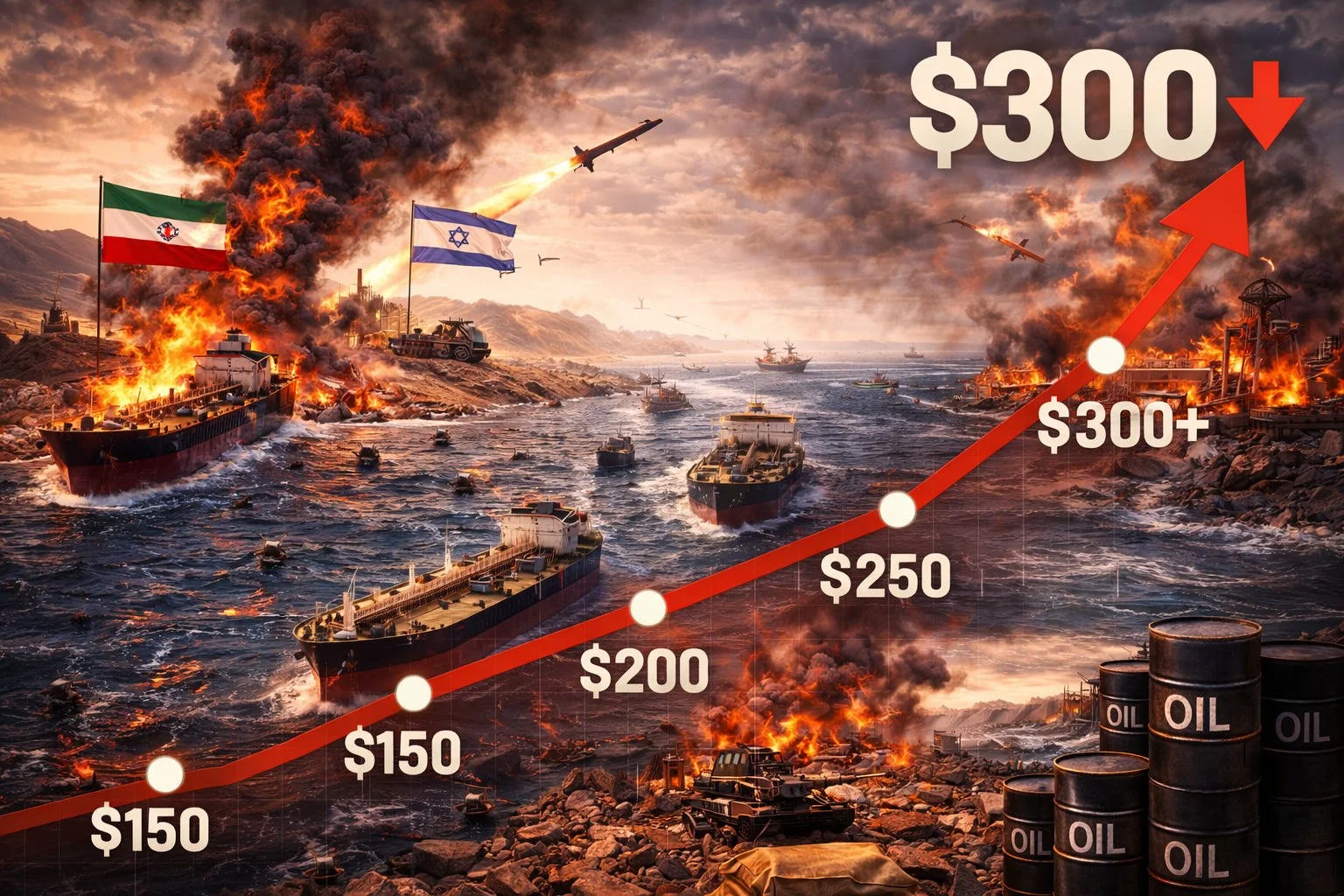
When people say “Third Gulf War,” they usually mean something bigger than a short exchange of strikes: a sustained, widening conflict around the Persian Gulf that turns the world’s most important energy corridor into a high-risk zone. And in oil markets, risk is a fuel of its own.
As of March 2026, we’re already seeing the early ingredients of an oil shock: tanker traffic disruption, war-risk insurance cancellations, and a jump in crude and gas prices. Reuters has reported major insurers canceling war-risk cover for vessels in and around Gulf waters (effective March 5), with roughly 150 ships stranded near the Strait and tanker rates surging.
So the question isn’t “could oil rise?” It’s: how high could it go if this turns into a true Gulf-wide war?
Below are scenario forecasts—not as predictions carved in stone, but as plausible price bands based on how oil shocks have behaved historically, and on what analysts are already modeling right now.
First, why this war can move oil so violently
Everything runs through one bottleneck: the Strait of Hormuz.
In 2024 and early 2025, flows through Hormuz made up about one-fifth of global oil and petroleum product consumption and more than one-quarter of global seaborne oil trade.
Alternative bypass pipelines exist, but the EIA estimates only about 2.6 million barrels per day could realistically bypass Hormuz in a disruption—helpful, but small relative to typical Hormuz volumes.
That’s why markets freak out so quickly: there isn’t a clean Plan B at the same scale.
And right now, it’s not just “fear.” It’s mechanics:
War-risk insurance is being pulled.
Ships are anchoring instead of transiting.
Freight and premium costs are surging.
That can create a de facto closure without a single “official” blockade.
The starting point: where prices are already behaving like a shock
In the first wave of escalation, Reuters reported Brent briefly pushing above $82 before settling lower—classic “gap up, whip around” volatility.
That matters because once the market is in shock mode, it can move from $80 to $100 faster than people expect if conditions keep worsening.
Scenario 1: Contained War, Risk Premium Sticks
Likely range: $85–$95 (with spikes)
This is the scenario where the fighting remains intense but shipping keeps moving, even if it’s more expensive and jumpy.
What’s happening here:
Hormuz remains passable most days.
Insurers don’t fully return to normal, but coverage exists (at a steep cost).
Attacks remain limited enough that the market prices a persistent “war premium” rather than a true supply crisis.
Why this doesn’t automatically hit $100:
Some price pressure is absorbed by inventories, rerouting, and incremental non-Gulf supply.
The market believes the disruption is temporary—measured in days, not weeks.
You still get scary headlines and nasty fuel prices, but not the full-blown “shortage-by-price” dynamic.
Scenario 2: Insurance-Driven Slowdown (De Facto Partial Closure)
Likely range: $95–$115
This is where it starts to feel alarmingly real.
In this scenario, the Strait may be open on paper, but it’s economically broken:
War-risk coverage is canceled or prohibitively expensive.
Shipowners refuse voyages.
Tankers pile up at anchor.
Cargo delays become persistent rather than occasional.
This is already the direction current reporting suggests: insurers have announced war-risk cancellations and shipping disruptions, with sharp increases in costs and anchored vessels.
Why $100 becomes more likely:
Even if oil exists, oil that can’t move is functionally missing.
Refiners start bidding up replacement barrels from farther away.
The market stops assuming “normal flows resume next week.”
Financial Times reporting on analyst views puts a plausible escalation band around $100–$120 if the situation worsens.
Scenario 3: Multi-Week Effective Closure (Storage Fills, Producers Forced to Cut)
Likely range: $110–$140 (and the world starts to sweat)
This is the scenario where the Strait stays severely constrained long enough that the region can’t simply “store it and wait.”
Here’s the ugly logic:
If exports are blocked or heavily reduced, Gulf producers can buffer for a while by storing crude.
But storage is not infinite.
Once storage fills, producers may be forced to shut in production, which turns a shipping problem into a true supply outage.
The FT reports JPMorgan warning that Gulf producers could hit storage limits within about 25 days in a severe disruption scenario—forcing production shutdowns.
At that point, oil isn’t just expensive because people are scared. It’s expensive because barrels are genuinely being withheld from the global system.
Why $120+ becomes plausible:
The market starts rationing demand.
Airlines, shipping, and heavy industry get squeezed.
Governments begin talking openly about emergency measures.
This scenario is where people start using phrases like “1970s-style shock” (because the psychology flips).
Scenario 4: Worse Than Shipping: Infrastructure Hits + Prolonged Hormuz Crisis
Likely range: $130–$170
Tail risk: $200+ (low probability, very high damage)
This is the “everything stacks at once” scenario:
Hormuz stays disrupted for weeks.
Insurance remains broken.
Energy infrastructure (refineries, export terminals, LNG facilities) takes sustained damage or repeated shutdowns.
Reuters has already reported that strikes and escalation disrupted regional energy output and contributed to large moves in oil and gas prices.
If that kind of disruption becomes persistent and widespread, the market starts pricing a genuine global shortfall.
Why the ceiling gets scary:
You can replace some Gulf barrels—but not quickly, and not cleanly.
LNG disruption can also tighten power markets and feed inflation.
Panic buying and precautionary demand add fuel.
Even relatively “measured” models show big sensitivity: FT reported Goldman Sachs estimating an $18 per barrel premium under a six-week Strait closure scenario (while emphasizing uncertainty about confirmed damage).
But real markets can overshoot models when fear spreads faster than logistics can adapt—especially if the newsflow suggests escalation is open-ended.
“Could it really hit $200?”
It’s a tail risk, not a base case. But it’s not impossible in a severe, prolonged combined shock where:
physical supply is lost,
shipping is impaired,
and markets believe it could last months.
History doesn’t guarantee it happens—but it proves oil can do brutal things during geopolitical shocks:
In 1973–74, prices nearly quadrupled during the embargo period.
In 1979–80, oil more than doubled over about a year during the Iran-era shock.
In 1990, prices roughly doubled in the months after Iraq invaded Kuwait.
Those were different eras—but the core lesson holds: when supply fears become believable, prices can jump far beyond what “feels reasonable.”
The 5 warning signs that oil is heading toward the higher scenarios
If you want a quick reality check, watch for these signals (the more you see together, the worse the scenario):
War-risk insurance stays canceled or returns only at extreme premiums (meaning ships still won’t sail).
Anchored vessel counts stay high or climb (persistent paralysis, not a temporary pause).
Tanker rates keep surging (shipping capacity effectively shrinks).
Confirmed, repeated energy facility outages (not just threats).
Official language shifts to “weeks” and “months,” not “days” (duration is everything in oil shocks).
Bottom line
If this stays a contained conflict with partial disruption, oil can hover in the $85–$95 range with sharp spikes.
If shipping economics break (insurance + risk), $100–$120 becomes much more realistic.
If the Strait stays severely constrained for weeks and forces production shut-ins, you’re staring at $110–$140 and a global inflation headache.
And if infrastructure damage stacks on top of prolonged disruption, $130–$170 is plausible—with a low-probability but very real $200+ tail risk if markets believe the crisis is open-ended.
This is why Hormuz panic doesn’t fade easily: the world can’t casually reroute a chokepoint that large—and oil markets don’t wait for certainty before they move.