
Gold, Oil, and the Dollar: Why “Safe Haven” Trades Move Together
In calm markets, these relationships look simple:
Gold up → dollar down (often)
Dollar up → oil down (often)
Then a real geopolitical shock hits and suddenly you see something that looks “wrong”:
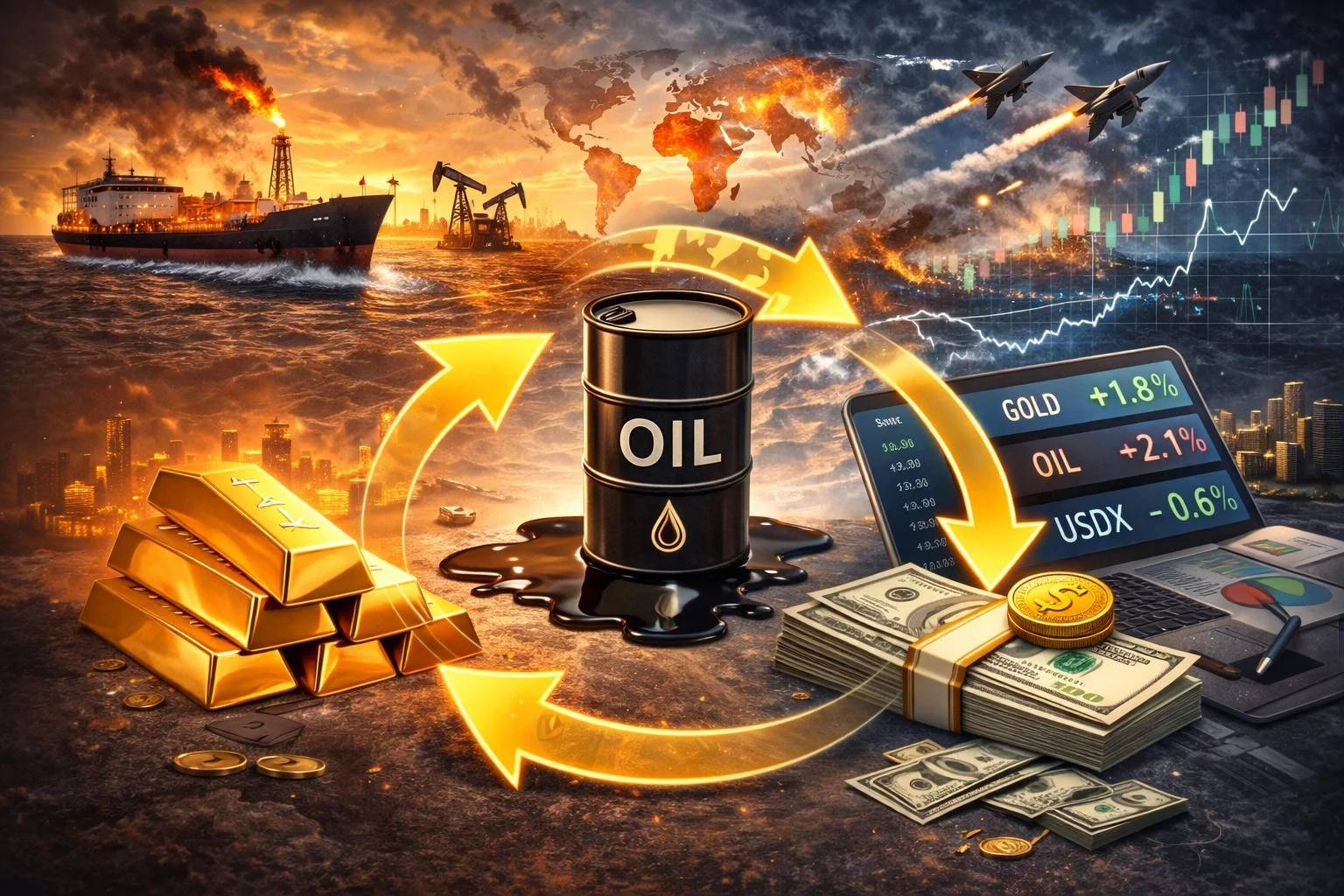
Gold rallies, oil spikes, and the dollar strengthens at the same time.
That’s not a glitch. It’s the market telling you it’s pricing two fears at once:
“We need liquidity and safety right now.”
“This could turn into an inflationary supply shock.”
Recent reporting during the current Iran conflict describes exactly this kind of behavior: investors shifting toward gold and the U.S. dollar while energy prices jump, reflecting a mix of safe-haven demand and inflation concerns.
Think of them as three different “defensive” trades
1) The dollar is a liquidity haven
In global stress, the dollar often strengthens because it’s the world’s main funding and settlement currency. When uncertainty rises, institutions tend to:
raise cash,
reduce leverage,
cover dollar liabilities,
and park funds in dollar assets.
So the dollar can rally even if U.S. politics are messy or U.S. equities are falling—because the market is chasing liquidity more than “optimism.”
2) Oil is a supply risk + inflation trade
Oil isn’t a classic “safety” asset like cash or government bonds. But during a Gulf crisis, oil can act like a hedge because it’s a key input into:
transport,
manufacturing,
food logistics,
and inflation expectations.
When a chokepoint or production region looks threatened, oil can spike because markets price a risk premium (fear of disruption), not because demand suddenly booms.
3) Gold is a monetary + uncertainty hedge
Gold tends to benefit when investors want something that:
isn’t someone else’s liability,
isn’t tied to one company’s cashflows,
and often holds up when confidence in paper assets weakens.
Gold can also rise on inflation fear, especially when markets worry central banks might be boxed in.
Why they can rise together during a crisis
A) “Risk-off” pushes USD up
A global risk-off move often means “buy dollars” because the dollar is the easiest place to hide at size (cash management, collateral, funding).
B) “Supply shock” pushes oil up
A Middle East escalation can raise the odds that:
shipping becomes more expensive,
insurance disappears,
or physical flows are delayed.
That pushes crude higher—sometimes violently—even if the dollar is strong.
C) “Stagflation fear” pushes gold up
Here’s the combo that makes gold and the dollar rise together:
Dollar up because liquidity demand rises.
Gold up because the market fears higher inflation and higher uncertainty.
Bonds may not help if investors worry about inflation (yields can rise even as fear rises), which can further support USD strength and keep gold attractive.
In other words: the market isn’t choosing one haven. It’s buying different hedges for different threats at the same time.
But aren’t oil and the dollar “supposed” to move opposite?
Often, yes—because oil is priced in dollars, and a stronger USD can make oil more expensive for non-USD buyers, cooling demand at the margin.
But in real crises, correlations can flip.
The European Central Bank has noted that the oil–dollar relationship is not stable over time and that in recent periods rising oil prices have coincided with a stronger dollar, complicating inflation dynamics.
Academic work also finds the oil–USD relationship can be time-varying rather than fixed.
Translation: in a supply shock, “fear of missing barrels” can outweigh “strong dollar = weaker demand.”
The “petrodollar” effect (why the dollar stays central)
Because global oil trade is heavily denominated in USD, big swings in oil prices can reinforce dollar demand through:
trade settlement needs,
hedging activity,
and financial flows tied to energy imports/exports.
That doesn’t mean oil “supports” the dollar in a simple mechanical way, but it helps explain why oil shocks often have currency consequences.
How to read the trio in real time: a practical checklist
When you see gold up + oil up + dollar up, ask which regime you’re in:
1) Is this a liquidity panic or an inflation panic?
If USD up + oil down + gold flat → classic liquidity squeeze / deflationary fear.
If oil up hard + gold up + USD also up → inflationary supply shock layered on top of risk-off.
2) What are real yields doing?
Gold often struggles when real yields rise sharply. If gold is rising anyway, the market may be pricing:
bigger tail risks,
sticky inflation,
or distrust that bonds will hedge the shock.
3) Is the move concentrated in the front end of commodities?
Geopolitical supply shocks tend to hit near-term oil prices first (tightness “right now”). When front-month crude rips higher, it’s usually a sign the market is pricing immediate disruption risk rather than a slow macro cycle.
The bottom line
Gold, oil, and the dollar can move together because they’re not the same trade:
USD = liquidity and funding safety
Oil = supply disruption and inflation risk
Gold = monetary hedge and uncertainty hedge
When a geopolitical crisis creates both risk-off fear and inflationary supply shock fear, markets often buy all three—at least for a while.