Why Starbucks Store Managers Are a Better Career Lesson Than Coffee Influencers
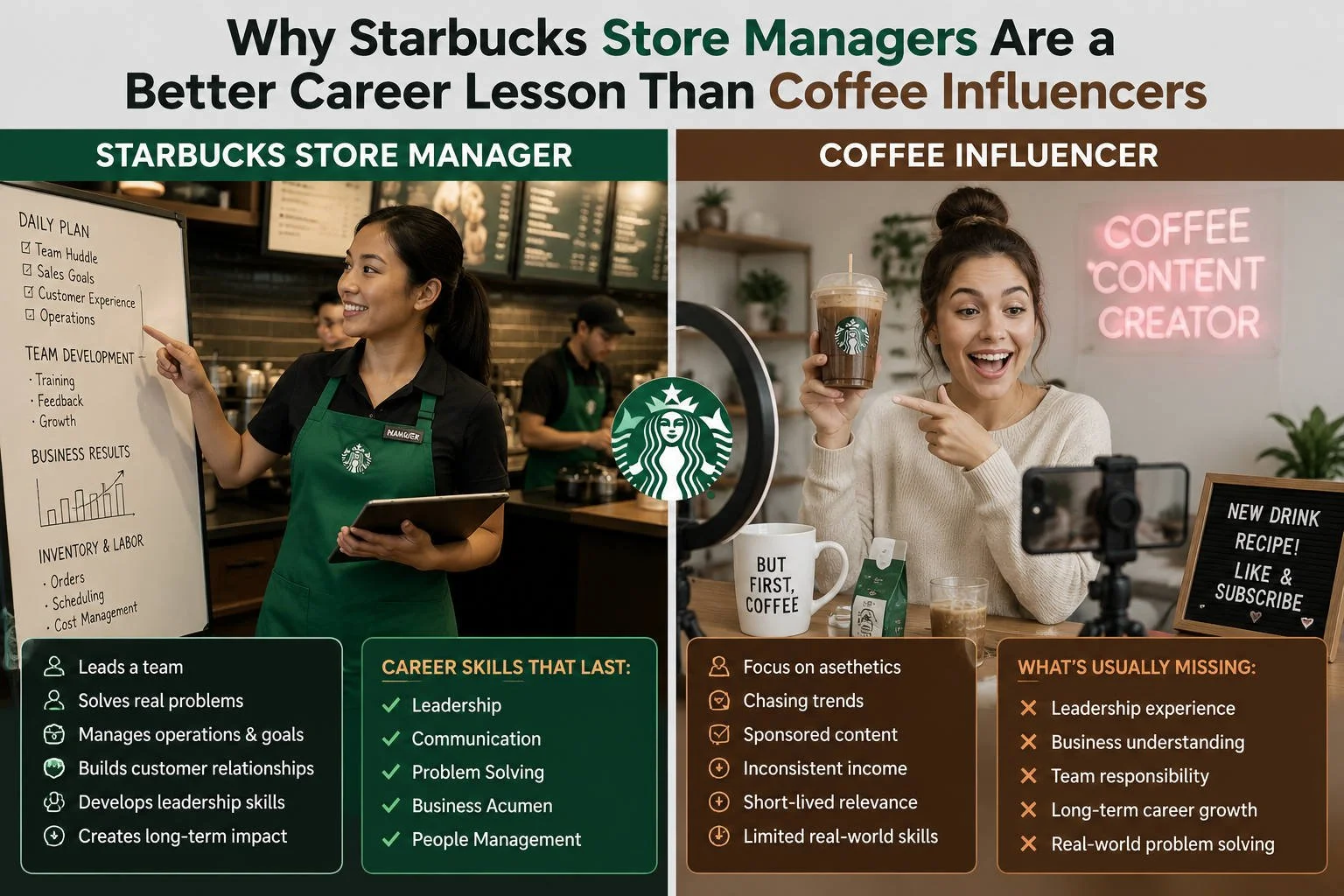
There are two types of coffee people on the internet.
The first type is the coffee influencer, standing in a kitchen with lighting so soft it appears to have been blessed by Scandinavian angels, slowly pouring oat milk into espresso while whispering about “ritual.” Their job is apparently to make a latte, film it from seven angles, and convince strangers that productivity begins with a $1,200 grinder and a ceramic cup shaped like a sad mushroom.
The second type is the Starbucks store manager, a person responsible for running an actual coffeehouse full of customers, employees, schedules, inventory, sales goals, complaints, training, safety, and some guy named Kyle who mobile-ordered twelve custom drinks during peak and is now glaring at the handoff plane like it insulted his bloodline.
One of these people teaches a better career lesson.
And it is not the one making a “cozy morning coffee routine” video while their apartment looks like no human has ever received mail there.
Starbucks store managers are a better career lesson than coffee influencers because they show what work actually looks like when it leaves the fantasy spa of personal branding and enters the fluorescent meat grinder of reality. They teach leadership, accountability, communication, execution, conflict management, sales, hiring, coaching, systems thinking, and emotional self-control in the face of a customer who believes “light ice” is a legally enforceable doctrine.
Coffee influencers teach angles. Store managers teach operations.
Angles are nice. Operations pay rent.
Starbucks Store Managers Learn the Stuff Influencers Pretend Is “Entrepreneurship”
Influencers love the word “entrepreneur.” They say it the way Victorian children said “consumption”: dramatically, constantly, and with no immediate cure in sight.
But actual entrepreneurship is not “I made a reel about cold foam.” It is managing resources, people, demand, standards, customer expectations, and money without collapsing into a pile of brand-neutral athleisure. That is what Starbucks store managers do.
Starbucks describes the store manager role as leading store partners to create and maintain the Starbucks Experience, while exercising discretion over the overall operation of the store. The role includes supervising the workforce, making staffing decisions, ensuring customer satisfaction and product quality, managing financial performance, and handling store safety and security. That is not “vibes.” That is a job with consequences.
A coffee influencer can say, “This latte changed my life,” and then spend 40 minutes editing steam.
A Starbucks store manager has to ask why labor was off, why the morning rush backed up, why customer connection scores dipped, why inventory is wrong, why a new hire is struggling, and why the bathroom looks like a raccoon attempted tax fraud in there.
That is business education, except instead of a case study, the case study is alive, caffeinated, and asking for a refund.
Store Managers Learn Leadership Where Leadership Can Actually Bite Them
Leadership online is easy. Just post a quote over a mountain and use the word “mindset” until LinkedIn begins leaking from the walls.
Leadership in a Starbucks store is harder because the team is right there. Looking at you. Tired. Under pressure. Covered in milk mist. Wondering whether today is the day the mobile order printer achieves sentience and declares war.
Starbucks says store managers are expected to demonstrate calm during high-volume or unusual events, train and hold partners accountable for customer service, implement company programs through action plans, delegate responsibilities, and coach store teams toward operational goals.
That is the career lesson. Not “be inspirational.” Please stop being inspirational. The workforce has suffered enough. The lesson is: be useful under pressure.
A manager who can keep a store functioning during peak has learned more about leadership than an influencer who calls themselves a “founder” because they opened a Notion template and sold three PDFs called Brew Your Best Self. Store managers do not get to hide behind captions. If the schedule is bad, everyone knows. If training is weak, everyone feels it. If communication is mush, the store becomes a beverage-themed demolition derby.
Leadership is not a personal aesthetic. It is whether the people around you can do better work because you are there.
Starbucks Managers Learn That “Brand” Is Not a Filter, It Is Execution
Coffee influencers are obsessed with brand. Their brand is beige. Their brand is ceramic. Their brand is sunlight touching a spoon. Their brand is apparently living in a home where every surface has been curated by a monk with a sponsorship deal.
Starbucks managers learn a less stupid version of brand: the brand is what happens at 8:17 a.m. when the line is long, the espresso bar is slammed, someone called out, and a customer’s drink is wrong.
Starbucks’ fiscal 2025 annual report says company-operated stores accounted for 83% of total net revenues, and the company’s retail objective is to sell quality coffee, tea, related products, and food while providing each customer with a unique Starbucks Experience. That means the store is not decorative. It is the business.
This is the part influencers frequently miss while arranging cinnamon sticks like a woodland proposal. A brand is not what you say you are. A brand is what customers experience repeatedly until they believe it.
If the store is messy, that is the brand. If the drinks are inconsistent, that is the brand. If the team is stressed and unsupported, that is the brand. If the manager fixes systems so the store runs smoother, that is the brand too.
A logo is not a brand. A latte photo is not a brand. A brand is hundreds of boring decisions made correctly by people who do not have time to photograph their sleeves.
Starbucks Store Managers Learn People Management, Also Known as “The Part of Work That Eats the Weak”
People management is the reason many so-called entrepreneurs retreat into solo content creation and call it “freedom.” Managing people requires listening, coaching, correcting, documenting, training, motivating, scheduling, and occasionally explaining the same policy so many times your soul begins buffering.
Starbucks’ store manager role includes monitoring staffing levels, supporting partner development, using performance management tools, giving feedback, recognizing team accomplishments, and ensuring legal and operational compliance.
This is career gold. Annoying gold, but gold.
Anyone can say “build a team.” Store managers actually have to do it. They have to onboard people. Retain people. Correct people without becoming a tiny tyrant in a green apron. Motivate people who are tired. Support people who are new. Handle conflict without immediately turning the break room into a courtroom drama.
Coffee influencers build an audience. Store managers build a team.
An audience can scroll away. A team has to close tonight.
The Career Path Is More Real Than “Manifesting a Brand Collab”
Influencer career advice often sounds like it was written by a fortune cookie that got a ring light.
“Post consistently.”
“Be authentic.”
“Find your niche.”
“Provide value.”
“Don’t give up.”
Excellent. Profound. Somewhere, a refrigerator magnet is taking notes.
Starbucks store management has a more concrete lesson: start somewhere, build skills, get promoted, learn the business, take on more responsibility, repeat until you become dangerously employable.
Starbucks said in 2025 that over 14,000 North American coffeehouse leaders gathered at its Leadership Experience event, including 12,000 store managers from company-operated and licensed stores across the U.S. and Canada. The same company page said that, on average, 60% of Starbucks store managers in the U.S. and Canada started as baristas, and a typical store manager leads a team of 18 partners.
That is a career ladder. Not a magical one. Not a “follow your passion and the algorithm will cradle you in its greasy little hands” ladder. A real one. Barista. Shift supervisor. Assistant store manager. Store manager. District leadership. Other operations roles. Maybe beyond.
Starbucks has also publicly said it established a goal to hire 90% of retail leaders from within, which is the sort of career-development sentence that sounds boring until you realize boring is exactly what you want when planning a life.
Influencer careers can be real, but they often depend on audience growth, platform changes, brand budgets, and the ongoing mercy of algorithms that behave like raccoons with graduate degrees in chaos. Store management is not easy, but the skills transfer. People management transfers. Scheduling transfers. Budgeting transfers. Customer service transfers. Training transfers. Surviving peak with your dignity only partially damaged transfers.
Store Managers Learn Business Numbers Instead of Pretending “Engagement” Is a Personality
Coffee influencers talk about engagement. Store managers talk about sales, labor, inventory, waste, staffing, product quality, and customer satisfaction.
One of those worlds has comments like “omg need this mug.” The other has payroll.
Starbucks’ store manager description includes using operational tools like labor scheduling, business reviews, cash management, inventory management, and financial reports to identify and address store performance trends.
That is an actual business education. It is not glamorous, which is how you know it is useful. Glamour is often where practical knowledge goes to be smothered under a linen napkin.
A Starbucks store manager learns that you cannot “vibe” your way around math. If labor is wrong, service suffers or costs explode. If inventory is sloppy, the store runs out of product or wastes money. If training is poor, quality drops. If communication is weak, the whole store turns into a group project where everyone hates everyone and nobody knows where the oat milk went.
Influencers can measure reach. Managers measure reality.
Reality is a harsher analytics dashboard.
Food Service Management Is a Real Occupation, Not a Content Goblin’s Mood Board
The U.S. Bureau of Labor Statistics says food service managers are responsible for daily operations in places that prepare and serve food and beverages. Their duties include hiring and training employees, ordering supplies, overseeing food preparation, inspecting work areas, ensuring health and safety compliance, addressing complaints, scheduling staff, managing budgets and payroll records, and establishing performance and customer service standards.
That is basically a full business degree wearing non-slip shoes.
BLS also reported that food service managers had a median annual wage of $65,310 in May 2024 and projected employment to grow 6% from 2024 to 2034, faster than the average for all occupations.
Does this mean every Starbucks manager job is a velvet staircase to prosperity? No. Let us not become corporate greeting cards with eyebrows. Food service management can be hectic, stressful, physically demanding, and full of nights, weekends, holidays, and people who have somehow made iced coffee their emotional support doctrine. BLS notes that food service management work can be hectic, dissatisfied customers may be stressful, and many managers work full time with schedules that include nights, weekends, and holidays.
But that is also why the career lesson is better.
It is not fantasy. It is training under pressure. It shows what management looks like when the espresso machine does not care about your personal brand.
Starbucks Benefits Teach a Better Lesson Than “Link in Bio”
Influencers monetize through a glorious buffet of instability: sponsorships, affiliate links, platform ad revenue, subscriptions, donations, merch, courses, and whatever new monetization scheme was invented by a 24-year-old wearing a beanie indoors.
Goldman Sachs Research estimated in 2023 that there were about 50 million global creators and said creator income comes mainly through brand deals, platform ad revenue sharing, subscriptions, donations, and direct payments from followers; it also said brand deals were the main revenue source at about 70% based on survey data.
Again, that can be a real business. But as a career lesson for most people, “depend on brand deals” is not exactly a sturdy bridge. It is more like crossing a river on sponsored popsicle sticks.
Starbucks, meanwhile, is useful to study because the employment package is visible and structured. Its U.S. benefits page lists medical, dental, and vision insurance options, mental health resources, paid leave, vacation and sick time, stock equity for eligible part-time employees, 401(k) match, education benefits, discounts, and weekly coffee or tea benefits.
Its Starbucks College Achievement Plan says benefits-eligible U.S. partners can receive 100% upfront tuition coverage for a first-time bachelor’s degree through Arizona State University’s online program.
This is not a claim that Starbucks is a benevolent forest spirit pouring health insurance from a copper kettle. It is still a corporation. It has labor disputes, operational problems, store closures, restructuring, and all the usual corporate weather systems. Starbucks itself disclosed that unions represent partners at about 6% of its U.S. company-operated stores and that labor market issues, wage inflation, turnover, unionization, and workforce availability can affect its business.
But as a career lesson, benefits matter. Stock matters. Tuition matters. Health coverage matters. Promotion paths matter. These are boring adult words, which is why they are more important than “use trending audio.”
Store Managers Learn Accountability, the Thing Influencer Culture Keeps Trying to Outsource to Aesthetics
The great thing about being an influencer is that when something goes wrong, you can call it “part of the journey.” The lighting was bad? Journey. Low engagement? Journey. Terrible sponsorship fit? Journey. Sold your audience a mushroom powder that tastes like drywall sneezed? Growth journey.
A Starbucks manager does not get that luxury.
If the store misses standards, the manager has to know why. If the team is struggling, the manager has to respond. If a customer complaint keeps repeating, it becomes a pattern. If product quality dips, someone must fix training. If the morning routine is broken, the manager cannot upload a moody black-and-white photo of a spoon and caption it “season of becoming.”
They have to manage.
Starbucks’ own leadership language in 2025 emphasized clearer service standards, simplified routines, customer connection, a four-minute wait-time goal, and leadership workshops for coffeehouse leaders.
That is accountability at scale. Not perfect accountability. Not magical accountability. But real accountability. The kind that produces actual professional muscle.
Influencer work can teach self-discipline and creativity. Fine. Wonderful. Give the ring light a tiny trophy. But store management teaches how to deliver results through other people in a real business with real constraints. That is harder and more transferable.
Starbucks Managers Learn Systems Thinking While Influencers Learn Which Mug Photographs Best
A coffee influencer thinks about the shot.
A store manager thinks about the system.
Who opens? Who closes? Who is trained for bar? Who can handle drive-thru? Which station slows down? What happens when mobile orders spike? How do you keep quality consistent when volume rises? How do you reduce friction for employees while still hitting customer expectations? How do you make the store feel human without allowing the line to become a municipal emergency?
Starbucks has been trying to sharpen exactly this kind of system. In 2025, the company described Green Apron Service as emphasizing warm customer acknowledgment, kindness, and “making every moment right,” while rolling out a Coffeehouse Playbook with updates to staffing, scheduling, technology, and routines meant to simplify tasks and create more space for customer connection.
That is the real lesson: hospitality is not just personality. It is design.
Bad companies think customer service is telling workers to smile harder. Better operators ask what system makes good service possible. Do workers have enough coverage? Clear routines? Training? Tools? Support? Leadership presence? Time to breathe? Or are they expected to create “connection” while being buried under 47 mobile orders and a printer screaming like a haunted cricket?
Store managers sit at the intersection of those questions. Coffee influencers sit at the intersection of crema and tripod placement.
Choose your professor.
The Starbucks Store Manager Career Lesson Is Portable
Here is the real reason Starbucks store managers beat coffee influencers as a career model: the skills travel.
A person who can manage a high-volume Starbucks store can walk into other food service, retail, hospitality, operations, training, district management, people leadership, customer experience, and small-business roles with skills that make sense to employers. They can say: I led a team. I managed scheduling. I handled customer complaints. I trained employees. I monitored sales and labor. I used reporting tools. I enforced safety and quality standards. I improved operations.
That is a résumé.
A coffee influencer can say: I built an audience. I created content. I negotiated brand deals. I analyzed engagement. I edited video. I developed a niche.
That can also be a résumé, but it is a narrower and weirder one, and it depends heavily on whether the person actually built a business or merely developed a public relationship with foam.
The better career lesson is not “Starbucks good, influencers bad.” Calm down. This is not a morality play performed by espresso beans.
The lesson is that operational careers teach durable skills. Creator careers can teach valuable skills too, but they often reward visibility before competence. Store management punishes incompetence immediately, usually around 7:45 a.m., in front of witnesses.
Useful Career Lessons to Steal From Starbucks Store Managers
First, learn how money moves. Even if you do not work in food service, understand labor costs, inventory, revenue, waste, and customer behavior. “Business acumen” sounds like something a consultant says before billing $18,000, but it really means knowing what makes the place work.
Second, get good at training people. The ability to teach a person a task, give feedback, and help them improve is wildly valuable. It is also rarer than it should be, because many adults think “training” means mumbling instructions once and then acting betrayed when the new person is confused.
Third, practice calm under pressure. Starbucks specifically calls out calm during high-volume or unusual events as a leadership behavior for store managers. This is useful everywhere. Panic is contagious. So is steadiness. Be the person who does not turn every problem into a weather event.
Fourth, understand that customer service is a system. It is not just friendliness. It is staffing, training, product quality, process design, and recovery when things go wrong.
Fifth, choose skills that survive platform changes. Nobody can algorithm-proof your career completely, but you can build skills that do not evaporate when an app decides your content should now be shown to 11 people and a bot selling sunglasses.
Coffee Influencers Are Fine, But Let’s Stop Acting Like Foam Is a Leadership Degree
Coffee influencers are not useless. Some are creative. Some teach real coffee skills. Some build impressive businesses. Some have taste, discipline, editing ability, marketing instincts, and community-building chops.
But the average viewer looking for career lessons should be careful. Influencer culture makes work look cleaner than it is. It cuts out the inventory issues, awkward conversations, compliance rules, bad shifts, broken equipment, interpersonal tension, and ugly middle part where adults have to solve problems without a soundtrack.
Starbucks store managers live in the middle part.
That is why they are more useful.
They do not just “love coffee.” Loving coffee is easy. Millions of people love coffee. Most of them are barely functional until it enters their bloodstream. A Starbucks store manager has to turn coffee into a coordinated operation involving people, products, standards, service, sales, and community. That is a career lesson with teeth.
Follow the Manager, Not the Mug Goblin
The coffee influencer gives you a fantasy: beautiful light, perfect pour, quiet morning, expensive beans, no customers, no staff, no payroll, no one asking why their drink has foam when they requested no foam but also wanted cold foam, because language has apparently failed us as a species.
The Starbucks store manager gives you reality: people, pressure, systems, conflict, growth, numbers, service, accountability, and leadership that has to work when the café is full and everyone wants something.
That is the better career lesson.
Not because Starbucks is perfect. It is not. It is a huge company with huge company problems. Not because store management is easy. It is not. Food service management can be stressful, physical, unpredictable, and full of moments that make a person briefly consider moving into a cave and befriending moss.
But because store managers learn the skills that make careers durable. They learn to lead teams, run systems, communicate clearly, handle pressure, read numbers, train people, solve problems, and deliver customer experience in the real world instead of the softly lit dollhouse of internet coffee culture.
So by all means, watch the coffee influencer pour the latte. Enjoy the foam. Admire the cup. Let the calming music convince you, briefly, that life is not an administrative swamp with passwords.
Then look at the Starbucks store manager.
That is the person teaching the real lesson: coffee is cute, but operations are what keep the lights on.