Why Costco Food Court Jobs Look Different From Normal Fast Food
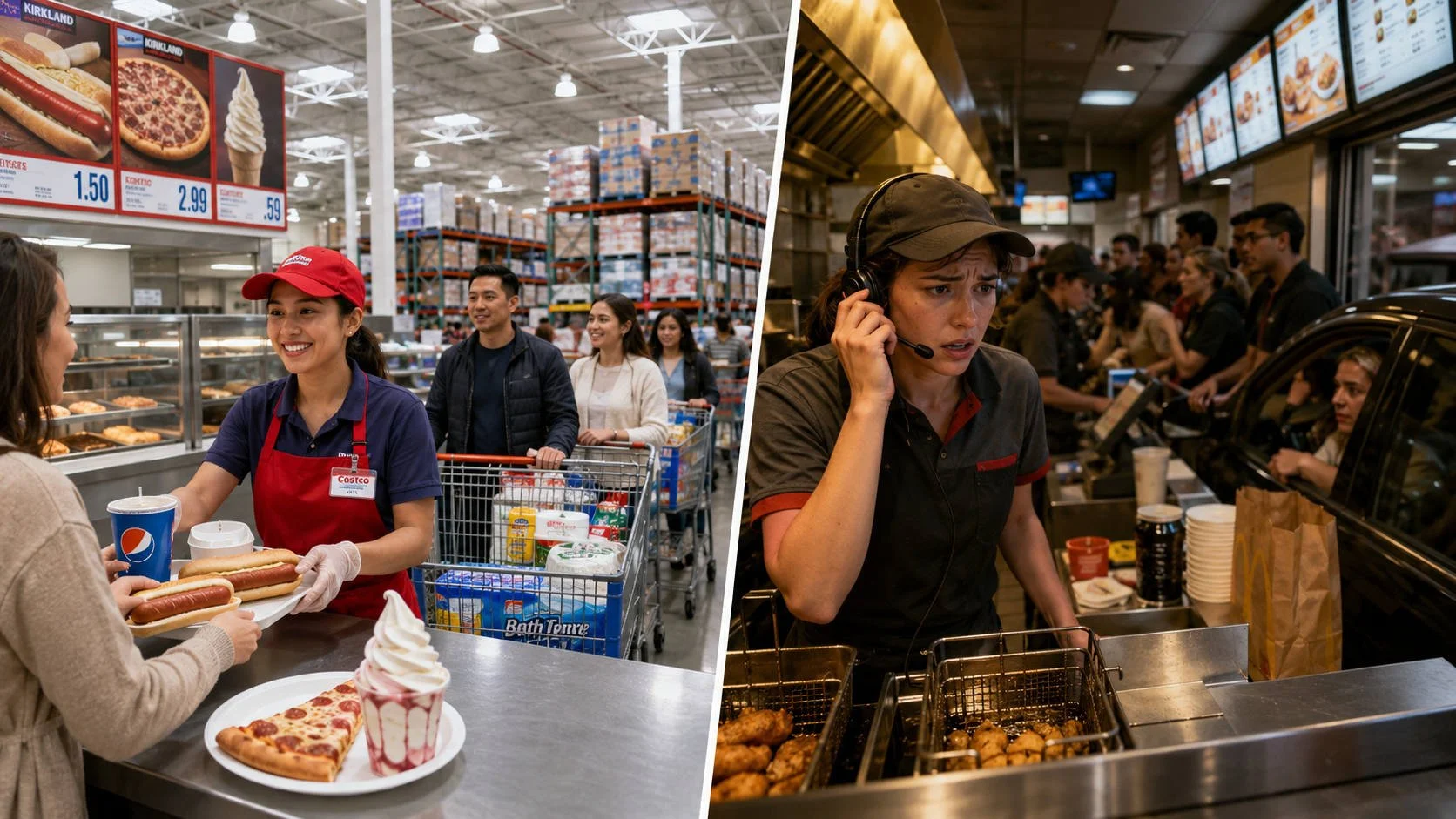
A normal fast food job happens in a restaurant. A Costco food court job happens inside a warehouse civilization where people buy paper towels by the geological layer, argue with a receipt checker over three cents, and reward themselves with a $1.50 hot dog like they just completed a pilgrimage.
So yes, Costco food court jobs look different from normal fast food. They are not simply “fast food, but near tires.” They are fast food fused to a membership warehouse, a retail traffic strategy, a bulk-supply logistics machine, and a customer base that can casually order a whole pizza while pushing a cart containing 48 eggs, a kayak, and enough detergent to cleanse a medieval kingdom.
Costco itself lists the food court as part of its “warehouse ancillary” businesses, along with gasoline, pharmacy, optical, hearing aids, and tire installation. The company says these ancillary businesses operate near or inside warehouses and encourage more frequent shopping. Translation: the food court is not just a place to eat; it is a little snack-shaped loyalty engine wearing a hairnet.
Costco Food Court Jobs Are Attached to a Membership Warehouse, Not a Sad Little Drive-Thru Hut
Normal fast food is built around the idea that any hungry person with six dollars and questionable impulse control can wander in, order a sandwich, and leave. Costco is different because the food court sits inside a membership ecosystem. Costco reported 145.2 million cardholders at the end of fiscal 2025, with U.S. and Canada renewal rates of 92.3% and worldwide renewal rates of 89.8%. That means the food court worker is not just serving “customers.” They are serving members—Costco’s preferred term for people who paid money for the privilege of buying mayonnaise in a bucket large enough to bathe a Labrador.
That changes the vibe. In normal fast food, a customer may be a random passing tornado who wants fries and emotional validation. At Costco, the food court is part of the member experience. The member has already walked through the warehouse, seen the rotisserie chickens, contemplated a sectional sofa, survived checkout, and now believes the hot dog is their constitutional right.
And honestly, Costco helped create that expectation. The $1.50 hot dog combo has become one of retail’s most famous fixed-price deals, and Axios reported in 2026 that Costco sold more than 245 million hot dog combos in fiscal 2025. That is not a menu item. That is an edible national infrastructure project.
The Costco Food Court Is Fast Food With Warehouse Logic
Costco’s whole business model is built around low prices, limited selection, high sales volume, and rapid inventory turnover. The company says its no-frills warehouse model, volume purchasing, efficient distribution, and reduced handling let it operate at lower gross margins than many retailers. In human words: Costco makes money by moving absurd quantities of stuff efficiently, not by decorating the room like a rustic farmhouse had a baby with an app startup.
That logic shows up in the food court. The menu is usually tight. The prices are aggressively value-coded. The operation is built for volume. A normal fast food chain may launch 19 limited-time sandwiches because someone in marketing saw a TikTok about Korean barbecue and lost supervision. Costco does not need that level of menu jazz hands. Costco has pizza, hot dogs, chicken bakes, drinks, desserts, and the general emotional power of “cheap food after spending $312 on household basics.”
This makes the job different. The challenge is not memorizing a constantly mutating menu of promotional nonsense like “the Spicy Ranch Volcano Stack with Crispy Onion Dust.” The challenge is surviving repetition at scale. It is not culinary theater. It is industrial snack deployment.
Costco Food Service Assistants Do More Than Hand Over Hot Dogs
The Costco food court job is not just “stand near buns and smile.” Costco’s Food Service Assistant description says workers prepare and sell food and drinks, pull and stock supplies and ingredients, clean the kitchen and eating areas, and provide prompt, courteous member service. A Canadian Costco food court posting gets even more specific: employees may roll, shape, top, and bake pizzas; slice pizza; steam hot dogs and buns; operate deep fryers; ring sales; take whole pizza orders at the counter and on the phone; dispense frozen yogurt, lattes, smoothies, and drinks; clean tables; mop floors; take garbage to the compactor; stock large-volume ingredients; and follow sanitation, temperature, rotation, and expiration rules.
That is not one job. That is seven jobs wearing one name tag.
Normal fast food has cross-training too, obviously. But Costco food court work is especially warehouse-adjacent. You are not just pulling fries from a freezer in the back. You may be pulling large-volume ingredients from a warehouse environment where everything appears to have been packaged for a family of 14 or a minor religious compound.
So when someone says, “Costco food court looks easier because the menu is smaller,” please invite them to make pizzas, steam hot dogs, answer the phone, refill machines, sanitize tables, restock bulk supplies, deal with a line of members who believe the soda lid shortage is a personal betrayal, and then mop the floor under a condiment station that looks like raccoons held a mustard conference.
The Volume Is the Job, Because Costco Shoppers Eat Like They Won a Court Case
Normal fast food has rushes: breakfast, lunch, dinner, late-night “I have made choices” hour. Costco food court rushes are tied to warehouse traffic. The line forms when people finish shopping, when families pile in on weekends, when someone orders several whole pizzas for a birthday party, and when civilization remembers that $1.50 still buys a hot dog combo in a world where breathing near a sandwich can cost $14.
The food court is not floating separately from the store. Costco explicitly says ancillary businesses encourage more frequent shopping, and food court sales are part of its broader warehouse ancillary and other business category. In 2025, that category represented $51.17 billion in net sales. The hot dog counter may look humble, but it lives inside a very large machine, which is a polite way of saying your shift may feel like serving lunch to a stampede in cargo shorts.
This is why the job looks different from ordinary fast food: the food court is a pressure valve. Shoppers come in hungry, leave tired, and expect value. The worker is not just selling lunch. They are the final boss in the Costco errand ritual.
Costco Pay Makes the Job Look Different From Normal Fast Food
Here is where the comparison gets less adorable and more financially radioactive for normal fast food.
Reuters reported in January 2025 that Costco planned to raise pay for most hourly U.S. store workers, with top-of-scale employees moving to $30.20 in the first year and rising further over the next two years; the same report said bottom-scale employees would rise by 50 cents to $20. As a reference point, the U.S. Bureau of Labor Statistics reported that fast food and counter workers had a median hourly wage of $14.65 in May 2024.
That does not mean every Costco food court applicant instantly gets a golden spatula and a mortgage preapproval. Pay varies by role, location, seniority, contract status, and whether the job is union or non-union. But compared with the broader fast food labor market, Costco has a reputation—and documented wage policies—that make the food court look less like a disposable starter job and more like a job someone might actually try to keep. Revolutionary. Someone inform the restaurant industry, preferably in crayon.
Costco’s 2025 annual report says “Take Care of Our Employees” is part of its code of ethics, and that compensation and benefits are its largest expense after merchandise costs. It also says Costco seeks to provide “not merely employment but careers,” emphasizing competitive compensation, benefits, employee development, promotion from within, and a target that at least 50% of its base be full-time employees.
Benefits Change the Whole Food Court Energy
Normal fast food benefits can sometimes feel like someone taped a coupon to a wet napkin and called it a compensation philosophy. Costco, meanwhile, publicly markets benefits as a major part of its employer identity. Its U.S. careers page says the company’s success depends on employee well-being and mentions benefits, paid time off, personal growth, career growth, 401(k), Sunday premium pay, and health insurance.
Costco Canada’s career page is even more explicit: it says benefit-eligible employees can get health care, dental care, retirement contributions, an employee and family assistance program, disability coverage, life and critical illness insurance, and an employee share purchase plan. It also says Costco prides itself on promoting from within, which is apparently what happens when a company discovers that workers are humans and not disposable drive-thru cartridges.
This changes how the job looks from the inside. A normal fast food job may be treated by management as a revolving door with fryer grease. A Costco food court job sits inside a company that publicly talks about retention, benefits, advancement, and long-term employment. Again: not paradise. It is still food service. There are still lines, spills, burns, cranky people, and the eternal tragedy of someone asking why the combo pizza is gone as if the cashier personally executed it at dawn. But the employment model is different.
Costco Food Court Workers Serve Members, Not Just Orders
Customer service in normal fast food often means surviving people who treat a missing sauce packet like a war crime. Costco food court workers deal with that too, except the customer is a member, and membership creates a special little entitlement soufflé.
The job posting language matters: Costco says Food Service Assistants provide “prompt and courteous member service.” Not customer service. Member service. That difference sounds small until you remember members pay annual fees, use household cards, qualify for rewards in some membership tiers, and have been trained by the brand to expect value as a sacred covenant.
That means the food court worker has to move fast while preserving the Costco feeling: efficient, polite, low-price, no-frills, vaguely miraculous. It is not “Would you like to make that a combo?” It is “Here is the combo that has survived inflation like a cockroach wearing a Kirkland logo.”
The Menu Is Smaller, But the Standards Are Not Smaller
A limited menu does not automatically mean an easy job. A piano has only 88 keys, and somehow people still manage to play jazz, so let us stop pretending fewer buttons equals no skill.
The Costco food court demands consistency. The pizza slice should look like the last pizza slice. The hot dog should not emerge like a boiled pool noodle from a haunted school cafeteria. The eating area has to stay clean despite being assaulted by children, condiments, and adults who somehow cannot deposit trash into an opening the size of a mailbox.
The official food court job description includes cash handling, production procedures, sanitation, machine cleaning, refilling, health code compliance, product rotation, temperature standards, and cleaning floors, counters, utensils, pans, machines, and eating areas. That is the glamorous reality beneath the hot dog mythology.
Normal fast food workers know this pain too, of course. The difference is that Costco food court workers are operating in a high-volume warehouse environment where the customer may have already spent two hours shopping and now expects the food court to be cheap, fast, clean, and emotionally restorative. No pressure. Just feed the entire post-checkout migration pattern of suburban North America.
Costco Food Court Jobs Are Physically Real Jobs, Not Cute Snack Theater
The Bureau of Labor Statistics says food and beverage serving workers spend much of their shifts on their feet, carry heavy items, work under pressure during busy periods, and face safety hazards like hot ovens, slippery floors, cuts, slips, and burns. It also notes that workers may need physical stamina and strength, including the ability to lift and carry stock and equipment that can weigh up to 50 pounds.
Now add Costco-scale supplies. Add pizza ovens. Add hot dog steamers. Add cleaning machines. Add trash. Add members. Add the condiment station, that sticky little swamp where mustard goes to reconsider its life choices.
This is why Costco food court jobs look different: the work is not cute just because the menu has a cult following. A food court worker is part cook, part cashier, part cleaner, part stocker, part traffic controller, and part therapist for someone whose whole pizza order is not ready yet.
Costco Food Court Jobs Can Be a Career Door, Not Just a Grease-Stained Exit
One of the biggest differences is what the job can lead to. Costco’s annual report says 95% of its employees are employed in membership warehouses and distribution channels, and that its U.S. and Canada retention rate was about 94% in 2025 for employees who had been with the company at least one year. The company links that retention to competitive compensation, benefits, employee development, promotion from within, and its full-time employment target.
That does not mean every food court worker becomes a warehouse manager. Calm down, LinkedIn. But it does mean the job sits inside a company that talks about internal growth as part of its operating model. In normal fast food, “growth opportunity” sometimes means you get to close on Sunday and learn where the mop bucket lives. At Costco, there is at least a clearer connection between entry-level warehouse roles, department moves, supervisor paths, and longer-term employment.
A Costco Canada food court posting even lists “assists in other areas of the warehouse as necessary” as a non-essential function. That one line explains a lot. The food court is not an island. It is one department inside a warehouse organism, and sometimes the organism wants you to help elsewhere because apparently the 400-pack of toilet paper does not sell itself.
Useful Tips for Anyone Applying to a Costco Food Court Job
Do not apply thinking this is “just hot dogs.” That is how you end up emotionally folded into a pizza box.
First, be ready to talk about speed and cleanliness. The official job duties are obsessed with cleaning, sanitizing, stocking, production standards, temperature rules, and product rotation, because food service is not just feeding people; it is preventing the dining area from becoming a lawsuit with napkins.
Second, emphasize member service. Costco is a membership business, and the language of the job is member-focused. Say you can be fast without becoming rude, calm without becoming useless, and polite even when someone asks a question with the energy of a raccoon trapped in a pantry.
Third, ask about the local wage scale, benefits eligibility, scheduling, union status, and advancement path. Costco’s broad wage and benefit reputation is strong, but your actual situation depends on location, hours, classification, seniority, and contract details. This is adulthood, unfortunately, and adulthood means asking boring questions before committing your spine to a pizza oven.
Fourth, prepare for physical work. If your dream job involves standing still and occasionally touching a register, this may not be your kingdom. Costco food court work involves prep, stocking, cleaning, heat, crowds, and repeated movement. Bring stamina. Bring good shoes. Bring the emotional toughness to see a table covered in chopped onions and not immediately abandon society.
Costco Food Court Jobs Are Fast Food After It Joined a Warehouse Cult
Costco food court jobs look different from normal fast food because the food court is not a normal restaurant. It is an ancillary business inside a membership warehouse built on low prices, limited selection, high volume, operational efficiency, and member loyalty. It sells food, yes, but it also sells the feeling that Costco still has your back, even if your cart contains 11 pounds of cheese and a patio umbrella.
The work is not necessarily easier. In some ways, it is probably worse in the specific way all high-volume food service jobs are worse: hot, repetitive, physical, messy, and filled with people who believe waiting four minutes is a constitutional injury. But it is different because the job sits inside a company that publicly emphasizes compensation, benefits, retention, career development, and member service more than the average fast food chain does.
Normal fast food says, “Here is a headset. Good luck against humanity.”
Costco food court says, “Here is a headset, a pizza oven, a steamer, bulk ingredients, a warehouse full of members, a legendary hot dog combo, a benefits conversation, and a line that appears to reproduce by mitosis.”
So yes, Costco food court jobs look different. They are not just fast food jobs. They are warehouse food service jobs inside one of retail’s most efficient, value-obsessed machines.
And somewhere in the middle of that machine stands a food court employee handing over a hot dog combo that costs less than a gas station protein bar, silently carrying the emotional weight of American bargain culture while someone asks whether the whole pizza is ready yet.
Heroism comes in many forms. Sometimes it wears gloves and refills the soda lids.