No. The public evidence behind the Pentagon’s reported 90-day plan concerns keeping military operations running through a disruption. It does not establish that a nationwide civilian blackout is imminent, or that one would last three months.
FORTRESS America is real. So are the infrastructure risks motivating it. The confusion comes from treating a military endurance goal, stockpiles and a separate regional electricity emergency as if they were one warning to households.
Where the 90 days comes from
Pete Hegseth announced FORTRESS America on September 30, 2026. The Army’s official account describes an effort to make installations more independent, harden them against intrusion and bring critical supply chains home.
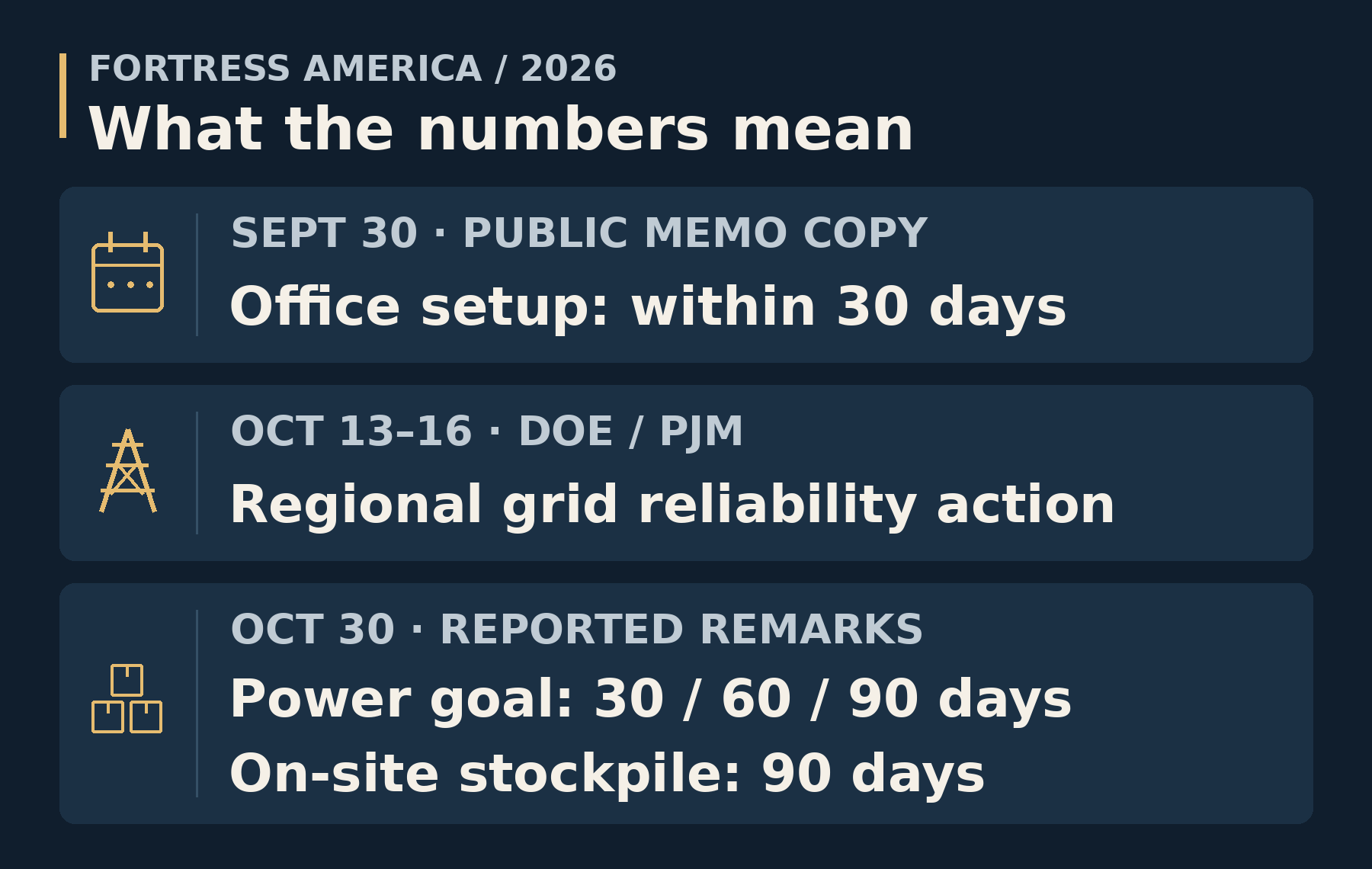
A publicly available copy of the establishment memo sets a 30-day deadline to establish a program office. That concerns creating the organization. The copy contains no 90-day endurance requirement. Its government-hosted original was inaccessible, so we could not authenticate the copy against that version.
The broader claim appeared in reporting about internal planning documents. The War Zone’s October 26 account attributes to Fox News a goal for major installations in the continental United States to sustain essential operations independently for at least 90 days, including electricity, water, fuel and communications. We have not independently inspected those underlying documents.
Later on-record remarks added an important distinction. In Breaking Defense’s October 30 report, installations chief Dale Marks described a power goal of 30, 60 or 90 days. Separately, he described a 90-day on-site stockpile of critical parts, fuel, propellants and ammunition.
Those are related ambitions with different meanings. Neither specifies when civilian electricity will fail.
The October grid emergency was a different event
The Energy Department’s October 12 announcement authorized additional generation options for PJM, the regional grid operator, for October 13–16. The stated problem combined elevated electricity demand with planned generator and transmission outages during maintenance season.
That was a real reliability concern. The response was designed to help keep electricity flowing, including access to backup generation if needed.
PJM’s operational update described unusually warm fall weather, equipment outages and demand-response measures. It said its public alert required no action from customers. Participating demand-response customers, however, could be called on to reduce use under their arrangements.
A regional emergency order with specified dates does not establish a nationwide, three-month outage. Its geography, purpose and duration all differ from the FORTRESS reporting.
A goal is only part of the evidence
Military resilience planning did not begin this autumn. The Army described a 14-day energy-and-water goal in 2017, tied to critical missions. An official 2021 account described that duration as a default when a mission had not specified another requirement.
The same account reported a May 22–23 exercise in Hawaii that disconnected named installations from the primary grid and supplied them through a local power network. That demonstrates something concrete, but only within the test’s duration and conditions. It cannot establish three months of independence across every base.
Likewise, Fort Stewart’s April 2026 exercise was designed to find gaps. Its organizers described a diagnostic exercise rather than a pass-or-fail inspection.
Implementation details remain important. Air & Space Forces Magazine’s October 20 reporting describes installation assessments still underway, with energy solutions tailored to each location. Costs and the full rollout were still being worked out. A base awaiting a future project cannot be counted as independently powered simply because the program has been announced.
The distinction matters in both directions. A plan does not prove an attack is coming. An ambitious announcement also does not prove the military has already achieved the capability it wants.
The risks are real. The household conclusion is narrower.
In a February 2024 release, NSA and its partners described compromised critical-infrastructure networks and assessed that Chinese state-sponsored actors were positioning themselves for disruption during a crisis or conflict. Dismissing every concern about the grid would ignore that evidence.
Britain’s preparedness campaign is another real development with a different scope. Its October 22 announcement describes household readiness for three days of disruption, including severe weather, within a three-year campaign. It does not announce a coordinated American blackout warning.
For households, practical outage planning remains worthwhile. CDC guidance recommends thinking through lighting and backup power, particularly for medical equipment. If an outage actually happens, food safety presents its own decisions; our fridge and freezer guide addresses those separately.
Before treating a preparedness headline as a warning for your home, check what its number measures and whom the instruction addresses. In this case, the evidence describes military resilience work and a separate regional grid response. It supplies no basis for converting either into a dated nationwide blackout prediction.