3 Scenarios for How the Iran War Ends (Fast, Slow, or Worse)
The phrase “how does the Iran war end?” sounds like a question for historians. But right now, it’s a question for everyone—because the endgame will shape oil prices, global shipping, regional security, and the daily lives of people far from the Middle East.
As of March 2, 2026, the conflict has moved past tit-for-tat strikes and into something that looks and feels like a widening regional war. The United States and Israel launched major attacks on Iran starting February 28, 2026, with stated goals that include degrading Iran’s missile capacity, hitting parts of its military infrastructure, and preventing Iran from obtaining a nuclear weapon. Iran has retaliated with missile and drone attacks and the fighting has already rippled into surrounding countries and critical energy routes.
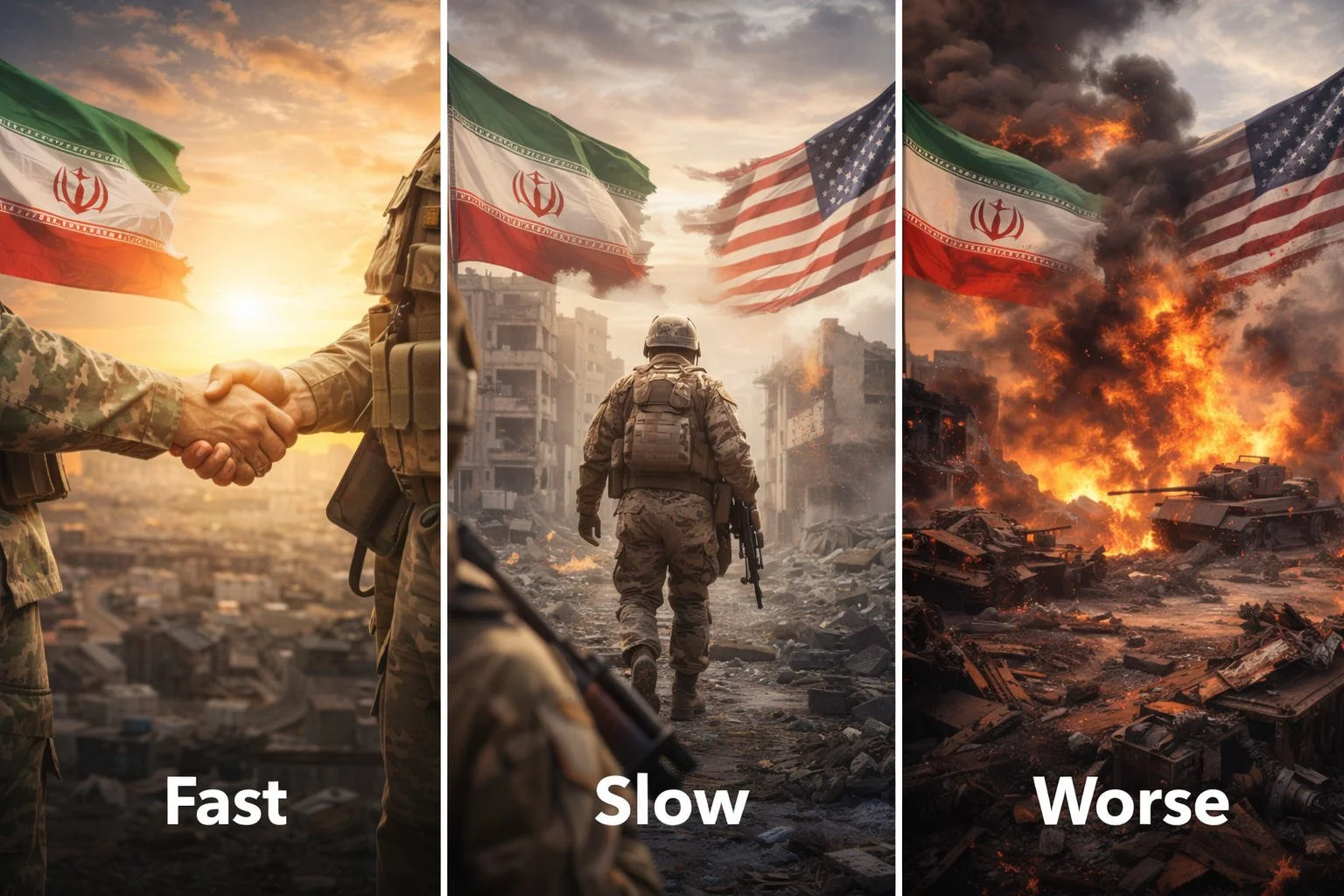
The hard truth: wars like this typically end in one of three ways—a fast stop, a slow grind into a deal, or a spiraling escalation that creates a much worse problem than anyone started with.
Below are three scenarios—Fast, Slow, or Worse—that outline what ending the Iran war could realistically look like from here.
Where things stand right now (March 2, 2026)
A few core facts shape every plausible ending:
The war began with large-scale strikes on February 28, 2026 by the U.S. and Israel, framed as targeting Iran’s leadership and military capabilities, with wider strategic aims described by major analysts and official statements.
Iran has retaliated with missile and drone attacks across the region, while the U.S. and Israel continue striking Iranian military targets.
The Strait of Hormuz has become a pressure point. Reuters reports major shipping disruption, damaged tankers, deaths, and a near-halt in traffic—exactly the kind of economic shock that can force political decisions quickly.
The U.S. is signaling a campaign measured in weeks, not days. AP quotes President Trump describing a timeline on the order of “several weeks,” potentially longer.
Domestic politics matter. A Reuters/Ipsos poll found only about one in four Americans supported U.S. strikes, with concerns about casualties and fuel prices—pressure that can accelerate a push toward an “exit” if costs rise.
Those constraints don’t tell us how it ends—but they narrow the possibilities.
Scenario 1: The “Fast” Ending (Days to ~2 Weeks)
This is the ending people hope for: intense violence, followed by a rapid stand-down—before the region (and global economy) takes deeper damage.
How a fast end happens
A fast end usually requires one of these turning points:
Backchannel diplomacy produces a face-saving deal.
Think: temporary ceasefire, mutual pauses in strikes, limited prisoner exchanges, and “we achieved our objectives” statements on all sides—without resolving the deeper conflict.A credible threat to energy and shipping forces a quick de-escalation.
If global markets keep reacting violently to Hormuz disruption, international pressure ramps fast—not just from rivals, but from partners who suddenly face fuel spikes and supply shocks. Reuters reporting on stranded ships and insurers pulling war-risk coverage shows how quickly normal commerce can freeze.A leadership calculation changes overnight.
Sometimes a key leadership group decides the current trajectory risks regime survival—or, conversely, risks a catastrophic U.S. escalation—and chooses a pause.
What it looks like on the ground
Airstrikes slow and become more limited, more defensive, more selective.
Iran’s regional attacks become less frequent or shift to symbolic actions.
The “big leverage points” (oil infrastructure, Hormuz shipping, major regional bases) become quiet rather than targets.
Signals to watch
Official hints of “objectives achieved” language from Washington or Jerusalem.
Rapid re-opening of shipping lanes and insurers restoring coverage (or governments escorting tankers).
A sudden pivot to negotiations framed around the nuclear issue (even if it’s “talks about talks”).
The catch
A fast ending is often fragile. It stops immediate bleeding, but it can freeze the conflict in place—setting up another crisis later.
Scenario 2: The “Slow” Ending (Weeks to Months)
This is the most common ending in modern high-stakes conflicts: a prolonged campaign, intermittent retaliation, and eventually a negotiated “off-ramp” when exhaustion and risk converge.
How a slow end happens
This pathway is driven by attrition + bargaining:
The U.S. and Israel continue a sustained air and naval campaign aimed at degrading missile capabilities and other strategic assets.
Iran continues retaliatory strikes—enough to impose cost and signal strength, but (in this scenario) not enough to trigger an all-out regional inferno.
Over time, both sides discover the same ugly reality: total victory is expensive, and escalation risks become harder to control.
Eventually, a deal emerges that may include:
Limits or verification measures tied to nuclear activity (even if framed differently by each side).
Quiet understandings about shipping, regional militia activity, and “red lines.”
What it looks like on the ground
Strikes continue, but their intensity becomes rhythmic—spikes and lulls.
More emphasis on air defense, counter-strikes, and strategic deterrence.
Regional spillover persists (bases, proxies, cyber), but without a decisive “break.”
Signals to watch
Official messaging shifts from “toppling” to “deterring” or “containing.”
More talk of timelines—“weeks,” “phases,” “benchmarks”—rather than imminent victory.
Public pressure grows as casualties and fuel costs rise—especially if polling and elections tighten the political window for sustained war.
The catch
Slow endings can still be brutal. They grind down militaries and civilians alike, and they create constant opportunities for miscalculation.
Scenario 3: The “Worse” Ending (Regional War + Uncontrolled Escalation)
This is the scenario everyone fears because it creates new problems that can’t be easily “undone.” It’s the pathway where the war stops being mainly about Iran—and becomes a broader regional conflict with global economic shock.
How “worse” happens
Escalation becomes likely when multiple pressure points stack at once:
A sustained Hormuz shutdown and expanding strikes on energy infrastructure.
Reuters reporting shows how quickly shipping disruption and insurer pullbacks can ripple into global markets. In the “worse” scenario, that disruption becomes prolonged, and energy targets become more frequent.U.S. involvement expands beyond air/naval operations.
Even discussions of ground troops can change incentives—encouraging preemptive strikes and broader mobilization. (Whether or not ground troops actually deploy, the signaling matters.)Accidents and misidentification multiply.
As the battlespace expands, the risk of “wrong target, wrong time” incidents rises—dragging in more actors and making diplomacy harder.Nuclear facilities become a central battlefield.
Once nuclear infrastructure is treated as a primary target set, the psychological stakes spike—and so does the risk of long-term proliferation dynamics.
What it looks like on the ground
More countries hit, more bases targeted, more systems activated.
Maritime security becomes a constant crisis, not a temporary disruption.
Diplomatic options shrink because leaders fear looking weak after absorbing larger losses.
Signals to watch
Persistent tanker attacks and long-lasting paralysis of shipping routes.
Clear escalation in U.S./Israel target sets and Iran’s retaliation footprint.
A collapse in domestic tolerance for the war combined with leaders doubling down anyway—often a sign the conflict is now driven by momentum, not strategy.
The catch
“Worse” endings can still “end”—but they end the way disasters end: with damaged states, deep instability, and aftershocks that last years.
What to watch next (a practical checklist)
If you’re trying to understand which scenario we’re moving toward, the next signals usually show up in this order:
Shipping and energy: Are Hormuz disruptions easing or hardening into a new normal?
Political language: Are leaders talking about achievable objectives—or total outcomes?
Retaliation pattern: Are attacks staying “bounded,” or expanding across more countries and critical infrastructure?
Public support and cost: Are casualties and fuel prices creating political drag that forces an off-ramp?
Bottom line
A fast end is possible if shipping and economic shock force a face-saving pause quickly. A slow end is arguably the default if both sides keep fighting while quietly looking for a negotiated exit. And a worse end becomes more likely the longer energy infrastructure and key shipping lanes remain under severe threat.
The biggest mistake is thinking the war “ends” only when someone wins. Many wars end when leaders decide the next month will be worse than the last—and finally accept a deal they didn’t want at the beginning.