A dispatch from the future, published 6 days before the predicted result. What is Future News?

Victoria’s Secret has earned its first third-quarter operating profit since 2022. The people who bought bras on Black Friday get no credit for this one. Their purchases belong to the fourth quarter. Among the customers who did count were the ones who turned up in August for a body mist some of them remembered from middle school.
In an August 7 dispatch from the Cosmopolitan beauty desk, Beth Gillette described opening a box of PINK’s reissued square bottles. Her colleague Jasmine Hyman supplied the review. “Oh my god, I was just transported to the middle school locker room.” Hot Crush, Pretty & Pure and Total Flirt had the sorts of names that could survive twenty years in the back of a bathroom cabinet. CEO Hillary Super later told investors that the collection had sold out online in less than a day.
Super gave no unit count on that September call. For the business, the interesting part was that PINK had given an old customer a reason to show up on a particular Friday. For years a retailer could accomplish much the same thing with a coupon. Which invitation the customer accepts makes quite a difference to what’s left in the till.
Why the quarter before Christmas matters
Last year Victoria’s Secret reported third-quarter sales of $1.47 billion and lost $19.1 million on operations. In the following quarter, which included the holiday season, sales reached $2.27 billion and the company earned $229 million on operations. Nearly $800 million in additional sales went through the business in those holiday weeks. A chain that can make money with that kind of volume faces a different test when the holidays are still ahead of it.
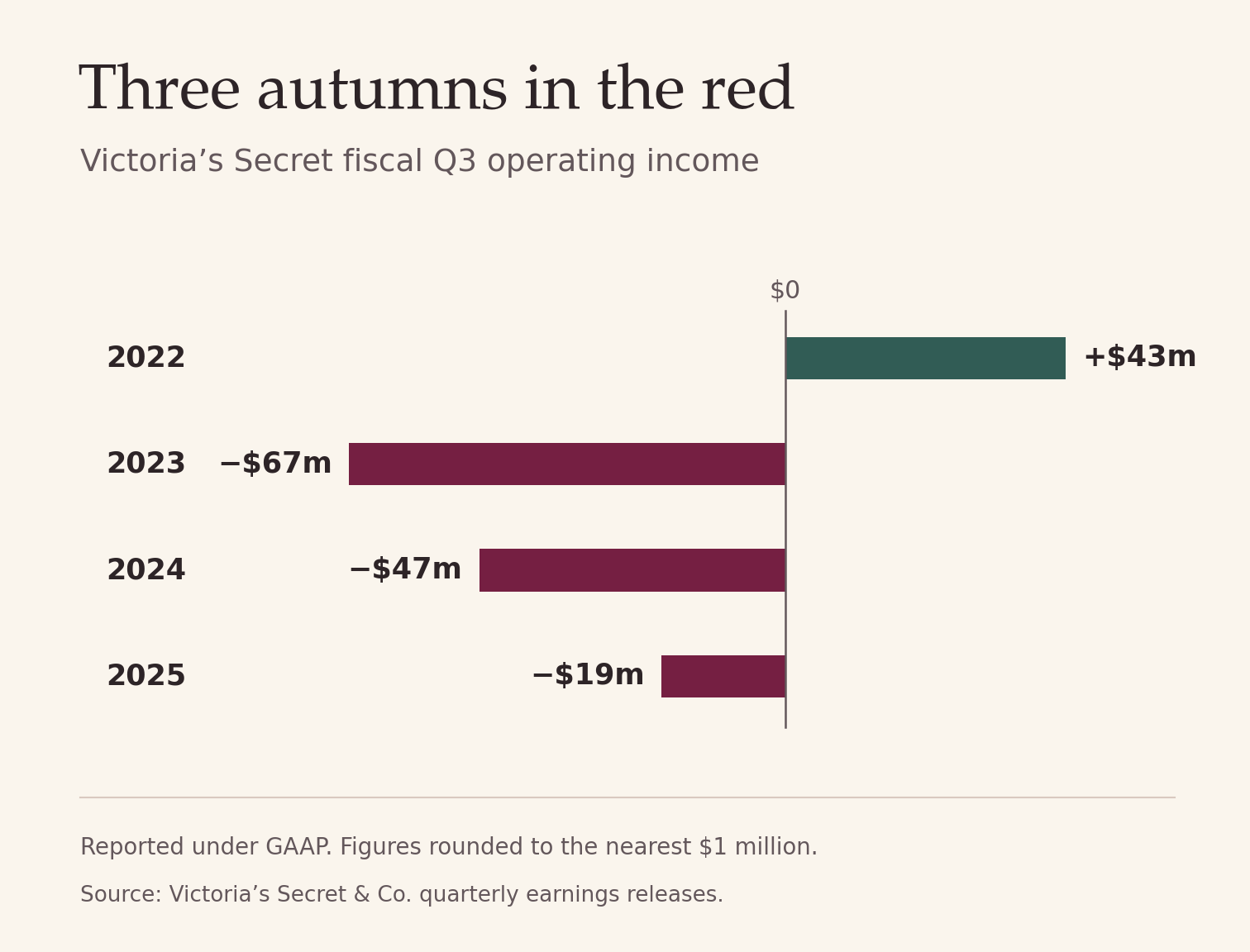
In fiscal Q3, Victoria’s Secret earned $43 million in 2022 and lost $67 million in 2023. Its losses narrowed to $47 million in 2024 and $19 million in 2025. Figures rounded to the nearest million.
The most revealing stretch in that chart is the one before the turnaround. Between the falls of 2024 and 2025, gross profit rose by almost $68 million. General, administrative and store operating expenses rose by about $40 million. Of that extra $68 million, roughly $28 million reached the operating-income line. The bills absorbed the rest. This is how a company can put together a good sales season, narrow its loss by more than half and still finish in the red.
It also gives a shareholder a decent way to read this year’s result. Take the increase in gross profit, subtract the increase in operating expenses, and compare what’s left with the $19.1 million the business needed to make up. That calculation works even if every upbeat adjective disappears from the earnings release.
What happened to the sale rack
In June, Victoria’s Secret learned one drawback of giving people fewer bargains. It had gone into its semiannual sale with less clearance merchandise. Shoppers took the early selection faster than management expected. As the sale wore on, there was less left for them to buy. Super acknowledged in September that the decision had cost the company sales in June. For anyone who has ever turned over the last three items on a sale table and found the same size three times, this part of the turnaround will sound familiar.
July offered a better use for that space. PINK introduced Marshmallow, a collection of four wireless bras priced from $29.95 to $49.95. Three pulled on over the head. The push-up kept a back closure. Those are small design decisions, but they give a shopper a reason to pick up a bra she doesn’t already own. Across Victoria’s Secret and PINK, the bra business grew by a mid-teens percentage that summer, according to Super.
The change showed up in the mix. Total units sold grew by a low-single-digit percentage in the second quarter. Units sold at regular price grew by a high-single-digit percentage. The average selling price per item also rose by a high-single-digit percentage. Meanwhile, in North American stores, shoppers bought fewer items per transaction and the share of visitors who bought anything was roughly flat. Online, the share who bought actually fell. Traffic increased in both channels. The stores could sell more overall while the person at the cash register carried fewer things, because more people came through the door and the average item rang up at a higher price.
Here’s what that was worth. On every $100 of summer sales, the company kept $38.80 in adjusted gross profit, up from $35.60 a year earlier. That extra $3.20 was available to help cover the costs of running the business. Management attributed about two-thirds of the gain to the merchandise itself, including fewer discounts. Higher sales also helped spread buying and occupancy costs over more dollars. August supplied an early check on whether the change could last. Super said business accelerated from a strong July, with Beauty picking up in particular. PINK Friday had also moved from the previous year’s second quarter into this year’s third. Some sales had changed which box they occupied on the calendar.
Last fall’s missing $19 million
A reader who remembers Victoria’s Secret breaking even last fall has an excellent memory. The company used that description in its earnings announcement. It was talking about adjusted operating income, rounded to the nearest million. The figure behind the zero was an $18,000 loss. On the consolidated income statement, the same thirteen weeks produced a loss of $19,072,000.
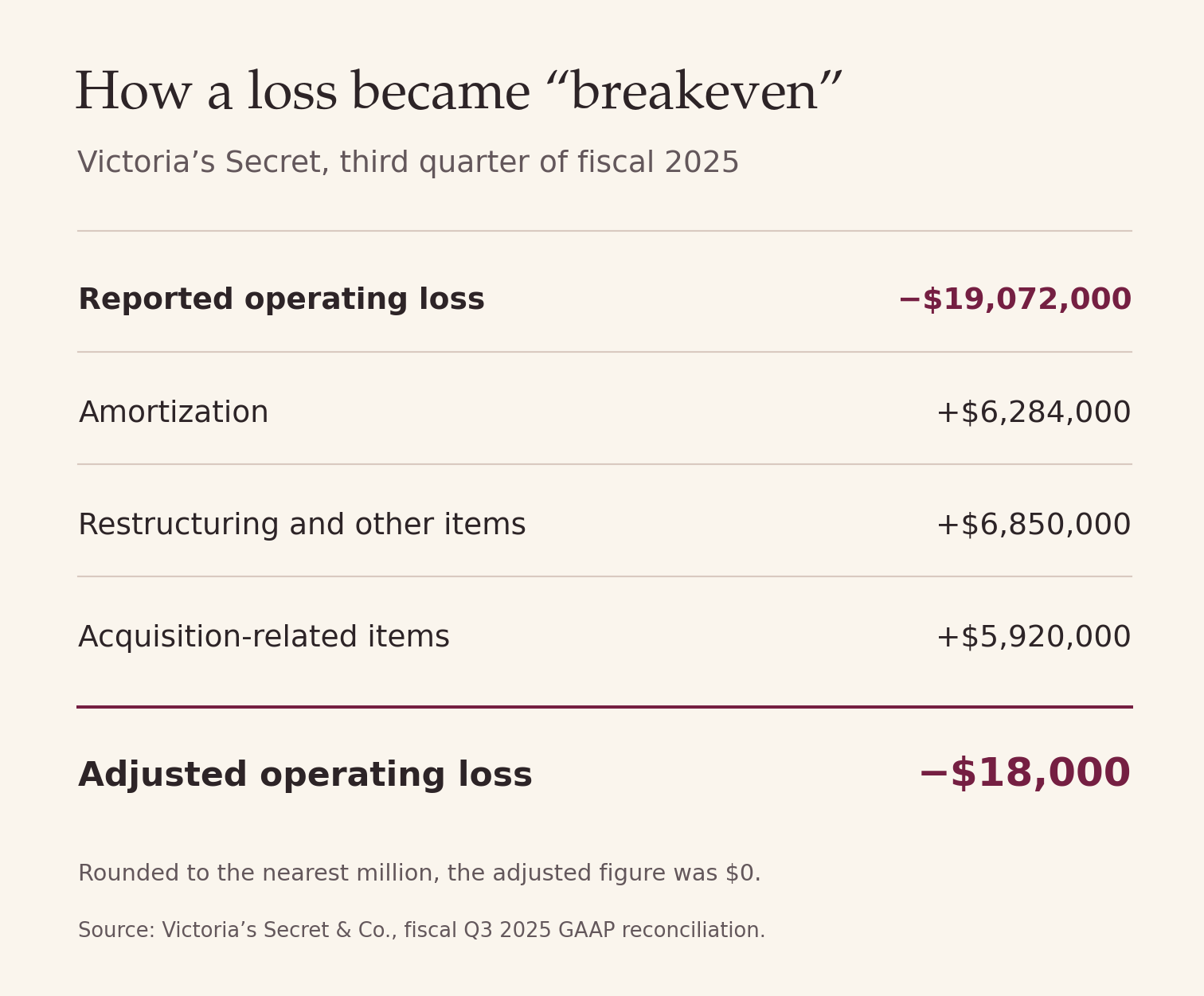
Victoria’s Secret added back $6.284 million of amortization, $6.850 million of restructuring and other items, and $5.920 million of acquisition-related items.
One entry deserves another look. When a company buys a business, some of what it pays can sit on its books as an asset and be charged to earnings over time. That scheduled charge is amortization. In the holiday quarter of 2025, Victoria’s Secret wrote down the value of assets in its Adore Me business by $120 million. In the first half of 2026, the comparable amortization adjustment that had amounted to $12.6 million a year earlier was zero. Part of the distance back to a reported profit could therefore disappear without anybody buying an extra bra.
Put the adjustment back into the autumn arithmetic. Suppose the $6.284 million amortization charge stayed gone and the other two costs returned at exactly last year’s amounts. Victoria’s Secret would need to improve adjusted operating income by just over $12.788 million to cross into a reported profit. Summer adjusted operating income had improved by about $69 million year over year. The adjusted figure already excludes approximately $136 million of summer operating income from tariff recoveries. The comparison still had a wrinkle. A systems outage had hurt operating earnings by an estimated $14 million in the prior summer. Even allowing for that distortion, the earlier improvement gives some scale to a $13 million hurdle. If the company supplies a new reconciliation, it will show which of those costs returned.
What did the runway earn?
On October 18, the fashion show drew 3.64 million simultaneous viewers at its peak across the livestreams tracked by Streams Charts, about a third more than the year before. A companion YouTube series followed aspiring models competing for a spot on the runway. Victoria’s Secret also sold items from the show through a dedicated collection. For a brand that wanted millions of people to look at the same merchandise at the same moment, the audience was a real achievement.
The viewer who watched for the music and closed the tab counted just as much toward that peak as the viewer who ordered a bra. The expense of putting on the show counted either way. In September, finance chief Scott Sekella said the company expected its fall selling, general and administrative expense rate to rise about one percentage point from the prior year’s adjusted rate. Marketing and higher expected incentive pay were among the reasons. At the midpoint of the fall sales outlook, one percentage point was nearly $16 million. Management’s entire operating-income outlook for the quarter was $10 million to $20 million. It had already allowed for those costs. The comparison shows how much an unexpected bill, or an unexpectedly good stretch of full-price selling, could matter.
Where to look in the earnings release
Open the consolidated income statement in the company’s quarterly results. Use the thirteen-week column. Look for operating income on that December 3 statement. Any amount above zero ends the three-year run of losses. An exact zero would leave the company waiting for its first profitable autumn since 2022. Keep a finger there before going down to earnings per share. Interest and taxes sit farther down the page. A modest operating profit and a loss for shareholders can both be true in the same quarter.
Then go back up to gross profit. Divide it by net sales and compare the result with last fall’s reported gross margin of about 36.4%. If the company also gives an adjusted result, use the reconciliation to see how much of the improvement remains on that basis. If more of each sales dollar survives the cost of the merchandise and the company reports stronger regular-price selling, the evidence for a change at the register gets stronger. If the reported improvement mostly tracks shrinking accounting charges, the four-year milestone still stands, but it tells a different story about the stores. One last comparison is worth making before giving the runway the credit. Much of the improvement in selling at full price was already visible in summer. The show was in October.
That’s why I’d keep the August box of body mist in mind when the next set of holiday figures arrives. PINK already knew how to get a former customer to remember what she wore in middle school. By the time she needs a second bottle, the relaunch will be old news. Whether she buys it at the price on the tag is a question worth more to Victoria’s Secret than the first day’s sellout.
Thanks for reading.
Follow @GripRoom on X (Twitter) for tomorrow’s news, today.