A dispatch from the future, published 11 days before the forecast deadline. What is Future News?
GameStop more than doubled the $41.3 million it earned from operations a year ago, clearing $82.6 million for the quarter that ended on Halloween. Black Friday belongs to the next set of books. So does every console a parent buys in December after extracting a solemn promise that it would count as both Christmas and a birthday.
For someone who owns GameStop shares, the useful part of that news is the word operating. By August the company owned nearly $5 billion of eBay stock. A good week for that investment could flatter GameStop’s earnings without a single extra customer walking into a store. This result answers the question you could ask from the other side of the glass counter. Once GameStop had paid for the goods, the people who sold them and the places where they worked, how much money was left?
The clue had been sitting in the summer earnings release since September. GameStop had recorded $182 million less in sales than it had a summer earlier. Somehow it had come away with $62 million more gross profit. A person looking only at the sales figure would have taken away almost exactly the wrong impression.
What can you buy at GameStop without taking anything home?
In April, GameStop opened Power Packs to the public. For $25 a collector could open a digital pack and find out which real, graded card it contained. The expensive packs went up to $2,500. At either end of the price list the buyer had three choices. Have the card shipped, leave it in the PSA Vault, or sell it back. A customer could buy a Pokémon card, own it briefly and dispose of it without ever finding out how it looked under the living-room lights.
There’s a surprisingly old-fashioned business underneath that arrangement. A buyer who has never handled a card wants to know whether it is genuine and what condition it is in. A seller wants the next buyer to accept the same answer. A grade from Professional Sports Authenticator gives the two of them something to agree on before they start arguing about the price. The vault means a change of ownership needn’t occasion a trip to the post office.
GameStop already had a role in the physical version of that transaction. In October 2024 it became an authorized PSA dealer. A collector could bring a card to a participating U.S. store and submit it for authentication and grading. That was a reason to visit a GameStop even for somebody who had no intention of buying a video game. Two years later, when management described the collectibles business in its filings, it counted the fees it earned for facilitating those submissions alongside sales of merchandise.
That detail matters when somebody tries to calculate what GameStop made by watching expensive cards change hands. A customer submitting a thousand-dollar card for grading has not bought a thousand dollars’ worth of anything from GameStop. The retailer earns a fee for arranging the service. Similarly, the price on a celebrated Power Packs pull tells you something about the collector’s afternoon. You still need the accounts to find out what kind of afternoon the retailer had.
Those accounts also put a limit on how much credit any one craze deserves. GameStop’s collectibles category includes trading cards, toys, apparel, figures and other merchandise. Management disclosed $356.3 million of summer collectibles sales. An exact Pokémon contribution, or an exact Power Packs profit, would be a fascinating figure to have. The category total doesn’t supply either one.
The summer when sales went backward
A new console is an excellent thing to have in a shop window. It brings people in, sells for hundreds of dollars and looks impressive on a receipt. For GameStop, new hardware also carries some of the thinnest margins in the store. The launch of Nintendo’s Switch 2 had lifted hardware sales in the summer of 2025. A year later, anyone comparing the two summers had to reckon with what was actually in the shopping bags.
In the earlier summer, video games accounted for just over half of GameStop’s sales under its revised product categories. Collectibles accounted for a little under a quarter. By the summer of 2026 the game category was down to a third and collectibles were up to 45 cents out of every sales dollar. That is a substantial change in the economics of a shop even if the old sign stays over the door.
Here is how it worked out for a shareholder. In the earlier quarter, $972.2 million of sales yielded $283.1 million after the cost of those sales. In the later one, $790.2 million yielded $345 million. On a hundred dollars of sales, GameStop went from keeping about $29 to keeping nearly $44 before its operating expenses. The $15 difference was large enough to overcome an almost one-fifth decline in sales. Management identified the change in what customers bought as the main reason gross margin rose.
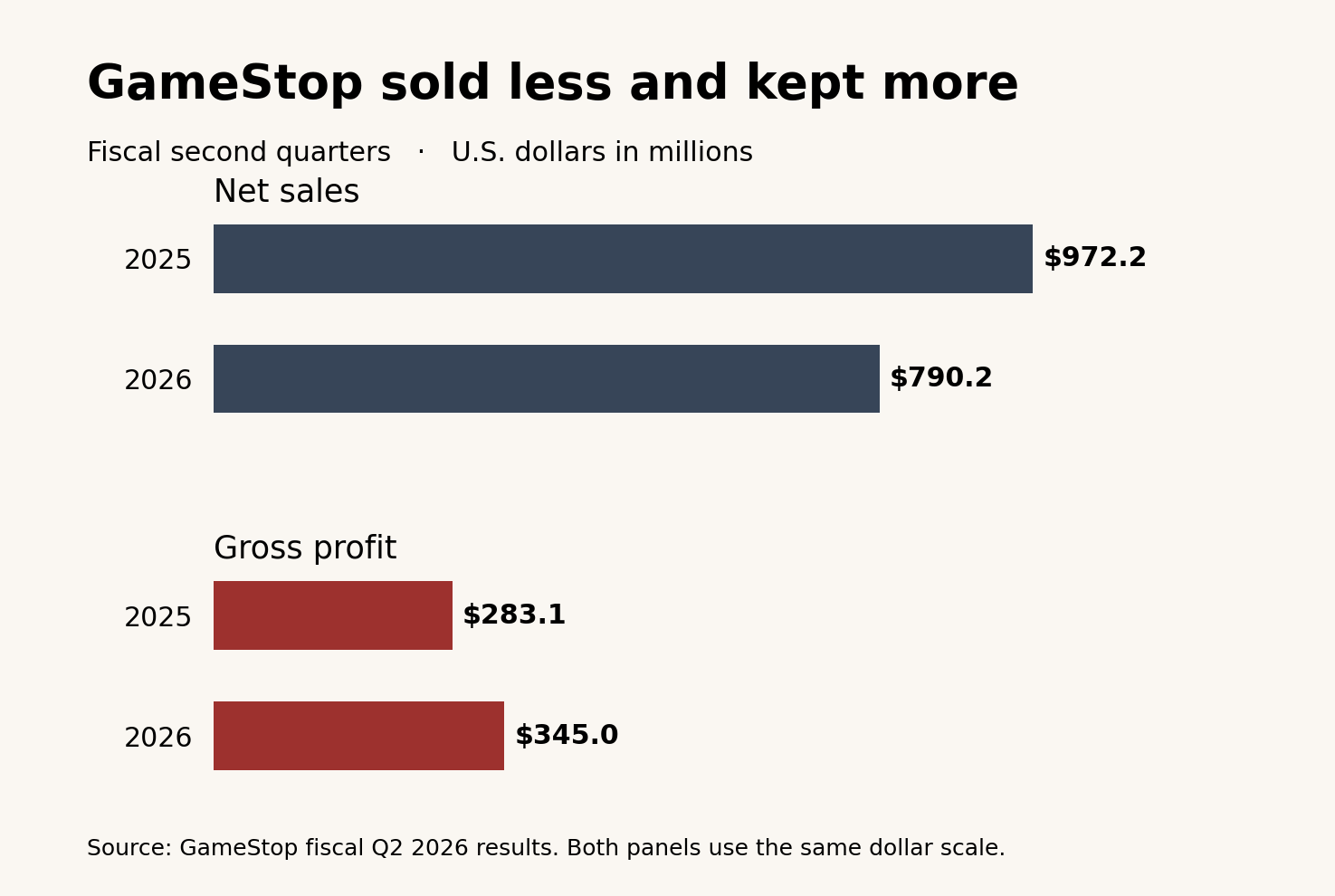
There was a second improvement on the other side of the ledger. Quarterly selling, general and administrative expenses fell from $218.8 million to $187.1 million. In its explanation of the decline, GameStop attributed $18.5 million of savings to store rent and occupancy costs after closures and international divestitures. It also cited lower spending on labor, consulting and professional services. A change in the product mix helped explain what was left at the register. Fewer leases helped explain how much of it made it through the month.
The $94 million that went out the door in France
Suppose you wanted to know how well the remaining stores had to perform to double last autumn’s profit. You might reasonably begin with the $821 million in sales GameStop reported in that quarter. The trouble with that starting point is a column labeled Europe. It belonged to a business GameStop no longer owned.
GameStop’s old segment accounts show $93.8 million in European sales and $27 million in gross profit for the quarter. The operation ran up $30.2 million in selling and administrative expenses. Even before an asset write-down, it had spent $3.2 million more than it made. The write-down added another $8 million and took the reported European operating loss to $11.2 million.
GameStop sold its remaining French operation in the second quarter of 2026. Come autumn, the company had nearly $94 million of last year’s sales to explain away before anyone could tell how the U.S. and Australian businesses were doing. On the earnings side, the sale made the year-over-year comparison easier. It would still be generous to credit management with saving $11.2 million every autumn in perpetuity. Eight million of that was an accounting charge taken in a particular quarter. A write-down is quite different from a landlord who expects another check on the first.
The cleaner comparison starts with the other two columns. A year earlier the U.S. had earned $56 million at the operating level and Australia had lost $3.5 million. Between them, the businesses GameStop kept had made $52.5 million on sales of $727.2 million. From there, an improvement of just over $30 million would get them past twice the old consolidated profit. That was a meaningful improvement to ask for. It was considerably less mysterious than asking a shrinking chain to conjure a second copy of its earnings out of thin air.
How much did the eBay shares earn the stores?
On paper, a modest move in eBay could produce a number as big as a quarter of GameStop retail earnings. GameStop reported owning approximately 43.4 million eBay shares as of August 1. With that many shares, a one-dollar move in eBay’s price changes the value of the stake by about $43.4 million, assuming the holding stays the same. For perspective, the entire operating profit GameStop had to show for the autumn of 2025 was $41.3 million.
A shareholder looking at the summer filing can see where the two stories part company. First comes the $160.2 million of operating income. Farther down come interest income and the gains associated with the eBay investment, including a $72.1 million unrealized gain on the shares. The distinction is useful on a bad day for eBay, too. The market can mark down what GameStop owns while customers and stores carry on doing precisely what they did the day before.
This is why a doubling still leaves room for a perfectly good argument among GME holders. Someone measuring the retail turnaround against last autumn has a result worth celebrating. Someone who read a November preview that put operating profit near $167 million came to the same earnings report with a much higher figure in mind. Neither reader needs a theory about short sellers to explain why they might disagree. They brought different numbers to the meeting.
The next comparison worth keeping is the one the holiday quarter will give them. A rush of console buyers can be good business and still bring down the percentage GameStop keeps on each dollar. A strong run of cards can lift that percentage even if the sales line looks ordinary. When the holiday numbers arrive in GameStop’s results, put gross profit in dollars beside the margin percentage before deciding which sort of Christmas the company had. A lower percentage of a much bigger till can pay a surprising number of bills.
For now, the October quarter has settled something narrower and more interesting than whether people still buy things at GameStop. The chain could more than double its operating profit before the biggest shopping weekend of the year. To understand how that became possible, start with what a customer could carry home for several hundred dollars. Then consider what GameStop could earn from a customer who left a single card in a vault.
Thanks for reading.
Follow @GripRoom on X (Twitter) for tomorrow’s news, today.