A dispatch from the future, published 4 days before the predicted result. What is Future News?
American Eagle Outfitters reported Wednesday that comparable sales at Aerie, including its OFFLINE activewear line, rose at least 10% from a year earlier. It’s the fifth straight quarter of double-digit growth for a brand that spent part of the summer teaching Americans how to wear their pajamas out for coffee.
Aerie had one advantage over the summer that it lost this fall. Its 19% summer gain came against a year when comparable sales had barely budged. This fall it had to beat the autumn when the streak began. Give each season its own $100 starting point two years back, and even a 10% gain this fall would bring Aerie within 47 cents of the summer’s two-year gain.
A second life for a pajama shirt
Consider the styling instructions for OVERSLEPT, Aerie’s sleepwear line. Wear the matching set to bed. In the morning, put on sneakers and take it out for coffee. Another day, wear the button-up with a mini skirt, or pull on the pajama bottoms with a fitted tank. Aerie was making a pitch for a share of the daytime wardrobe, one half of a pajama set at a time.
Jen Foyle, who oversees both American Eagle and Aerie, had a merchant’s reason to care whether anyone took that advice. Someone buying a bra might already own all the bras she needs for a while. Give her a reason to come back for a shirt, a pair of leggings or a fleece and the store gets more chances at her clothing budget. In September, Foyle described shoppers putting outfits together across categories. She could point to sales of tees and tanks, sports bras at OFFLINE and a new Float bra that Aerie introduced in July. The product that started the relationship could be quite different from the one that brought somebody back.
There was evidence at the register. In the quarter ended August 1, Aerie recorded more transactions and a low-double-digit increase in the average price paid per item. A higher average can come from a different mix of clothes in the basket. A shopper trading a tank for a sweatshirt can lift it even if both price tags stay exactly where they were. The rise in transactions meant customers were also making more trips to the register, physical or digital.
The question Kelly Crago asked after Labor Day
The most revealing moment on American Eagle’s September 9 earnings call came when BMO analyst Kelly Crago asked executives how the two brands were actually doing so far that quarter. The company’s written outlook had given investors a single growth range for the group. That left plenty of room to be wrong about what was happening in either store.
Mike Mathias, who presented the outlook that day, told Crago that American Eagle was running roughly flat. At Aerie, comparable sales were already growing in the high teens to around 20%, the range management expected for the full quarter. Labor Day had passed. By then the company could see most of the back-to-school rush, including purchases that had shifted between weeks. Mathias also described more traffic in stores and online, more items per transaction and higher order values. Aerie was drawing more people in, and those who bought something were leaving with fuller bags.
Foyle reckoned there were eight weeks left. To see what those weeks could change, suppose the opening five weeks of a 13-week quarter grew 19% and each week had accounted for an equal share of the previous year’s sales. Growth of about 4.4% over the last eight weeks would still get the whole quarter to 10%. Back-to-school Saturdays can carry more weight than ordinary October afternoons, and AEO never supplied the weekly dollars. But the exercise shows how much room there was between keeping the streak and delivering everything management had in mind.
October gave skeptics a fair argument. A year earlier, Aerie had promised to keep AI-generated people out of its ads. By October 21, Metricool had identified the announcement as Aerie’s most-liked Instagram post in a year. The following March, when Pamela Anderson starred in the campaign, marketing chief Stacey McCormick told Vogue that brand awareness had risen, while acknowledging the company hadn’t tested the message separately from the extra publicity. There’s no dollar value you can put on those likes from the evidence Aerie shared. What the timing tells you is that last autumn’s burst of attention still lay ahead in the comparison when Mathias spoke in September.
How 10% gets within 47 cents of 19%
Aerie’s streak began with an 11% increase in fall 2025. It reached 23% over the holidays, then 25% in the spring and 19% in the summer. Foyle had a phrase for the task this left her merchants. They had to “comp the comp”. Here’s what that took in dollars.
Start with $100 in comparable sales in summer 2024. Aerie’s 3% summer gain in 2025 brings that to $103. The following summer’s 19% takes it to $122.57. Now start over with $100 in fall 2024. The first autumn’s 11% takes it to $111. Another 10% gets it to $122.10. That’s the 47 cents. Repeat the summer’s 19% on top of last fall’s 11% and you get $132.09. Anyone asking Aerie to grow at the same rate again was asking for a considerably better two years.
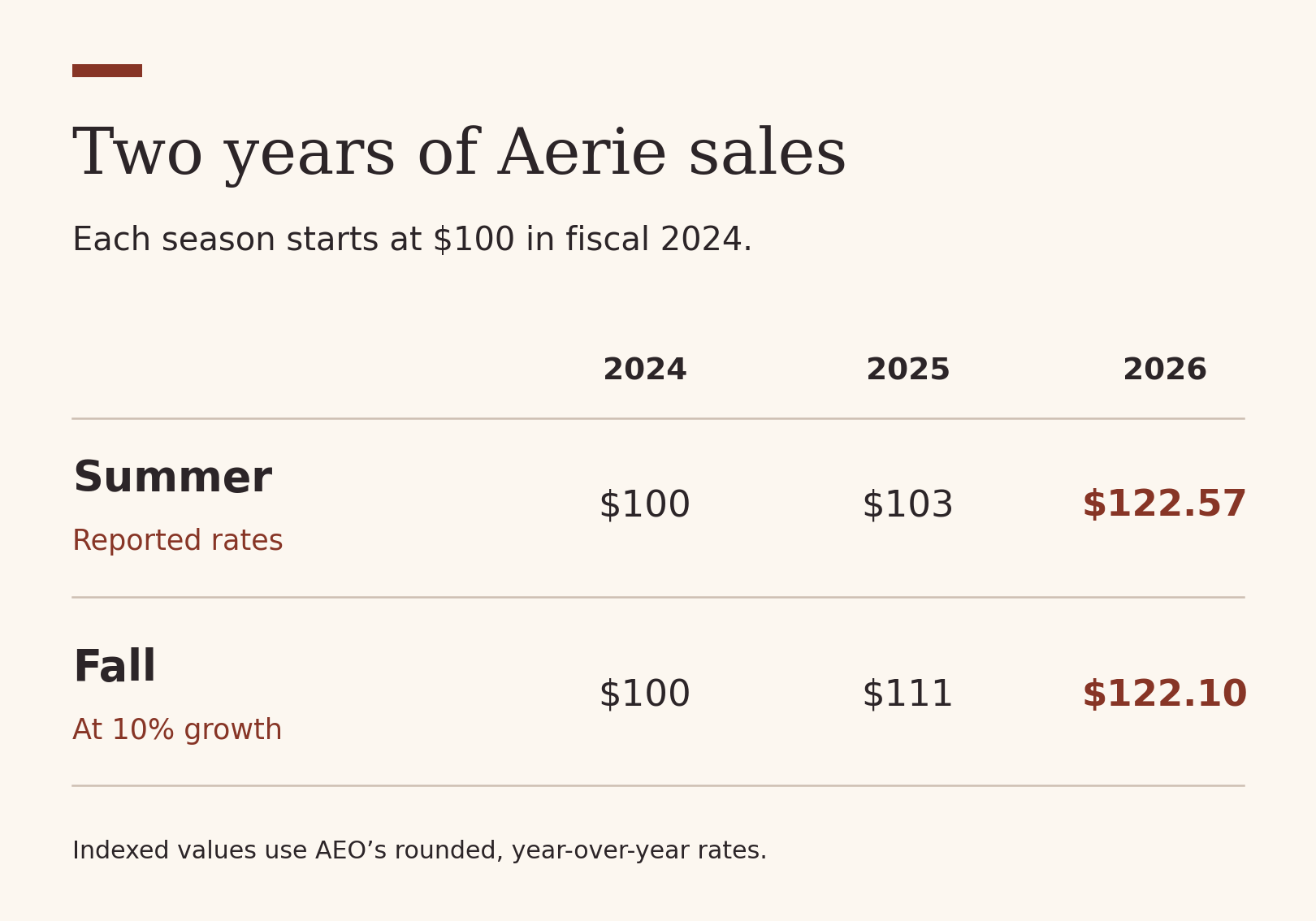
Summer’s reported rates turn $100 into $122.57. At exactly 10% growth this fall, the equivalent would be $122.10. Each season starts from its own base of $100
These are illustrations built from rounded company figures. The actual sales dollars differ by season, and the stores eligible for comparison change over time. Under AEO’s counting rules, a store ordinarily joins the calculation in its thirteenth month. The brand figure also includes its direct online business. A new Aerie shop can have a terrific first Saturday and lift revenue that day. The shop has to celebrate its first birthday before its sales count toward the streak.
American Eagle’s other name on the door
By spring, Aerie had passed $2 billion in sales over twelve months. The more telling figure came a quarter later. In the summer, Aerie added $106.7 million in revenue over the year before. American Eagle Outfitters, the entire company, added $96.7 million. The American Eagle brand itself posted a small revenue gain. A drop in revenue from other businesses offset part of Aerie’s gain. For anyone who still thought of Aerie as the little shop next to the jeans store, the little shop had supplied more than the parent company’s entire dollar increase.
Consider the view from another mall storefront. Hollister put up 11% net sales growth this fall, a number that could easily pass for the same achievement. Its comparable sales rose 5%. Both figures belong to a successful quarter at Hollister. Only the second one answers the question that matters to Aerie’s streak. In AEO’s December 2 results materials, it’s the Aerie brand comparable-sales line that counts. A 9% gain there would have ended the run even if total Aerie revenue had risen twice as fast.
The holiday quarter gives Foyle a tougher assignment again. Last holiday’s 23% increase means that for every $100 Aerie sold two holiday seasons ago, it has $123 to beat this time. Can Aerie get the customer who bought the pajama shirt back through the door for something to wear with it? For a company with $123 to beat, it’s worth suggesting shoes to wear to coffee.
Thanks for reading.
Follow @GripRoom on X (Twitter) for tomorrow’s news, today.