A dispatch from the future, published 122 days before the forecast deadline. What is Future News?
In late October, someone shopping for Starlink’s top residential plan in Marysville, Kansas, could get it for $104 a month. In Rolla, Missouri, the same plan was listed at $156. That $52 difference disappears in the year-end tally. SpaceX reported at least 15 million Starlink consumer broadband subscriptions worldwide as of December 31, 2026. A line in either town counts as one. Hold 15 million lines for a full month, and an average of $66.67 per line brings in $1 billion in service revenue.
A year earlier, SpaceX had 8.9 million. In twelve months it added at least 6.1 million net subscriptions, more than the entire 4.4 million it had at the end of 2024. At that scale, a single dollar either way on the average monthly service bill is worth $15 million over a full month. The business has reached a size where the price on a Missouri order page deserves some of the attention usually reserved for a rocket launch.
What a Starlink subscription buys
Picture a family with a dish at home and a separate Roam plan for the camper. SpaceX counts two subscriptions. A family of five sharing one home connection counts once. A small business buying a standard priority plan can also appear in the consumer total. An entire planeload of passengers using Wi-Fi under a managed airline contract adds zero. SpaceX spells out what counts as a service line in its quarterly filing. To check the milestone, look for the December 31 figure under “Starlink consumer subscribers” in SpaceX’s official results through March 31, 2027. Without a comparable worldwide tally of at least 15 million by that date, a count of people who have opened a laptop on Starlink can’t settle it.
There was a good clue to the December number in the September earnings release. SpaceX had gone from 12 million subscriptions at the end of June to 13.6 million at the end of September. It needed another 1.4 million to reach 15 million. That left room for quarterly additions to fall by about 200,000 from the summer pace and still produce the headline. A repeat of the roughly 300,000 drop in quarterly additions that followed the 2025 holiday quarter would have left it at 14.9 million. Both the milestone and a narrow miss were within an ordinary quarter’s reach.
There’s an oddity here for anyone accustomed to judging a growth company by its percentage growth. Going from 4.4 million to 8.9 million meant a little more than doubling. Going from 8.9 million to 15 million works out to about 69%. Yet even at the minimum year-end figure, SpaceX added roughly 1.6 million more lines in 2026 than it did in 2025. That difference alone is the size of the entire summer quarter’s gain.
What a ZIP code is worth to SpaceX
An internet provider running fiber down a street knows where the next customer will use the connection. SpaceX’s satellites keep moving. Its customers generally want to watch the game or join a video call from one particular address. Spare bandwidth over a lightly served area is of limited help to a customer trying to get online in a crowded one. A national price leaves SpaceX charging the same amount in both places. Local prices give it a way to sell capacity where there’s room and ask more where capacity is dear.
The October offers in Kansas and Missouri show how far apart those prices could get. Rolla’s quote for Residential Max was 50% above Marysville’s. For a household that kept service for a year at those quoted rates, the difference would come to $624. It’s easy to see how Starlink could look like a bargain to one family and an expensive fallback to another, even before either family plugged in the dish.
In the United States, many of the people buying Starlink already had a working internet connection. When Ookla traced the previous connections of people switching to Starlink, about nine in ten of the switchers it could identify came from outside fiber, including cable, DSL and fixed wireless. Its sample required evidence of a previous connection. A person getting home internet for the first time could never show up as a switcher in that analysis. What the study does establish is a market well beyond the last house at the end of the road. SpaceX can win a customer who has perfectly good reasons to want a second choice.
Brazil offers a look at what that competition can do to a market. In Anatel figures compiled by Teleco, Starlink went from roughly 836,000 Brazilian fixed satellite connections in June to 994,000 in September. Starlink added about 158,000 connections while Brazil’s entire fixed satellite market grew by 129,000. Other satellite operators together finished about 29,000 connections smaller.
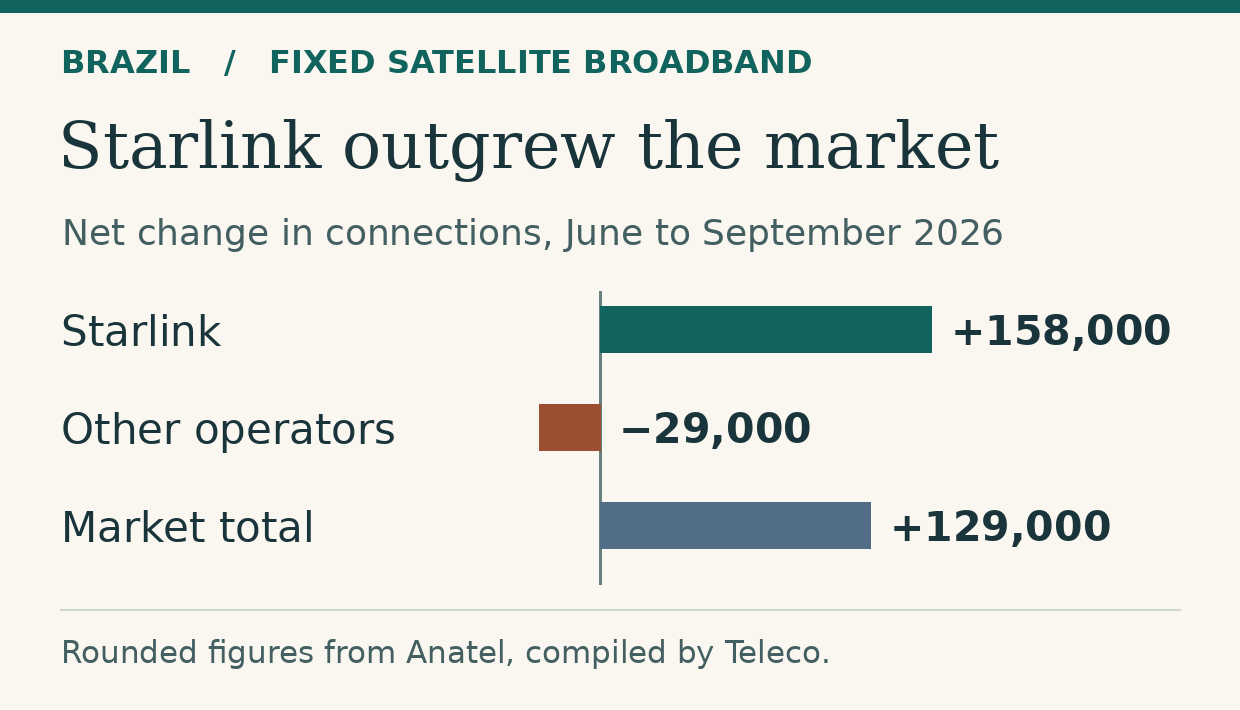
Rounded net changes in Brazilian fixed satellite broadband connections. Source data from Anatel via Teleco.
Those totals leave room for several stories about individual Brazilians. An old satellite customer could move to fiber while someone else buys Starlink for a first connection. The aggregate figures would look much the same as a direct switch. What the regulator’s numbers let us say with confidence is interesting enough. A market of just over a million connections found room for 129,000 more in a quarter, and Starlink gained share while it grew.
The price of a billion-dollar month
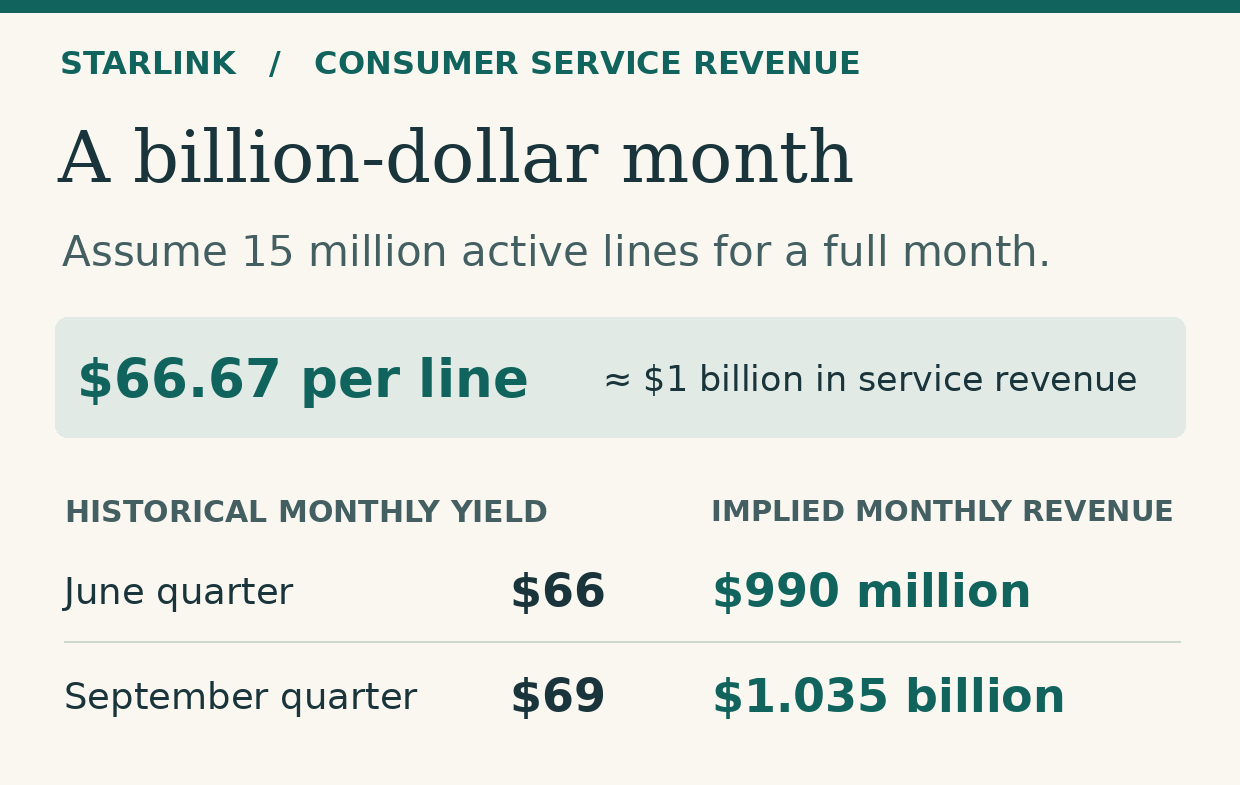
At 15 million lines active for an entire month, Starlink needs average monthly service revenue of about $66.67 per line to bring in $1 billion from consumer service. SpaceX has already done business on both sides of that price. It reported $66 per line in the June quarter and $69 in the September quarter. At 15 million lines for a full month, those yields would produce $990 million and $1.035 billion, respectively.
There’s a good reason to resist penciling a billion dollars into the December books on the strength of the year-end total. A customer who activated a line on New Year’s Eve gets the same place in the December 31 count as a customer who joined on October 1. Only one of them could have paid for service throughout the quarter. SpaceX calculates revenue per line using the average subscriber base over the period. And when a customer buys a kit, SpaceX generally books that sale on delivery. The consumer revenue figure in the accounts includes equipment as well as service. To see whether Starlink can sustain a billion-dollar service month, the timing, the monthly yield and the distinction between a bill and a box all matter.
Now consider what SpaceX offered over Black Friday. Eligible new residential customers in twelve countries, including the United States, Canada and Brazil, could get their first six months of service at half price. The discount applied to service. The offer called for standard pricing after six months. A household that stayed through December counted in full even if every service bill it had received was half price.
If that offer filled spare capacity with customers who stayed, then SpaceX got paid for bandwidth it might otherwise have left idle and acquired a future stream of full-price bills. If someone already had a dish in their shopping cart and was simply waiting for payday, the same offer might have handed six months of savings to a customer SpaceX was about to win anyway. Both buyers look identical in the December count. The real difference between them is what it cost SpaceX to win business it wouldn’t otherwise have had.
The airplane that counts as zero
Some of the best news for people following SpaceX came from a business that contributed nothing to the 15 million. Between the September quarters of 2025 and 2026, Starlink’s consumer revenue rose from $1.986 billion to $3.121 billion, a gain of $1.135 billion. Over the same period, enterprise and government revenue rose by $1.016 billion, chiefly because more aircraft entered service. Those contracts supplied about 47 cents of every extra dollar of connectivity revenue. It came within $119 million of matching the consumer business’s entire year-over-year gain.
This helps explain a pair of numbers that can look like a misprint. Average consumer service revenue per line fell from $83 to $69 year over year in the September quarter. Meanwhile, the connectivity segment’s operating margin climbed from 38.4% to 45.1%. One number describes the monthly service revenue from an average consumer line. The other captures the economics of the larger business, including all those airline and government contracts. SpaceX can sell a less expensive home plan and still earn a higher margin across the network. It doesn’t disclose enough here to tell us the profit on the dish in Marysville.
That dish also came with costs someone had to pay. In the September quarter, SpaceX said higher kit volumes added $222 million to its cost of revenue compared with the prior year. Depreciation added another $160 million, largely tied to satellite and launch costs. Even when SpaceX flies its own satellites on its own rockets, the cost of getting them to orbit works its way through the accounts. The financial advantage of filling spare bandwidth is greatest when the next paying customer can use equipment SpaceX already has in the sky.
The December total settles how large the consumer business has become. To judge what that size is worth, keep the $66.67 figure handy when SpaceX next reports its monthly revenue per line. Then give the holiday customers time to receive a seventh bill. By then, the family that got six months at half price will have learned how the dish handles a busy evening, whether anyone misses the old provider and exactly what Starlink wants to charge at that address. Fifteen million tells you how many lines SpaceX carried into the new year. The family’s decision when that bill arrives will tell you something about how many it gets to keep.
Thanks for reading.
Follow @GripRoom on X (Twitter) for tomorrow’s news, today.