A dispatch from the future, published 33 days before the forecast deadline. What is Future News?
AMC Entertainment broke the pre-pandemic revenue record of $5.471 billion it set in 2019. The comeback was visible months before the annual results. By September, AMC had already taken in $330 million more than in the same nine months of 2019, with 70 million fewer visits. Food and drink accounted for seven of every ten dollars of that gain.
By 2026 the crowds were coming back, too. In the first nine months, AMC recorded 30.7 million more visits than a year earlier. And each visit was doing more for the business. AMC’s worldwide gross profit per patron rose from $1.10 to $3.40 over the same period. For a theater operator, those are two good things to have happen at once.
The extra $7.21 in a trip to AMC
AMC counted 263.9 million visits through September 2019. In the corresponding stretch of 2026 it counted 193.8 million. Some of that decline is easy to picture. The chain averaged 1,429 fewer screens. That still leaves a puzzle. Visits per average screen fell about 15%, while revenue per average screen rose about 25%, from $377,000 to $471,000. Even allowing for the smaller circuit, a screen with fewer customers was doing considerably more business. These are chain-wide averages across a changing collection of theaters.
Put the two September income statements side by side and the extra $330 million is easy to account for. Ticket sales were actually $29.3 million lower. Food and drink brought in $231.5 million more, about seven dollars of every ten in the net increase. The remaining business, which includes booking fees and advertising, added $127.7 million. Add the two gains, subtract the decline at the box office, and the result is exactly the $329.9 million difference between AMC’s 2019 and 2026 accounts.
There’s another way to put a price on those empty seats. Give each missing visit its 2019 value of $15.25 in company revenue. Losing 70 million of them would have cost AMC about $1.07 billion. But revenue for each visit the chain did get had risen to $22.46. Spread the extra $7.21 over nearly 194 million visits and it comes to $1.40 billion. That was enough to cover the billion-dollar hole with room to spare. The figure includes what advertisers paid to reach the audience, so a family looking at its receipt would see only part of it.
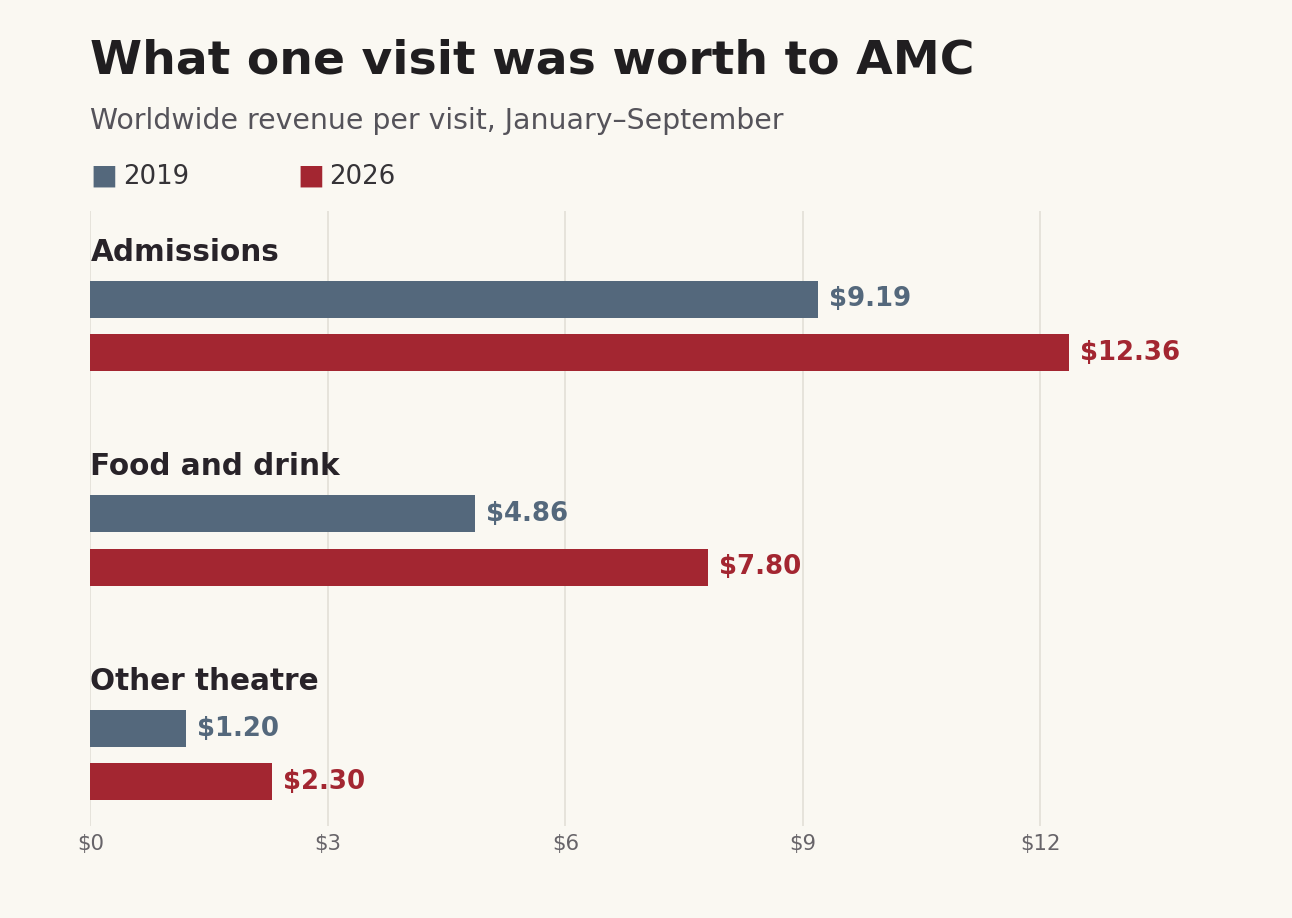
GripRoom calculations from AMC’s 2019 operating figures and 2026 revenue breakdown. Both periods run from January through September.
A popcorn bucket with teeth
In 2024, AMC sold a Dune: Part Two popcorn bucket shaped like a sandworm. Reaching in for a handful meant putting your fingers into its mouth. It cost $24.99 before tax. Nels Storm, then AMC’s vice president of food and beverage strategy, explained the timing to NPR. The idea was to sell through the supply on opening weekend. By the time the next film arrived, the concession stand needed room for somebody else’s souvenir.
The sandworm was the version that made the news. The less photogenic detail is in the fine print of the 2026 filing. For the first nine months, AMC said U.S. food and drink revenue per visit rose from $8.53 to $8.79 compared with the year before. Guests who made a purchase bought fewer items per transaction. Higher prices still lifted the average. The people carrying two drinks back to their seats could spend more even if they left the candy behind.
To see why a trip to the counter matters so much, follow a dollar through the theater. AMC generally owes the distributor a share of admissions. Through September, it had about 51 cents left from each ticket dollar after film exhibition costs. A food-and-drink dollar left 81 cents after product costs. Both helped pay for the crew, the building and everything else it takes to run a multiplex.
In dollars, the tickets left $1.223 billion and the counter left $1.232 billion. That gave concessions a $9 million lead despite ringing up $882 million less in sales. In the same nine months of 2019, ticket sales had led by $83.5 million after those costs. The busiest cash register was still the one selling tickets. The one selling drinks and popcorn had earned just as important a place in the business.
AMC went into Christmas with room to spare
By Thanksgiving, anyone with AMC’s filings could put a number on what the holidays had to deliver. Subtract the $4.3532 billion already booked from the old record. The last three months had to bring in more than $1.1178 billion. AMC had earned $1.2883 billion the previous holiday quarter. Christmas business could fall 13% and the chain would still finish about $3 million ahead. A 14% decline would leave it nearly $10 million short.
There was a perfectly respectable holiday season on the wrong side of that line. In late 2023, AMC had Taylor Swift’s The Eras Tour and Beyoncé’s Renaissance, with the chain itself distributing both concert films. Repeating that quarter’s $1.1044 billion would have missed the record by $13.4 million. Thanksgiving 2026 gave skeptics something more recent to go on. On the Saturday of the holiday weekend, the five-day domestic box office was tracking around $224 million, well below the previous year’s $290 million.
But a holiday weekend makes a poor stand-in for three months of business across two continents. October ticket sales in the U.S. and Canada were already about $167 million ahead of October 2025. Across the Atlantic, October box office in the UK and Ireland rose 35%. That mattered to a chain whose international theaters had supplied nearly a quarter of revenue through September. Watching the American Thanksgiving numbers alone meant overlooking a good October twice.
The calendar also put a limit on what the two big Christmas films could do. AMC had Avengers: Doomsday and Dune: Part Three scheduled for December 18. That allowed fourteen calendar days of ticket sales before the books closed. Even the AMC gift card under the tree had its own clock. AMC defers revenue on gift cards, generally recognizing it when the customer redeems the card, with separate rules for balances that go unused. Buy one in December and use it for a January matinee, and the cash and the movie can belong to different years.
What a record dollar buys
The 2019 record was measured in the dollars of 2019. By October 2026, U.S. consumer prices were about 31% above their October 2019 level. On that rough purchasing-power comparison, matching what $5.471 billion bought back then would take about $7.18 billion. An American household price index can only approximate the change for a company that also sells tickets in pounds and euros. The annual record measures the dollars AMC booked worldwide.
The $534 million swing in cash flow
For shareholders, the most encouraging number in the November earnings release was down in the cash-flow table. In the first nine months of 2025, AMC reported negative free cash flow of $409.2 million. A year later it reported positive free cash flow of $124.7 million on its own measure. That’s a $533.9 million swing. Capital spending over those periods was $162.7 million and $158.8 million, respectively. Cutting investment by $3.9 million explains very little of a half-billion-dollar improvement.
Debt still took a bite. AMC incurred $405.9 million of interest expense and a $19.2 million net loss in the first nine months of 2026. Yet by November it had put together two consecutive quarters of record revenue and adjusted EBITDA. The nine-month free cash flow figure gave shareholders a second way to check how much progress was reaching the business.
Go back to those 30.7 million extra visits. By the time people started coming back in those numbers, AMC was taking in $7.80 in food and drink for every person who walked through the door, up from $4.86 in the comparable stretch of 2019. That average includes the people who walked straight past the popcorn. The next time a family of four came through the doors, the lobby was worth almost $12 more to AMC at those averages, before anyone settled into a seat.
Thanks for reading.
Follow @GripRoom on X (Twitter) for tomorrow’s news, today.