A dispatch from the future. What is Future News? Written November 28, 2026, three days before NIO’s scheduled earnings report.
NIO’s third-quarter revenue rose more than 50% from a year earlier. The Chinese electric-car maker had already counted the cars. It delivered 109,178 of them, up 25.4%. For a clue to how sales grew roughly twice as fast, consider one of the customers in that count.
On September 23 in Suzhou, NIO founder William Li handed over the 30,000th ES9 to He Yinjun, chairman of the imaging software company Insnex. It had taken less than four months to find that many buyers for an electric SUV whose entry version, battery included, started at 498,000 yuan. In the monthly delivery bulletin, He’s purchase counted for exactly as much as someone taking home a little firefly hatchback. In the accounts, those two customers could be worth very different sums.
Here’s how much changed in a single summer. From the second quarter to the third, NIO delivered 1,520 more vehicles in total and 8,797 more ES9s. Both numbers can be true because deliveries of everything else, taken together, fell by 7,277. A glance at the group total would have missed a substantial change in what people were buying.
A different NIO in the driveway
A year earlier, ONVO, NIO’s family-car brand, had narrowly outsold the premium brand that carries the company’s name. Over July, August and September 2025, ONVO delivered 37,656 vehicles to the premium brand’s 36,928. The small-car brand firefly contributed another 12,487. NIO disclosed all three in its third-quarter filing for 2025.
One year later, the premium brand delivered 62,500 vehicles. ONVO fell to 27,728. Firefly grew to 18,950. Add the July, August and September figures and the premium brand alone gained 25,572 deliveries. Across the entire company, the gain was 22,107.
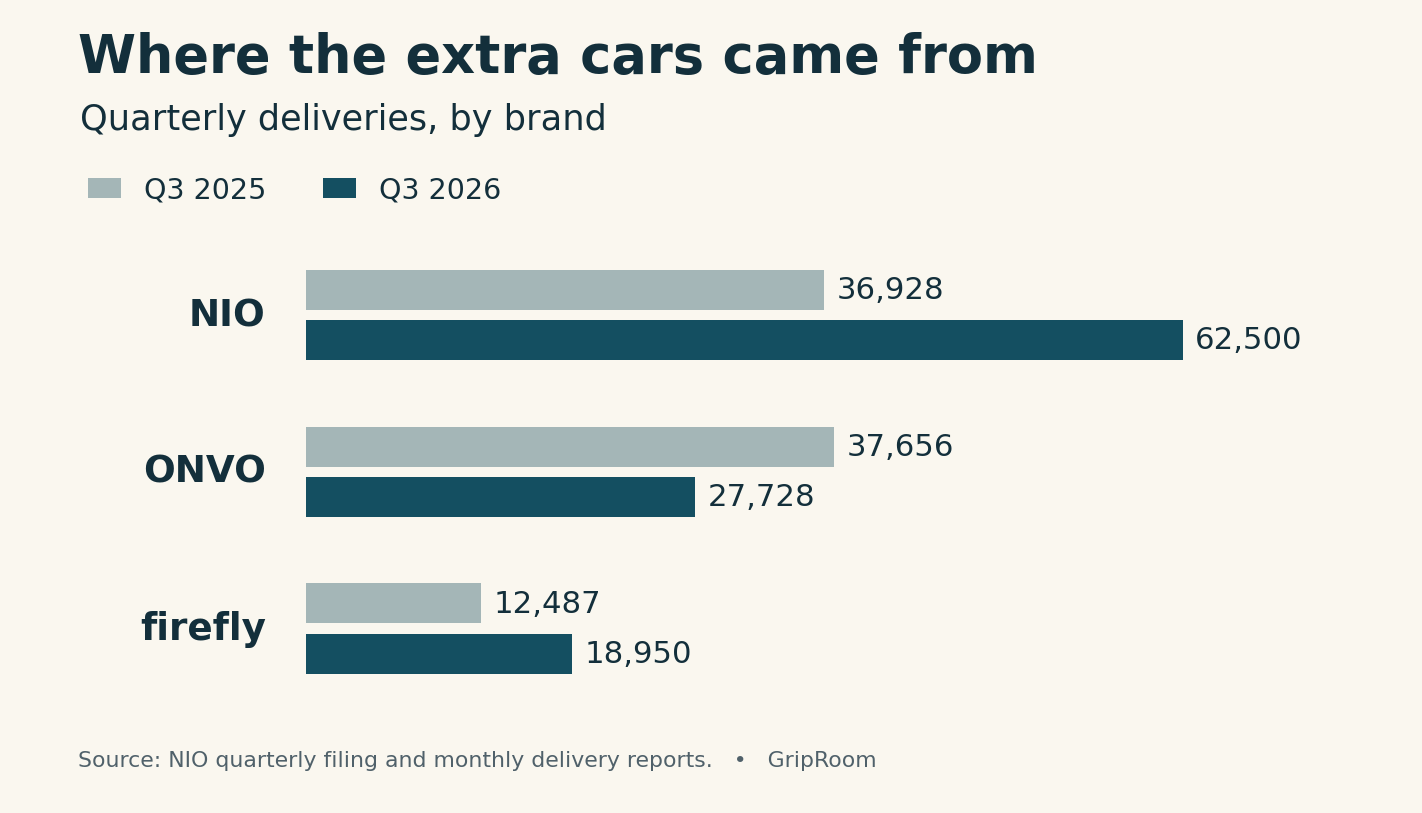
That rearrangement explains why a delivery bulletin was such a poor guide to the year-over-year revenue gain. Take 100 cars from the summer of 2025 and about 42 wore the premium NIO badge. Take 100 from the summer of 2026 and about 57 did. Small cars were selling better, too. The place in the lineup that gave way was the middle, where ONVO handed over nearly 10,000 fewer vehicles than it had a year earlier.
There’s a limit to what the badges can explain. By the spring of 2026 the premium brand already accounted for 56.6% of group deliveries, according to NIO’s second-quarter figures. Its summer share of 57.2% was barely higher. To see what changed between spring and summer, it helps to look inside that premium showroom.
The half-million-yuan SUV got a full summer
The ES9 began deliveries on May 28. That gave NIO just over a month to sell it in the second quarter and three full months in the third. The monthly model counts compiled by CnEVPost from China Passenger Car Association data put ES9 deliveries at 11,703 in the spring quarter and 20,500 in the summer. For scale, those totals were equivalent to about one in nine of NIO’s worldwide deliveries in the second quarter and nearly one in five in the third.
Curiously, the ES9’s best individual month through September was June, when 8,595 went out the door. July brought 6,315, August 6,479 and September 7,706. The flagship could contribute 75% more cars than in the previous quarter without once matching its June high. Three ordinary months of selling an expensive new model did more for the quarter than one spectacular launch month.
NIO had another big SUV for buyers who wanted to spend less. In July it added a five-seat version of the ES8 starting at 382,800 yuan with the battery. By September, the ES8 and ES9 together accounted for 18,252 of the premium brand’s 21,318 deliveries. In other words, about half of all the vehicles NIO Inc. delivered that month came from just two large SUVs. That is quite a concentration for a company whose offerings extend all the way down to a city hatchback.
Why the ES9 has two prices
Look up the ES9 and two quite different entry prices turn up. At launch, NIO offered the same entry trim at 498,000 yuan with the battery or 390,000 yuan for a buyer taking its battery subscription. That 108,000-yuan difference matters to someone financing a car. It is also where an otherwise sensible attempt to reconstruct NIO’s sales from its price list goes astray.
Under the Chinese subscription arrangement described in NIO’s annual filing, two buyers are involved in the same handover. The driver buys the vehicle and subscribes to use the battery. A battery asset company buys the battery from NIO. NIO recognizes the revenue allocated to that battery sale when the vehicle and battery are delivered. Some services, including an extended warranty, earn revenue over time.
So the lower number on the order page tells you what the driver pays up front. It leaves out the other buyer. Multiplying the higher price by every ES9 has problems of its own, starting with three different trims that topped out at 628,000 yuan with the battery. The filings offer a cleaner way to measure how much the choice of car mattered across the business.
An extra 1,317 yuan per car
In the summer of 2025, NIO recorded 21.794 billion yuan in total revenue. Suppose everything in that business, from vehicle sales to service work, had simply grown in proportion to deliveries. The 25.4% increase in cars would have taken revenue to about 27.33 billion yuan. The figure needed for 50% growth was 32.69 billion. More than 5.3 billion yuan of the distance to that threshold lay beyond what selling more cars at last summer’s economics could explain.
Much of that distance had been covered before July. In Q3 2025, dividing reported vehicle sales by deliveries gives about 220,536 yuan a car. By Q2 2026 the same calculation gives 269,912 yuan, a rise of more than 22%. That is an average across the whole lineup. No individual customer needed to pay 22% more for the same model. NIO itself attributed the previous quarter’s higher average selling price to the change in the mix of vehicles sold.
Now apply that spring average to the 109,178 vehicles NIO delivered in the summer. Give the company exactly the same 3.079 billion yuan of other sales it recorded in the spring. That produces 32.55 billion yuan in quarterly revenue, or 49.34% year-over-year growth, before giving NIO a single extra yuan per car for the stronger ES9 mix.
The remaining gap was about 144 million yuan. Spread over 109,178 deliveries, it took just 1,317 yuan more per vehicle to clear it, less than half a percent above the spring average. Other sales could have closed some of the gap as well. That line includes parts and after-sales service, power services, used cars and technical work. The 1,317 yuan is a break-even calculation, distinct from the price increase any buyer actually paid.
What the SUVs have to earn next
Back on September 1, management guided to revenue growth of 52.7% to 56.2%. July and August deliveries were already public. When the quarter closed, the group finished only 322 cars shy of the midpoint of its delivery forecast. Anyone reading the guidance could see a 50% revenue gain coming. The harder figure to appreciate was how much of it depended on customers continuing to choose the expensive end of the range.
For shareholders, the money left over on each sale deserves as much attention as the selling price. NIO’s second-quarter vehicle margin rose to 18.5% from 10.3% a year earlier, an improvement the company attributed mainly to the vehicles it sold. Yet NIO still recorded a net loss of 528 million yuan that quarter. Engineering the next vehicle, launching it and staffing the places that sell it all make claims on the money a flagship brings in.
October gave a first look at the trade-off. NIO delivered 34,246 vehicles across its three brands, down from 37,408 in September. Even as the group delivered fewer cars, the ES8 and ES9 still represented more than 85% of premium-brand deliveries. The appetite for large SUVs was still visible. So was the company’s exposure if buyers moved on.
Which brings us back to the handover in Suzhou. He Yinjun’s car was one of 37,408 that NIO delivered that September. The figure worth remembering is that 7,706 of those handovers involved the same flagship he chose. A year earlier, the ES9 hadn’t been on sale at any price. By September 2026 it was common enough to change what a delivery was worth to the whole company.
Thanks for reading. Follow @GripRoom on X (Twitter) for tomorrow’s news, today.