Why TikTok Made “Little Treat Culture” the New Snack Economy
Humanity has been rewarding itself with small edible bribes since the first exhausted cave person said, “I survived being chased by a wolf, so yes, I deserve the good berry.” The little treat is ancient. The little treat is primal. The little treat is the tiny snack-shaped proof that life has not completely become a spreadsheet wearing deodorant.
But TikTok did something far more economically useful and psychologically sinister: it gave the little treat a name, a ritual, an aesthetic, a hashtag-shaped identity, and a direct line from “I completed one email” to “I deserve a $7 drink that looks like a fairy got promoted to regional manager.”
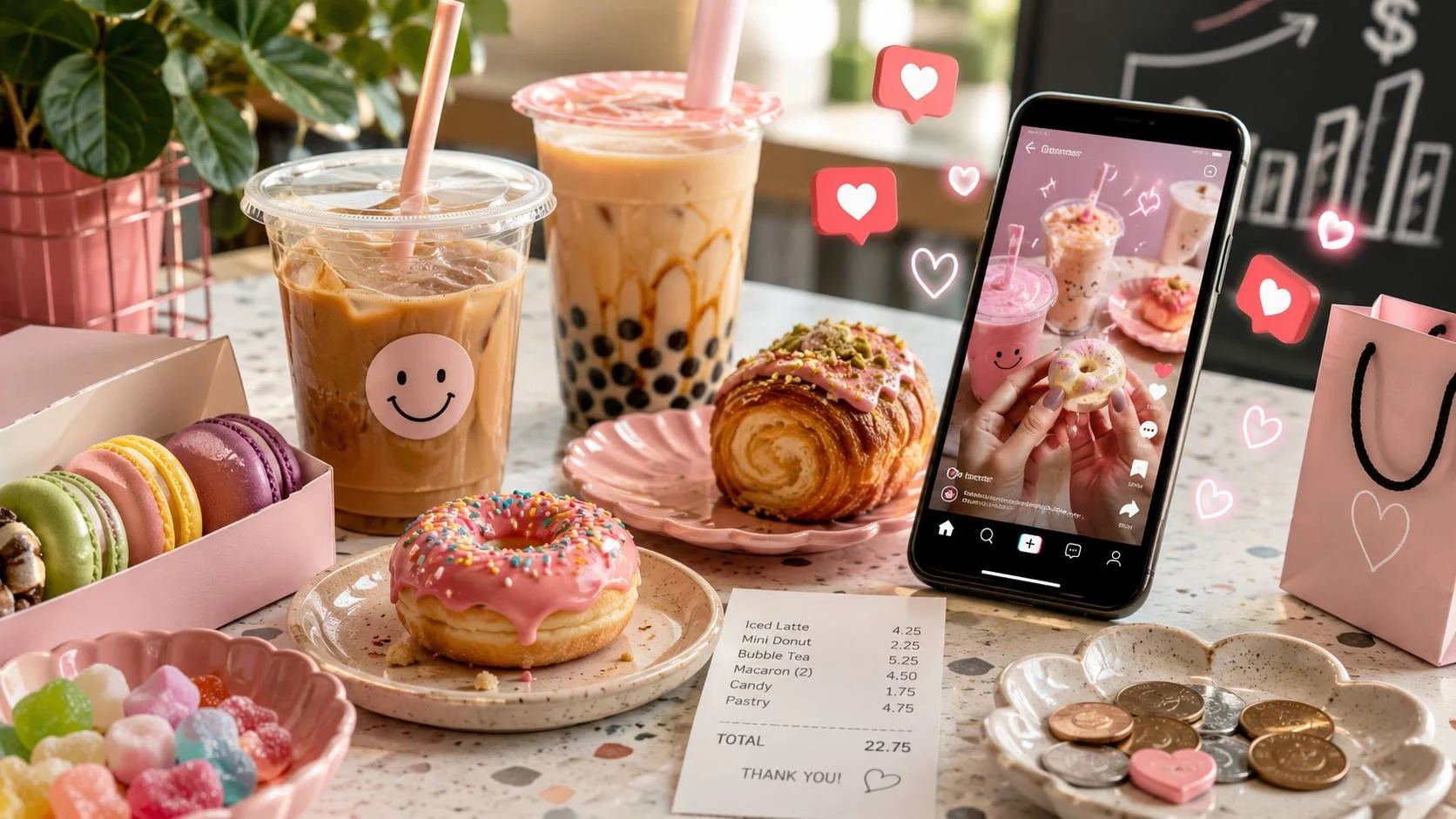
That is how little treat culture became the new snack economy. Not because people suddenly discovered pastries. Please. We have known about pastries. The croissant has been sitting there for centuries being flaky and superior. TikTok turned small indulgence into a social script: a latte after a bad meeting, a cookie after laundry, boba because the day had vibes, a gas-station candy run because adulthood keeps making threats.
And brands, smelling emotional vulnerability the way sharks smell blood, moved in with resealable bags, tiny premium snacks, “treat yourself” ads, and limited-time products dressed like therapy with sprinkles.
What Is Little Treat Culture?
Little treat culture is the habit of buying or eating a small indulgence as a reward, mood boost, stress patch, or tiny ceremonial rebellion against the day. It can be food, coffee, boba, ice cream, candy, fast food, baked goods, skincare, candles, or any other pocket-sized proof that you are still technically the main character despite rent, email, inflation, and the lingering sense that your dishwasher is judging you.
Circana’s 2025 survey of more than 1,000 American consumers found that nearly half seek small indulgences regularly and 62% consider little treats part of their self-care routine. Among food treats, Americans named ice cream, chocolate or candy bars, and baked goods as top favorites, while beverages like soft drinks, milkshakes, and coffee drinks also ranked high.
This is the whole economy in one depressing little bow: consumers want joy, but not necessarily a luxury handbag, a week in Santorini, or a couch that does not resemble a hostage. They want a five-dollar hit of “I am alive and there is frosting.”
TikTok Turned Snacks Into Emotional Vocabulary
TikTok’s role is not just that people post snacks. That is old internet. Instagram already taught everyone to photograph brunch like it was testifying before Congress. TikTok’s contribution was making snacks feel like behavior. A little treat is not just a muffin. It is a punchline, coping mechanism, identity marker, and reward system.
TikTok describes itself as a discovery platform where more than a billion people come to share what they love, learn things, and find ideas, with the experience built around what users are into rather than only who they know. That matters because the platform does not merely show you one person’s cookie. It notices you paused near cookie content and begins feeding you the cookie cinematic universe like a snack-obsessed raccoon operating a recommendation engine.
Research on TikTok personalization found that language, location, following, liking, and video view rate all influence what users are recommended, with follow behavior strongest, then likes and view rate. Translation: stare at one creamy matcha for too long and the app may start behaving like your personal beverage goblin.
That is why little treat culture spreads so efficiently. TikTok does not need you to search “snack-based emotional regulation for people avoiding long-term goals.” It can simply notice you like soft lighting, pastries, “day in my life” videos, convenience-store hauls, boba reviews, and someone whispering “you deserve a little treat” like a cashier at the Church of Financial Leakage.
The Little Treat Is Cheap Luxury for an Expensive Life
The little treat economy makes sense because big milestones have become financially obscene. Houses are expensive. Rent is rude. Groceries behave like they attended a pricing seminar taught by pirates. Vacations require planning, money, time off, and the spiritual strength to endure an airport.
A little treat asks less. It says: you cannot buy stability, but you can buy a cookie.
Bank of America’s 2025 Better Money Habits study found that Gen Z adults ages 18 to 28 see the high cost of living as their top barrier to financial success, with 51% citing it. Among Gen Zers whose spending was higher than expected, groceries and toiletries, rent or utilities, and dining out were major surprise expenses.
The same report found that 57% of Gen Z treats themselves at least weekly, 24% daily or multiple times a week, and 59% say they occasionally, often, or always spend more than intended on little treats.
So no, this is not just “kids these days buy too much coffee because they hate discipline.” That argument has the intellectual depth of a wet napkin. A generation facing high costs and delayed milestones is buying small, controllable pleasures because the larger promises of adulthood arrived wrapped in barbed wire and an adjustable-rate mortgage.
Snacks Became the New Meal Architecture
The snack economy was already waiting with a clipboard. TikTok did not build the snackification of life from scratch; it just added a ring light and a voiceover.
Mondelēz’s State of Snacking report, developed with The Harris Poll and tracking consumers across 12 countries, says the past several years have shown a consistent consumer preference for snacks over meals. Its 2024 findings say 91% of global consumers have at least one snack per day, 61% have at least two, and 60% found inspiration to try a new snack from social media.
That is not a snack drawer. That is a snack civilization.
The three-meal structure is not dead, but it has been badly injured by work schedules, commuting, hybrid routines, delivery apps, loneliness, caffeine, and the modern belief that lunch should be eaten while answering Slack messages like a productivity hamster with access to hummus.
Little treat culture thrives in this wreckage because it does not require a meal. It requires a moment. A pocket of permission. A small edible interruption in the parade of nonsense.
The Treat Is a Reward System for Doing Barely Anything, Which Is Honestly Relatable
One of the funniest parts of little treat culture is how low the reward threshold has become.
Did laundry? Little treat.
Sent an email? Little treat.
Went to the pharmacy? Little treat.
Survived a meeting where someone said “circle back”? Immediate pastry. Possibly two.
Circana found that consumers often treat small indulgences as rewards: 50% cite reward as a reason for buying little treats, while 45% feel they need to earn them. The “earned” behaviors include surviving a tough day, caring for mental health, completing a difficult task, doing a basic task like laundry, or hitting a major milestone.
This is absurd and also deeply human. Modern life contains too many tasks that produce no satisfying conclusion. You answer emails and more emails appear, like mold with subject lines. You clean the kitchen and someone uses a spoon. You pay a bill and the next bill arrives wearing a tiny villain cape.
The little treat gives closure. Not real closure. Candy closure. But still.
Brands Saw the Trend and Immediately Put on a Fake Therapist Voice
The moment a consumer trend gets named, brands begin speaking in the tone of a youth pastor who found Canva.
Panera, for example, launched a 2024 “Big Treat Menu” inspired by TikTok’s little treat trend, with People reporting that social media users joke about rewarding themselves with a little treat after even minor tasks. The menu included over-the-top sweet breakfast items like CinnaTops, which topped frosted cinnamon rolls with cookies or brownies, because apparently “little” was just a suggestion and Panera heard “dessert forklift.”
This is how the snack economy works now. A joke becomes a trend. A trend becomes a menu. A menu becomes a limited-time drop. A limited-time drop becomes content. Content becomes demand. Demand becomes another cinnamon roll wearing a cookie like a hat.
Snack companies understand that little treat culture rewards novelty, convenience, portability, and visual appeal. Circana found that Gen Z’s top food little treats include fast food, ice cream, chocolate or candy bars, salty snacks, and baked goods, while top beverage treats include soft drinks, milkshakes, smoothies, coffee, and boba. This is not subtle. The consumer is basically handing brands a map labeled “Put dopamine here.”
TikTok Made the Little Treat Shareable Without Requiring a Whole Personality
A little treat is perfect TikTok content because it is small enough to be accessible and specific enough to be personal.
A luxury haul can make people angry. A vacation vlog can feel distant. A designer bag can radiate “please rob me or at least resent me.” But a cookie? A convenience-store drink? A pastry after therapy? A boba run after a bad shift? That feels reachable. It says, “You too can experience this tiny ceremony of self-bribery for less than the cost of a movie ticket and one medium-sized regret.”
Mondelēz’s 2024 report says 81% of global consumers pay attention to the sensory experience of snacks, and 8 in 10 agree that snacking is their way of treating themselves after a productive day. TikTok is built for sensory snack content: crunches, pours, wrappers, cream tops, cross-sections, melted chocolate, close-ups, “come get a little treat with me,” and the sacred straw stab into boba film, which has somehow become a miniature ritual of capitalism.
This is not merely food. It is snack theater. Tiny edible cinema for people whose attention spans have been lightly microwaved.
The New Snack Economy Is About Mood, Not Hunger
The old snack question was: “Am I hungry?”
The little treat question is: “Have I suffered enough to justify sugar?”
Circana found that consumers buy little treats for indulgence, reward, impulse, stress coping, and self-care. Specifically, 34% cite coping with stress and 30% cite self-care. Mondelēz also reported that younger generations are more likely to snack to boost mood, find comfort, and manage stress.
That is the emotional engine. The snack is not solving hunger. It is patching the mood leak.
This is why little treat culture feels both harmless and slightly cursed. On one hand, buying yourself a cookie after a brutal day is not moral collapse. On the other hand, an entire commercial system has now learned to monetize the exact moment when you are tired, stressed, sad, bored, underpaid, overstimulated, and standing near a checkout display.
The little treat is self-care when chosen intentionally.
It becomes snack-based auto-pilot when the algorithm, the ad, the craving, and the contactless payment terminal form a tiny unholy committee.
“Affordable” Does Not Always Mean Cheap
Little treat culture is built on the phrase “it’s only five dollars,” which has ruined more budgets than anyone wants to admit.
Circana found the median little treat costs about $5, with the most expensive “still little” treat costing a median of $10, adding up to about $30 monthly or $360 yearly by its survey math. Bank of America’s Gen Z report adds the spicy little financial footnote: 59% of Gen Z reported sometimes spending more than intended on little treats.
This is the part where people get stupid in both directions.
One camp says, “Stop buying coffee and you’ll afford a house,” which is a fantasy so dumb it should be stored in a museum next to asbestos wallpaper.
The other camp says, “Little treats don’t matter at all,” which is also wrong, because repeated discretionary spending can absolutely matter when money is tight. A cookie will not destroy your future. Twelve tiny “it’s only” purchases per week might at least take a suspicious little bite out of it.
The real problem is not one latte. It is unconscious repetition dressed as self-love.
TikTok Also Made Treats Competitive, Because Of Course It Did
Nothing wholesome survives contact with content metrics.
A little treat starts as a small joy. Then TikTok adds aesthetics. Then someone finds a better treat. Then the treat becomes imported, limited-edition, pistachio-filled, topped with something, served in a cup shaped like emotional instability, and suddenly your gas-station KitKat looks like it failed art school.
This is the upgrade treadmill. Ordinary candy becomes boring. Ordinary coffee becomes inadequate. The algorithm rewards novelty, not restraint. It wants the rare snack, the absurd snack, the seasonal snack, the “run don’t walk” snack, the snack someone found at a store 38 miles away and filmed like they discovered an ancient temple guarded by sour gummies.
Circana found that 62% of Gen Zers have bought a little treat highlighted or endorsed by an influencer, and nearly three in five turn to TikTok for little treat inspiration. So yes, treat culture is personal. It is also heavily suggestible, because humans are just shopping carts with feelings.
Little Treat Culture Rebranded Impulse Buying as Self-Care
The most powerful trick little treat culture pulled was making impulse buying sound emotionally literate.
“I bought this because I was stressed” used to sound like a warning sign. Now it sounds like wellness, provided the pastry is photographed correctly and the caption has enough ironic detachment.
Circana found 40% of consumers cite impulse purchasing as a reason for little treats, and one in three say they struggle with self-control around small indulgences. That does not mean little treats are bad. It means the line between “small joy” and “tiny compulsion with whipped cream” is thinner than people want it to be.
Self-care should restore you. It should not quietly train you to need a purchase after every mild inconvenience. If your coping system requires a snack every time someone schedules a meeting, the snack is no longer a treat. It is emotional payroll.
The Snack Economy Loves Rituals Because Rituals Repeat
Brands do not merely want you to buy a treat. They want you to develop a treat ritual.
Friday donut. After-work boba. Payday pastry. Grocery-store chocolate. Gym-adjacent smoothie that costs more than the workout. Coffee before class. Fries after therapy. The same specific snack from the same specific place because now it is not just food; it is lore.
Circana notes that popular little-treat rituals include having a regular treat schedule, buying the same treat every time, or pairing a treat with another form of self-care. This is extremely useful to brands because rituals are habits wearing a ceremonial hat.
A habit says, “I keep buying this.”
A ritual says, “This is part of who I am.”
Congratulations. Your identity now has a punch card.
Why Little Treat Culture Works So Well on Gen Z
Gen Z did not invent coping through consumption, but they did grow up in the ideal conditions for little treat culture to become fluent, memeable, and monetizable.
This is a generation shaped by social media, pandemic disruption, high housing costs, expensive groceries, unstable career expectations, and a world where every large goal seems to arrive with a hidden fee and a mental health waiver. Bank of America found that 33% of Gen Z reported being financially stressed, with economic instability, slow progress toward goals, and insufficient income among top stress causes.
So the little treat becomes a manageable win. It is immediate. It is affordable-ish. It is photographable. It is socially legible. It says, “I cannot control the economy, but I can control this iced coffee.”
Is that a rational long-term solution? No.
Is it emotionally understandable? Obviously.
Is it exactly the kind of thing brands can exploit while saying “we see you”? Also yes, and please notice how the cash register just winked.
The Useful Way to Participate Without Becoming a Snack Puppet
Little treats are not the enemy. Joyless restriction is not a personality upgrade. Nobody becomes spiritually superior by denying themselves a cookie and then making everyone nearby hear about it.
But little treat culture works best when it is intentional instead of algorithmically summoned.
Set a little treat budget. Not because you are a joyless accountant in human form, but because freedom without a number becomes vibes with overdraft fees. Circana found 24% of Americans maintain a budget line for small indulgences, and more than two in five Gen Zers do the same.
Make the treat actually satisfying. Do not buy a sad snack you barely want just because a video told you it was “so worth it.” Half of TikTok’s food opinions sound like they were written by people being held hostage by affiliate codes.
Keep a few low-cost treats at home. The snack economy depends on convenience. Beat it at its own greasy little game. A grocery-store chocolate bar, good tea, frozen cookie dough, popcorn, or fancy soda at home can prevent the “I deserve a treat” errand from becoming a $19 side quest.
Use treats for pleasure, not basic emotional maintenance. A cookie after a bad day is fine. A cookie because you cannot tolerate any feeling without a purchase is a flashing dashboard light wearing sprinkles.
Do not let the algorithm choose your cravings. Seeing a snack 11 times does not mean you want it. It means the app has dragged your brain through a tiny food commercial obstacle course.
TikTok Made the Little Treat Into a Business Model
TikTok made little treat culture the new snack economy by turning small indulgences into content, language, ritual, and identity. It transformed snacks from “something you eat” into “something you deserve,” “something you post,” “something you collect,” “something you use to survive a Tuesday,” and “something a brand can sell back to you with faux-therapeutic sincerity.”
The little treat works because it is small, immediate, sensory, emotional, affordable enough to justify, and photogenic enough to spread. It fits perfectly into a world where people snack more, meals are less structured, money is tight, stress is high, and social media turns every craving into a community activity with a checkout link.
The result is a snack economy powered by mood management. A cookie is no longer just a cookie. It is self-care. A latte is no longer just caffeine. It is a coping mechanism in a plastic cup. A convenience-store candy run is no longer impulse spending. It is “romanticizing your life,” which is apparently what we call buying gummies under fluorescent lighting now.
And honestly, sometimes the little treat is good. Sometimes the little treat is necessary. Sometimes the day is a flaming shopping cart and a pastry is the only sane response.
Just remember: the treat should serve you.
Once you start serving the treat economy, you are no longer having a snack. You are doing unpaid emotional labor for a muffin.