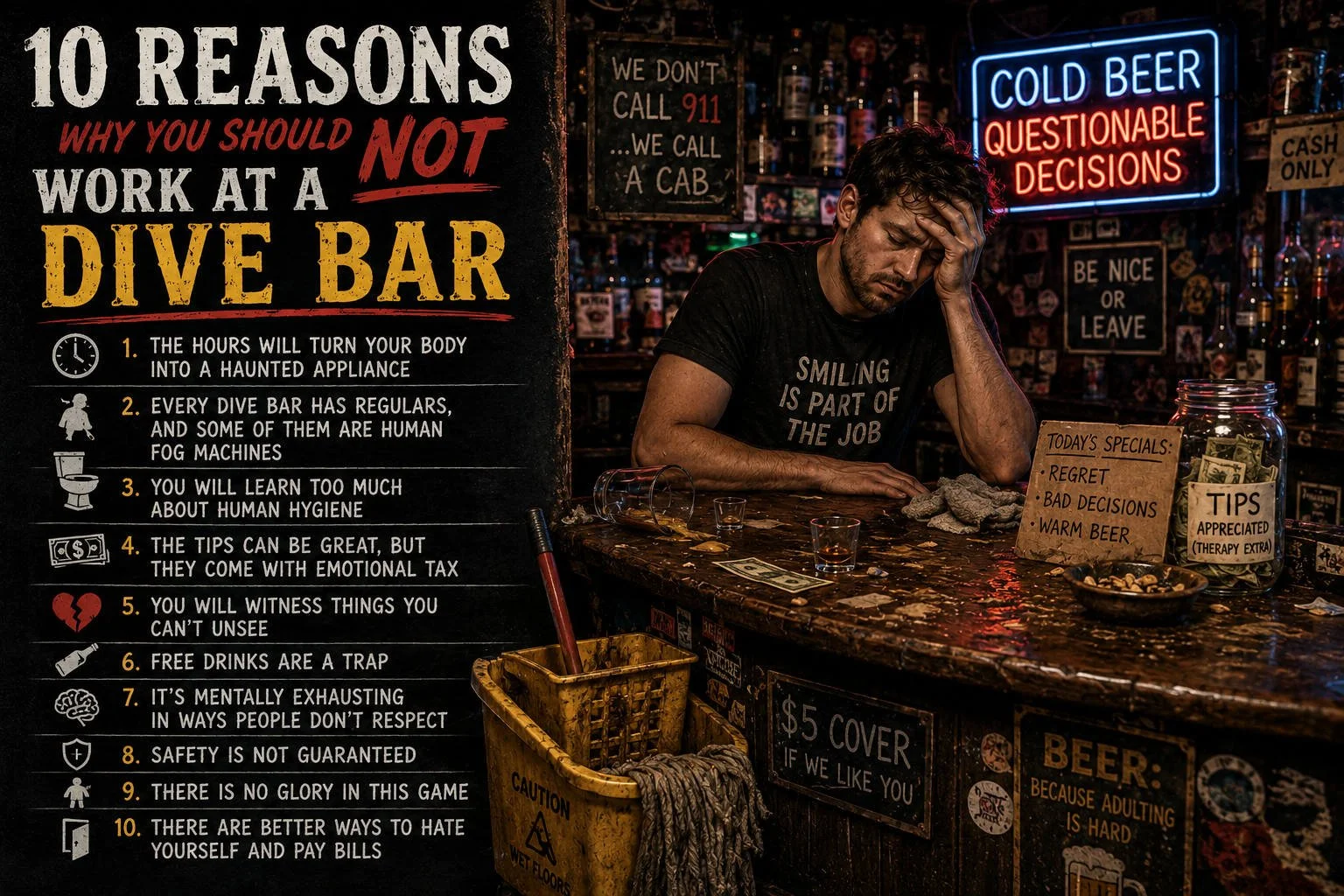
10 Reasons Why You Should Not Work at a Dive Bar
Working at a dive bar sounds romantic if your main source of career advice is a movie where everyone has cheekbones, leather jackets, and mysteriously affordable rent. You imagine dim lights, regulars with tragic backstories, jukebox poetry, cash tips, and the warm glow of being the cool person who knows what everyone drinks.
Adorable.
A dive bar job is less “gritty neighborhood charm” and more “standing in spilled beer while a man named Rick explains why the ATM fee is unconstitutional.” It is customer service with worse lighting, later hours, stronger smells, and a front-row seat to the collapse of human dignity at $5 for a house lager (which is actually just Bud Light.)
That does not mean dive bars are bad. Dive bars can be wonderful. They are community bunkers with open mic and the occasional game of bingo. They are where lonely people become regulars, cheap beer becomes therapy, and someone’s divorced uncle becomes a local landmark. But working at a dive bar is a different animal. The customer gets atmosphere. You get the mop.
So before you decide to become the charming bartender in a place where the bathroom lock is more of a suggestion, here are 10 reasons why you should not work at a dive bar.
1. The Hours Will Turn Your Body Into a Haunted Appliance
Working at a dive bar means living on bar time, which is not time as understood by doctors, farmers, or emotionally stable adults. Your shift may start when normal people are eating dinner and end when the rooster is waking up.
Your sleep schedule will become a crime scene.
You will eat meals at times that make no biological sense. Breakfast at 2 p.m. Dinner at midnight. A “snack” at 4:30 a.m. consisting of fries, olives, and something you found in the walk-in while questioning every life choice that led you to this refrigerator.
The human body was not designed to sleep through daylight after inhaling secondhand chaos for eight hours. Eventually, your circadian rhythm will file a missing person report. You will start saying things like “morning” at 5 p.m. and meaning it. Your friends with normal jobs will invite you to brunch, and you will stare at the message like they asked you to attend a sunrise cult meeting.
Useful tip: If you do work bar shifts, protect your sleep like it is cash in a bad neighborhood. Blackout curtains, a consistent wind-down routine, and refusing “just one after work” will save you from becoming a raccoon with rent.
2. Every Dive Bar Has Regulars, and Some of Them Are Human Fog Machines
Regulars are the backbone of a dive bar. They keep the place alive. They know the staff, the history, the broken barstool, the exact day the jukebox betrayed them, and which bartender pours “correctly,” meaning “recklessly.”
Some regulars are lovely. Some are funny, generous, loyal, and protective.
Others are unpaid building fixtures with opinions.
They will tell you the same story 90 times. They will complain if their beer is too cold, too warm, too foamy, too fast, too slow, or not served with the emotional reverence they believe they deserve as a man who has been drinking there since 2008 and once fixed the dartboard.
They will flirt badly. They will overshare. They will ask intrusive questions. They will develop imaginary friendships with you because you smiled while accepting money, which they mistook for a sacred emotional contract.
Working at a dive bar means learning the difference between hospitality and becoming someone’s unpaid therapist with access to tequila.
Useful tip: Be warm, but keep boundaries. A friendly bartender survives. A bartender who becomes everyone’s emotional support bartender gets consumed like free popcorn.
3. You Will Learn Too Much About Human Hygiene
Dive bars reveal things about the human body that should remain classified.
You will see what people do to bathrooms when they think society has briefly left the room. You will smell smells that have no academic name. You will clean spills that are not technically identifiable as drinks. You will touch surfaces that feel sticky in a way that suggests the building itself is sweating.
The floor will be wet. Always. From what? Beer, melted ice, soda, regret, possibly rain, possibly something brought in on someone’s boot from an alley with a vendetta. You will stop asking. Asking is for people who still believe answers help.
And then there are the glasses. Lipstick. Backwash. Mystery foam. One guy who puts peanut shells in his pint glass because civilization apparently did not reach his chair.
Working at a dive bar teaches humility because nothing humbles a person faster than unclogging a toilet while a drunk stranger knocks on the door asking, “You almost done?”
No, Kenneth. I am not almost done. I am negotiating with your legacy.
4. The Tips Can Be Great, but They Come With Emotional Tax
People talk about bartending money like it rains cash from the ceiling while you casually pop beer caps and say cool things. And yes, some nights can be good. A dive bar can produce solid tips, especially if the regulars like you and the drinks move fast.
But that money is not free.
You earn it by managing moods, egos, intoxication, impatience, loneliness, aggression, flirting, jokes that should have died in 1997, and people who think tipping one dollar grants them constitutional authority over your time.
A good tipper can make your night. A bad tipper can make you wonder whether humans deserve glassware.
You will serve someone all night, listen to their divorce update, laugh at their story about a boat they definitely should not own, remember their drink, tolerate their friend, charge them fairly, and then they will leave 73 cents and a wet napkin.
Beautiful. Very moving. Put it in the Louvre under “Portrait of a Cheap Bastard.”
Useful tip: Do not emotionally attach to individual tips. Track your average over time. One awful tip feels personal; the weekly total tells the real story.
5. You Will Become a Professional Bouncer Without the Pay or the Shoulders
Dive bars often run lean. That means the bartender is not just a bartender. You are also cashier, janitor, therapist, DJ, conflict mediator, ID checker, lost-and-found clerk, amateur plumber, and occasionally the person who has to tell a drunk man he is done for the night.
This is the least fun part of the job because alcohol turns some adults into toddlers with car keys and legal liability.
Cutting someone off requires tact, timing, and the ability to say “no” to a person whose brain is currently being operated by whiskey and unresolved high school sports memories. Some people accept it. Others act like you have personally invaded their homeland.
You will hear:
“You don’t know me.”
“I’m fine.”
“I had two.”
“I know the owner.”
“I’m a bartender too.”
“My cousin is a cop.”
“I spend money here.”
Congratulations, everyone. None of these sentences metabolize alcohol.
Useful tip: Know your house policy, document incidents, and never argue longer than necessary. A drunk debate is just two people wasting time, except one of them has access to the register.
6. Dive Bar Drama Spreads Faster Than Cheap Rum
Every dive bar is a small ecosystem. Staff, regulars, owners, ex-staff, ex-regulars, current situationships, former situationships, one guy banned until “probably next month,” and at least three people who claim they are “basically family here,” which usually means they are emotionally dangerous near closing time.
Drama is inevitable.
Someone is mad at the bartender. Someone is dating someone’s ex. Someone got cut off and is making it a human rights issue. Someone believes their favorite seat has been stolen. Someone said something about someone’s boyfriend. Someone owes someone money. Someone is crying in the bathroom, and it is somehow your problem because you have napkins.
Dive bars are intimate, and intimacy plus alcohol plus boredom creates drama like damp bread creates mold.
You may think you are above it. Cute. The drama will still know your name. It will crawl under the door wearing boots and ask if you heard what happened on Tuesday.
Useful tip: Do not date regulars. Do not gossip with regulars. Do not take sides in regular feuds unless you enjoy being dragged into a community soap opera with worse lighting.
7. Your Social Life Will Move Into the Bar Like a Depressed Houseplant
When you work nights and weekends, your social life starts shrinking around your job. Your coworkers become your friends because they are awake when you are awake. Your regulars become familiar because they are always there. The bar becomes your workplace, after-work spot, social circle, and emotional weather system.
This is convenient. Then it is weird. Then it is unhealthy if you do not notice it happening.
You finish a shift and stay for a drink. Then two. Then suddenly you are spending your night off at the place you work because it is easy, familiar, and everyone knows you. Congratulations, your workplace has swallowed your personal life like a python in a neon sign.
The danger is not just drinking too much, though yes, that danger is very real. The danger is forgetting there is a world outside the room where the floor is sticky and the same 14 songs keep playing.
Useful tip: Build at least one social habit outside the bar. Gym, breakfast with a friend, a hobby, a class, a walk, anything. Remind your brain that life exists beyond domestic beer and laminated menus.
8. The Owner Might Be a Legend, a Lunatic, or Both
Dive bar owners can be wonderful. Some are old-school operators who know every pipe in the building, every regular’s birthday, and exactly how to stretch a dollar until it screams.
Others are chaos in human pants.
A bad owner will cut corners, avoid repairs, under-schedule shifts, “forget” payroll details, hire their cousin who should not be allowed near ice, and treat basic workplace safety like an optional luxury for fancy people with clean bathrooms.
The ice machine breaks? “Just make it work.”
The POS system crashes? “Write it down.”
The toilet floods? “Can you handle it?”
The door guy calls out? “You’ll be fine.”
The neon sign catches fire? “Is it busy?”
Working at a dive bar can teach you resourcefulness, which is great, unless “resourcefulness” is code for “management has abandoned you in a building held together by duct tape and local superstition.”
Useful tip: Before taking a job, visit the bar as a customer. Watch how staff interact, how management behaves, how clean the place is, and whether everyone looks charmingly tired or legally endangered.
9. You Will See the Sad Side of Drinking Up Close
Dive bars can be fun. They can also be where people go when fun has left and habit is driving.
This is the part nobody puts in the cool bartender fantasy. You will see people drink because they are celebrating, sure. But you will also see people drink because they are lonely, grieving, angry, broke, bored, addicted, or terrified of going home.
You will watch patterns form. The same person at the same stool at the same time ordering the same drink with the same hollow little joke. You will see people damage relationships in real time. You will see people spend money they clearly do not have. You will see regulars decline slowly enough that everyone notices and nobody knows what to do.
It can make you cynical. It can also make you compassionate, if you do not let the job sandblast your soul into bartender gravel.
The hard truth is that alcohol service means participating in an industry that sells relief. Sometimes harmless relief. Sometimes expensive relief. Sometimes relief that turns into a trap with a coaster.
Useful tip: Know your limits emotionally. You can care about customers without trying to save them. You are not equipped to fix everyone at the bar, and trying will turn you into a very tired martyr with a bottle opener.
10. The Job Can Make You Tough in Ways You Did Not Ask For
Working at a dive bar will sharpen you. You will get faster, funnier, harder to rattle. You will learn how to read people. You will learn how to multitask under pressure. You will learn when a room is about to go bad before anyone says anything. You will become fluent in eye contact, tone, posture, silence, and the exact sound of a glass breaking behind you while your soul leaves your body for three seconds.
These are useful skills.
But toughness has a cost if you do not put it down sometimes.
You may become impatient with normal people. You may start assuming everyone is lying, drunk, cheap, or about to ask for something annoying. You may develop a permanent customer-service squint. You may find yourself saying “behind” in your own kitchen while alone, which is when the job has entered your bloodstream and should be billed rent.
The danger is not that dive bars ruin everyone. They do not. Some people thrive there. Some make good money, build community, and love the chaos.
The danger is pretending it is just a fun job with drinks. It is emotional labor with alcohol, money, late nights, risk, noise, bodily fluids, and strangers who think your name tag means “available for nonsense.”
Should You Ever Work at a Dive Bar?
Maybe. If you have thick skin, sharp boundaries, good instincts, and a strong stomach, a dive bar job can be weirdly rewarding. You can make money. You can build confidence. You can learn people better than most office workers ever will. You can collect stories so strange they sound illegal to invent.
But you should know what you are signing up for.
Do not work at a dive bar because you think it will be glamorous. It will not. Glamour does not smell like stale beer and fryer oil.
Do not work at a dive bar because you want to party. That is how you become the employee everyone has to cover for.
Do not work at a dive bar because you are bad at boundaries. The bar will find that weakness and use it as a coat rack.
Work there only if you understand the bargain: the money can be good, the people can be memorable, the chaos can be funny, and the whole thing can still chew through your sleep, patience, and faith in bathroom etiquette.
Dive Bar Jobs Are Not for the Delicate or the Delusional
A dive bar is a beautiful mess when you are on the customer side of the wood. Cheap drinks, bad decisions, good jukebox, weird regulars, the comforting sense that no one here is pretending too hard.
But behind the bar, the romance gets a mop bucket.
You are not just serving drinks. You are managing a nightly parade of thirst, boredom, loneliness, ego, flirtation, poor math, sticky surfaces, and adults who need to be reminded that closing time is not a personal attack.
So yes, there are at least 10 reasons why you should not work at a dive bar. The hours are brutal. The regulars are a mixed wildlife preserve. The bathrooms are a war crime. The drama breeds in corners. The money comes with emotional tax. The job can swallow your social life, bruise your patience, and turn you into someone who can identify trouble by the way a man enters a room wearing flip-flops in February.
Still, if you survive it, you will become sharper. Faster. Stranger. Harder to fool. Better at reading people. Worse at tolerating nonsense.
A dive bar job is not glamorous.
It is a paid internship in human behavior, conducted under neon, with a mop in one hand and the growing suspicion that civilization is mostly held together by bartenders who know when to cut someone off.