Why The Krusty Krab Teaches More About Fast-Food Loyalty Than It Should
First things first: The Krusty Krab is not a restaurant. It is a wooden barrel with tables, a cash register, one employee who cares too much, one employee who wishes everyone would drown even though they already live underwater, and an owner whose emotional range begins and ends with “money noise.” By any normal hospitality standard, this place should be condemned, studied, and then turned into a cautionary case at business school called What If Capitalism Had Barnacles?
And yet Bikini Bottom keeps coming back.
That is the annoying part. The Krusty Krab should not work. Mr. Krabs is openly cheap. Squidward treats customer service like a court-ordered punishment. The building looks like something washed out of a shipwreck and got a health permit through bribery or clerical error. The main product is a burger with a secret formula so protected that the show’s entire competitive landscape revolves around one plankton-sized man repeatedly attempting corporate espionage like a tiny MBA villain.
Still, the Krusty Krab has what every real fast-food chain is currently trying to manufacture with apps, points, digital coupons, limited-time sauces, celebrity meals, nostalgia collabs, “surprise and delight,” and enough push notifications to make your phone feel like it’s being haunted by fries.
It has loyalty.
And not the fake kind where someone downloads an app because a chicken sandwich is $1 off if they surrender their email, birthday, location, and probably a small vial of blood. The Krusty Krab has actual cultural, emotional, habitual loyalty. Customers want the Krabby Patty. SpongeBob wants to make the Krabby Patty. Plankton wants to steal the Krabby Patty formula. Mr. Krabs wants to monetize the entire ecosystem of desire until the sea itself files for bankruptcy.
Ridiculous? Yes. Useful? Horribly.
The Krusty Krab Understands the Power of One Iconic Product
The first lesson is embarrassingly obvious: fast-food loyalty usually begins with one product people can identify in their sleep. McDonald’s has fries and Big Macs. Taco Bell has late-night edible architecture. Starbucks has coffee drinks that sound like someone naming a racehorse. The Krusty Krab has the Krabby Patty, which is not just a menu item but a religious object with sesame seeds.
Nickelodeon describes SpongeBob as a fry cook at the Krusty Krab, “Krabby Patty flipping” being central to the character, and also notes that he protects the Krabby Patty secret formula from Plankton. Mr. Krabs, meanwhile, is listed as the owner of the Krusty Krab, a man whose official special interests include money and his daughter Pearl, in that order spiritually if not legally.
That is branding so simple even a marketing department could understand it, assuming they stopped saying “consumer journey” long enough to breathe. The Krusty Krab does not need a 78-item menu. It does not need twelve chicken platforms and three seasonal beverages with foam emotions. It has one thing everyone knows. The Krabby Patty is the anchor.
Real fast food chains know this, which is why they keep returning to signature items even while pretending innovation means putting spicy sauce on something that already existed. A loyalty program can remind someone to come back, but the product gives them a reason. Otherwise, the app is just a digital pamphlet for disappointment.
The Secret Formula Is Really Brand Mystery, You Greasy Little Scholars
The Krabby Patty secret formula is not just a plot device. It is a lesson in mystique. Plankton’s entire personality is basically “What if LinkedIn envy became a copepod?” Nickelodeon describes Plankton as the owner, founder, and only customer of the Chum Bucket, constantly scheming to steal the Krabby Patty Secret Formula and run the Krusty Krab out of Bikini Bottom.
That is funny because it is insane. It is also business strategy wearing cartoon pants.
A secret formula gives customers something to believe in. It says: there is something special here, something competitors cannot simply copy, something hidden behind the kitchen door besides SpongeBob’s labor rights violation. The actual ingredients barely matter. The secrecy is the ingredient. The mystery creates value because customers are not just eating a burger; they are participating in a story.
Modern chains try to do this with “secret sauces,” “limited drops,” “vault items,” and app-only exclusives. Most of it feels like a spreadsheet wearing sunglasses. The Krusty Krab version works because the secret is baked into the world. The product’s mythology is not a campaign. It is the campaign, the product, the rivalry, and half the show’s operating system.
The lesson: people do not become loyal to a SKU. They become loyal to a story they can repeat.
The Chum Bucket Proves Competition Can Make Loyalty Stronger
The Chum Bucket is one of the funniest business failures in television because it sits right across from the Krusty Krab and still cannot get customers. This is not a location problem. This is a “your product is chum and your founder keeps using robots for kidnapping” problem.
But the Chum Bucket does something useful for the Krusty Krab: it gives the brand an enemy.
Brands love enemies. Coke has Pepsi. Apple had Microsoft. McDonald’s has Burger King. The Krusty Krab has Plankton, a one-eyed founder with the energy of a rejected patent application. His constant failure reinforces the Krusty Krab’s position as the place people actually want. Every time Plankton tries to steal the formula, the show tells us the same thing: the Krabby Patty is worth stealing.
That is loyalty by contrast. Customers do not only know what they like. They know what they are not choosing.
This is why fast-food rivalries stick in the public mind. People enjoy picking sides, even when the sides are “burger” and “different burger.” Rivalry turns preference into identity. It gives customers a tiny tribal flag to wave while eating fries in a parked car like a divorced king.
SpongeBob Is the Loyalty Program, Unfortunately
Here is the part restaurant executives should hate because it cannot be automated cleanly: SpongeBob is the real loyalty engine.
Not the formula. Not the sign. Not Mr. Krabs. SpongeBob.
Nickelodeon calls SpongeBob the “best fry cook Bikini Bottom has to offer,” and his whole identity is wrapped around the Krusty Krab, Krabby Patties, and protecting the secret formula. He is cheerful, consistent, proud of the product, and somehow still emotionally invested in a job where his boss would charge him rent for oxygen if the ocean allowed it.
In real restaurants, employees are often treated like replaceable spatula accessories, then management acts stunned when service feels dead-eyed and customers stop feeling attached. The Krusty Krab, despite being run by a crustacean landlord goblin, understands that one passionate employee can become part of the brand.
SpongeBob is not just making food. He is creating ritual. He is the reason the product feels cared for. Customers may not consciously think, “I return because the fry cook radiates pathological enthusiasm,” but they feel it.
Fast-food chains keep investing in loyalty programs because repeat visits are money. McDonald’s reported nearly 210 million 90-day active loyalty users across 70 markets at the end of 2025, with nearly $37 billion in systemwide sales to loyalty members for the year. That is not a cute side project. That is the golden calf wearing a headset.
But points cannot fully replace people. A reward can bring someone back once. A good experience makes them come back without needing to be bribed like a toddler near a dentist.
Squidward Shows the Danger of Consistency Without Warmth
Squidward is also part of the brand, technically, in the way a pothole is part of a commute. He is consistent. He is recognizable. He is always there, radiating contempt from behind the register like a clarinet-playing DMV clerk.
And weirdly, that matters too.
Loyalty is not always built from delight. Sometimes it is built from predictability. Customers know what the Krusty Krab is. They know the food. They know the staff. They know the room. They know the experience will be loud, weird, probably overpriced by Mr. Krabs, and still somehow satisfying. That predictability is a fast-food superpower.
People return to fast food because it reduces decision fatigue. You know what you are getting. The menu is a security blanket with sodium. This is why chains obsess over operational consistency. Nobody wants to order the same burger at two locations and have one taste like nostalgia and the other taste like a mop gained sentience.
Squidward proves the ugly version of the point: even a grumpy cashier can become part of the ritual if everything else is strong enough. But please, restaurant brands, do not read that as permission to make service worse. That would be exactly the kind of lesson a consultant would extract after being dropped as a baby into a PowerPoint.
The Krusty Krab Has Emotional Loyalty, Not Just Transactional Loyalty
Modern restaurant loyalty programs are everywhere. The National Restaurant Association reported that 96% of loyalty and reward program customers say they are a good way to get more value, and 52% participate in restaurant, coffee shop, snack place, or deli programs that offer them. Customers also join multiple programs, averaging 3.6 restaurant loyalty programs overall.
That is useful, but it also reveals the problem. If everyone belongs to multiple programs, are they loyal or merely coupon-literate? Are they devoted fans, or are they just wandering discount goblins with app folders?
Deloitte makes this distinction more politely than I will: restaurant loyalty programs often start with transactional rewards like discounts and free items, but stronger loyalty comes from emotional connection, simpler programs, personalization, exclusive access, and experiences. Deloitte’s survey found that 67% of restaurant loyalty members belong to two or more programs, which means many customers are engaged but not married. They are dating several burrito apps at once, the hussies.
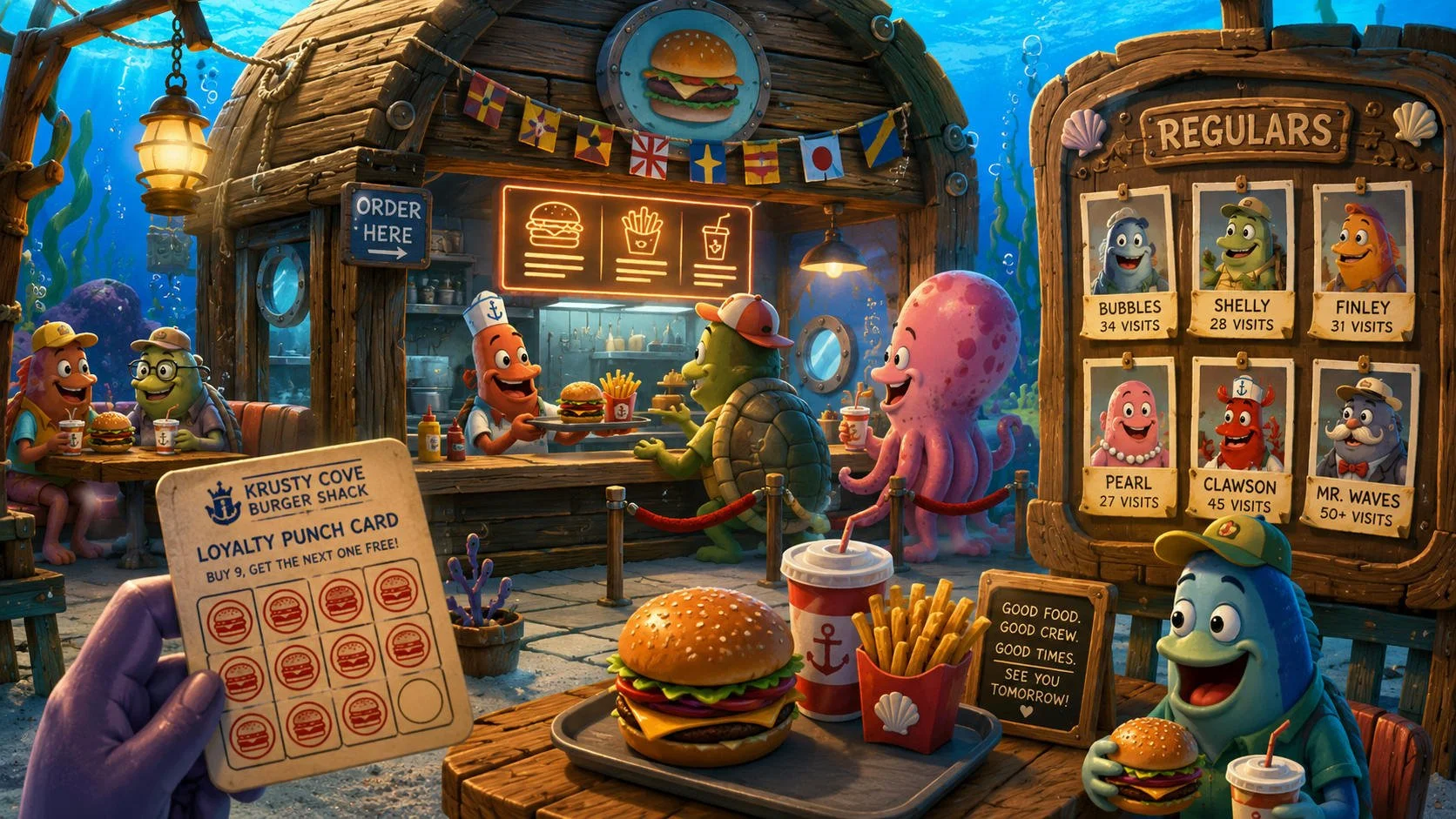
The Krusty Krab’s loyalty is emotional. People are not collecting Patty Points. There is no “buy nine Krabby Patties, get one existential crisis free” punch card. Customers come back because the Krabby Patty means something inside that universe. It has status. It has mythology. It has community. It has demand so powerful that a rival business keeps trying to steal its soul in a bottle.
That is what real brands want but often try to fake with app confetti.
Value Still Matters, Because Mr. Krabs Is a Warning Label With Eyestalks
Of course, emotional loyalty has limits. This is where Mr. Krabs becomes less a character and more a regulatory failure. Nickelodeon literally describes him as cheap, greedy, proud of it, and obsessed with making as much money as possible while spending as little as possible.
Hilarious on television. Less charming when your actual fast-food receipt looks like it financed a yacht.
This matters because restaurant loyalty is under pressure. Tillster’s 2026 consumer sentiment report found that 45% of consumers said their favorite restaurant chain changed in the last year, up sharply from one-third in 2025. The same report said 69% of diners had decreased or maintained dining-out budgets due to economic conditions, while food quality, convenience, and speed were the top factors in deciding where to eat.
That is the real-world version of Bikini Bottom looking across the street and thinking, “Maybe chum is affordable now.” When customers feel squeezed, loyalty becomes conditional. People love brands until the brand starts acting like Mr. Krabs with a tablet POS system.
PYMNTS reported that restaurant loyalty enrollment climbed to 48% of diners in 2025, weekly engagement rose to 47%, and 93% of members check for deals before deciding where or what to eat. Loyalty influences decisions for 61% of delivery customers and 54% of QSR patrons. Translation: customers are loyal, yes, but many are loyal to value first and your adorable mascot second.
The Krusty Krab teaches that a beloved product can carry a lot of abuse. But not infinite abuse. If the value feels insulting, customers eventually notice. Even fish have receipts.
Nostalgia Is Loyalty With a Time Machine
The Krusty Krab’s biggest real-world lesson is nostalgia. People who grew up watching SpongeBob do not merely remember the Krabby Patty. They want to taste the idea of it, which is absurd because it is a fictional burger from a cartoon sea barrel, and yet here we are, adults with retirement accounts and unresolved condiment emotions.
That nostalgia became literal in 2024, when Wendy’s and Paramount launched the Krabby Patty Kollab for SpongeBob’s 25th anniversary, with a Krabby Patty Kollab Burger and Pineapple Under the Sea Frosty in the U.S., Canada, and Guam. Wendy’s described it as the first time food inspired by the iconic Krabby Patty was brought into the real world and onto menus through a national QSR partner.
Paramount also said the broader Krabby Patty Kollab brought more than 100 renditions to over 250 local restaurants in cities including New York, Los Angeles, Chicago, Dallas, Atlanta, San Francisco, Seattle, Miami, Las Vegas, Toronto, London, and Mexico City. It also noted SpongeBob has been seen in more than 180 markets, translated into 30-plus languages, and averages more than 90 million total viewers every quarter.
That is not just a promotion. That is nostalgia being converted into foot traffic with a side of fries.
Fast-food brands adore nostalgia because it lets them borrow emotional equity from childhood, which is disgusting and effective. A limited-time SpongeBob burger does not need to be the greatest burger on land. It only needs to make people say, “Wait, I always wanted to try that,” and suddenly a fictional sandwich has done more brand work than some chains’ entire loyalty departments.
Scarcity Works Because Humans Are Predictably Embarrassing
The Krabby Patty is always available in Bikini Bottom, but its secret is scarce. In the real world, SpongeBob-themed food was limited-time. Both versions work because scarcity makes people pay attention.
Limited-time offers are fast food’s favorite little panic button. They create urgency. They make customers show up now instead of vaguely intending to show up later, which is where most consumer intent goes to die in a shallow grave next to abandoned shopping carts.
But scarcity only works when the thing feels worth chasing. The Krabby Patty has decades of fictional demand behind it. Plankton’s obsession functions as free advertising. SpongeBob’s pride makes it feel crafted. Bikini Bottom’s customers make it feel socially validated. Wendy’s could launch a Krabby Patty because the audience already understood the object.
A brand cannot simply declare something scarce and expect loyalty. “Limited-time ranch foam” is not mythology. It is a cry for help.
The Krusty Krab Is a Third Place, Somehow
The Krusty Krab is also a community space. A bad one, maybe. A sticky one, definitely. But still a place where Bikini Bottom gathers. That matters because fast-food loyalty is partly spatial. People are loyal to the stop on the way home, the lunch near work, the booth from high school, the drive-thru after practice, the chain they trust while traveling.
Restaurants are not just food dispensers. They are habit containers. The Krusty Krab has location, repetition, characters, and a predictable product. That is enough to become part of daily life.
Modern apps can enhance that, but they can also make restaurants feel like vending machines with branding. The more everything becomes order-ahead, pickup shelf, scan code, leave immediately, the harder it is to build the kind of memory that turns into loyalty. Convenience is great. Sterility is not. Nobody gets emotionally attached to a pickup cubby unless they are extremely lonely or a raccoon.
What Real Fast-Food Chains Should Learn From This Damp Little Empire
The Krusty Krab teaches five useful lessons, which is five more than a crab shack run by a miser should be allowed to teach.
First, own a signature product. Loyalty needs a center of gravity. If customers cannot name the thing you do best, your brand is just a menu wearing a logo.
Second, build mythology. The secret formula matters because it creates story. Real brands do not need actual secrecy, but they do need identity beyond “now with rewards points.”
Third, make employees part of the experience. SpongeBob’s enthusiasm is ridiculous, but it is also the restaurant’s soul. A brand whose frontline workers seem miserable cannot app its way into affection.
Fourth, remember value. Customers may love you, but they are not obligated to fund your executive bonus through a $14 combo meal and a fountain drink that costs nine cents to produce. Mr. Krabs is funny because he is fictional. In real life, he is a customer churn strategy.
Fifth, use nostalgia carefully. The Krabby Patty Kollab worked because SpongeBob has deep cultural roots. Nostalgia should feel like a reward, not a mugging in a Halloween costume.
The Krusty Krab Should Not Be This Smart, But Here We Are
The Krusty Krab is a terrible restaurant and a brilliant brand. It has a hero product, a clear rival, a memorable founder, a passionate employee, a recognizable location, a secret worth protecting, and a customer base that keeps returning despite the cashier giving off the warm hospitality of a locked bathroom.
That is fast-food loyalty in its purest, dumbest form.
Real chains have better technology, better supply chains, better analytics, better loyalty databases, and fewer documented attempts at formula theft by microscopic villains. Yet many are still chasing what the Krusty Krab had all along: a product people crave, a story people remember, and an experience familiar enough to become ritual.
The lesson is not that fast-food brands should copy The Krusty Krab. Please do not. Health inspectors already have enough to do.
The lesson is that loyalty is not created by points alone. Points are math. Loyalty is memory, appetite, identity, routine, value, and just enough irrational affection to make someone pass three other restaurants because they want your thing.
The Krusty Krab gets that. Accidentally, probably. But it gets it.
And that is embarrassing for everybody with a marketing budget.