Why Panera Became the Official Restaurant of Laptop Lunch
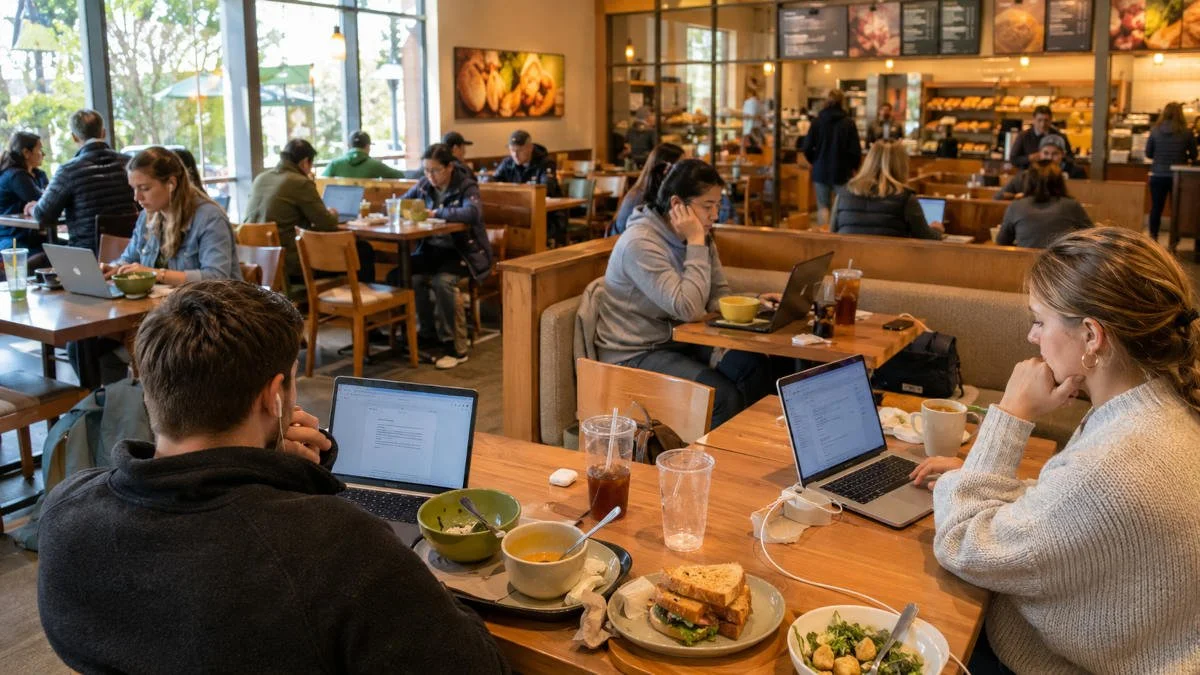
First things first: Panera is not a restaurant so much as a climate-controlled holding pen for people pretending a half sandwich and a spreadsheet constitute “having balance.” It is where America goes when it needs lunch, Wi-Fi, a power outlet, and the faint moral superiority of ordering soup instead of eating fries in a parked car like a raccoon with refinancing options.
Panera did not become the official restaurant of laptop lunch because it was cool. God no. Nobody has ever walked into Panera and thought, “Finally, danger.” Panera became the laptop lunch capital because it mastered something far more powerful than coolness: permission. Permission to sit. Permission to sip coffee for too long. Permission to answer emails in public while chewing bread with the energy of a tired substitute teacher.
And in the age of hybrid work, that is basically a business model with ciabatta.
Panera Free Wi-Fi Built the Laptop Lunch Kingdom
Panera understood the laptop lunch before the laptop lunch knew it had a name. While other restaurants were still acting like Wi-Fi was a government secret, Panera made free internet part of the deal. Today, Panera says it offers free Wi-Fi to guests, no Panera login required, though some locations may limit or disable the service. Translation: yes, you may open Outlook next to the broccoli cheddar, but please do not attempt to found a startup in Booth 7.
This was not some accidental side quest. Back in 2012, USA Today reported through ABC News that Panera had made a “big business bet” years earlier by offering free Wi-Fi long before Starbucks did. The goal was to attract customers between meals, and the experiment reportedly helped raise early sales by about 15%. By April 2012, Panera had 2.7 million monthly Wi-Fi sessions across 1,565 locations, which is less “bakery-café” and more “America’s softest internet café with soup.”
That is the heart of the Panera laptop lunch: the food gets you in the door, but the Wi-Fi lets you pretend you are being productive instead of avoiding your actual office, your actual kitchen, or your actual thoughts.
Panera Became the Third Place for People Who Hate Calling It That
Sociologist Ray Oldenburg coined the idea of the “third place”: somewhere that is not home and not work, where people can hang out and feel vaguely human. Starbucks mainstreamed the concept with comfortable seating, outlets, and free Wi-Fi, and other bakery-café brands followed. Now, restaurants are rediscovering dine-in spaces as people crave places to sit, work, and exist without buying a coworking membership named something unbearable like The Hive Loft Collective.
Panera fits this role because it is aggressively nonthreatening. It is the beige cardigan of restaurant chains. The lighting says, “You can finish your quarterly deck here.” The booths say, “We will not ask why your laptop has 43 tabs open.” The carpet says, “Many have fallen before you.”
Panera is not trying to be sexy. It is trying to be available. And frankly, that is more useful at 12:37 p.m. on a Tuesday when your calendar says “sync” six times and your soul has left the meeting.
Remote Work Made Panera Lunch Make Even More Sense
The laptop lunch boom did not happen in a vacuum. Remote and hybrid work turned lunch from a break into a weird little mobile office migration. Pew Research Center found in 2025 that among employed adults with jobs that can be done from home, 75% were working remotely at least some of the time. Nearly half of workers who currently work from home at least sometimes said they would be unlikely to stay at their job if remote work disappeared.
So yes, people still need somewhere to go. Not the office, obviously; that place has fluorescent lights and someone named Brent saying “circle back” near a microwave. Not home, either, where the laundry is staring at you like unpaid debt.
Panera slots neatly into the middle. It is not home. It is not work. It is a place where you can eat a sandwich, take a call, and pretend the person beside you reviewing PDFs is not slowly becoming part of the furniture.
The Panera Laptop Lunch Menu Is Built for Midday Indecision
Panera’s menu is practically engineered for people who want lunch but refuse to commit emotionally. The famous You Pick Two lets customers choose two entrées from soups, salads, sandwiches, and more, which is perfect for the laptop lunch crowd because it turns indecision into a brand platform.
A full lunch can feel too heavy when you still have three hours of pretending to listen on Zoom. A salad alone feels like punishment from a wellness influencer. Soup alone is what you eat when your immune system has filed a complaint. But soup and half a sandwich? That is civilization. Barely, but still.
Panera has also leaned into its core menu—bakery items, breakfast, soups, sandwiches, salads, and value—while emphasizing taste, quality, and price points. That matters because the laptop lunch customer wants something reliable, not a culinary adventure that requires a waiver and a tiny fork.
Sip Club Turned Panera Into a Subscription-Based Loitering Device
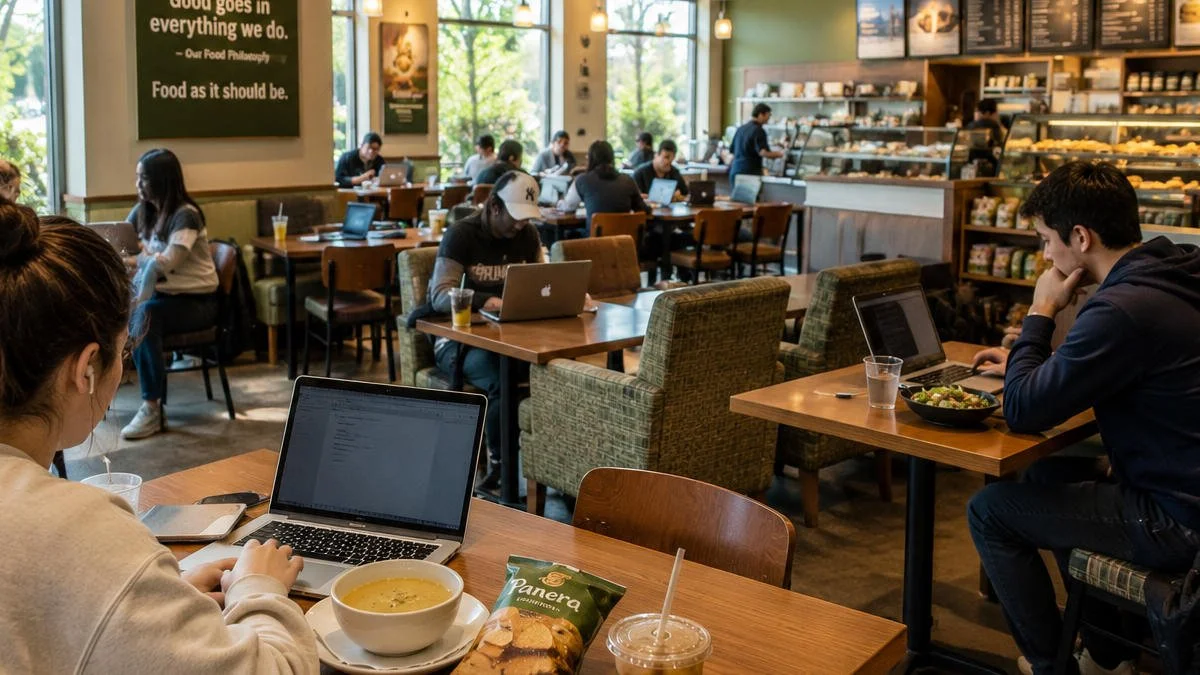
Then came the drink subscription, and Panera basically handed laptop people the keys to the kingdom. The Unlimited Sip Club currently offers eligible drinks once every two hours during normal café hours, including drip coffee, iced coffee, hot tea, fountain drinks, and select bubbler beverages. The standard monthly subscription renews at $14.99 plus tax, with a promotional $5-per-month offer for new monthly subscribers through May 31, 2026.
This is diabolically effective. Not evil, exactly. More like “midwestern evil,” where nobody raises their voice but somehow you now own a reusable cup and have been in the same booth since 10:12.
Sip Club makes Panera feel less like a restaurant visit and more like a mildly hydrated membership lifestyle. You are not buying coffee. You are buying a reason to enter the building again. And again. And again, until the staff recognizes you and your laptop by name.
Panera’s Size Made the Laptop Lunch Habit Scalable
A local café might have better coffee, better pastries, and a barista who looks like they own three synthesizers. But Panera has scale. As of October 28, 2025, Panera reported 2,239 bakery-cafés across 48 states, Washington, D.C., and Ontario, under the Panera Bread and Saint Louis Bread Co. names.
That matters. Laptop lunch depends on predictability. You do not want to gamble your lunch break on a charming little place with four seats, no outlets, and Wi-Fi named after the owner’s dog. You want to know there will be a table, a menu you recognize, a bathroom, and a social contract loose enough to allow 90 minutes of “just finishing something.”
Panera is not always the best option. It is the known option. And known options win, because modern life is already enough of a circus without letting lunch become an escape room.
Panera Is Now Openly Reinvesting in the Café Experience
Panera seems to know the dining room still matters. In its 2025 “Panera RISE” strategy, the company said it would focus on refreshing the menu, value, guest service, and expansion. It also specifically described reinvigorating the bakery-café as an “everyday oasis” and investing in front-of-house labor.
“Everyday oasis” is a bold phrase for a place where someone is probably taking a Teams call next to a cinnamon crunch bagel, but the idea is clear: Panera wants the café to be useful again, not just a pickup shelf with soup branding.
That is smart. The laptop lunch customer is not just buying calories. They are buying a temporary office with better smells.
How to Do Panera Laptop Lunch Without Becoming a Booth Goblin
There is etiquette here, because society has rules even if your inbox does not.
Buy something if you are staying. A coffee counts. A meal counts better. Do not occupy a six-person table during the lunch rush with one laptop, one charger, and the haunted stare of someone formatting a PowerPoint.
Use headphones. Nobody needs to hear your quarterly pipeline call. The broccoli cheddar has suffered enough.
Pick a corner when possible. The best laptop lunch seating is close to an outlet, away from the main flow, and not blocking actual diners who came to commit the ancient human act of eating without spreadsheet accompaniment.
Leave during peak chaos if you are done buying things. Restaurants are not public libraries with paninis. They need table turnover. Be less of a barnacle.
Why Panera Won Laptop Lunch
Panera became the official restaurant of laptop lunch because it did the unglamorous stuff well. Free Wi-Fi. Predictable seating. Familiar food. Unlimited drinks. Enough locations to make it routine. A vibe that says, “Yes, you may send emails here, but please do not become emotionally dependent on the booth.”
It is not glamorous. It is not edgy. It is not artisanal in the “we fermented this chair” sense. But it works.
Panera is the lunch spot for people who need to eat, work, recharge, and briefly convince themselves they are not just one Slack notification away from becoming soup. It is the airport lounge of suburban productivity. The coworking space with baguettes. The official restaurant of laptop lunch, not because anyone crowned it, but because America opened its laptops, looked around, saw free Wi-Fi and soup, and said: “Fine. This will do.”