Why Donald Trump Hasn’t Died of a Heart Attack Yet Even Though His Diet Is Terrible
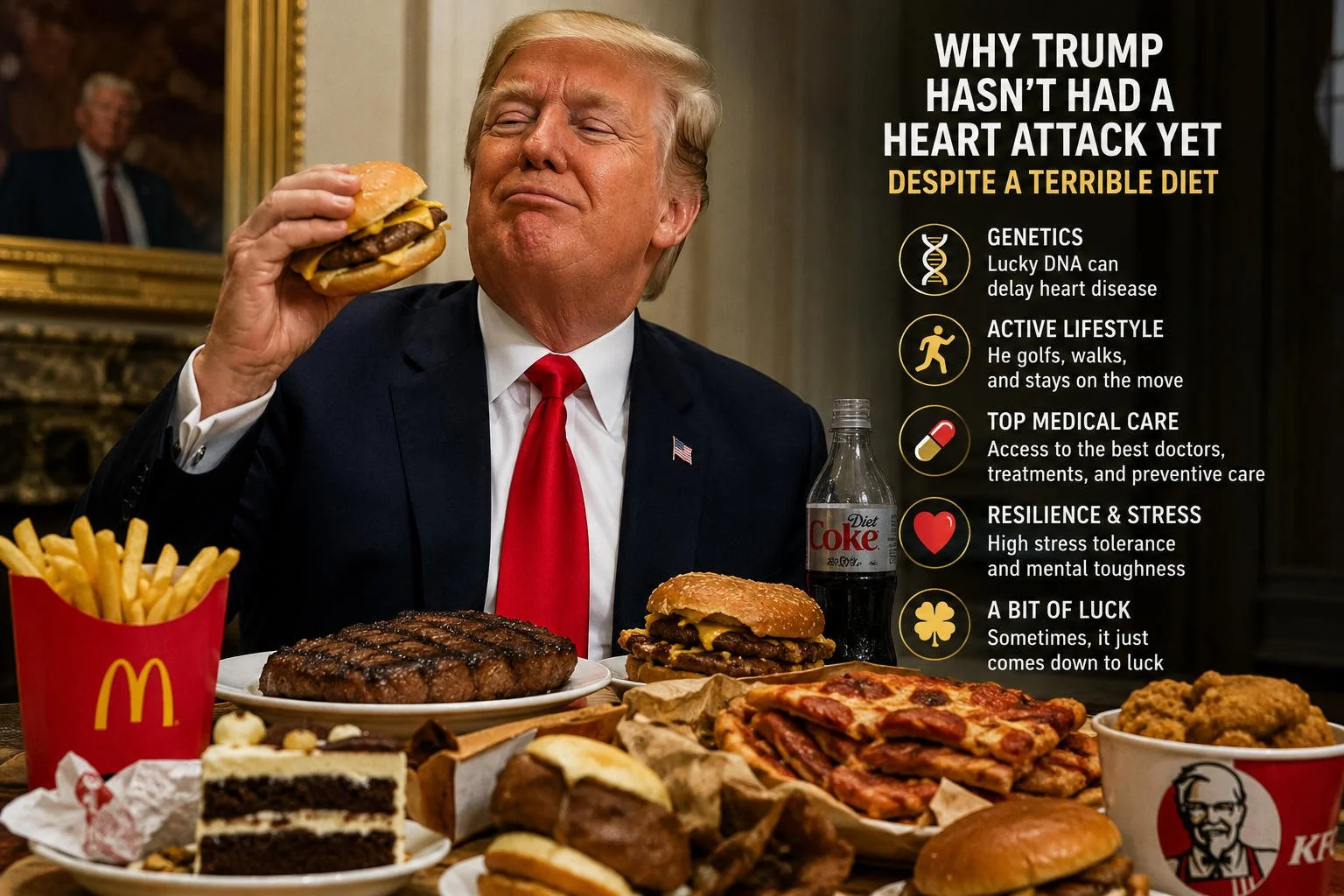
Donald Trump eats like the food pyramid was personally mean to him in the 1980s.
Fast food. Soda. Well-done steak with ketchup. Burgers. Fries. Red meat. The occasional public performance of treating vegetables like suspicious immigrants at the border of his plate. It is not so much a diet as a long-running hostage situation between American chain restaurants and cardiology.
And yet, as of the latest public information, he is still here, still talking, still golfing, still insisting he feels great, and still turning nutrition science into a vibes-based casino. In May 2026, Reuters captured him joking, “Maybe junk food is good,” which is the sort of sentence that makes every registered dietitian quietly stare at a wall.
So why hasn’t he died of a heart attack yet?
The annoying answer: because health risk is not a vending machine. You do not insert Big Macs and instantly receive a myocardial infarction. The human body is unfair, inconsistent, medically managed, genetically loaded, and occasionally operated by pure spite.
A Bad Diet Raises Risk. It Does Not Set a Kitchen Timer.
Let us start by disappointing everyone who wants biology to behave like a morality play.
A terrible diet can raise cardiovascular risk. But it does not mean someone automatically dies at a narratively satisfying moment, preferably after asking for extra ketchup. Heart disease is driven by multiple risk factors: blood pressure, cholesterol, smoking, diabetes, weight, age, family history, physical inactivity, diet, and more. The CDC lists high blood pressure, high cholesterol, and smoking as key risk factors, while also naming obesity, unhealthy diet, physical inactivity, diabetes, and excessive alcohol use as important contributors.
That means diet matters. It just does not operate alone. It is one villain in a crowded room, not the entire Marvel franchise.
Trump’s diet may look like it was assembled by a child with a lobbyist, but cardiovascular risk is cumulative. Some bad factors hurt you. Some good factors help you. Some medicines intervene. Some genes laugh in the face of logic. Some people do everything “right” and still get sick. Some people eat like the fryer oil has a security clearance and somehow keep going.
Fair? No. Biology has never been accused of customer service.
The Public Health Reports Actually Show Some Good Numbers
Here is the part that ruins the cheap joke, so naturally it has to be included.
Trump’s April 2025 White House physician memo listed him at 75 inches tall and 224 pounds, with blood pressure of 128/74, resting heart rate of 62, fasting glucose of 89.7, A1c of 5.2, total cholesterol of 140, HDL of 77, and LDL of 51. The same report said his EKG and echocardiogram showed no abnormalities and described his heart function as normal.
Now, should we treat presidential medical summaries like stone tablets delivered from Mount Sinai? Absolutely not. Presidential health disclosures are curated documents, not a livestream from the inside of the left ventricle. But based on the numbers released, his cholesterol and blood sugar were not screaming “fast-food catastrophe” in the way you might expect from the public legend of a man spiritually sponsored by McDonald’s.
This is where the article becomes unfairly educational: what someone eats and what their bloodwork looks like are related, but not identical. Medication, genetics, body composition, age, activity, sleep, stress, and reporting limitations all matter.
Very rude of the body to have nuance. Someone should hold hearings.
Cholesterol Medication Is Doing Heavy Lifting, Because Of Course It Is
The same 2025 physician memo listed Trump as taking rosuvastatin and ezetimibe for cholesterol control, plus aspirin for cardiac prevention.
That is not a small detail. That is basically the heart-health equivalent of hiring a cleanup crew after the fast-food parade.
Statins such as rosuvastatin lower LDL cholesterol and reduce the risk of heart attack and stroke; ezetimibe reduces intestinal cholesterol absorption and is commonly used as an additional LDL-lowering drug.
So when people ask why Trump’s cholesterol numbers appear controlled despite a reported diet heavy in fast food and steak, the answer may include: because modern medicine exists and is apparently willing to do the dishes after dinner.
This is not an endorsement of eating like a drive-thru menu with legs and saying, “My statin will handle it.” That is not a health plan. That is making your liver work customer service. But medication can substantially reduce certain risks, especially LDL-related risk.
Not Smoking Is a Huge Advantage
Trump’s official health summary says he has lifelong abstinence from tobacco and alcohol.
This matters enormously. Smoking is one of the biggest cardiovascular risk factors. The CDC lists smoking among the key heart disease risk factors, alongside high blood pressure and high cholesterol.
So while Trump’s food choices may resemble a patriotic assault on fiber, his avoidance of tobacco is a major protective factor. Same with alcohol, depending on the person and pattern of use.
This is one of those deeply irritating health realities: a person can have one awful habit and still benefit from avoiding another awful habit. The body is not grading on moral consistency. It is not saying, “Well, he put ketchup on steak, revoke vascular privileges.” It is adding and subtracting risks like a grim little accountant.
He Has Rich-Guy Medicine, Which Is Different From Normal Medicine
Another factor: Donald Trump is not trying to get a cardiology appointment through an insurance portal designed by goblins.
He is the president of the United States. He has constant access to physicians, testing, monitoring, specialists, and Walter Reed. In 2026, he was scheduled for a third medical checkup at Walter Reed in just over a year; reports noted that his October 2025 follow-up included advanced imaging, which his doctor said was recommended to rule out cardiovascular issues.
This matters because early detection, medication adjustment, and immediate access to care can change outcomes. A wealthy and medically monitored person can carry risk factors differently than a regular American who has to decide whether chest discomfort is “bad enough” to justify a $2,000 emergency-room roulette spin.
Same biology. Different support system. Charming little country we’ve built.
Age Raises Risk, But It Does Not Guarantee Collapse on Schedule
Trump will turn 80 on June 14, 2026. Age is a major cardiovascular risk factor, which is why doctors become increasingly interested in the plumbing after a certain point, much like homeowners with old pipes and denial.
But age is not a deadline. Plenty of people live into their 80s and beyond with risk factors. Plenty of people do not. The body is a probability machine, not a Netflix plot arc.
This is why the public fascination with Trump’s diet is so weirdly satisfying and scientifically shallow. People want his food choices to produce instant cosmic justice, preferably involving a Filet-O-Fish wrapper as Exhibit A. But risk works over decades. Arteries do not care about your narrative demands. They are busy being tubes.
His Reported Diet Is Still Not Good, Please Do Not Be Cute
Now, none of this means his diet is secretly genius. Let us not let the junk-food lobby drive the ambulance.
Reports over the years have repeatedly described Trump as fond of fast food, Diet Coke, and well-done steaks with ketchup; former campaign staff and food writers have made his eating habits part of his public mythology.
A diet heavy in fast food and red meat can be high in sodium, saturated fat, calories, and ultra-processed ingredients, all of which can contribute to higher cardiovascular risk depending on the overall pattern. The American Heart Association notes that unhealthy diets high in sodium, calories, saturated fats, trans fats, and sugar increase high-blood-pressure risk, and being overweight adds strain to the heart and circulatory system.
So no, “Trump is alive” is not evidence that fast food is health food. That is like saying “my uncle never wore a seatbelt and lived to 92” as if physics has been defeated by family lore.
Anecdotes are not nutrition science. They are stories wearing confidence.
The Public Doesn’t Actually Know His Full Medical Picture
The most honest answer is also the least satisfying: we do not know everything.
We have public summaries. We have reported food habits. We have visible observations. We have political spin. We have official claims. We do not have complete medical records, coronary calcium scores, detailed imaging reports, full longitudinal labs, sleep data, exercise data, stress markers, genetics, or the contents of every meal.
The Washington Post reported in May 2026 that independent physicians had raised questions about Trump’s bruised hands, swollen legs, and the transparency of White House health disclosures, while noting that presidents are not required to disclose full health records.
So the article title asks, “Why hasn’t he died of a heart attack yet?” The grown-up answer is: because from the outside, nobody can calculate his exact risk, and death does not follow a pundit schedule.
Annoying. Accurate. The worst combination.
Genetics and Luck Are Real, Which Is Terrible News for Moralizers
A lot of health commentary quietly assumes that bodies dispense justice. Eat badly, die early. Eat well, live forever. Very tidy. Very wrong.
Genetics matter. Family history matters. Randomness matters. Medical care matters. Some people are metabolically lucky. Some are not. Some people can tolerate years of bad habits better than others. Some people get clobbered despite trying hard.
This does not mean lifestyle is meaningless. It means lifestyle is one major input into a system that also includes inherited risk, accumulated exposures, environment, stress, access to care, and luck.
Basically, your arteries are not running a meritocracy. Which, given the subject of this article, feels thematically appropriate.
Trump Also May Not Eat Terribly Every Single Meal
Public diet lore is always exaggerated because “man eats normal grilled chicken sometimes” is not a headline. Nobody clicks that. Nobody wants to read “President Has Salad, Nation Continues.”
Trump’s public food image is fast food, steak, Diet Coke, and dessert. But he is also surrounded by professional kitchens at the White House, Mar-a-Lago, clubs, fundraisers, and official events. It is possible that the infamous foods are real but not the entire picture.
That does not make the diet good. It just means we should not pretend a handful of memorable menu items equals a complete nutritional audit.
The man’s diet may be terrible. It may also be less cartoonishly constant than the public myth. Sadly, the body does not care about memes. It cares about averages.
The “He Feels Great” Argument Is Not Science
Trump has repeatedly framed his survival as evidence that maybe the usual health advice is overrated. This is classic rich-guy folk medicine: “I feel fine, therefore the rules are fake.”
No.
Feeling fine is nice. Feeling fine is not a diagnostic test. Many cardiovascular problems build quietly. A person can feel fine right up until the body announces a merger with the emergency department.
That is why screening exists. That is why blood pressure matters. That is why cholesterol matters. That is why doctors keep asking questions instead of simply reading a Truth Social post and saying, “Well, he says he feels young, pack it up, cardiology is solved.”
What This Actually Teaches About Diet and Heart Risk
The useful takeaway is not “eat like Trump.”
The useful takeaway is also not “every unhealthy eater is doomed tomorrow.”
The useful takeaway is this: heart risk is layered. Diet matters. Weight matters. Blood pressure matters. Cholesterol matters. Smoking matters. Diabetes matters. movement matters. Medications matter. Age matters. Access to healthcare matters. Luck matters.
A terrible person can have a terrible diet and still have controlled cholesterol because they take medication. A person can be overweight but not diabetic. A person can avoid tobacco and alcohol, lowering two major risks. A person can be medically monitored so problems are caught earlier. A person can be alive not because the habits are good, but because the total risk picture has not yet produced the catastrophic event everyone keeps mentally scheduling.
This is less emotionally satisfying than “fast food man should explode,” but it has the advantage of being true.
The Heart Is Not a Punishment Button
Donald Trump has not died of a heart attack despite his reported diet because the human body is a messy probability engine, not a Fox News chyron with arteries.
His diet may be lousy. His age raises risk. His weight is not ideal. His public food preferences are a cardiologist’s haunted screensaver.
But he also reportedly does not smoke or drink. His publicly released cholesterol numbers were low, likely helped by cholesterol medication. His blood sugar numbers were normal in the 2025 summary. His official cardiac testing was described as normal. He has elite medical access. He has monitoring, specialists, medications, and enough institutional healthcare support to make the average American’s insurance plan crawl under a desk and cry.
So no, his survival is not proof that junk food is secretly good.
It is proof that risk is not destiny, medicine is powerful, privilege matters, and biology refuses to deliver clean moral endings just because the menu looks like it was assembled by a 12-year-old billionaire in a golf cart.
The steak may be well-done.
The science, unfortunately for everyone’s jokes, is not.