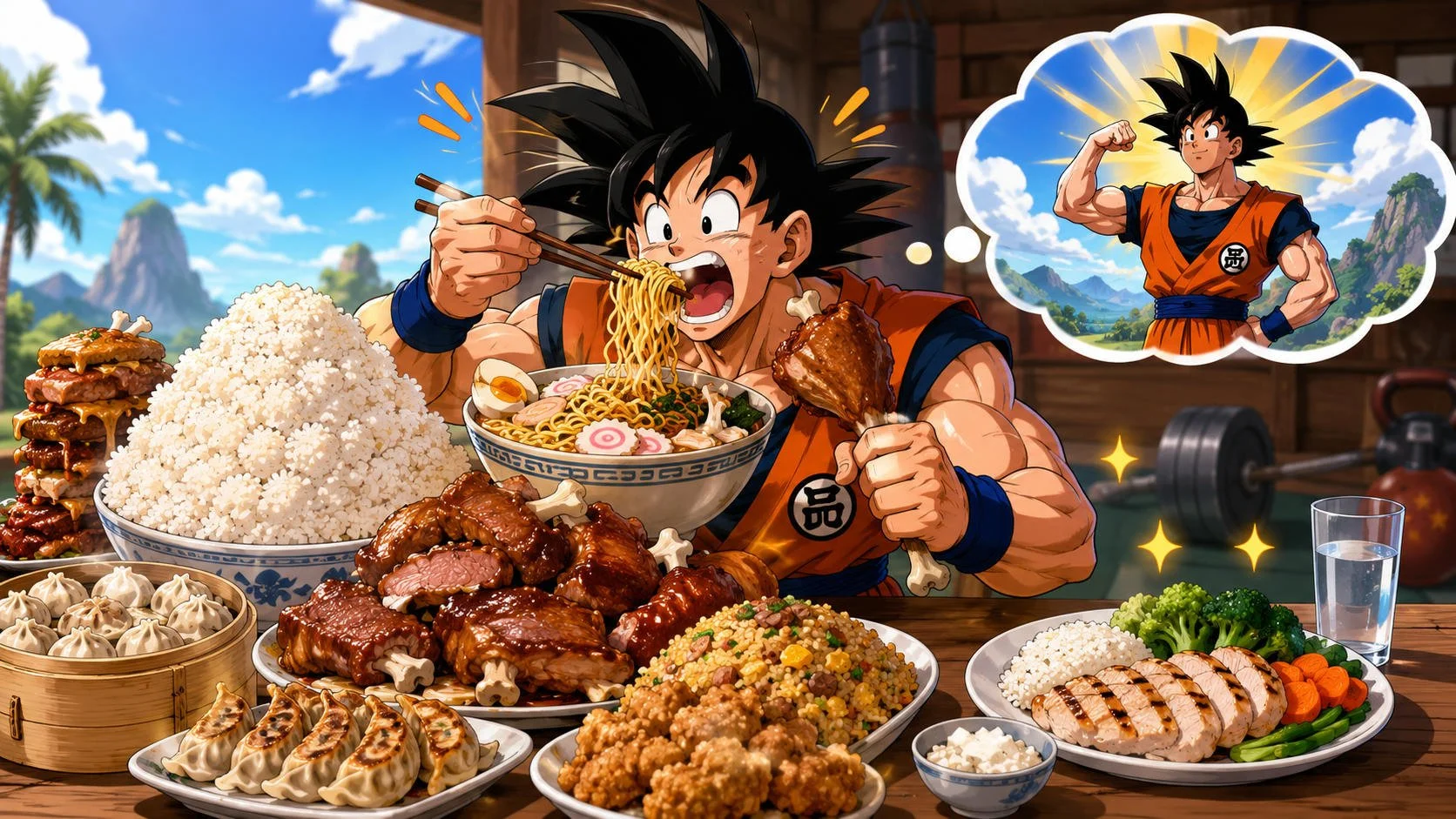
Goku eats like a man who saw a buffet and decided it had insulted his family.
A normal athlete finishes training and has rice, meat, vegetables, maybe a protein shake. Goku finishes training and inhales enough food to bankrupt a cruise ship. Whole fish. Mountains of rice. Meat on the bone. Bowls stacked like construction materials. The man treats dinner like a boss fight and somehow walks away shredded, cheerful, and ready to punch a god.
Wonderful television. Horrible nutrition advice.
Because here is the inconvenient little reality: Goku is not a fitness influencer. He is an alien martial arts hurricane with cartoon metabolism, gravity-room trauma, and the digestive system of a wood chipper blessed by Zeus. Copying his eating habits because you want abs is like copying Mario’s plumbing technique because you want to improve your squat.
Goku Is a Saiyan, Not a Meal Plan
The official Dragon Ball site does not exactly hide the gag. It notes that Saiyans like Goku, Gohan, and Vegeta have eating habits “about as different from regular humans as their power levels are,” and even cites a scene where young Goku eats the equivalent of 50 people’s worth of food after the 21st Tenkaichi Budokai. That is not “bulking.” That is a restaurant insurance event.
This is the first thing Goku gets wrong for real-world fitness: he makes absurd intake look consequence-free.
In anime logic, huge meals equal fuel, recovery, comedy, and proof that the hero is built different. In human logic, huge meals equal calorie surplus, digestion, sleepiness, possible fat gain, and you lying on the couch whispering “why did I do this” while a pile of takeout containers judges you.
Goku can eat like a forklift because the story needs him to. You, tragically, live in a body governed by biology, not Akira Toriyama’s panel pacing.
Huge Meals Do Not Automatically Build Muscle
The Goku fantasy says: train hard, eat gigantic, become powerful.
The human version is more annoying: train progressively, eat enough, recover, repeat for months, and maybe your sleeves get slightly tighter if life doesn’t sabotage you with stress, sleep debt, and the siren song of gas station taquitos.
Sports nutrition texts commonly recommend a calorie surplus of roughly 400–500 calories per day for athletes trying to gain mass, aiming for slow weekly gains that are more likely to include lean mass when paired with resistance training. That is a modest surplus, not “eat until your chair files a workers’ comp claim.”
And newer research on trained lifters suggests that faster weight gain from larger surpluses may mostly increase fat gain rather than magically creating more strength or muscle thickness. In other words, more food can become more body weight, yes. Congratulations, science has discovered the pantry. But more body weight is not automatically more muscle.
Your body is not a vending machine where you insert ramen and receive delts.
Goku Confuses “Fueling” With “Demolishing the Dining Room”
To be fair, the man trains hard. Ridiculously hard. Goku runs, spars, lifts, fights, dies, comes back, trains under gods, trains in gravity, fights again, eats again, and somehow remains more emotionally available to combat than to parenting.
The official Dragon Ball site describes his training on King Kai’s planet, where gravity is 10 times Earth’s. Even after removing his heavy training uniform and eating his fill, Goku still could not catch Bubbles at first; only after about 40 days did he adjust.
That detail is accidentally useful: food did not do the training for him.
Eating helped him recover, sure. But adaptation came from repeated stress, practice, and time. He did not eat a heroic lunch and immediately unlock “Monkey Capture Ultra Instinct.” He trained. Then trained more. Then kept training until his body adapted.
That is the fitness lesson buried under the rice mountain: food supports training. It does not replace it.
Eating Huge Before Training Is How You Become a Weighted Vest With Regrets
Goku will eat a banquet and then go fight someone who can destroy a moon. This is entertaining because he is fictional and because nobody wants to watch a 22-minute episode where he waits for digestion.
In real life, eating a huge meal before training is a great way to feel like your stomach has become a duffel bag full of soup.
Mayo Clinic advises eating large meals at least three to four hours before exercise and small meals or snacks one to three hours before exercise; eating too much before training can leave you feeling slow, while eating too little may leave you underfueled. Cleveland Clinic similarly recommends a balanced meal three to four hours before exercise, with carbs and moderate lean protein, while limiting fats and fiber because they digest more slowly and can upset your stomach.
Translation: do not eat like Goku and then attempt leg day unless you want your warmup to become a courtroom drama between your intestines and gravity.
Goku’s Protein Strategy Is Basically “Yes”
Goku’s approach to protein appears to be: eat all available animals, pause briefly, then ask whether more animals exist.
This is spiritually powerful and nutritionally stupid.
The International Society of Sports Nutrition recommends about 1.4–2.0 grams of protein per kilogram of body weight per day for most exercising individuals trying to build or maintain muscle. It also notes that per-serving recommendations are often around 20–40 grams of high-quality protein, or about 0.25 grams per kilogram, ideally distributed every three to four hours.
That is the part Goku misses: distribution matters.
One absurd protein landslide is not necessarily better than several useful meals. Your body can use a lot of protein across the day, but “one whole steer after sparring” is not a superior strategy. It is just a picnic for wolves with biceps.
Better move: protein at each meal. Eggs, yogurt, chicken, tofu, fish, beans, lean beef, cottage cheese, protein powder if needed. Boring? Yes. Effective? Also yes. Fitness is mostly boring things done consistently, which is why anime wisely skips the grocery list.
Carbs Are Not the Villain, but Goku Still Overdoes the Buffet Arc
One thing Goku gets right: he is not afraid of carbohydrates. Rice, noodles, bread, fruit, whatever. He eats carbs like someone who understands that high-output training needs fuel.
This is good. Carbs are not tiny demons. They are the main fuel source for hard training, especially high-intensity efforts. The joint position paper from Dietitians of Canada, the Academy of Nutrition and Dietetics, and the American College of Sports Medicine states that performance and recovery are enhanced by well-chosen nutrition strategies, including the right type, amount, and timing of food and fluids.
But the word is well-chosen, not “dump the entire rice cooker into your face and call it discipline.”
Carbs help. Calories still count. Timing still matters. Food quality still matters. You cannot turn every meal into a Saiyan festival and then blame your metabolism for refusing to animate properly.
The Missing Goku Food Group: Vegetables That Are Not Just Decoration
The official Dragon Ball food article actually says balanced meals with staple foods, mains, and side dishes are important for martial artists. Amazing. Even the franchise is out here saying, “Maybe eat a vegetable, you orange-pajama chaos goblin.”
Goku’s on-screen meals, though, are usually meat, rice, noodles, fish, and more meat. Vegetables appear with the emotional confidence of background extras at a disaster movie.
Real fitness needs micronutrients, fiber, hydration, and gut health. You need fruits and vegetables. You need potassium, magnesium, folate, vitamin C, phytonutrients, and all the other deeply unsexy nutrients that do not get fan art but do help your body function.
A plate of meat and rice is fine.
A mountain of meat and rice forever is how your colon starts writing a memoir.
Huge Meals Can Make Recovery Worse If They Wreck Sleep
Goku can presumably sleep after eating enough food to feed a youth soccer league. You may not be so lucky.
Huge late meals can mean reflux, poor sleep, stomach discomfort, and the sensation that your digestive system is moving furniture at 2:17 a.m. And sleep is not optional for fitness. It is where recovery happens, which is extremely annoying because it means the least macho activity in the world is one of the most anabolic.
The gym crowd loves to talk about “beast mode,” but nobody wants to admit beast mode needs bedtime.
A realistic fitness diet is not just “eat more.” It is eat enough, eat at useful times, hydrate, recover, and stop treating your digestive system like a training partner you are trying to defeat.
Goku’s Biggest Lie Is That Appetite Equals Need
Goku is hungry, therefore Goku eats. Fine. He is Goku. His body burns through energy like a jet engine in a karate gi.
But normal people often confuse appetite, boredom, stress, habit, reward-seeking, and actual energy need. You may not need a huge meal. You may be tired. You may be under-slept. You may be thirsty. You may be emotionally recovering from an email. You may simply want fried chicken because existence is rude.
That does not make you bad. It makes you human, which is like being a Saiyan except weaker and with insurance paperwork.
The mistake is turning every craving into “fuel.” A 2,000-calorie feast after a 45-minute workout is not automatically recovery. Sometimes it is just dinner wearing a fake mustache.
What Goku Actually Gets Right
Goku is wrong about portion size for humans, but he is not wrong about everything.
He eats after hard training. Good.
He is not scared of carbs. Good.
He eats real food, not just powders named “Anabolic Thunder Dust.” Good.
He trains consistently. Very good.
He understands that performance requires fuel. Also good.
He does not seem to spend 45 minutes arguing online about whether rice is “optimal,” which may be his greatest achievement.
The problem is scale. Goku’s principles are useful. His portions are psychotic.
The Human Version of a Goku Fitness Diet
A sane Goku-inspired diet would look nothing like Goku’s actual plate, because again, you are not an alien fist tornado.
For muscle gain, aim for a modest calorie surplus, not a buffet massacre.
Get protein at each meal, roughly 20–40 grams depending on body size and training.
Eat carbs around training so you have energy instead of performing squats like a dying phone battery.
Include fats, but do not load up on greasy, heavy meals right before workouts unless your goal is to burp through deadlifts.
Eat fruits and vegetables because your body is not built entirely from steak and plot armor.
Hydrate.
Sleep.
Adjust based on results.
If weight is flying up and your strength is not, congratulations, your “bulk” has become a storage unit. Reduce the surplus. If training performance is trash and weight is dropping, eat more. If digestion is terrible, stop treating dinner like a competitive sport.
The Goku Meal Timing Rule
Here is the practical version:
Before training, eat something digestible: rice, oats, banana, toast, yogurt, eggs, lean protein, a simple sandwich, or whatever your stomach tolerates.
After training, eat carbs plus protein within a reasonable window. Mayo Clinic suggests a meal with both carbs and protein within two hours after working out when possible, to help recovery and glycogen replacement.
Across the day, distribute protein instead of trying to solve muscle growth with one giant evening meat avalanche.
This is less exciting than Goku inhaling 30 bowls of food, but it has the advantage of working in a universe where your stomach is not drawn by animators.
The Anime Bulk Is Not a Personality
The worst thing Goku teaches gym people is the romantic idea that eating huge is inherently hardcore.
It is not.
Sometimes eating big is necessary. Competitive athletes, hard gainers, endurance athletes, and people doing high-volume training may need a lot of food. Fine. Great. Bring snacks.
But “I train, therefore I must eat like a cartoon bear” is not strategy. It is cosplay with macros.
A disciplined surplus is strategy.
A planned meal schedule is strategy.
Tracking performance, body weight, recovery, and digestion is strategy.
Eating until your soul leaves and then calling it “the grind” is just gastrointestinal theater.
Final Verdict: Goku Is Fitness Inspiration, Not Nutrition Guidance
Goku gets huge meals wrong because he makes eating absurd amounts look like the secret to strength. It is not. The secret is training stimulus, enough energy, enough protein, smart carbs, recovery, sleep, consistency, and not using anime biology as a dietary framework.
He is a Saiyan. You are a person with rent, joints, and a stomach that does not operate on shonen logic.
Steal Goku’s discipline. Steal his joy in training. Steal his refusal to fear food. Steal his love of rice if you must.
Do not steal his portion sizes.
Because unless you are training under 10 times Earth’s gravity, fighting intergalactic tyrants, and recovering from death as a recurring career obstacle, you probably do not need a 50-person meal.
You need dinner.
Calm down, Kakarot.