Why Costco Is the Guy Fieri of Grocery Stores
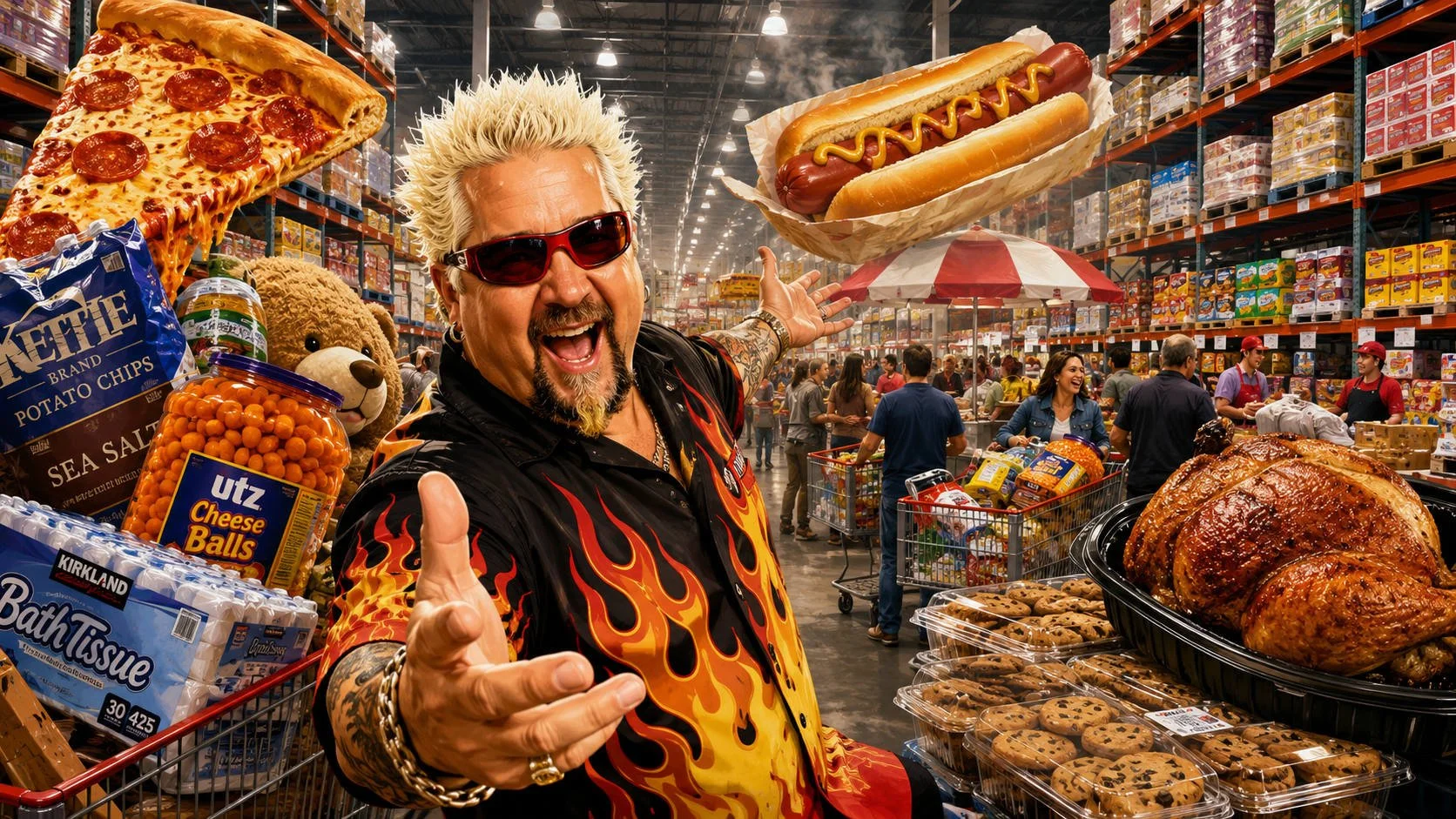
Costco is not a grocery store. Let us start there. A grocery store is where you buy apples, milk, cereal, and maybe one emotionally unnecessary candle. Costco is where you enter for paper towels and leave with a rotisserie chicken, 48 batteries, a kayak-adjacent object, two pounds of pesto, sweatpants, a mattress topper, and the haunted feeling that you just participated in a retail religious ceremony.
Which brings us to Guy Fieri.
Costco is the Guy Fieri of grocery stores because it has no interest in being elegant, restrained, or approved by people who say “curated” while holding a $14 bottle of shrub vinegar. It is loud. It is populist. It is excessive. It is deeply American. It is somehow both ridiculous and extremely good at what it does. Like Guy Fieri, Costco has built a massive empire by understanding one sacred truth that snobs keep missing while nibbling microgreens in a room full of exposed brick: people love big flavor, big value, big portions, and the feeling that somebody is actually on their side.
Costco currently operates hundreds of warehouses around the world, reporting 914 warehouses as of September 2025 and fiscal-year net sales of $269.9 billion. This is not “a store.” This is a bulk-buying civilization with forklifts.
Costco and Guy Fieri Both Made Excess Feel Friendly
Guy Fieri’s whole brand is excess without apology. Spiky hair. Flame shirts. Donkey Sauce. Camaro energy. A vocabulary that sounds like a barbecue menu got into energy drinks. He does not whisper food into being. He announces it with sunglasses on the back of his head.
Costco works the same way.
Nothing at Costco is subtle. The carts are enormous. The ceilings look like an aircraft hangar. The peanut butter comes in sizes that suggest your household is either very large or preparing for a regional shortage. The muffins are sold in quantities that make “just one” impossible because apparently baked goods now require inventory management.
But the trick is that Costco’s excess feels friendly, not fancy. It does not say, “Look how exclusive this is.” It says, “Look how much you get.” That is the same emotional lane Guy Fieri owns. He did not become famous by telling America to admire a single scallop under a foam cloud. He became famous by championing diners, drive-ins, barbecue joints, sandwich shops, burger counters, and places where the menu understands cheese as both ingredient and architecture.
Food Network’s official bio notes that Fieri studied hospitality management at UNLV, opened his first restaurant, Johnny Garlic’s, in 1996, and later built a large restaurant and media career around accessible, high-energy food culture. Translation: the man knows how to turn comfort food into a whole weather system.
The Costco Food Court Is Flavortown With Fluorescent Lighting
If Costco had a mayor, it would not be a finance executive in a quarter-zip. It would be Guy Fieri holding a $1.50 hot dog combo and pointing at the soda machine like he had discovered democracy.
The Costco food court is one of the great American value shrines. It is not beautiful. It is not atmospheric. It has the ambiance of a DMV that learned to make pizza. But it knows exactly what it is: cheap, filling, dependable, and immune to your artisanal sandwich opinions.
Costco sold more than 245 million hot dog-and-soda combos in fiscal 2025, according to comments from its CFO reported after the company’s earnings call. That is not a snack program. That is a national infrastructure project with mustard.
The hot dog combo is pure Fieri logic: big, simple, affordable, slightly absurd, and beloved because it refuses to become precious. No one wants the Costco hot dog “deconstructed.” No one wants the bun replaced with a heritage grain crisp. No one wants it served on slate with pickled ramps and a story about the butcher’s childhood. They want a hot dog and a drink for $1.50, because sometimes civilization briefly remembers how to be useful.
The Rotisserie Chicken Is Costco’s Triple-D Feature
Every Guy Fieri episode has that moment where he walks into a modest-looking place and reveals that some unglamorous dish has a cult following. Costco’s version is the rotisserie chicken.
The $4.99 Kirkland Signature rotisserie chicken is Costco’s edible mascot. It is cheap, hot, salty, ready, and displayed at the back of the warehouse like a poultry pilgrimage site. In 2025, Costco reported selling more than 157 million rotisserie chickens, and the $4.99 price has been held steady since 2009.
That chicken is not just dinner. It is Costco saying, “We know why you came.” Just like Fieri finds the dish that keeps locals coming back, Costco knows the chicken is part grocery item, part traffic engine, part household emergency plan. You can shred it into tacos, soup, salad, sandwiches, pasta, rice bowls, or eat the skin over the sink like a raccoon with a mortgage. No judgment. Well, some judgment. But not enough to stop you.
The chicken also reveals the darker grown-up part of the Costco-Fieri comparison: value has machinery behind it. Costco’s chicken strategy has drawn scrutiny and lawsuits over production, labeling, and food-safety allegations. That does not cancel the cultural power of the bird, but it does remind us that miracle pricing usually has backstage labor, sourcing, and supply-chain consequences.
Kirkland Signature Is the House Sauce
Guy Fieri has Flavortown. Costco has Kirkland Signature.
Kirkland Signature is not just a private label. It is Costco’s secret handshake. It turns batteries, vodka, olive oil, toilet paper, coffee, dog food, lasagna, protein bars, and golf balls into one giant trust exercise. Costco’s investor profile says Kirkland Signature products are designed to be equal or better quality than national brands, while Costco’s own Kirkland page calls the brand one of the main reasons to become a member.
That is extremely Guy Fieri. The branding is not subtle. It does not have a delicate serif font and a pastoral goat on the label. It says Kirkland Signature like a man slapping the roof of a bulk detergent tub.
And yet people trust it. That is the genius. Kirkland has made private label feel less like a compromise and more like insider knowledge. Buying Kirkland is not “settling.” It is “knowing the move.” It is the grocery equivalent of Fieri walking into a strip-mall diner and telling you the meatloaf is secretly outstanding.
Costco Is Proudly Uncool, Which Makes It Cool
Costco does not chase cool. That is why it became cool.
A normal trendy grocery store wants you to admire its tiny sauces, hand-stacked citrus, chalkboard fonts, and cheese counter that feels emotionally overqualified. Costco says, “Here are 36 croissants, a pressure washer, and a pallet of sparkling water. Good luck.”
That is deeply Fieri. Guy Fieri became a cultural force partly because he refused to pretend food had to be fragile to matter. He did not ask permission from the tweezers-and-foam class. He drove around eating burgers, wings, ribs, tacos, sandwiches, and fried things while saying words like “money” and “off the hook” with the confidence of a man who knows television food snobbery is mostly scented candle smoke.
Costco has the same anti-snob appeal. It is not embarrassed by quantity. It does not apologize for value. It does not care whether your dinner party guests are impressed that the Brie came in a wheel large enough to stop a door.
It knows the American household truth: people need food, toilet paper, snacks, laundry detergent, and maybe a 12-foot skeleton if the seasonal aisle gets persuasive.
The Treasure Hunt Is Costco’s Flavor Road Trip
Fieri’s whole television mythology is the road trip: somewhere out there, in a town you were not paying attention to, a person is making something incredible in a place with laminated menus and suspiciously good fries.
Costco has its own version: the treasure hunt.
You walk in for groceries and find Korean barbecue jerky, Belgian cookies, a six-pack of marinara, imported cheese, a robot vacuum, wool socks, patio furniture, and a seasonal dessert that somehow weighs more than a newborn. Costco’s investor profile says its warehouses carry one of the largest and most exclusive product-category selections under one roof, from groceries and appliances to apparel, jewelry, automotive supplies, furniture, and office equipment. That is not shopping. That is retail wandering with consequences.
This randomness is not a flaw. It is the show.
You do not shop Costco purely with a list. You shop Costco with a list and emotional flexibility. The treasure-hunt items are the grocery equivalent of Fieri turning down a side street and finding a barbecue joint attached to a gas station that somehow serves brisket capable of healing generational trauma.
Both Brands Understand the Power of the Regular Person
Guy Fieri’s genius is not that he made food fancy. It is that he made normal food feel worth celebrating.
Costco does that too. It celebrates household competence. Not sexy competence. Not influencer competence. Real competence. Feeding a family. Stocking a pantry. Saving on gas. Buying snacks for a soccer team. Getting a sheet cake. Finding dinner when everyone is tired. Purchasing enough paper towels to survive a youth birthday party.
Costco’s model is membership-based, and its company profile says it exists to offer quality, brand-name merchandise at substantially lower prices than conventional retail sources. That is the entire emotional pitch: pay to enter the club, then feel like you are winning once inside.
Fieri’s emotional pitch is similar: come to Flavortown, where food does not have to be elite to be worthy. Come to the diner. Come to the drive-in. Come to the place with neon signs, giant portions, and a cook who cares more about flavor than posture.
Both brands flatter the ordinary person without acting superior to them. This is rare. Most brands either pander or lecture. Costco and Fieri do neither. They hand you a giant portion and say, basically: you get it.
Costco Samples Are Grocery Television
The free sample station is Costco’s version of a Guy Fieri tasting scene.
A tiny paper cup of soup. A square of frozen pizza. A bite of sausage. A cube of cheese. A miniature dumpling. A cookie fragment so small it barely exists, yet somehow causes six adults to form a line like pilgrims.
Samples turn shopping into content. They create little episodes inside the warehouse. You do not just buy food; you encounter food. You try it. You judge it. You walk away pretending you were not influenced, then circle back and put the 48-count box in your cart because the sample lady smiled and your defenses collapsed.
This is very Fieri. He understands that food becomes more persuasive when someone enthusiastic hands it to you and says, “You gotta try this.” Costco has industrialized that moment with hairnets and toothpicks.
Costco Makes Value Feel Like Swagger
Budget shopping is often framed as compromise. Costco turns it into swagger.
The giant cart says: I planned ahead. The hot dog says: I beat inflation at lunch. The rotisserie chicken says: dinner is handled. The Kirkland bottle says: I know the house brand is the move. The 30-pack of paper towels says: my household fears nothing except storage limitations.
That is pure Guy Fieri energy. His style takes food that snobs might dismiss and gives it swagger. Chili cheese fries are not sad. They are righteous. Burgers are not basic. They are art if the crust is right and the sauce has conviction. A diner is not low-status. It is a community institution with onion rings.
Costco does the same for grocery value. It makes saving money feel less like sacrifice and more like participation in a secret economy where a giant bag of almonds is somehow a flex.
The Portions Are Ridiculous Because the Audience Is Honest
Costco understands that people are not always buying for tonight. They are buying for households, parties, kids, offices, neighbors, freezers, holidays, sports teams, and that vague future self who will absolutely use all 96 tortillas before they become a dry stack of regret.
Guy Fieri understands this too. His food world is not built around one delicate bite. It is built around abundance. Sauces run. Cheese melts. Sandwiches require two hands and a legal strategy. Plates arrive like they have something to prove.
The snob complaint is obvious: too much, too loud, too big, too obvious. And yes. Correct. That is the point.
Abundance is part of the pleasure. Costco and Fieri both know that food is not only fuel or status or nutrition. Sometimes food is reassurance. The fridge is stocked. The table is full. The sandwich is large enough to create a logistical challenge. The party will not run out of chips unless someone invites a youth hockey team.
Costco Is Not Classy. It Is Useful. That Is Better.
There is a certain kind of grocery store that wants to make you feel refined. Costco wants to make you feel prepared.
This is why the Guy Fieri comparison works so well. Fieri is not selling refinement. He is selling pleasure, personality, and high-functioning chaos. Costco is the same. It does not ask you to admire its restraint. It asks whether you want a 6-pound lasagna and a discounted set of tires.
Useful is underrated because useful is not sexy. But useful is what people return to. Costco’s renewal rates were 92.3% in the U.S. and Canada and 89.8% worldwide at the end of fiscal 2025. People do not renew memberships at that rate because the lighting is romantic. They renew because the place works.
Guy Fieri works too. The man is easy to parody, which lazy people confuse with being easy to dismiss. But his endurance comes from sincerity. He loves the food. He loves the operators. He loves the big messy American middle of eating culture. Costco has that same weird sincerity. It sells value without acting embarrassed by value.
What Grocery Stores Can Learn From Costco’s Flavortown Energy
Costco proves that value is a brand personality, not just a price point. A cheap product can feel cheap. A value product can feel heroic. The difference is trust.
Costco also proves that scale can have charm if it has rituals. The card check. The samples. The food court. The receipt inspection. The rotisserie chicken walk. The seasonal aisle. The Kirkland label. The giant cart. These things create identity. Shopping becomes repeatable theater.
That is very Fieri. Flavortown is not real, and yet everyone understands it. It is a state of mind: bold, messy, generous, slightly ridiculous, and allergic to culinary shame. Costco’s warehouse is Flavortown with bulk toilet paper and a membership desk.
Other grocery stores sell groceries. Costco sells the feeling that you are getting away with something.
The Practical Costco Lesson for Shoppers
The Costco-Fieri energy is powerful, but it can also get expensive if you are weak near seasonal snacks.
The trick is to use Costco’s abundance strategically. Buy the rotisserie chicken if it becomes three meals. Buy the giant produce only if your household will eat it before it turns into compost theater. Buy Kirkland staples you actually use. Use the food court as a value meal, not as a reason to add a sundae, pizza slice, and churro-equivalent object because the cart has room.
Costco can save money, but only if you shop like a person with a freezer and a plan. Otherwise, it becomes a museum of bulk optimism. Nobody needs 4 pounds of cheese puffs unless there is a party, a teenager, or an emotional event you are not ready to discuss.
Guy Fieri energy is fun. Guy Fieri energy with budgeting is better. Flavortown still needs pantry rotation.
Costco Is the Guy Fieri of Grocery Stores Because It Believes in the People
Costco is the Guy Fieri of grocery stores because it is bold, excessive, practical, democratic, and impossible to ignore. It does not whisper luxury. It yells value from a warehouse aisle while handing you a sample of meatballs.
Like Fieri, Costco makes lowbrow culture feel triumphant. It understands that people do not always want delicate. They want dependable. They want satisfying. They want the hot dog to stay $1.50. They want the chicken to be ready. They want the private label to be good. They want the treasure hunt. They want to feel smart while buying snacks in quantities that suggest mild panic.
The critics can roll their eyes. They always do. That is their cardio.
But Costco and Guy Fieri both won because they respect appetite. Not just literal appetite, though yes, obviously, there is a lot of poultry involved. They respect the appetite for value, fun, abundance, usefulness, and food that does not need to apologize for being enjoyable.
Costco is not a grocery store trying to be beautiful.
It is a grocery store driving a red Camaro through the bulk aisle, yelling about savings, stopping for a hot dog, and somehow making the whole country want a membership.