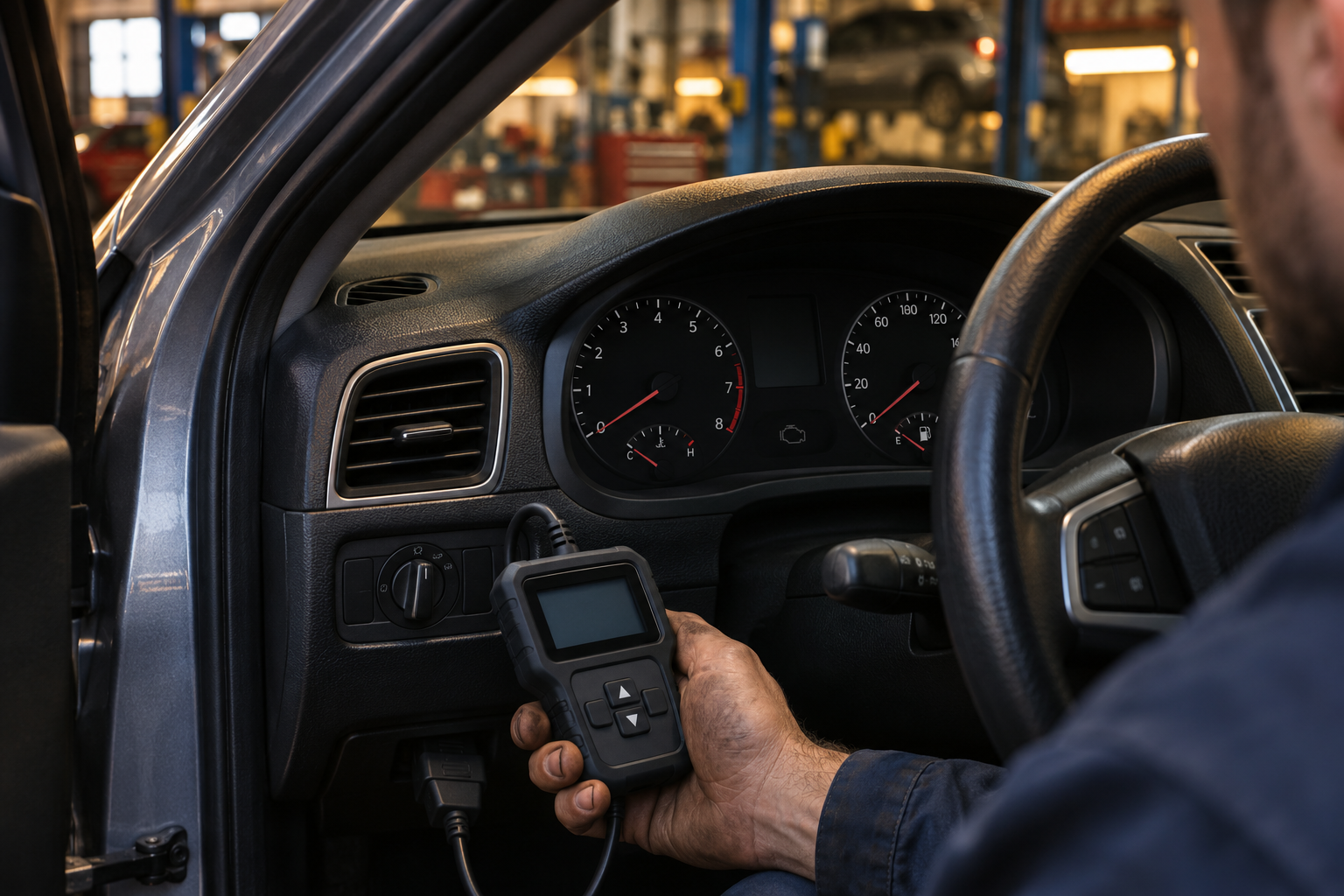
An unlit dashboard does not tell you whether the car has finished its self-tests, whether the inspection machine can read them, or whether another part of the inspection failed. The useful answer is on your test report.
You drive into the inspection station with a car that starts normally, runs normally and has no check-engine light. Then the report says it did not pass.
Before you buy an oxygen sensor, replace a catalytic converter or spend the weekend driving aimlessly to “reset the computer,” find out exactly which inspection requirement stopped you.
A car can fail an emissions inspection with its check-engine light off because its emissions self-tests are unfinished, its warning lamp does not work correctly, the inspection equipment cannot obtain the required information, or another inspection item fails. In California, an applicable permanent trouble code can also matter after the light goes out. The rules depend on the state, vehicle and type of test.
The first useful step is simple: get the inspection report and keep it. “Failed emissions” describes the outcome, but it does not identify the repair.
The inspection asks more questions than your dashboard answers
Think of the check-engine light as one piece of information, rather than a certificate that the car is ready for inspection.
For an onboard-diagnostic inspection, there are several separate questions:
Does the warning lamp work when it is supposed to?
Is the car's computer commanding that lamp on?
Have enough of the required self-tests finished?
Can the inspection equipment communicate with the vehicle?
Does the car meet the other requirements of its inspection program?
Federal onboard-diagnostic testing procedures distinguish the computer's command from what a person sees on the dashboard. They also check readiness and whether the lamp illuminates during the key-on, engine-off check. A lamp that never lights can itself be a failure.
That distinction explains why looking at the dashboard, or obtaining a quick “no codes” reading, does not reproduce the entire inspection. Neither tells you everything the station needs to know.
It also explains why the advice to “just get the light turned off” can send you in the wrong direction. Erasing information may leave you with less evidence of the original problem and unfinished tests before your next appointment.
A government example shows exactly how the light can pass and the car can fail
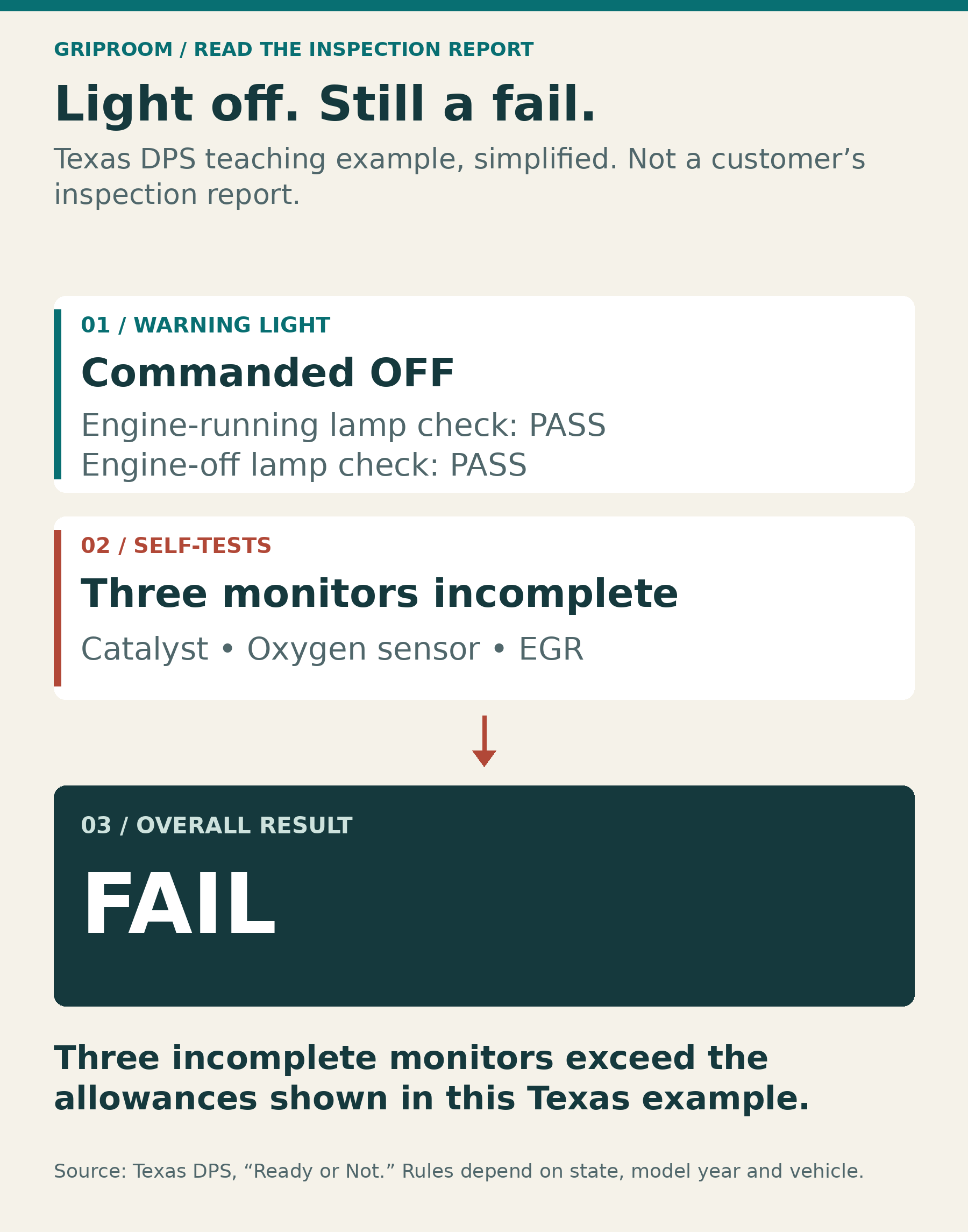
Texas's Department of Public Safety publishes a particularly useful sample inspection result.
In that example, the computer is not commanding the check-engine light on. Both lamp-check results pass. But three emissions monitors are unfinished: the catalyst monitor, oxygen-sensor monitor and exhaust-gas-recirculation monitor.
The overall result is a failure.
This is an agency teaching example, not a vehicle GripRoom tested. Its value is that it shows the supposed contradiction on one report. The lamp checks and readiness checks are separate, and passing one does not erase a failure in the other.
Texas's guide distinguishes three labels:
Ready: the self-test has run.
Not Ready: the self-test has not finished.
N/A or N/S: the system is not required or supported for that vehicle.
Do not count every N/S entry as a problem. A scanner may display a long list of possible systems, including ones your car does not use.
“Not ready” does not tell you to buy a new part
The monitor is a self-test. The component is the thing being evaluated. Confusing them can get expensive.
If your report says the catalyst monitor is incomplete, that alone does not establish that the catalytic converter needs replacing. It tells you the inspection lacks a completed check of that system.
A recent battery replacement, battery disconnection during repair work, or clearing of diagnostic codes can interrupt the accumulated information the computer needs. Maryland's not-ready guidance identifies these situations and advises getting the correct drive cycle for the vehicle from its manufacturer or service provider.
Start by reconstructing what happened before the test. Was the battery replaced last week? Did a shop clear codes after a repair? Did somebody connect a scanner and press an erase button while investigating a different issue?
Tell the technician those details. A recent reset changes the starting point for diagnosis. It does not prove there is no mechanical fault, and an incomplete monitor that persists deserves investigation rather than an endless succession of retests.
Also avoid reading “Ready” as a permanent guarantee of good health. New York's inspection program explains that monitors continue running when their enabling conditions are met. They can subsequently identify faults. Completion describes whether a check has been performed; the inspection still considers the other relevant results.
The exact unfinished monitor can matter as much as the number
Advice from a driver in another state can be perfectly accurate for their inspection and wrong for yours.
Consider a hypothetical 2016 gasoline car with only its catalyst monitor incomplete, no commanded check-engine light, and no other problems for the purposes of this example.
Texas's published criteria permit one unfinished noncontinuous monitor on qualifying 2001-and-newer vehicles. That hypothetical car meets that readiness allowance. California's currently published criteria for gasoline vehicles from 2000 onward allow an unfinished evaporative-system monitor, not an unfinished catalyst monitor. The same status therefore does not meet California's readiness criterion. Texas DPS; California BAR.
This comparison covers readiness only. It does not certify that the car would pass every other inspection requirement.
California also illustrates why old advice needs checking. An all-monitor regulation became effective in October 2025, but BAR's implementation explanation says changes are phased in and existing pass/fail criteria remain while it analyzes the data. The published test reference still contains the exceptions described above, checked November 18, 2026.
Use your state's current program guidance, your model year and your fuel type. A rule for a gasoline passenger car is not automatically the rule for a diesel truck.
Hundreds of thousands of unfinished tests do not mean hundreds of thousands of failures
Public inspection data show why those labels need care.
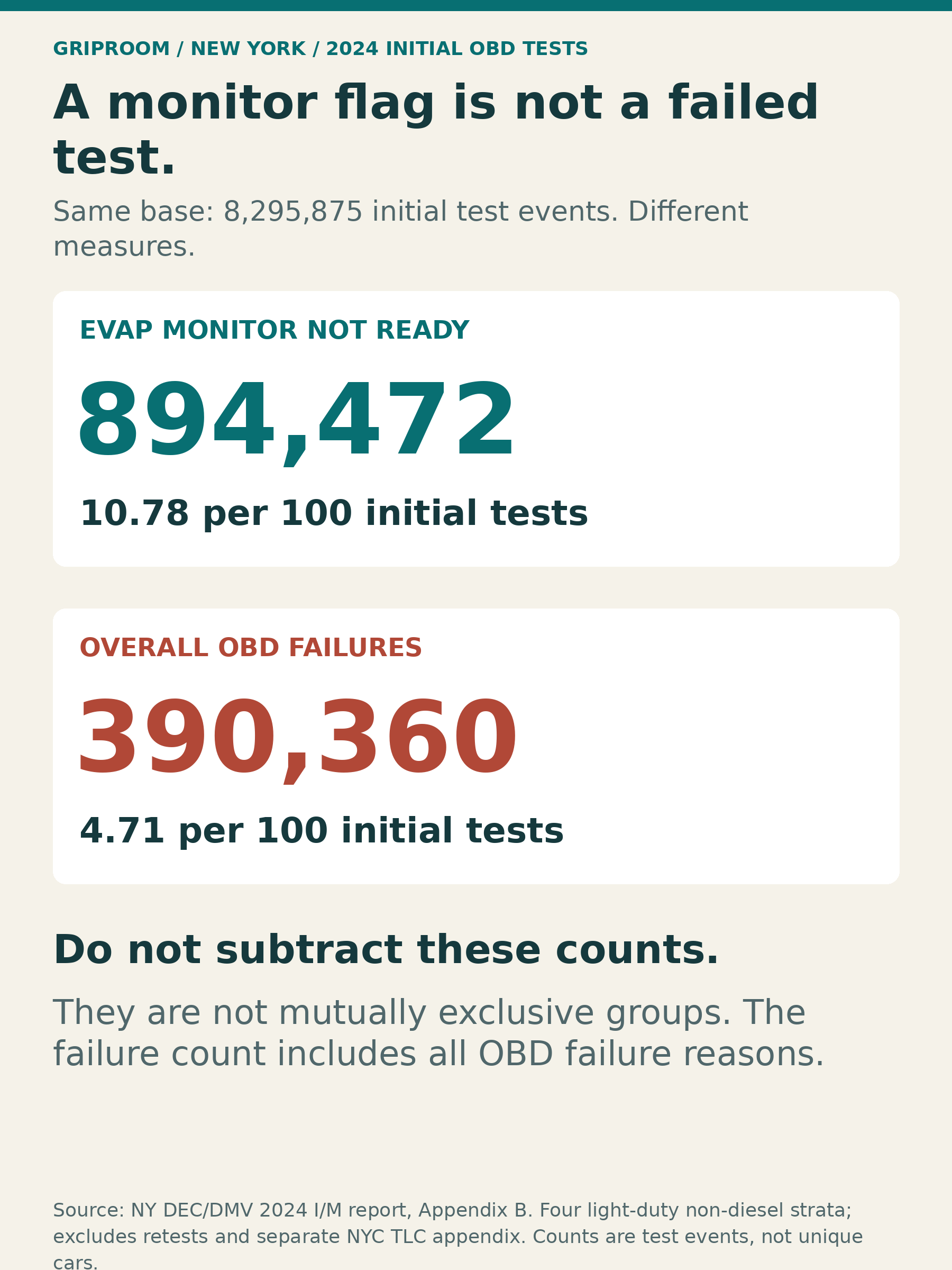
GripRoom examined the New York DEC/DMV 2024 annual inspection report, combining its four initial-inspection groups for light-duty non-diesel passenger vehicles and trucks in the New York metropolitan area and upstate. These exclude the separately reported taxi program, diesel vehicles and retests.
Across 8,295,875 initial tests, 894,472 records had an unfinished evaporative-system monitor: 10.78 per 100 initial tests. The same groups recorded 390,360 overall onboard-diagnostic failures, or 4.71 per 100 initial tests.
These calculations use all initial tests in the selected groups as the denominator, including tests without a usable result for that particular monitor. They are not the report's differently calculated per-monitor percentages.
The unfinished-monitor count is larger than the overall failure count. An unfinished test therefore cannot simply be counted as a failed inspection. But the figures overlap, and subtracting them would not tell us how many vehicles passed despite that flag.
Nor do these tables establish how often cars fail with the dashboard light off. They do not provide the necessary combination of lamp status and failure reason. The data are useful context, not a nationwide failure estimate.
There is no universal number of miles that makes a car ready
“Drive it another 50 miles” sounds reassuring because it gives you a finish line. Unfortunately, an odometer does not tell you whether the necessary testing conditions occurred.
Maryland expressly warns that simply driving may not guarantee readiness. The vehicle may need a particular combination of conditions, and the appropriate procedure depends on its design. The practical question is whether the required monitors have completed, not whether you have covered somebody else's recommended distance.
For example, Ford's 2020 Super Duty owner's manual contains a specific inspection-readiness procedure involving mixed driving and a period with the vehicle off. That is an example of manufacturer guidance for specified vehicles, not a drive cycle to apply to every Ford, let alone every car.
Some instructions are intended for professionals. A Mercedes-Benz readiness bulletin for certain diesel vehicles gives different requirements for different monitors and warns that actions such as clearing faults or disconnecting the battery can hinder completion. Its procedures include specialist diagnostic work, and the document explicitly addresses trained technicians.
Ask for the procedure that applies to your vehicle. Do not copy an aggressive acceleration, coasting or high-speed routine from a forum and attempt it in unsuitable traffic. Have readiness checked before paying for another inspection.
“No communication” may need software, not more driving
If the inspection report says the machine could not communicate with the car, stop treating the problem as automatically another unfinished drive cycle.
There is a documented example involving Ford and Lincoln vehicles. Customer Satisfaction Program 22N15 addresses gateway-module software that can prevent inspection equipment from communicating correctly with certain vehicles. The program includes specified builds of vehicles such as the Escape, Bronco Sport and Corsair, along with several commercial chassis.
Ford's December 2023 document offers a one-time software update for eligible vehicles with unlimited years and miles under its terms. It also says some vehicles already received an equivalent over-the-air remedy.
This does not mean every Escape with an inspection problem needs that update. Eligibility is vehicle-specific, and a repair may already have been completed. Ask the dealer to check the VIN and current program status.
The useful lesson is broader: an inspection failure can involve the connection between the vehicle and the test equipment. Before authorizing replacement parts, ask whether there is a known manufacturer bulletin, software issue or program covering the exact result on your report.
California permanent codes can survive after the light goes out
For applicable 2010-and-newer vehicles, California checks permanent diagnostic trouble codes. BAR's test reference says these can cause failure even when the warning light is not commanded on. They cannot simply be erased with a scanner or a disconnected battery; the vehicle must verify the relevant condition before clearing them.
The reference also describes a specific exception involving both 15 warm-up cycles and 200 miles since diagnostic information was cleared, plus vehicle-specific exceptions. Meeting that criterion does not guarantee the car passes the rest of its inspection.
Crucially, a warm-up cycle does not mean turning the ignition on and off. BAR's explanation of the rule describes coolant rising by at least 40°F after starting and reaching at least 160°F.
If your report identifies a permanent code, ask the technician to distinguish the original fault, the vehicle's verification process and any applicable inspection exception. “The light is off now” does not settle all three.
Some failures are outside the computer check
The inspection may include more than connecting a cable under the dashboard.
California's consumer inspection guide describes visual and functional inspections, onboard-diagnostic checks and tailpipe testing for older vehicles. Which parts apply depends on the vehicle. A warning lamp cannot tell you the outcome of every one of those checks.
Georgia's 2026 program guidance, for example, describes both an onboard-diagnostic test and a visual catalytic-converter check for its qualifying model years.
Read the category on your report. A visual failure, measured tailpipe failure and readiness failure call for different follow-up questions. There is little value in completing more driving if the recorded problem is a missing or unacceptable component.
Also separate emissions requirements from safety-inspection requirements where both exist. A broader vehicle inspection can include items that the check-engine light was never designed to report.
What should you ask the shop to show you?
A useful explanation should connect the proposed work to the failed item. If somebody recommends a converter because the report says “catalyst not ready,” ask what diagnostic evidence establishes a converter fault rather than an unfinished test. If the report says “no communication,” ask how the proposed repair addresses communication.
You are not accusing the shop of being wrong. You are asking for the missing link between a result and a bill.
The same approach helps after a repair: ask what was corrected, whether the required monitors have completed, and whether any inspection issue remains. “We turned the light off” leaves those questions unanswered. A clear explanation gives you something to compare with the retest report if the car still does not pass.
Before the retest, use this checklist
You do not need to become an emissions technician. You need enough information to avoid repeating the wrong action.
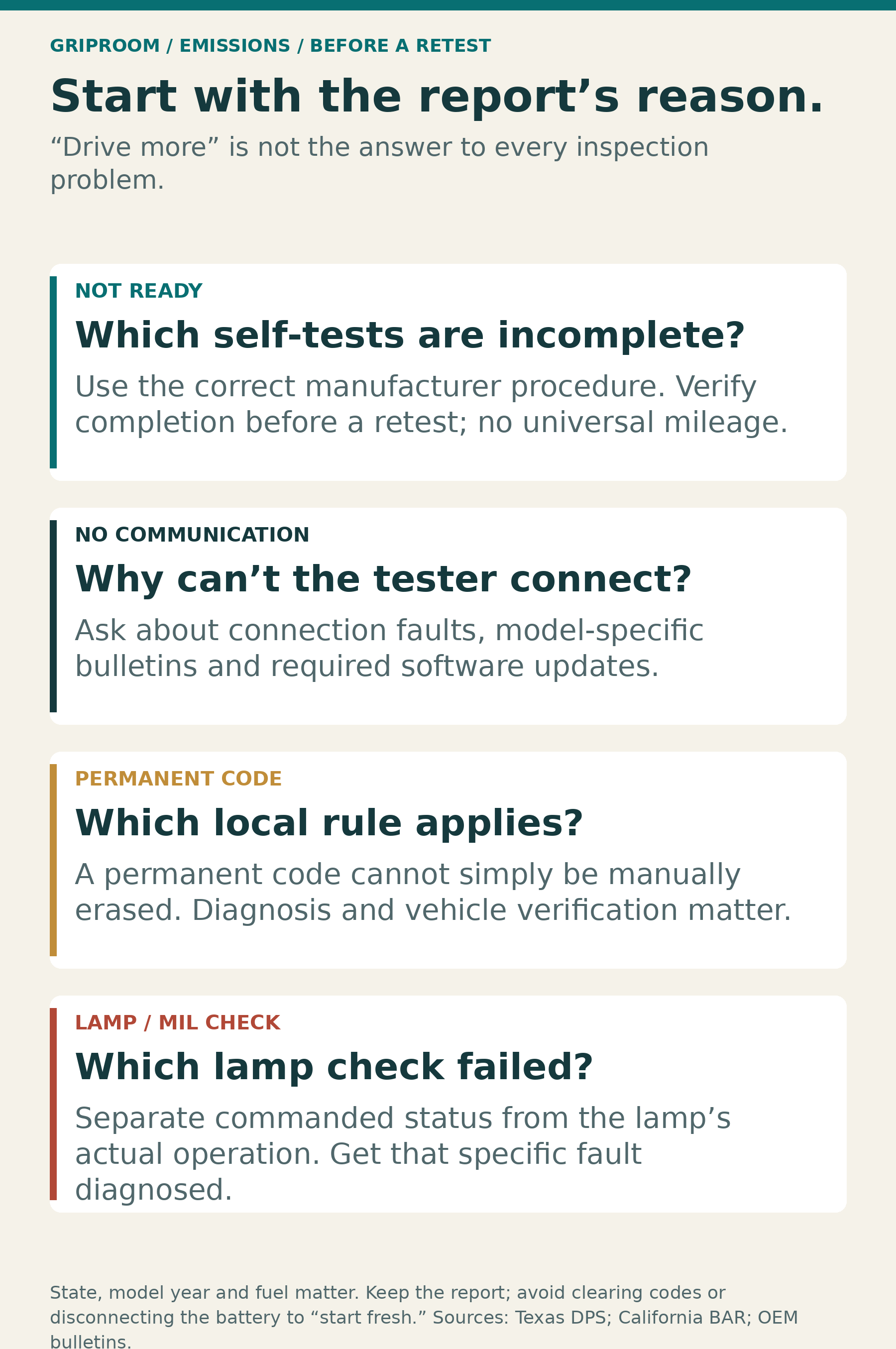
First, keep the report and identify the result. Ask whether the problem was readiness, a lamp check, a trouble code, communication, a visual inspection or a tailpipe measurement. If several items failed, get all of them explained.
Second, record the exact unfinished monitors separately from codes. A monitor name and a diagnostic code are different pieces of evidence. Photograph or write down the results before anything is cleared. An unsupported monitor should not be mixed into your unfinished-monitor count.
Third, explain the recent history. Mention battery work, repairs, software updates and code clearing. If you have the previous repair invoice, bring it. The sequence can be more useful than saying the car “has been running fine.”
Fourth, ask for a specific next step. Try: “Which requirement prevented a pass, and what will show that this has been resolved before I return?” If the answer is more driving, ask for the correct vehicle procedure and a readiness check afterward.
Fifth, check deadlines and retest terms. Do not assume a rejected or failed inspection automatically extends your registration or permits continued driving. Read your notice and the local program's instructions. Retest rules vary; Georgia, for example, offers one free retest at the original station within 30 calendar days, counting the day of the initial test.
Finally, ask about coverage before authorizing expensive work. Emissions warranties can differ from the basic vehicle warranty. CARB's warranty overview explains federal and California coverage categories, including longer protection for certain major components. The manufacturer must determine what applies to your vehicle and fault.
A clear dashboard is useful information. Your inspection report is more specific. Start with the exact reason you did not pass, and you are much less likely to spend money fixing the wrong problem.