Replacing a card can change the number without breaking the payment connection. Canceling the service, blocking future charges and disputing a payment are different jobs.
You get a replacement card with a different number. You never enter it into the subscription website. Then the next monthly charge appears anyway.
That can happen because payment networks operate services that update stored card details for participating businesses. A subscription can also use a payment token that remains connected to your account when the underlying card changes. The company does not necessarily need you to type the new number. Visa’s account-updater documentation and Stripe’s explanation of network tokens describe these two mechanisms.
This is not, by itself, evidence that somebody stole your replacement card. It is also not proof that the charge was authorized.
The important distinction is that replacing a card protects or updates a payment credential. It does not automatically cancel the agreement you made with a subscription company. And if the company is charging you incorrectly, another replacement may leave the underlying problem untouched.
Your card number is not the whole payment relationship
A card-on-file service is designed to remember how to charge you. That is useful when the payment is your electricity bill and less welcome when it is a membership you thought had ended.
Visa Account Updater exchanges information between participating card issuers and the businesses that process stored-card payments. It supports changes including expiration dates, replacement numbers and lost or stolen cards. Mastercard has a comparable service called Automatic Billing Updater, or ABU. Its privacy notice explains that a merchant can receive updated payment details without the cardholder taking another step.
Think of the difference between changing a mailing address and ending a magazine subscription. Forwarding keeps deliveries arriving; it does not decide whether you should still receive the magazine. Card updating serves a similar continuity function for payments.
Not every merchant participates. Stripe’s payment-recovery guidance says automatic updating depends on issuer participation and varies internationally. You can therefore get both outcomes from the same replacement: one subscription continues, while another asks for new details.
That is why “my other subscriptions stopped” does not prove this one discovered your number improperly.
Sometimes the merchant does not need the new number at all
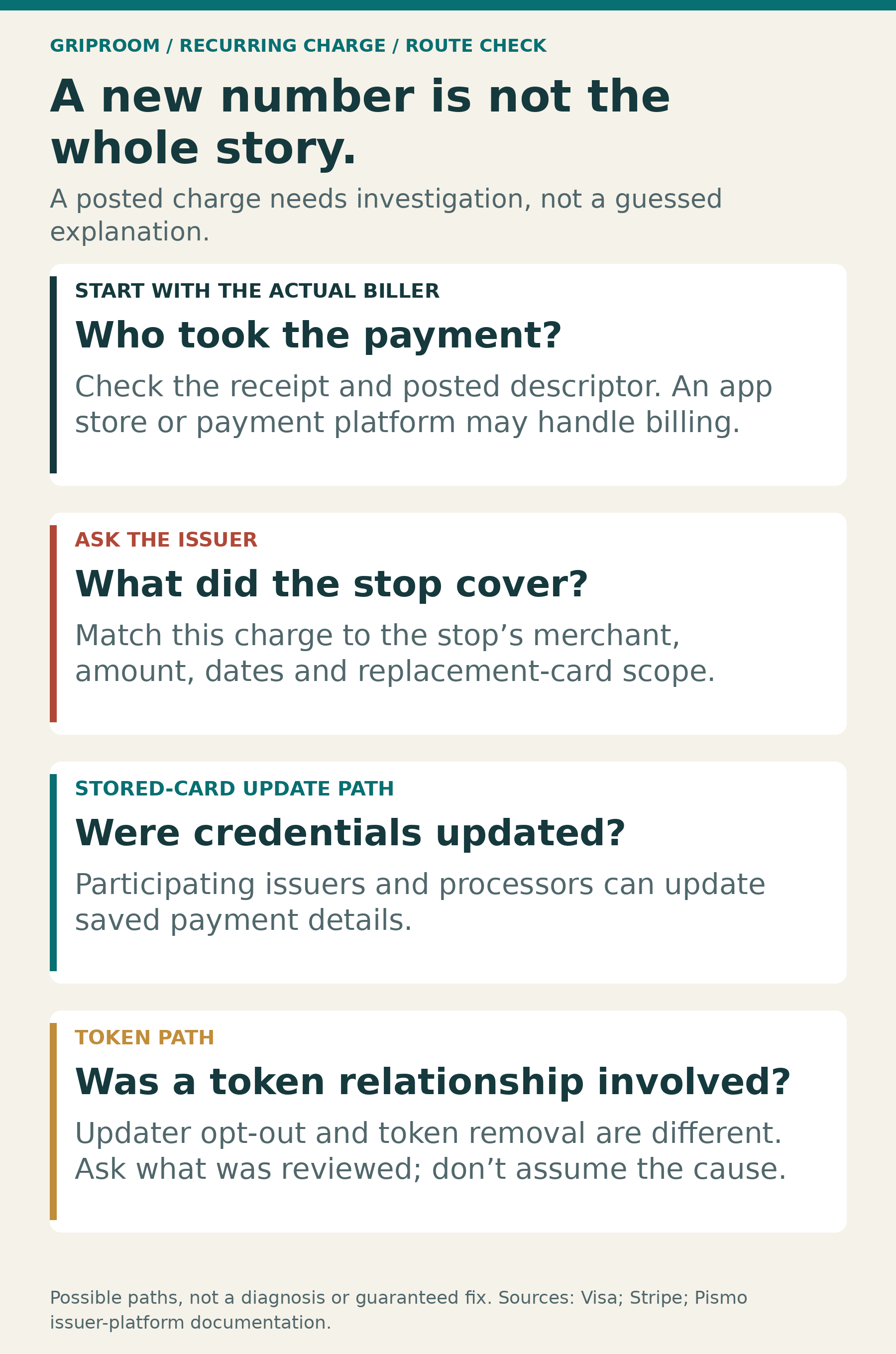
A network token is a substitute payment credential linked to the underlying card. The network can maintain that link when card details change. The merchant may continue charging through the token rather than collecting the number printed on your new plastic. Stripe explains how this works.
This creates a useful troubleshooting distinction: stopping automatic updates and removing a token relationship are not necessarily the same operation.
For example, payment processor Pismo’s Mastercard implementation documentation states that opting a card out of ABU does not delete its associated Mastercard Digital Enablement Service tokens.
That does not mean every continuing charge is token-based, or that your bank uses Pismo. It means “we turned off the updater” is not enough information to diagnose every case. If unwanted charges continue, ask the issuer to investigate the payment connection rather than repeatedly assuming a new piece of plastic will solve it.
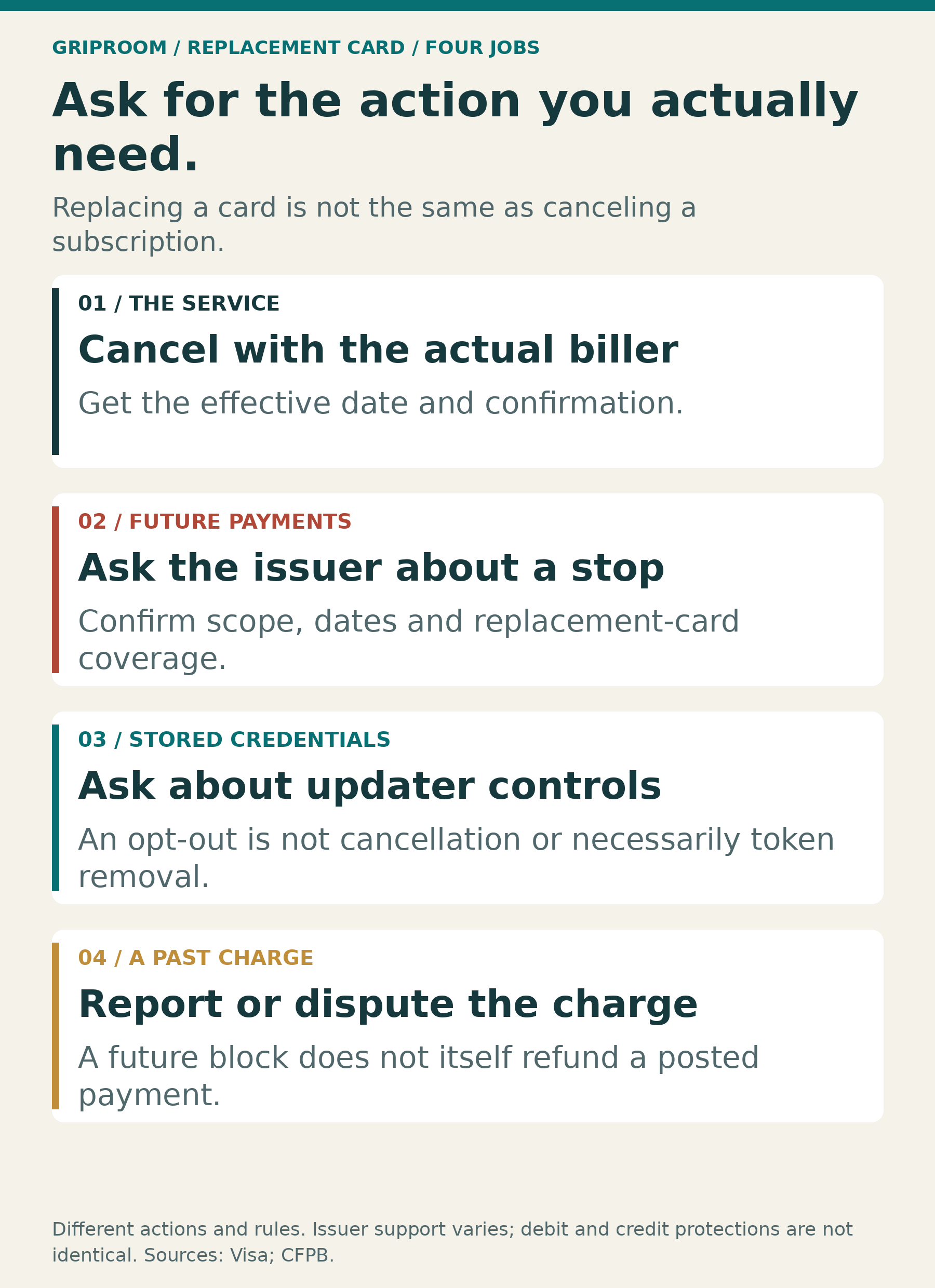
There are four different things you might need done
These requests often get compressed into “stop charging me,” but they deal with different problems.
Cancel the subscription. This addresses your relationship with the service provider. Obtain confirmation and the effective cancellation date. A payment block does not erase a valid amount you still owe under the agreement. The CFPB makes this distinction explicit.
Stop future payments. This asks the issuer to prevent specified charges. The available tools and their limits depend on the account and issuer. A future stop does not automatically reverse a charge that has already completed. Visa distinguishes its stop-payment service from disputes.
Prevent automatic card-detail updates. This addresses how replacement information is shared. Visa documents issuer-submitted opt-outs. As a concrete Mastercard example, Citadel offers an ABU opt-out through its online and mobile banking services. Do not assume every issuer offers the same interface. You may also need to update wanted payments manually.
Dispute an incorrect charge. This addresses money already billed or taken. Explain what happened accurately: a charge after confirmed cancellation is different from a subscription you never authorized. FTC subscription guidance recommends disputing charges that continue after cancellation.
You might need two or three of these actions. Confirmation that one was completed is not confirmation that the others were.
Start with who is actually billing you
Look at the transaction details and the original subscription receipt. The service you use and the company handling its billing may not be the same.
If PayPal is involved, for instance, check the merchant’s automatic-payment arrangement, not just your general preferred card. PayPal’s instructions explain that an automatic payment can have its own selected payment method and backup setting.
Then establish what you are seeing. Is it a completed charge, a pending transaction, or simply an app’s prediction of the next payment? Capital One says its expected-transactions list is based on past activity and may be outdated after a cancellation. A predicted renewal is not the same thing as a new charge. Capital One’s help page explains the distinction.
This short check helps you give support a specific problem: “This charge posted after my cancellation became effective,” rather than “The subscription is still somewhere in the app.”
Why a card lock or merchant block may not do what you expect
A card lock can be useful, but it is not necessarily a master switch. Chase says its lock blocks new purchases but not recurring transactions.
Even a dedicated recurring-payment block has boundaries worth checking:
Timing: Capital One’s eligible merchant blocks exclude transactions already pending before the block.
Duration: Capital One describes those blocks as lasting 12 months, not indefinitely.
Amount: U.S. Bank says an amount-specific recurring-charge stop matches only that exact amount.
Scope: A merchant-wide block may affect other recurring payments you still want from the same business.
These are documented issuer examples, not universal rules. Check Capital One’s terms and U.S. Bank’s stop-payment instructions for their respective limitations.
Capital One also warns that, in some cases, a merchant can override its attempt to block a charge. Its public explanation does not describe the mechanism, so do not assume an override means a merchant hacked anything. The practical lesson is to check subsequent statements rather than treating a block confirmation as the end of the matter. Capital One’s recurring-charge disclosures include that warning.
If a block fails, ask the issuer to compare the actual transaction against the instruction it created. Visa’s technical guidance explains that stops depend on matching merchant information, the card and other specified limits. It also describes linking stops to replacement cards. You do not need to learn the technical identifiers; you need the bank to check whether its instruction covered this payment.
Debit cards and credit cards have different protections
For a U.S. consumer’s preauthorized electronic transfer, including qualifying recurring debit-card payments, Regulation E provides a stop-payment right. You can notify the financial institution orally or in writing at least three business days before the scheduled transfer. It may require written confirmation within 14 days and must explain that requirement and where to send it. The current regulation and official commentary address debit-card-network processing explicitly.
A bank’s technical difficulty does not simply eliminate that protection. In its Winter 2024 supervisory report, the CFPB documented debit-network failures involving valid stops. It said recovering the money afterward through a dispute was not an adequate substitute for honoring the stop. The report also says operators revised processes in response; it is not evidence that every bank currently has the same problem.
Credit-card billing errors follow a different framework. The CFPB recommends reporting the problem promptly and following up with a written notice to preserve your rights. Send it no later than 60 days after the issuer sent the statement on which the error first appeared, using the designated billing-dispute address. Keep copies and pay correct, undisputed amounts on time. The CFPB’s billing-error instructions explain the process.
That deadline is not permission to wait, and it is not a universal deadline for every kind of payment dispute.
Three situations that look similar but need different answers
These examples are hypothetical.
Your streaming service follows your replacement card, and you still want it. Continuity may be working as intended. Check the amount and account, but do not conclude that the new number has been stolen merely because a payment succeeded.
You canceled a membership, received confirmation, and were billed again. Gather the cancellation’s effective date and the transaction details. Ask about disputing that charge and stopping future ones. A new card number alone is not the evidence that the charge was wrong; the cancellation record is much more useful.
The bank confirmed an updater opt-out, but another charge appeared. Ask what payment method or token was used and what the opt-out actually covered. If a separate merchant block existed, ask about its dates, amount limits and coverage of your replacement card. Do not assume that another replacement is the only available next step.
What to say when you call your issuer
For a charge after cancellation, start with something concrete:
“I canceled this service on [date], effective [date]. I have the confirmation, but a charge for [amount] posted on [date]. I want help disputing that charge and, separately, preventing future recurring charges. Please tell me which requests you are opening.”
Then ask only the questions that fit:
Does the stop cover all recurring amounts or one specific amount?
When does it begin, and when does it expire?
Will it cover a replacement card too?
If an earlier stop failed, can your payments team compare this transaction with the block’s details?
If an updater opt-out was completed, was any separate token connection reviewed?
What confirmation or supporting documents do you need?
Ask for a reference number and confirmation of what was completed versus what remains pending. Use the issuer’s genuine app or the number on your statement or card.
If you never authorized the activity, say that instead. Report suspected unauthorized charges promptly; do not describe an unfamiliar subscription as your canceled membership or invent a stolen-card report to obtain a replacement.
The new number is not the finish line
The useful question is not just “How did they get my card?” It is “Which payment connection is still active, and what needs to happen to end it?”
A wanted subscription surviving a replacement is convenient. An unwanted one surviving a cancellation needs attention. Keep the cancellation record, distinguish future stops from past-charge disputes, and check what the issuer actually confirmed. Changing the number is one action. Ending the problem may require a different one.