Why Dragon Ball Z Makes Giant Meals Feel Like Training Fuel
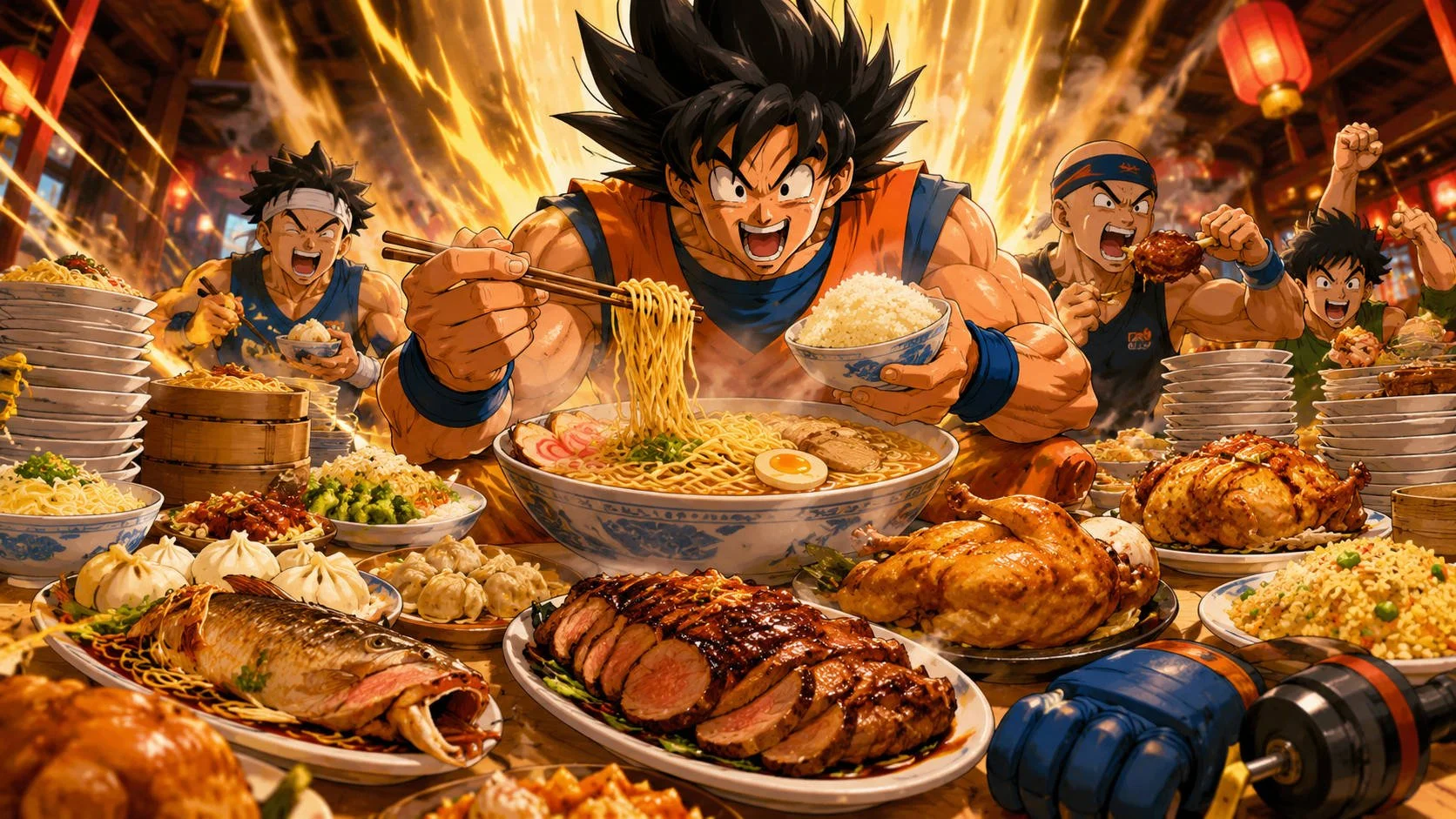
In Dragon Ball Z, no one eats like a normal person. A normal person finishes a workout and has chicken, rice, vegetables, maybe a smoothie if they are insufferable in a moderately organized way. Goku finishes training and eats like someone opened a buffet in front of a wood chipper. Plates disappear. Fish skeletons stack up. Rice bowls vanish. Meat legs are stripped clean. The man treats dinner like another opponent that foolishly agreed to fight him.
And somehow, it works.
The giant meals in Dragon Ball Z do not feel like gluttony. They feel like training fuel. That is the magic trick. In most stories, a character eating an entire table’s worth of food would be comic relief, moral failure, or a county fair incident. In Dragon Ball Z, it becomes proof of intensity. The bigger the appetite, the bigger the engine. The meal is not a break from training. It is training’s invoice.
Toei Animation lists Dragon Ball Z as a 291-episode adventure/action series from 1989, with Goku facing overwhelming new enemies and Gohan joining battles that become “even more vigorous.” That is the show’s entire operating system: fight, train, nearly die, recover, eat enough to financially injure a restaurant, repeat until hair changes color.
Dragon Ball Food Is Not Decoration. It Is Part of the Power Fantasy.
The official Dragon Ball site has a whole food feature that basically says the quiet part out loud: balanced meals with staple foods, mains, and side dishes are treated as part of a martial artist’s training regimen. That is hilarious because it sounds like a sports dietitian accidentally got hired by Capsule Corp, but it also explains why food scenes feel so central to the series.
The same official feature breaks Dragon Ball meals into staples like rice, bread, and noodles; mains like steaks, meat on the bone, giant fish, and hot-pot dishes; and drinks like coffee, cream soda, and milk. So yes, this universe understands carbohydrates, protein, and beverages before it understands shirt durability, parenting schedules, or why every tournament needs at least one existential threat.
Food in Dragon Ball Z is not a dainty garnish beside the plot. It is part of the world’s logic. The heroes train hard, fight hard, and eat hard. Appetites become visual shorthand for vitality. If Goku is eating, he is alive, recovering, and probably about to make a terrible strategic decision involving mercy toward a villain.
This is why giant meals feel like fuel: the show connects eating to effort. It does not present the feast as laziness. It presents it as the other side of absurd labor.
Saiyan Appetite Is Worldbuilding With Chopsticks
The official Dragon Ball site says the franchise is famous for scenes where characters gobble down mountains of food, especially Saiyans like Goku, Gohan, and Vegeta. It even gives the legendary example of young Goku eating the equivalent of 50 people’s worth of food after the 21st Tenkaichi Budokai, racking up a 470,000 Zeni bill and nearly vaporizing Master Roshi’s tournament prize money.
That is not a meal. That is a municipal event.
But in the logic of the show, this makes sense. Saiyans are not office workers doing three sets of cable rows and rewarding themselves with a protein cookie named something like Alpha Choco Annihilator. They are alien warrior engines who recover from planet-shaking combat, gravity training, energy blasts, near-death beatings, and screaming so hard the weather changes.
The appetite sells the biology. Goku does not merely say, “I train hard.” The food scene proves it. The meal is the body demanding payment for all the nonsense the plot just forced it to survive.
That is why Vegeta eating big does not read like a cheat day. It reads like maintenance on a violent sports car with widow’s peaks.
The Meal Is a Recovery Scene Without Saying “Recovery”
Modern sports nutrition talks about glycogen, protein synthesis, hydration, and timing. Dragon Ball Z says: here is Goku eating fifteen bowls of rice and a dinosaur leg.
Same basic idea, fewer PDFs.
EatRight, the Academy of Nutrition and Dietetics’ public-facing site, says carbohydrates are the major fuel for muscles because the body converts carbohydrate to glycogen, which is stored in muscles to power workouts. It also says protein helps build and repair, but more protein does not magically make you stronger unless the muscles are actually put to work. Congratulations, sports science has confirmed what King Kai could have said in one sentence if he ever stopped telling jokes from 1978.
This is what Dragon Ball Z gets emotionally right. The show understands that training creates hunger. Not “I deserve a treat because I walked past a gym” hunger. Actual demand. Big effort requires fuel, and the body asks for that fuel loudly.
The giant meals make recovery visible. We do not need a lecture about replenishing energy stores. We watch Goku inhale rice and meat like a cheerful sinkhole and understand: the fight emptied him out.
Senzu Beans Are the Ultimate Sports Nutrition Lie
Every sports product secretly wants to be a Senzu Bean. Every gel, drink mix, recovery shake, electrolyte tablet, protein bar, gummy chew, and $4.79 packet of mango-flavored endurance goo is chasing the same dream: eat one thing, instantly become functional again.
Dragon Ball’s official site explains that Senzu Beans are special food grown at Karin Tower; one bean keeps a person full for ten days, heals injuries, and restores physical stamina and energy. That is not nutrition. That is a lawsuit waiting to happen if any supplement company tried to put it on a label.
But as fantasy, it is perfect. The Senzu Bean condenses the whole recovery process into one tiny object. No meal prep. No hydration plan. No protein timing. No ice bath. No nap. Just eat the bean and return to getting punched through mountains.
The Senzu Bean is funny because it is the thing athletes wish existed. The show knows recovery matters so much that it invents a magical shortcut. It is basically the ultimate post-workout supplement, except it actually works and does not come with a subscription discount code from a shirtless man yelling in a garage.
Giant Meals Make Training Feel Earned
A big reason Dragon Ball Z meals feel satisfying is that the show earns them. Goku does not sit around all day, glance at a dumbbell, and then demolish a restaurant because “bulking season.” He trains under brutal conditions: weighted clothing, gravity rooms, wilderness survival, martial arts drills, sparring, and battles where the injury report usually includes “planet endangered.”
That effort changes how the food reads. A feast after work feels different from a feast instead of work.
This is also why the meals are often communal. Dragon Ball food scenes are not just about calorie intake; they are about return to life. After training or battle, eating with friends and family means the crisis paused long enough for rice bowls to exist. That is a big deal in a universe where someone is always threatening Earth because they had childhood issues and a tail.
The meal says: the body survived. The group survived. The table is full. For five glorious minutes, nobody is charging a beam attack.
Chi-Chi Is the Real Strength Coach, and Nobody Wants to Admit It
Every Dragon Ball fan talks about training masters: Roshi, King Kai, Whis, Piccolo, gravity chambers, hyperbolic nonsense architecture. But who keeps feeding the fighters? Who handles the infrastructure of absurd appetite? Who has to live with a husband and sons who can eat like a village fire?
Chi-Chi.
The series often turns Chi-Chi into the nagging domestic counterweight to Goku’s obsession with fighting, which is unfair because someone in that family has to notice groceries exist. Goku wants to train. Gohan needs to study. Goten is probably hungry. The rice does not cook itself unless Bulma invents a capsule for it, which frankly she should have done by now.
This is the hidden lesson: training fuel requires a food system. Even in a cartoon universe, someone shops, cooks, serves, cleans, and pays. The giant meal looks heroic when Goku eats it. It looks like unpaid labor if you imagine the kitchen afterward.
Very inspiring. Very shōnen. Very “who washed the 87 plates?”
Dragon Ball Z: Kakarot Turns Food Into Actual Stats
The video game Dragon Ball Z: Kakarot makes the food logic even more explicit. In that game, meals and full-course dishes are used to boost stats, and guides note that players can unlock recipes and have Chi-Chi cook full-course meals at Goku’s house.
This is hilarious because it turns the show’s emotional logic into RPG mechanics. Eat food, become stronger. Not metaphorically. Not “good nutrition supports performance over time.” Just eat the deluxe meat course and watch numbers go up like your stomach has a spreadsheet.
But that is exactly how Dragon Ball Z already feels. Food is not separate from power. It is part of progression. Training breaks the body down. Eating builds it back up. The game simply stops winking and says, yes, the ramen is a stat investment.
Finally, a franchise brave enough to admit that dinner is part of the skill tree.
What DBZ Gets Right About Training Fuel
For all its screaming, hair lightning, and medical malpractice beans, Dragon Ball Z gets several big-picture ideas right.
First, it respects appetite after effort. Hard training can increase energy needs. EatRight notes that casual exercisers working out for an hour or less usually do fine with a balanced diet, but athletes doing strenuous training or multiple events in a day may need intentional recovery nutrition. In other words, not everyone gets a Goku plate. Some people get a normal dinner and the opportunity to calm down.
Second, it makes carbohydrates look powerful. Modern fitness culture often treats carbs like they broke into the house and stole everyone’s abs. Dragon Ball Z says rice, noodles, and bread belong at the training table. EatRight says carbs fuel working muscles, which means Goku eating rice by the basin is not just comedy. It is accidentally reasonable.
Third, it understands recovery is urgent after big effort. EatRight says for strenuous workouts, carbohydrates should be consumed within 30 minutes of finishing, and a balanced meal should follow within a couple of hours. DBZ expresses this same idea through characters eating immediately after fights, except with the subtlety of a dump truck unloading roast meat.
Fourth, it knows that protein matters but does not worship it alone. The Dragon Ball food article talks about staples, mains, sides, and drinks, not just meat towers. Yes, there is a lot of meat. It is a warrior anime, not a lentil seminar. But the meals are usually mixed: rice, noodles, fish, meat, soup, vegetables, drinks. That looks a lot more like food than a shaker bottle full of beige gym dust.
What DBZ Gets Hilariously Wrong
Now, let us not pretend Goku’s diet is an actual plan. That way lies emergency room bills and a very confused grocery cashier.
Normal people do not need to eat like Saiyans. They do not have Saiyan metabolism, Saiyan training load, Saiyan recovery biology, or the ability to turn near-death injuries into future strength gains, which would be very useful but probably terrible for health insurance premiums.
EatRight specifically warns that people often overestimate calories burned during workouts. For a casual exerciser training for an hour or less, a healthy balanced diet is usually enough. This is devastating news for the man who did 45 minutes of chest day and then ordered dinner like he had just fought Frieza.
Also, DBZ mostly ignores hydration unless water is needed dramatically, spiritually, or because someone got thrown into a lake. EatRight says proper hydration before, during, and after activity is important, and sports drinks are more appropriate than water for moderate- to high-intensity exercise lasting longer than an hour. Dragon Ball characters apparently hydrate on vibes, rage, and plot structure.
And rest? Rest exists in Dragon Ball, but only between crises, and usually someone ruins it by arriving from space. In the real world, training adaptation requires food, hydration, and sleep. In DBZ, adaptation requires being beaten almost to death, eating a bean, and yelling at clouds until your hair becomes a different tax category.
The “Giant Meal” Is Really a Fantasy of Permission
The deeper reason DBZ meals are so appealing is that they remove guilt from appetite.
In real life, people moralize food constantly. Eat too much, eat too little, eat clean, eat dirty, earn your meal, burn it off, watch your macros, track your calories, be disciplined, be flexible, be mindful, be shredded, be normal, somehow do all of this while working and answering emails. Very relaxing. Great culture. No notes.
Dragon Ball Z offers a much simpler equation: train hard, eat big, get stronger.
That is the fantasy. Appetite is not shameful. Appetite is proof. Hunger means the body worked. Food is not temptation; it is fuel. Eating is not moral failure; it is part of the heroic cycle.
This is why watching Goku eat is weirdly satisfying. He is not negotiating with himself. He is not apologizing to the table. He is not saying, “I shouldn’t.” He is eating because he needs to eat, and everyone else can either bring more rice or be quiet.
The Normal Human Version of the Goku Meal
For actual athletes, the lesson is not “eat 50 people’s worth of food and bankrupt a martial arts master.” The lesson is to match food to workload.
After a normal workout, eat a balanced meal with carbohydrates, protein, fluids, and some color from fruits or vegetables. After a long or intense session, refuel sooner. After multiple practices or events in a day, plan snacks and meals instead of hoping your body runs on motivation and one sad granola bar from 2019.
A DBZ-inspired recovery plate for normal humans might look like rice or noodles, chicken or tofu, vegetables, broth or soup, fruit, and water. Boring? Maybe. Effective? Yes. Less likely than Goku’s meal to require a bank loan? Also yes.
If the workout was short and casual, do not use Goku as your legal defense for eating like an alien prince at a wedding buffet. If the workout was long, hot, intense, or repeated, then yes, eat like someone who intends to recover instead of becoming furniture for the rest of the day.
Why Giant Meals Fit the Shōnen Training Myth
Shōnen stories love visible effort. Push-ups. Sparring. Bleeding. Screaming. Weighted clothes. Mountain training. Tournament arcs. The body must be shown working so the power-up feels earned.
Food is part of that visual economy. A giant meal says the training was not symbolic. It cost something. It emptied the tank. Now the tank must be refilled, preferably with enough noodles to frighten a server.
That is why DBZ meals are not random comedy. They are the civilian version of a power-up. The aura is gone, the plates arrive, and the warrior rebuilds. It is recovery as spectacle.
The show makes eating feel active. Even sitting at the table, Goku is doing something intense. He is not delicately consuming dinner. He is attacking it with the same commitment he brings to sparring, minus the property damage.
Usually.
DBZ Makes Food Feel Like Fuel Because Effort Comes First
Dragon Ball Z makes giant meals feel like training fuel because the show builds a complete loop: train, fight, deplete, recover, eat, grow stronger. Food is not a random joke pasted onto the story. It is part of how the story explains power.
The official Dragon Ball material basically confirms the pattern: balanced meals are part of martial artist training, Saiyans are famous for eating mountains of food, and special recovery foods like Senzu Beans turn nourishment into literal battle strategy.
Sports nutrition says the boring real-world version: carbohydrates fuel muscles, protein helps repair, hydration matters, and recovery food becomes more important when training is strenuous or repeated. Dragon Ball Z says the same thing through rice bowls, meat legs, giant fish, and one orange-clad disaster man eating like the buffet personally insulted him.
That is why the meals feel heroic. The appetite is not separate from the training. It is evidence of it.
Goku’s giant meals work because they are earned by impossible exertion. They are funny because they are absurd. They are satisfying because they free food from guilt and return it to purpose. Eat, recover, train, fight, repeat. Simple. Stupid. Perfect.
And maybe that is the most useful lesson for normal athletes: stop treating food like either a reward or a crime. Treat it like support for the work you actually do.
Just maybe stop before you eat 50 people’s worth of food and leave Master Roshi staring at the bill like the real villain finally arrived.