
What the NFL Combine Says About Protein, Body Metrics, and Food Anxiety
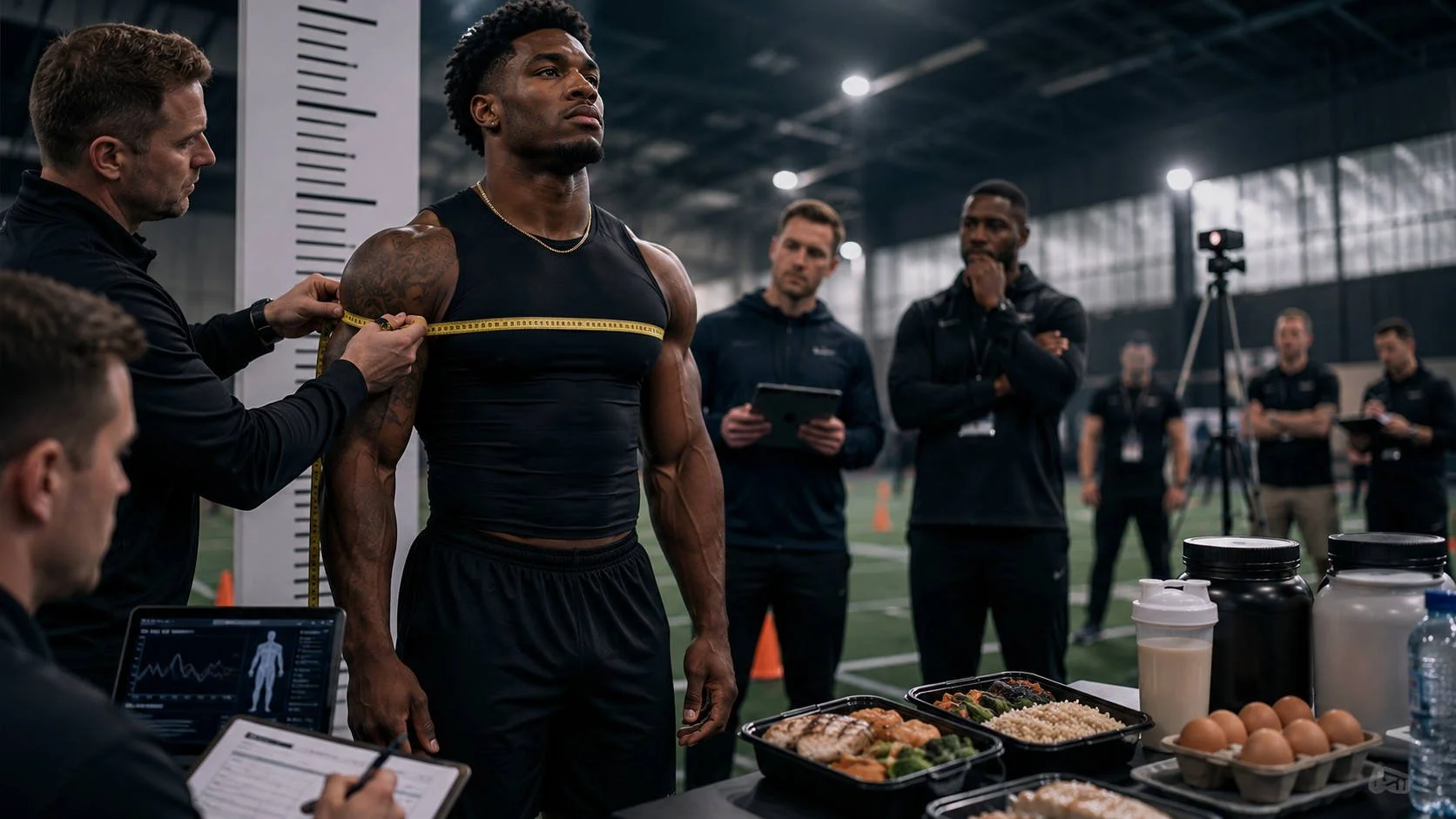
The NFL Combine is what happens when football decides the human body should become a spreadsheet with hamstrings. Every year, elite college players arrive in Indianapolis, get measured like extremely valuable furniture, run timed sprints in compression shorts, bench press 225 pounds until their triceps start negotiating peace terms, and then wait while strangers debate whether their arms are long enough to deserve generational wealth.
It is athletic evaluation, yes. It is also America’s strangest body audit. A meat census. A televised cattle auction with better shoes.
The NFL describes the Scouting Combine as a four-day, invitation-only event where roughly 300 draft-eligible college players are evaluated by scouts on medical, mental, and physical criteria. The 2026 event was scheduled for February 26 through March 1 at Lucas Oil Stadium in Indianapolis, with the league inviting 319 prospects and featuring drills like the 40-yard dash, bench press, vertical jump, broad jump, three-cone drill, 20-yard shuttle, and 60-yard shuttle.
This is where the Combine becomes more than football. It reveals a broader sports culture obsessed with protein, body metrics, “ideal” size, and the low-grade food anxiety that grows when a person’s weight, arm length, hand size, and speed become public property.
The NFL Combine Is a Scale Wearing a TV Contract
The Combine pretends to be about performance, and it is. But before anyone runs, jumps, cuts, catches, or explodes out of a stance, the first ritual is measurement.
Height. Weight. Hand size. Arm length. Wingspan. Numbers so specific they make normal bathroom-scale anxiety look quaint, like a Victorian illness cured by walking near a lake. Reports from recent Combine results list measurements including height, weight, hand size, arm length, and wingspan, followed by athletic testing like the 40-yard dash, jumps, shuttles, three-cone drill, and bench press.
This is the first food lesson: athletes are not just eating to “be healthy.” They are eating to become a number someone else wants. A receiver wants to be fast but not fragile. A lineman wants mass but not the kind that makes coaches whisper “bad weight,” which is one of those phrases sports invented so body judgment could wear a whistle. A quarterback’s hand size gets discussed like the fate of civilization depends on gripping a wet football in November.
And if you think this metric worship is harmless, please enjoy the Combine discourse around offensive lineman arm length, where one-eighth of an inch can apparently become a theological crisis. In 2026, NFL.com noted that Spencer Fano’s 32 1/8-inch arms could push teams into a tackle-versus-guard debate because they fall below the typical 33-inch standard for NFL tackles. Nothing says “healthy relationship with the human form” like treating forearms as draft-day legislation.
Protein Became a Personality With a Shaker Bottle
Protein matters. Let’s not become idiots in the opposite direction. Athletes need protein for muscle repair, adaptation, and recovery. This is real. This is science. This is not just something written on a tub by a company called Alpha Beast Labz with a logo that looks like a wolf filing taxes.
The International Society of Sports Nutrition says that for building and maintaining muscle mass, most exercising individuals do well with overall daily protein intake in the range of 1.4–2.0 grams per kilogram of body weight per day. It also notes general per-serving guidance of about 20–40 grams of high-quality protein, or 0.25 g/kg, and suggests distributing protein every 3–4 hours across the day.
That is useful. Normal. Manageable.
Then sports culture gets its filthy little hands on it and turns protein into a religion. Suddenly every meal becomes a macro audit. Every snack needs a justification. Every athlete is one missed shake away from being spiritually erased by a linebacker with better meal prep.
The NCAA’s 2023 student-athlete wellness data found that protein products and energy drinks were each used by 44% of student-athletes in the past year, with multivitamins at 41% and creatine at 23%. That does not mean every athlete is doing something wrong. It means supplement culture is not some fringe cave under the gym; it is the carpeting.
Protein is a nutrient. Sports culture treats it like a passport.
The Combine Turns Food Into Body Engineering
The Combine does not say, “Eat enough to recover, sleep well, and support your health.” That would be too reasonable, and football did not become football by calmly respecting nuance.
The Combine says, “Be 6-foot-5, 312 pounds, explosive, lean enough, strong enough, fast enough, bendy enough, medically clean, interview-ready, and please have arms long enough to block a weather event.”
Food becomes engineering. Athletes are not just hungry. They are under construction.
This is especially true in football because positions have wildly different body expectations. The body that gets praised at cornerback would be treated like a clerical error at nose tackle. The body that makes a guard employable might make a wide receiver look like he swallowed another wide receiver. And each position has its own little mythology about what size “should” look like, because apparently the human body needed more bureaucracy.
The 225-pound bench press captures this perfectly. NFL.com describes the Combine bench press as a test where players perform as many reps as possible at 225 pounds until failure, measuring overall strength and endurance. It is a useful test in some ways. It is also the reason millions of men have convinced themselves that shoulder pain is a personality trait.
The problem is not that metrics exist. The problem is that metrics start pretending they are the whole person. A measurement can inform evaluation. It should not become a tiny god with a clipboard.
Body Metrics Are Useful Until They Start Eating the Athlete
Sports nutrition experts are not allergic to body composition data. Sometimes it matters. Muscle mass can help performance. Body size can affect role. Weight change can be medically or competitively relevant.
But the responsible literature is dramatically less unhinged than the average draft-show conversation. A 2023 British Journal of Sports Medicine review on body composition in sport found that body composition is only one of many variables affecting performance, that its influence should not be overstated, and that no unique body-composition cutoff identifies a performance advantage. The authors also stressed that body-composition data should be treated as confidential medical information and handled by a multidisciplinary athlete health and performance team.
Confidential medical information. Imagine that. What a radical concept. Perhaps a person’s body data should not be tossed into public debate like nachos at a tailgate.
The Combine is the opposite environment. Even when teams handle medical data privately, the public-facing culture trains fans to discuss bodies like inventory. Too short. Too light. Bad weight. Short arms. Small hands. Needs to bulk up. Needs to slim down. Needs more mass. Needs less mass. Needs to become a different mammal by April.
Food anxiety grows beautifully in that swamp, like mold in a protein shaker nobody washed.
Food Anxiety in Football Is Not Always About Getting Smaller
When people talk about disordered eating or food anxiety, they often imagine thinness pressure. That is real and serious, but football adds a different flavor of madness: the pressure to get bigger while staying “good bigger,” not “bad bigger,” because even weight gain apparently needs moral branding.
The NCAA found that despite two-thirds of student-athletes perceiving themselves as the right weight for their sport, a majority were actively trying to change their weight. More than 40% of men’s sports athletes reported trying to gain weight, while 45% of women’s sports athletes reported trying to lose weight.
That is the quiet part of athlete food anxiety: many athletes are not eating based on hunger, fullness, pleasure, or ordinary health. They are eating toward a role. A number. A coach’s comment. A depth chart. A scout’s expectation. A Combine measurement.
For football players, food anxiety can look like force-feeding. It can look like waking up already tired of chewing. It can look like panic when weight drops after practice. It can look like fearing carbs, worshipping protein, chugging shakes, or treating a restaurant menu like a hostile contract negotiation.
The National Eating Disorders Association warns that athletic stressors are not always positive and that pressure to excel, plus overemphasis on body weight, body composition, and body shape, can pose significant risk for athletes.
So yes, a 300-pound lineman can have food anxiety. It just may not look like the version people recognize from glossy wellness panic.
The NFL Body Is Not a Diet Template for Normal Humans
One of the dumbest things fans do is watch elite football players and decide their diet has lessons for Dave in accounting, who performs one mildly intense squat per fiscal quarter.
NFL prospects are not normal exercisers. They are genetic outliers training for a violent, specialized job interview where one bad tenth of a second can become a talking point. Copying their diet because they look powerful is like copying a race car’s fuel strategy because you also own something with wheels.
The sports nutrition position paper from Dietitians of Canada, the Academy of Nutrition and Dietetics, and the American College of Sports Medicine says performance and recovery are enhanced by well-chosen nutrition strategies involving the type, amount, and timing of food, fluids, and supplements. It also says athletes should be referred to registered dietitians or nutritionists for personalized plans that account for health, nutrient needs, performance goals, physique characteristics, practical challenges, and food preferences.
That last word matters: preferences. Athletes are still people. Not forklift batteries. A plan that ignores taste, culture, budget, schedule, digestion, mental health, and sanity is not a nutrition plan. It is a punishment document with grilled chicken.
The Combine Is Powerful, but It Is Not Prophecy
Here is the part that should make everyone calm down, though of course it will not because draft culture runs on panic and laminated opinions.
The Combine matters, but it does not perfectly predict football greatness. A 2023 machine-learning study using Combine data found it could predict whether a draft prospect would play at least one NFL snap with 83% accuracy, but it could not reliably predict later career success; its best model for later success had low explained variance. Translation: the spreadsheet can see the doorway, not the whole career.
This should soften the way people talk about bodies. It will not, because humans see a number and immediately want to build a religion around it.
A 4.37-second 40-yard dash is impressive. It does not mean the athlete can read coverage, stay healthy, handle pressure, learn a playbook, recover from failure, or avoid becoming a cautionary documentary with shoulder pads. A huge bench press is impressive. It does not automatically mean functional football strength. A perfect body profile is helpful. It does not block Von Miller by itself.
The Combine tells us things. It does not tell us everything. This sentence should be printed on every draft analyst’s forehead, tastefully, in 12-point font.
REDs, Under-Fueling, and the Myth of “More Discipline”
The most dangerous food myth in sports is that all body change is discipline. Lose weight? Discipline. Gain muscle? Discipline. Skip meals? Discipline. Train exhausted? Discipline. Ignore hunger? Discipline. Collapse into hormonal chaos because you tried to outwork biology? Still discipline, apparently, if the lighting is inspirational enough.
Relative Energy Deficiency in Sport, or REDs, is one of the terms that punctures this nonsense. NEDA explains that REDs can affect athletes of any gender, sport, or competitive level, and that low energy availability occurs when there is a mismatch between energy intake and exercise expenditure, leaving insufficient energy for healthy function and performance.
This matters for Combine culture because athletes preparing for a public body audit may be tempted to manipulate food aggressively. Cut weight. Add weight. Chase a look. Chase a number. “Clean up” so hard the body starts sending smoke signals.
The 2023 REDs materials also emphasize safe body-composition monitoring, qualified providers, multidisciplinary treatment, and removing toxic environments where athletes are shamed for eating behaviors or body size.
In other words: yelling “lock in” at an under-fueled athlete is not coaching. It is caveman HR.
What the Combine Teaches About Protein Without Being a Maniac
The sane lesson from the Combine is not “eat as much protein as possible until your kidneys hire counsel.” It is that protein should support training, not become the emotional center of your day.
For serious athletes, protein intake needs to be planned around training load, body size, recovery needs, and total energy intake. The ISSN’s 1.4–2.0 g/kg/day range is a reasonable evidence-based starting point for many exercising people, but the Combine athlete is not “many people.” A 320-pound offensive lineman, a 190-pound corner, and a normal adult trying to lift three days a week do not need the same plan because reality continues to be rude and specific.
The useful approach is boring, which is how you know it probably works: eat enough total calories, distribute protein across meals, include carbohydrates because football is not powered by vibes, hydrate, sleep, and use supplements only when they solve an actual problem.
Supplements can be practical. They are not personality replacements.
What Coaches, Parents, and Athletes Should Learn
The Combine teaches that measurement is unavoidable in elite sport, but the culture around measurement is optional. You can measure without humiliating. You can evaluate without turning a teenager’s body into public roast beef. You can discuss performance without making every meal feel like a referendum on worth.
Body data should be private, contextual, and interpreted by qualified professionals. That is not softness. That is competence with pants on.
Athletes should have access to sports dietitians, not just locker-room folklore from a guy who once gained 18 pounds by drinking melted ice cream and calling it “mass phase.” Nutrition should support performance, recovery, and health, not become a compliance test administered by a scale.
Fans should also calm down. A player’s hand size is not an invitation to become a phrenologist with Wi-Fi. A player’s weight is not your business beyond its relevance to football evaluation. And even then, perhaps speak like the body you are discussing belongs to a human being instead of a Madden slider.
The NFL Combine Is a Mirror With a Stopwatch
The NFL Combine says everything about modern sports nutrition culture without meaning to.
It says protein is important, then shows how quickly importance becomes obsession. It says body metrics can help evaluation, then shows how easily numbers become destiny. It says elite athletes need precise preparation, then shows how precision can curdle into food anxiety when every pound, inch, and rep feels like a verdict.
The Combine is not evil. It is useful, fascinating, and occasionally spectacular. Watching a 310-pound human run faster than most office workers can move toward free pizza is legitimately impressive.
But it also reveals the weird bargain athletes make: become measurable, become marketable, become optimized, become discussed. Eat to fit the role. Train to satisfy the stopwatch. Build a body that survives both football and the commentary fungus growing around it.
Protein matters. Metrics matter. Performance matters.
But so does health. So does privacy. So does eating without feeling like every bite has to report to a scouting department.
The NFL Combine is a job interview where the résumé has a vertical jump. Fine. That is elite sport. But when the body becomes the résumé, food becomes stressful fast.
And that, in the end, is what the Combine really teaches: the athlete is not just chasing a faster time or a better rep count. He is trying to stay human while the machine turns him into numbers.
Very inspiring. Very American. Please enjoy your protein shake responsibly, and maybe wash the bottle before it develops its own draft stock.