What the Costco Hot Dog Teaches About Food Price Trust
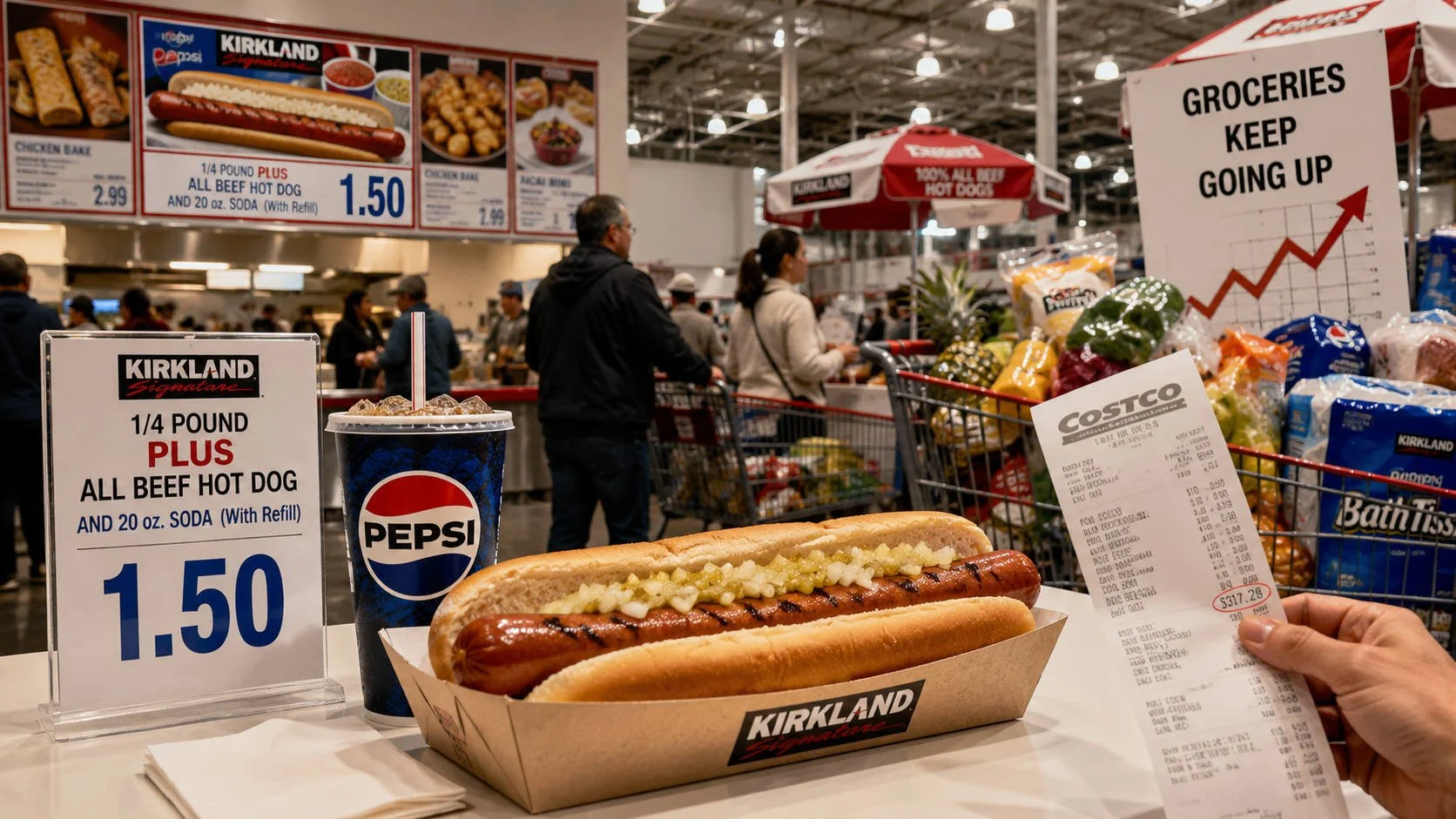
The Costco hot dog is not just a hot dog. That would be too normal, and America has worked very hard to ensure no food item remains merely itself. It is a hot dog, a soda, a corporate identity statement, an inflation protest, a membership-renewal spell, and a little edible monument to the idea that somewhere in this bloated economy, one number has not crawled upward like a haunted grocery receipt.
For more than 40 years, Costco’s hot dog-and-soda combo has stayed at $1.50, a price that looks less like a menu item and more like a clerical error everyone agreed to protect with their lives. ABC News reported in 2022 that the Kirkland Signature hot dog and fountain drink combo had held its price since 1985, and Costco executives have repeatedly reassured shoppers that the price is not being dragged into the inflation swamp anytime soon.
This is why the Costco hot dog matters. Not because it is haute cuisine. It is a tube of meat in a bun, not a doctoral thesis with mustard. It matters because it teaches a simple, brutal lesson about food price trust: customers do not just remember what something costs. They remember whether the company made them feel stupid for believing the price.
The Costco Hot Dog Is a Price Anchor With Relish
A price anchor is a number customers use to judge everything else. Costco’s anchor is not hidden in an app, buried behind a digital coupon, or available only after joining “Frankfurter Rewards Plus Platinum,” because apparently every company now thinks buying lunch should require a loyalty ecosystem and a blood sample.
It is simply $1.50.
That number has become so famous that it now does work far beyond the food court. It tells shoppers: yes, Costco sells $1,200 patio sets, 48 rolls of toilet paper, and olive oil in quantities suitable for a small monastery, but also here is a hot dog and drink for less than the price of breathing near a coffee shop.
Using the 1985 CPI annual average of 107.6 and the April 2026 CPI reading of 332.407, $1.50 in 1985 would be roughly $4.63 today by a simple CPI adjustment. So Costco is not merely “holding the line.” It is standing on the line with a folding chair, daring inflation to approach.
That visible refusal becomes trust. Not abstract trust. Not brand-deck trust. Real trust. The kind where a shopper sees one stable price and thinks, “Maybe this place is not actively trying to harvest my organs through dynamic pricing.”
Food Price Trust Is Broken Because Everyone Keeps Playing Hide-the-Cost
People are not paranoid about food prices because they suddenly developed an irrational emotional bond with unit pricing. They are paranoid because shopping has become a weird little detective game where every package might be smaller, every deal might require an app, and every “new look, same great taste” label sounds like a corporate raccoon whispering, “We removed two ounces and hoped you were busy.”
Food prices are still a major public worry. Pew Research Center reported in 2025 that two-thirds of Americans were very concerned about food and consumer goods prices. The Federal Reserve’s 2025 household well-being report said just over nine in ten adults viewed price increases as a minor or major concern. That is not “some shoppers are annoyed.” That is the entire country staring at a grocery shelf like it just insulted their mother.
And food inflation has not exactly retired to a beach. USDA’s Economic Research Service reported that food prices in April 2026 were 3.2% higher than a year earlier, while overall CPI was up 3.8%. Specific categories were even more obnoxious, with nonalcoholic beverages up 5.1% year over year and wholesale beef prices still 14.2% higher than April 2025.
So when Costco keeps the hot dog combo at $1.50, customers notice. Not because they have a sacred spreadsheet titled “Important Sausage Metrics.” They notice because everything else keeps changing just enough to make them feel mugged by decimals.
Costco’s Real Product Is Not the Hot Dog. It Is the Promise.
The Costco hot dog is cheap, but the important thing is not cheapness alone. Plenty of cheap things are terrible. Airport sandwiches can be expensive and terrible, proving that price and dignity have filed for divorce. The Costco hot dog works because it represents a promise that has stayed visible, consistent, and easy to understand.
Costco’s own investor materials describe the company’s model as offering members low prices on a limited selection of national-brand and private-label products to generate high sales volume and fast inventory turnover. Its company profile also says Costco aims to carry quality goods at substantially lower prices than typical wholesale or retail sources.
That is the business philosophy. The hot dog is the edible logo.
And unlike most corporate “values,” which tend to sound like they were assembled from LinkedIn refrigerator magnets, the hot dog is measurable. It does not say “value.” It costs $1.50. It does not say “customer obsession.” It sits there, unchanged, while other menus add 23 cents because someone in finance discovered “margin opportunities,” the mating call of the coward.
The Membership Model Makes the Hot Dog Possible
Of course, Costco is not a charity operating under the holy doctrine of Our Lady of Discount Meat. The company makes serious money, and the hot dog sits inside a much larger machine.
Costco reported fiscal 2025 net sales of $269.9 billion and membership fee revenue of $5.323 billion, up from $4.828 billion the prior year. That membership revenue matters because Costco is not trying to squeeze every possible penny out of every single item. It makes money by convincing people that the membership itself is worth renewing.
And yes, membership fees went up. Costco’s customer service page says that effective September 1, 2024, Gold Star memberships increased from $60 to $65, Business memberships from $60 to $65, and Executive memberships from $120 to $130.
This is the part where the hot dog becomes strategically useful. Costco can raise the membership fee and still preserve the $1.50 combo as a sacred little proof-of-value coupon. “Yes, the annual fee went up five dollars, but behold: the dog remains.” Very Old Testament. Very sodium-forward.
The Hot Dog Is Not a Loss. It Is a Trust Deposit.
People love calling the Costco hot dog a “loss leader,” and maybe it is, depending on costs, operations, and whatever secret meat arithmetic lives behind Costco’s curtain. But even if Costco makes little or nothing on it, calling it a loss leader undersells the genius.
It is a trust deposit.
Every time a member buys the combo, Costco makes a tiny payment into the customer’s belief that the company still gives a damn about value. That belief is worth more than squeezing another dollar out of the food court, because a shopper who trusts Costco is a shopper who may buy tires, rotisserie chicken, berries, allergy medicine, a mattress, and a kayak they have no business owning.
Costco’s current CEO Ron Vachris leaned into this in 2026, appearing in a company social video and saying the hot dog price would not change “as long as I’m around,” while calling it “amazing quality, amazing value.” Business Insider reported the video received unusually high engagement, because apparently watching a CEO eat his own hot dog with conviction is now what passes for leadership theater. Fine. At least this one came with a meal.
The Jim Sinegal Hot Dog Threat Became Retail Scripture
Part of the Costco hot dog mythology comes from the famous story involving co-founder Jim Sinegal and former CEO Craig Jelinek. Jelinek reportedly told Sinegal Costco could not keep selling the combo for $1.50, and Sinegal responded with the now-legendary warning not to raise “the effing hot dog.” The New Yorker revisited the story in 2025 and noted Jelinek’s point was that Costco solved the problem by building a hot dog plant in Los Angeles, though what the public remembered was the folk-hero threat.
This story works because it gives the price a guardian. The hot dog is not cheap by accident. It is cheap because leadership allegedly treated raising the price like arson.
And that matters for trust. Customers want to believe someone inside the company is saying no. No to random price creep. No to sneaky cuts. No to the spreadsheet goblin who thinks customers will not notice if the bun becomes 8% sadder.
Costco Chose Operational Boringness Over Customer Betrayal
The least glamorous part of the Costco hot dog story is also the most important: Costco figured out how to protect the price operationally. This is where most companies collapse into excuses and begin speaking fluent margin fog.
Keeping a price stable for decades means someone has to make hard, dull decisions about supply, production, scale, vendors, logistics, and menu simplicity. Not fun. Not viral. Not “innovative” in the startup sense, where innovation means putting a subscription on a toaster.
Costco’s genius is that it treats low prices as an engineering problem, not just a marketing slogan. The menu stays limited. The volume is massive. The food court does not offer eighteen aioli personalities and a seasonal bun flight. It sells the damn hot dog.
That is the lesson other food businesses keep missing. Customers do not need every item to be frozen in 1985 like a Reagan-era meat shrine. They need to believe price changes are honest, explainable, and not caused by a boardroom seeing how far it can push them before revolt.
The Water Option Shows How Fragile Trust Can Be
In 2026, Costco added an option that lets shoppers swap the fountain soda for bottled Kirkland water while keeping the combo at $1.50. Axios framed it as a small change that could appeal to more health-conscious customers while also potentially shifting value from volume to choice.
This is where price trust gets interesting. The price stayed the same, but the offer changed. Some shoppers see bottled water as a nice option. Others see it as a subtle value adjustment because a refillable soda and a bottle of water are not psychologically identical.
That does not mean Costco betrayed the republic. Calm down, Beverage Court. It means even tiny changes to a trusted food deal get inspected like archaeological evidence. When a company builds trust around consistency, customers become very sensitive to what “same price” actually means.
Same price plus same value equals trust.
Same price plus less value equals shrinkflation wearing a fake mustache.
The Costco Hot Dog Is the Opposite of Shrinkflation Theater
Shrinkflation works by keeping the sticker price steady while quietly reducing the amount or quality. It is the corporate equivalent of stealing one stair from a staircase and hoping nobody falls down.
Research on pricing transparency has found that consumers perceive price increases as fairer when companies disclose them directly rather than letting customers discover them elsewhere. Price fairness research also links fairness perceptions to loyalty, which is a fancy academic way of saying people remember when they feel played.
The Costco hot dog is powerful because it resists the hidden-price-change game. The sign is blunt. The combo is blunt. The whole thing has the subtlety of a warehouse forklift, which is exactly why people trust it.
There is no “now with optimized portion architecture.” There is no “new premium format.” There is no app-only sauce credit redeemable every third Tuesday during a lunar event. It is a hot dog and a drink for $1.50. A sentence so clear it sounds illegal in modern food retail.
What Food Brands Should Learn From the Costco Hot Dog
The first lesson is that simple prices build memory. Customers remember $1.50. They do not remember $7.89 with a $2.14 app credit, a 10% loyalty bonus, and a delivery fee named after someone’s MBA thesis.
The second lesson is that visible value beats promotional confetti. A permanent fair price is more powerful than a rotating carnival of discounts that requires shoppers to tap through six screens like they are defusing a coupon bomb.
The third lesson is that consistency creates emotional equity. The hot dog has become part of the Costco ritual: shop, overspend, question why you bought a tub of pesto large enough to baptize a goat, then end the trip with a $1.50 reminder that maybe you still won.
The fourth lesson is that trust survives profit when profit does not look predatory. Customers know Costco makes money. They are not idiots, despite what some loyalty apps seem to assume. What they appreciate is the sense that Costco is not trying to extract maximum pain from every transaction.
The fifth lesson is that do not mess with sacred items unless you enjoy becoming a case study in public irritation. Every brand has a few products customers use to judge the entire business. For Costco, it is the hot dog. For other companies, it might be fries, coffee, rotisserie chicken, a house salad, or one specific sandwich that somehow became emotionally load-bearing. Touch it carefully.
What Shoppers Can Learn From the Costco Hot Dog
The Costco hot dog is a great deal, but it is not a full theory of household finance. Do not buy a $65 membership solely to eat hot dogs unless your retirement plan is “condiments.” Costco itself says purchasing is exclusive to members, though members can bring guests; the guest does not get purchasing privileges.
Use the hot dog as a signal, not a spell. It tells you Costco is serious about some visible value items, but that does not mean every item in the warehouse is automatically the cheapest. Unit-price check the stuff you buy often. Compare perishables honestly. Do not buy 12 pounds of something “to save money” if half of it is going to die in your fridge like a soggy financial lesson.
Also, remember that the hot dog works because it is paired with a shopping trip. Costco is betting you will come in for value and leave with a cart containing socks, salmon, batteries, and an appliance you suddenly decided your personality needed. The hot dog is cheap. Your lack of cart discipline is not.
Why the Costco Hot Dog Feels So Personal
People are attached to the Costco hot dog because it makes the economy feel briefly sane.
That is the emotional core. The actual food is fine. Good, even. But the cultural meaning is much bigger than the taste. In a world where food prices rise, packages shrink, apps gatekeep discounts, and every checkout screen looks like it was designed by a slot machine with a minor in behavioral economics, the $1.50 hot dog says: here is one thing that did not get worse.
That is why people defend it. That is why executives get asked about it. That is why articles like this exist, because apparently one hot dog has become more trustworthy than half the institutions in modern life.
The Costco hot dog teaches that food price trust is not built by slogans. It is built by repeated proof. Same price. Same promise. Same weirdly comforting warehouse ritual.
The Hot Dog Is Cheap, but the Trust Is Expensive
The Costco hot dog is a $1.50 meal and a billion-dollar trust symbol stuffed into a bun. It works because the price is simple, stable, visible, and connected to a business model that can afford to treat value as a long-term relationship instead of a seasonal promotion with clip-art confetti.
Costco did not make the hot dog legendary by reinventing lunch. It made it legendary by refusing to betray a number.
That is the whole lesson. Food companies keep trying to earn trust with loyalty apps, limited-time offers, influencer partnerships, and packaging that screams “family size” while quietly feeding a family of two emotionally distant hamsters. Meanwhile, Costco has been standing there for four decades saying, “Hot dog and soda. Buck fifty.”
And somehow, that is more persuasive than an entire marketing department wearing fleece vests and saying “consumer value proposition” until the room loses consciousness.
The Costco hot dog teaches that in food pricing, trust is not complicated. It is just rare.
Hold a promise long enough, and people will believe you.
Put it in a bun, and they may even renew.