What Shake Shack Says About Why “Better Burgers” Feel Worth More
Shake Shack is the restaurant industry’s most successful argument that a burger can put on a nicer bun, get a better haircut, and suddenly charge more without everyone calling the police.
This is not an insult. Well, not only an insult. Shake Shack has spent two decades proving something surprisingly durable: people will pay more for a burger when it feels like an upgrade, not just a transaction. The “better burger” is not merely a burger with fresher lettuce and a sauce that went to branding school. It is a whole value illusion — and sometimes a real value proposition — built out of quality cues, hospitality, design, menu restraint, origin story, and the deeply human desire to believe lunch can be slightly less depressing.
Shake Shack started as a hot dog cart in New York City’s Madison Square Park in 2001, originally tied to fundraising for a public art project. Its popularity led to a permanent kiosk in 2004, described by the Madison Square Park Conservancy as Danny Meyer’s tribute to the American roadside burger stand. That origin story matters because it gives the chain the one thing a lot of fast-food brands would sacrifice a mascot for: authenticity that did not come from a mood board titled “Urban Nostalgia Burger Moment.”
Today, Shake Shack is no longer a cute little park kiosk selling burgers to people pretending a line is “part of the experience.” As of its Q1 2026 financial release, the company said it had expanded to more than 685 locations systemwide, including more than 440 in the U.S. and 245 international locations. So yes, the humble burger stand grew up, found private equity’s phone number, and became a global machine with crinkle fries.
The “Better Burger” Is Really a Price Permission Slip
The phrase “better burger” sounds innocent, like a burger that remembers your birthday. But in business terms, it means one very specific thing: permission to charge more.
Shake Shack’s category lives between old-school fast food and casual dining. It is not McDonald’s, where value is supposed to arrive in a paper bag with the emotional energy of a bus transfer. It is not a sit-down restaurant either, where someone brings you water and pretends not to judge your fries. It is fast casual: you order at the counter, but the whole experience quietly says, “This costs more because we are not doing the absolute minimum over here.”
The New Yorker described the rise of fast casual as a shift away from traditional fast food’s factory model toward restaurants emphasizing fresher, more natural, and often locally sourced ingredients. The piece specifically grouped Shake Shack with brands that changed what people expected fast food could be, making higher prices feel less outrageous because the food seemed better, fresher, and more intentional.
That is the psychological trick. Shake Shack is not asking you to compare its burger only to a cheaper fast-food burger. It is asking you to compare it to a restaurant burger, a diner burger, a boutique burger, the vague memory of a burger you once loved on vacation, and the sad little freezer patty currently dying in your apartment. Against that lineup, Shake Shack starts to look like the responsible middle child: more expensive than fast food, less annoying than a gastropub, and unlikely to arrive impaled with a steak knife like the chef is threatening you.
Ingredients Do the Heavy Lifting, Because Lettuce Needed a Resume
Shake Shack’s value story begins with ingredient signals. The company describes itself as serving elevated versions of American classics using high-quality ingredients, including made-to-order Angus beef burgers, crispy chicken, hand-spun shakes, house-made lemonades, beer, wine, and more. It also ties its brand to “premium ingredients,” hospitality, design, and community investment.
This is where “better burger” becomes a vocabulary lesson. A regular burger has beef. A better burger has Angus beef. A regular bun is a bun. A better burger has a potato bun, because apparently potatoes had to get involved to make bread feel luxurious. A regular sauce is sauce. A better burger has ShackSauce, capitalized like it owns property.
Shake Shack’s animal welfare policy also says its beef standards include no added hormones, no antibiotics, no animal by-products or sub-therapeutic antibiotics in feed, and humane treatment of cattle throughout their life. Its chicken and pork standards include similar commitments around antibiotics and welfare practices.
Are most customers reading the sourcing policy before ordering? Absolutely not. People are not standing in line murmuring, “Ah yes, the cattle welfare framework, that’ll pair nicely with cheese fries.” But the information creates a quality halo. Even if a customer only vaguely absorbs the message — better beef, better sourcing, better standards — the burger starts to feel like it belongs in a higher price bracket.
This is how premium food branding works. You do not need every customer to memorize the supply chain. You need them to feel that the supply chain exists, somewhere, wearing a clean apron and making responsible choices.
Shake Shack Sells Familiar Food Without Making It Feel Cheap
The smartest thing Shake Shack does is sell food people already understand. Burgers. Fries. Shakes. Chicken. Lemonade. Hot dogs. Frozen custard. It is not asking America to fall in love with an ancient grain bowl named after a minor Greek island. It is selling the most legible comfort foods in the country and then upgrading the cues.
This matters because people are more likely to pay extra for a premium version of something familiar than for something that makes them feel like they need a glossary and a therapist. A burger is democratic. A burger is obvious. A burger does not require the waiter to say “the chef is exploring texture.” It is meat, bun, cheese, sauce, and hope.
Shake Shack’s genius is that it makes a familiar food feel edited. The menu is not a 140-item laminated panic attack. The core proposition is clear. That restraint makes the food feel intentional, which is very convenient, because intention is what restaurants call simplicity when they want to charge more for it.
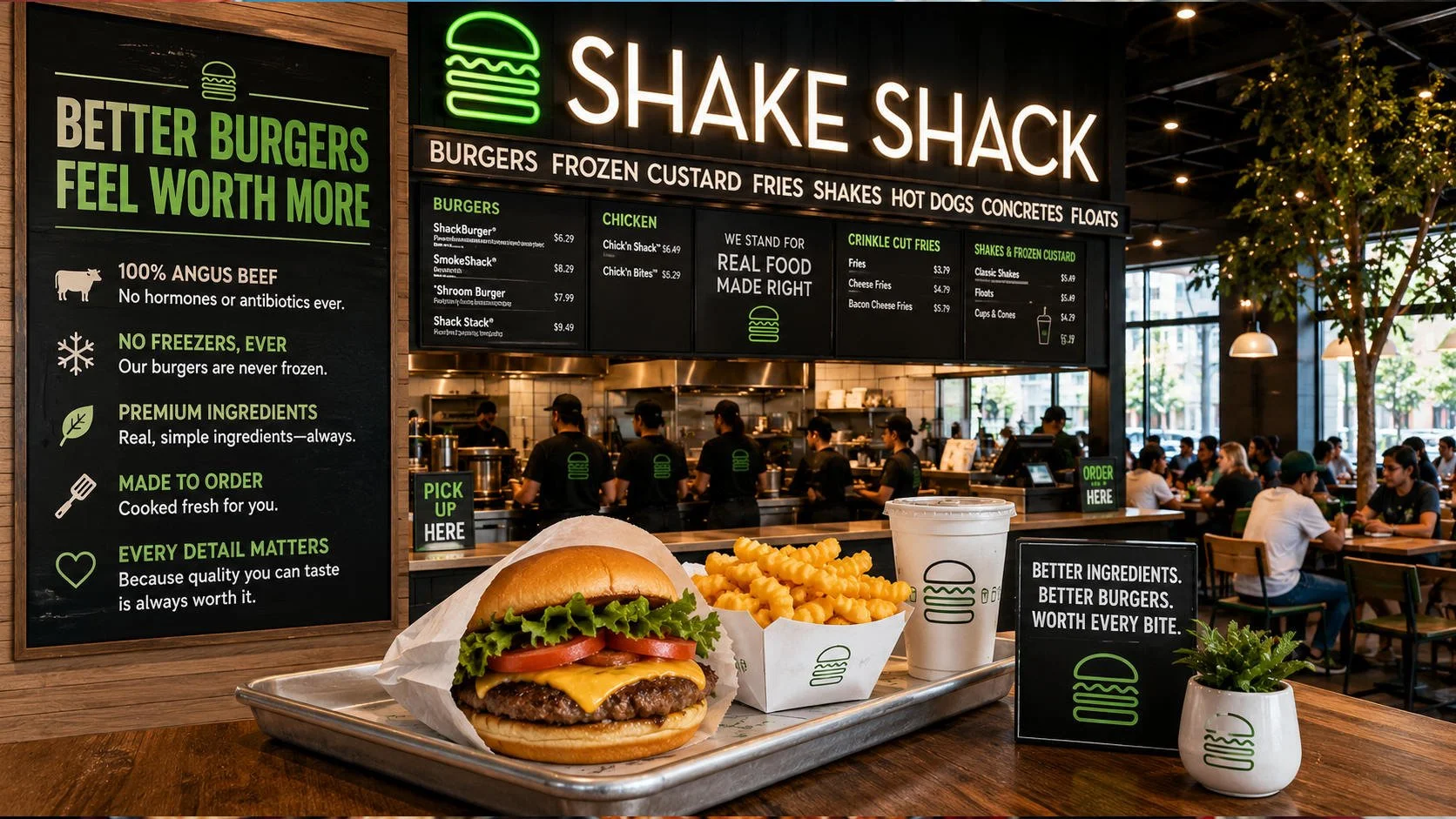
There is also the visual discipline: the bun is glossy, the lettuce looks awake, the cheese melts properly, the crinkle fries look like a nostalgic school cafeteria snack that married into money. The whole tray says, “This is fast food, but not the kind that makes you stare at your steering wheel afterward wondering where the years went.”
Hospitality Is Part of the Burger, Unfortunately for Everyone Who Thinks Value Is Just Price
One of the reasons Shake Shack can charge more is that it inherited hospitality DNA from Danny Meyer’s restaurant world. The company’s values page says it aims to deliver exceptional food and hospitality while serving team members, guests, and communities. It also explicitly says Shake Shack aspires to bring the world’s best “fine casual” experience to as many people as possible.
That phrase, fine casual, is doing an absurd amount of work. It is fast casual wearing a blazer. It says you are still ordering at a counter, yes, but the vibe should feel warmer, cleaner, and more human than a typical “NEXT CUSTOMER” burger chute.
This is crucial because restaurant value is no longer just the number on the receipt. Deloitte’s 2026 restaurant value research found that while price is a major part of perceived value, it does not explain everything. Deloitte’s analysis says price explains 67% of restaurant value perception, leaving 33% shaped by non-price factors; it also identifies food quality, service quality, speed, food presentation, staff attitude, atmosphere, and cleanliness as drivers of purchase intent.
Translation: people will forgive a higher check if the experience does not feel like being processed through a damp airport. Food can cost more when the place feels better, the order is right, the staff is decent, the tables are clean, and the burger does not arrive looking like it was sat on by a raccoon with deadlines.
Shake Shack Is Selling “Worth It,” Not “Cheap”
The modern restaurant market is obsessed with value because customers have noticed that eating out costs real money now, which was inconsiderate of them but understandable. McKinsey noted in January 2026 that restaurant and takeout costs rose about 6% from January 2024 to September 2025, while food-at-home costs rose about 3% during the same period. That gap makes diners scrutinize whether a restaurant meal is actually worth leaving the house, paying the markup, and putting on pants with structure.
Fast-food chains have responded by yelling “value” until the word has been beaten into a paste. In April 2026, McDonald’s moved toward a simpler McValue menu with 10 items under $3, following similar value plays from Taco Bell, Wendy’s, Panera, and KFC. The Associated Press also noted that chains are trying to balance budget offers with higher-priced premium items, because apparently the entire industry is now juggling discounts in one hand and truffle-adjacent burgers in the other.
Shake Shack cannot win by being the cheapest. It would be ridiculous. That is not its lane. A Shake Shack value proposition is not “look how little this costs.” It is “look how much better this feels than the cheaper thing.” That is more fragile but also more powerful. Cheapness competes with everyone. Worth-it-ness competes with disappointment.
Datassential’s 2025 value research put this plainly: 74% of diners said a meal can represent excellent value even at a higher price point, and many operators said diners evaluate service, environment, and experience rather than just the check total.
This is the whole Shake Shack thesis in one sentence: the burger can cost more if the customer leaves thinking, “Fine, that was actually good,” instead of “I have been financially mugged by mayonnaise.”
The Premium Burger Works Because It Feels Like a Small Upgrade, Not a Major Splurge
A Shake Shack meal is not cheap, but it is also not a steakhouse. That middle zone is the magic. It lets customers buy a little upgrade without making it a full “occasion.” Nobody has to say, “We’re celebrating your promotion at Shake Shack,” unless the promotion was from intern to emotionally stable intern. But a ShackBurger can still feel like a treat.
That is why better burgers work so well. They occupy the “small luxury” category. A few extra dollars can convert a forgettable fast-food meal into something that feels chosen. In a world where actual luxuries involve mortgage paperwork and airline fees that look like ransom demands, paying more for a better burger is a manageable little indulgence.
This is also why the burger format matters. Burgers are emotionally forgiving. A fancy salad has to justify itself like it’s applying to law school. A premium burger just has to be hot, juicy, salty, balanced, and served with fries that don’t taste like they were reheated by candlelight.
The customer is not necessarily buying health. Let us not become delusional. The customer is buying quality-coded indulgence. That is different. A better burger lets people feel less foolish about indulgence because the ingredients, sourcing, and experience imply care. It is still a cheeseburger. It is just a cheeseburger with a college application.
The Financials Show the Model Works, But Also That It Is Not Magic
Shake Shack’s business results show why the model is attractive. For fiscal 2025, the company reported total revenue of $1.445 billion, up 15.4% from 2024, and systemwide sales of $2.229 billion, up 15.9%. It also reported 45 new company-operated Shacks and 40 new licensed Shacks during the year.
In Q1 2026, Shake Shack reported total revenue of $366.7 million, up 14.3% year over year, and systemwide sales of $558.3 million, up 14.1%. Same-Shack sales rose 4.6%, though the quarter also included a small operating loss and net loss, which is a useful reminder that premium burgers are not immune to costs, weather, labor, beef prices, tourism swings, or the general economic atmosphere of everyone clutching receipts like legal evidence.
The point is not “Shake Shack has solved restaurants.” Nobody has solved restaurants. Restaurants are chaotic little machines that turn rent, labor, beef, training, equipment, and customer mood swings into a margin that can evaporate because it rained too much. The point is that Shake Shack has built a brand where premium pricing can make sense to customers when the execution holds.
But that last phrase matters: when the execution holds.
A better burger cannot merely announce that it is better. It has to behave better. Cold fries, messy service, long waits, dirty tables, tiny portions, or inconsistent burgers will destroy premium value faster than a finance bro saying “elevated burger concept” near a landlord.
“Better” Is a Bundle of Signals, Not Just a Patty
So why do Shake Shack burgers feel worth more?
Because the customer is not evaluating the patty alone. They are evaluating a bundle of signals:
The origin story says this is not just a faceless chain.
The ingredients say the food is higher quality.
The menu says the brand knows what it is.
The design says this is not a fluorescent punishment chamber.
The hospitality says someone thought about the guest experience.
The bun, sauce, fries, shakes, and branding say this is familiar but upgraded.
The price says premium, but not unreachable.
That bundle is what makes “better burgers” work. Remove enough pieces and the value collapses. A premium burger in a dirty room is just an expensive burger with delusions. A beautiful store with a mediocre burger is an interior design project that happens to sell lunch. A fancy sourcing statement attached to bad execution is a morality play with fries.
Shake Shack’s best trick is making the whole thing feel coherent. The brand does not say, “Here is a cheap burger.” It says, “Here is a burger that belongs in a better fast-food universe.” And because normal fast food has spent years raising prices while often still feeling like normal fast food, that premium universe starts looking less ridiculous.
The McDonald’s Problem Helps Shake Shack
Shake Shack also benefits from a weird market reality: traditional fast food got more expensive. When the gap between fast food and fast casual narrows, the customer starts doing dangerous math.
If a conventional fast-food combo creeps toward the price of a better burger meal, the question changes from “Which is cheapest?” to “Which one will make me feel least robbed?” That is where Shake Shack becomes dangerous. It does not have to be cheap. It just has to feel sufficiently better for the difference to seem rational.
This is why the fast-food value war matters. McDonald’s under-$3 menu, Taco Bell value items, and other discount bundles are not just about low-income diners. They are defensive moves against the feeling that fast food lost its automatic value advantage. The AP quoted experts saying younger customers increasingly want emotional experiences, personalization, and ingredient transparency, and that competing only on cost is not enough in the long run.
That is exactly the opening Shake Shack has always used: don’t be cheapest; be more desirable.
How to Tell Whether a Better Burger Is Actually Worth It
Here is the useful part, because otherwise this becomes a love letter to branded sauce, and nobody needs that in their life.
A better burger is worth the premium when it passes five tests.
First, the burger has to be noticeably better than the cheaper option. Not “the menu said Angus” better. Actually better. Juicier, hotter, better sear, better bun, better toppings, better balance. If the difference only exists in the copywriting, congratulations, you bought a paragraph.
Second, the sides have to pull their weight. A premium burger place with weak fries is committing treason. Fries are not an accessory. They are the burger’s legal counsel.
Third, the experience has to be clean and consistent. Fast casual lives or dies on execution. If you are paying extra and still wiping mystery sauce off the table like a volunteer at a county fair, the value story has fallen into a sinkhole.
Fourth, the price has to make sense against local alternatives. A Shake Shack meal may feel worth it in a market where every decent lunch is already expensive. It may feel less worth it where excellent local burger spots are cheaper or where fast-food value deals are genuinely strong. Value is contextual, not tattooed onto the bun by angels.
Fifth, you have to want the actual product, not the brand aura. If you are paying more because the burger scratches the exact craving, great. If you are paying more because the logo made you feel like a better person, please sit quietly and think about what capitalism has done to your lunch.
The Real Lesson From Shake Shack
Shake Shack says “better burgers” feel worth more because value is not the same thing as low price. Value is confidence. Confidence that the burger will taste good. Confidence that the brand is not wasting your money. Confidence that the experience will feel cleaner, warmer, and more intentional than the cheaper alternative. Confidence that paying more buys something tangible, not just a receipt with attitude.
The better-burger model works because it takes America’s most familiar fast food and gives it just enough quality, polish, sourcing language, and hospitality to feel like an upgrade. Not fine dining. Not health food. Not moral superiority between buns. Just a better version of something people already love.
That is the genius. Shake Shack did not ask customers to change their cravings. It asked them to raise their expectations.
And once people believe a burger can be better, they become willing to pay more for one — as long as the burger keeps proving it deserves the upgrade. Otherwise, the whole thing turns into a very expensive reminder that a potato bun cannot save a mediocre lunch.
Shake Shack’s lesson is simple: better burgers feel worth more when “better” shows up everywhere — in the food, the service, the room, the story, the consistency, and the tiny emotional relief of eating a burger that does not feel like it was assembled by a printer jam.
That is not cheap. But when it works, it feels worth it.
And in the restaurant business, “worth it” is the only value meal that actually matters.