Why Disney Cruise Food Feels Like Controlled Abundance
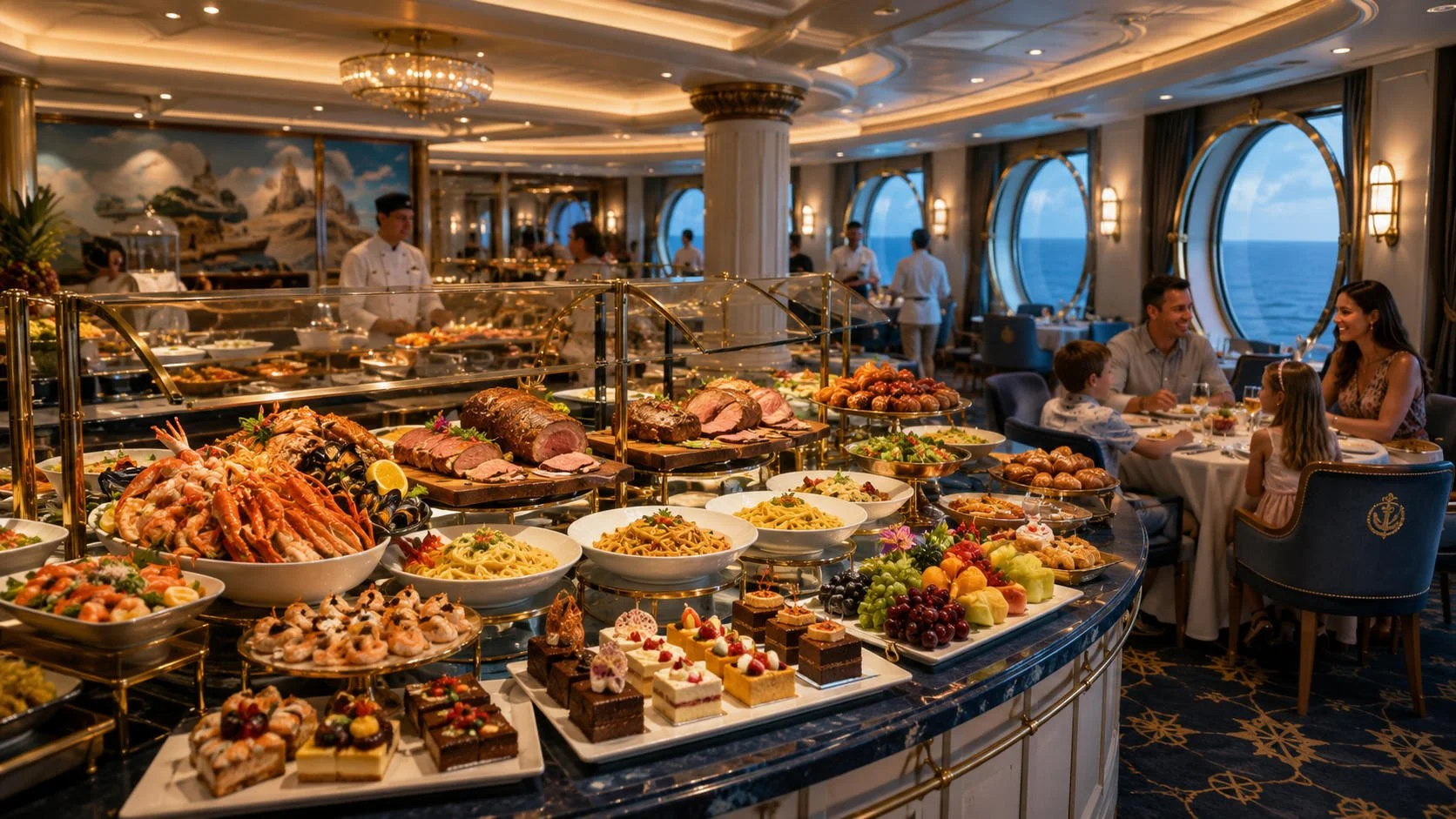
A Disney cruise is what happens when a buffet gets a project manager, a soundtrack, and a mouse-shaped compliance department.
The food feels endless, but not wild. It feels generous, but not chaotic. It feels like you can eat all day, but only inside a system so carefully engineered that even your second dessert has been spiritually assigned a time slot. This is not abundance in the “everyone stampede toward shrimp until maritime law collapses” sense. This is controlled abundance: plenty everywhere, but organized, themed, timed, staffed, labeled, and politely monitored by a floating entertainment empire that has never met a guest behavior it could not turn into a schedule.
Disney Cruise Line’s dining works because it gives passengers the thing cruises have always promised — food everywhere, no constant wallet pain, permission to indulge — while sanding down the ugly edges of abundance. The result is not “unlimited food.” It is unlimited-ish food inside a beautifully managed edible maze.
Disney Cruise Food Is Abundant, But Not Lawless
Disney’s own “what’s included” page says the fare covers breakfast, lunch, dinner, casual buffets, grab-and-go options, and 24-hour room service. It also lists endless soft-serve ice cream, quick bites like pizza, tacos, burgers, and salads, plus all-you-care-to-enjoy soft drinks, coffee, and tea on deck and at table-service restaurants. This is why a Disney cruise guest can spend the day drifting from breakfast to pool-deck snack to soft serve to dinner to late-night room service like a raccoon with a MagicBand and no shame.
But the key is that this abundance is contained. The food is included, yes, but it is not just dumped in front of you like a medieval king’s fever dream. There are dining rooms. There are rotations. There are quick-service venues. There are room service menus. There are beverage stations. There are adult-only upcharges lurking in the shadows wearing dress shoes. The ship says, “Eat all you want,” then immediately adds, “Here is the approved framework, please stop trying to carry soft serve into the theater like a dairy goblin.”
That is the Disney genius. It sells freedom by surrounding it with rails.
Rotational Dining Is the Mouse’s Meal Algorithm
The heart of Disney Cruise food is rotational dining, which is a phrase that sounds like something your doctor warns you about after looking at your cholesterol but is actually one of Disney’s best cruise inventions. Disney says rotational dining makes sure guests enjoy each of the three themed dining venues onboard, with pre-assigned dining arrangements included in every booking and a dedicated service team that learns your preferences throughout the voyage. Guests get their restaurant schedule and table number through the Disney Cruise Line Navigator app.
Translation: you do not choose dinner every night. Dinner chooses you, but in a fun hat.
This solves a major vacation problem: decision fatigue. On land, families spend half their vacation debating where to eat until everyone becomes a low-blood-sugar war criminal. On a Disney cruise, the answer is already waiting in the app, because the app is now your tiny glowing cruise parent. You rotate through the restaurants, your servers come with you, and everyone pretends this is casual even though it is clearly a hospitality machine with better choreography than most weddings.
The result is comforting. You get novelty without planning. You get variety without panic. You get the same servers without eating in the same room every night like you are trapped in a banquet hall time loop.
Themed Dining Makes Dinner Feel Like Entertainment
Disney does not merely feed you. Obviously not. That would be too normal. Disney takes dinner and gives it intellectual property, lighting cues, character moments, and enough narrative scaffolding to make a chicken entrée feel like it has an agent.
On the Disney Wish, the three family dining locations are 1923, Worlds of Marvel, and Arendelle: A Frozen Dining Adventure. Disney Parks Blog describes rotational dining as a way to experience highly themed environments, different cuisines, and familiar servers each night, and notes that the restaurants leave guests wanting to order more — “which you can.”
That last part is crucial. The abundance is not just quantity. It is theatrical permission. You can order another appetizer. You can try a different dessert. You can act like the menu is a tasting flight and not a binding legal document. Disney has turned “sure, have another plate” into part of the magic, because apparently even overeating needs brand alignment now.
Worlds of Marvel is a perfect example of controlled abundance in costume. Disney lists it as dining, live shows, and character experiences, with breakfast, lunch, and dinner periods on Disney Wish, Disney Treasure, and Disney Destiny. It is not just a restaurant; it is a meal that has been kidnapped by superheroes and returned with a menu.
This is why Disney Cruise food feels bigger than it is. A steak in a plain dining room is dinner. A steak under Marvel screens while Groot is involved is “an experience,” which is restaurant code for “you are paying for food plus emotional fog machine.”
The Buffet Exists, But Disney Makes It Behave
Cruise buffets can have the energy of a county fair held during a mild emergency. Disney knows this, so its newer ships push casual abundance into spaces that feel more designed than “trays under lamps, good luck peasants.”
Marceline Market, found on Disney Wish, Disney Treasure, and Disney Destiny, is described by Disney as a stylish food hall serving breakfast and lunchtime favorites with Disney whimsy, animated-film touches, and a wide array of offerings. Mickey & Friends Festival of Foods is a quick-service outdoor venue on Disney Wish, Treasure, and Destiny, offering pizza, burgers, tacos, barbecue, snacks, and Disney’s signature soft serve.
This is buffet logic, but prettier. Disney understands that “lots of food” feels better when it is divided into themed stations instead of presented as one giant human feeding experiment. Food halls feel modern. Stations feel curated. Buffets feel like your aunt’s wedding at a hotel near the interstate. Same basic abundance, different emotional tax bracket.
That is controlled abundance again: many choices, but separated into zones so nobody has to confront the full moral weight of eating pizza, tacos, barbecue, and ice cream within the same 22-minute window.
Included Food Makes the Cruise Feel Like Prepaid Freedom
One reason Disney Cruise food hits so hard is that much of it is already paid for before you step onboard. That changes the psychology completely.
On land, every snack is a tiny fiscal slap. A drink here, fries there, ice cream for the kid, coffee for the adult, another snack because someone looked at a churro and became medically fragile. On a Disney cruise, many of those little moments are absorbed into the fare: soft drinks at meals and beverage stations, quick bites, soft serve, and room service. Disney also says complimentary room service is included 24 hours a day for breakfast, lunch, dinner, and snacks, with service available until 1:30 a.m. on the final day.
This is the emotional seduction of the cruise model. You are not necessarily spending less overall — please, this is Disney, not a soup kitchen with fireworks — but you are spending differently. You have already taken the big financial punch. Now the small snacks feel “free,” which is the most powerful lie in vacation economics.
“Free” soft serve is not free. It is prepaid soft serve. But your brain does not care. Your brain is wearing sunglasses on deck 11 and yelling, “Another cone, captain.”
The Upcharges Are the Guardrails
Disney’s food abundance has borders, and those borders often wear elegant adult-only clothing.
Disney says adult-exclusive restaurants are available on all Disney Cruise Line ships for guests 18 and older, including Enchanté, Palo, Palo Steakhouse, Palo Trattoria, and Remy depending on the ship. Reservations are required, guests skip their scheduled rotational dining restaurant when they go, and this premium dining is not included in the cruise price; additional fees apply.
There it is: abundance with a velvet rope.
The included food makes the cruise feel generous. The premium restaurants preserve hierarchy. You can eat plenty without paying extra, but you can also pay more to feel like a refined adult who did not just eat soft serve at 10:17 a.m. while standing barefoot near a pool.
Specialty beverages work the same way. Disney includes soft drinks, coffee, and tea in key places, but bar drinks, beer, wine, bottled water, specialty coffees, smoothies, and other specialty beverages cost extra. The ship gives you abundance, then quietly reminds you that Champagne is not part of your mouse-approved hydration journey.
Family Dining Without Family Collapse
Disney Cruise food feels controlled because it is built for families, and families are basically portable chaos with sunscreen.
The same servers following your table matter more than people realize. If a child drinks apple juice every night, the server knows. If someone needs a kids’ menu, Disney says children’s menus are available in all restaurants in the dining rotation. If allergies are a concern, Disney Parks Blog notes that separate allergy menus and clear indications are available aboard the Disney Wish, with guests advised to ask their server.
This is where Disney’s system becomes genuinely useful instead of just theatrically efficient. Parents do not have to re-explain everything every night to a new server in a new restaurant while a child slowly melts into the carpet. The restaurant changes; the service relationship stays. That is not just hospitality. That is emotional load management with bread service.
And yes, it is all very controlled. But when the alternative is a family of four arguing in a hallway because nobody knows where dinner is, control starts looking less like tyranny and more like mercy in a nautical blazer.
Disney Island Food Extends the Spell
The controlled abundance does not stop when the ship docks at Disney’s island destinations. Disney’s included-cruise page says its island retreats include BBQ lunch, soft drinks, soft serve ice cream, beach parties, character appearances, towels, lounge chairs, umbrellas, kids clubs, waterslides, and adult-exclusive beach areas.
This is important because Disney knows vacation psychology. If you step off the ship and immediately start paying à la carte for every drink and plate, the spell breaks. Suddenly you remember money exists. Terrible. Unmagical. Honestly rude.
So the island day continues the prepaid-abundance fantasy. You are still inside the bubble. You can eat barbecue, get a drink, grab soft serve, see characters, and continue pretending your wallet has been put in a medically induced coma.
Why Controlled Abundance Feels So Valuable
Cruises are growing partly because people like packaged value and predictable convenience. CLIA’s 2025 State of the Cruise Industry report said 34.6 million people cruised globally in 2024, projected 37.7 million in 2025, and found that 82% of cruisers intended to cruise again. It also noted that nearly one-third of cruise guests sail with three or more generations, which is exactly the kind of group that benefits from not having to negotiate dinner like a hostage exchange.
Dining is a huge part of that satisfaction. A 2025 study in the International Journal of Gastronomy and Food Science analyzing more than 38,000 cruise dining reviews found that gastronomy is a strategic differentiator for onboard satisfaction, and that diverse cuisines and themed dining significantly enhance the cruise experience. The study also emphasized that cruisers value culinary quality, variety, and memorable dining moments.
That is basically Disney’s food strategy written in academic pants. Variety? Yes. Theming? Aggressively. Memorable dining? Sometimes dinner comes with superheroes, princesses, animation history, or The Lion King. Culinary quality? The internet may fight about every individual dish until the ocean boils, but Disney clearly understands that food must feel like part of the vacation, not refueling between merch opportunities.
How to Use Disney Cruise Food Without Becoming a Plate Goblin
The practical move is to treat Disney Cruise food like a system, not a dare.
Do the rotational dining at least once through before deciding you are too special for it. That is the core Disney dining experience, not an obstacle between you and more fries. Use quick-service spots for convenience, not as a personal challenge to eat across every station before dinner. Order extra in the dining rooms when you genuinely want to try something, not because the word “included” turned your judgment into wet cardboard.
Skip adult-exclusive dining if the included restaurants already feel like enough. Book it if you want a quieter, more grown-up meal and understand you are leaving the included rotation for a paid premium experience. Do not act betrayed when premium means premium. That is literally the sign on the velvet rope.
Also, pace yourself. A cruise makes abundance feel harmless because the food is everywhere. But your body still knows you ate soft serve, barbecue, pizza, two desserts, and a burger in the same day. Your body is not fooled by nautical theming. It has internal organs, not pixie dust.
Disney Cruise Food Is Abundance With a Clipboard
Disney Cruise food feels like controlled abundance because that is exactly what it is.
The abundance is real: included meals, themed dining, casual food halls, quick bites, soft serve, soft drinks, island BBQs, and 24-hour room service. But the control is just as real: assigned rotations, scheduled dining, dedicated servers, app-based plans, venue categories, premium upcharges, adult-only reservations, and beverage boundaries.
This is why it works. Disney does not simply give you more food. It gives you managed plenty. Enough choice to feel spoiled, enough structure to prevent chaos, enough theming to make dinner feel like entertainment, and enough included snacks to make your brain whisper, “This is value,” while your credit card sits somewhere quietly recovering from the cruise fare.
It is not an all-you-can-eat free-for-all. It is an all-you-can-reasonably-fit-into-a-magic-schedule vacation machine.
And honestly? That may be the most Disney thing imaginable: even abundance has a table number.