What Guy’s Grocery Games Teaches About Finding Value in Any Food Aisle
There are cooking shows where chefs float through farmers markets fondling heirloom tomatoes as if each one contains the last honest emotion in America. Then there is Guy’s Grocery Games, a show where chefs sprint through a fake supermarket like the floor is lava, the clock is a landlord, and Guy Fieri has personally declared war on calm decision-making.
And somehow, amid the yelling, carts, speed shopping, judge panic, and enough bowling-shirt energy to power a regional casino, Guy’s Grocery Games is one of the most useful shows on television for understanding grocery value.
Yes. This loud little Flavortown fever dream may actually teach you how to shop better. Tragic news for everyone who thought grocery wisdom could only come from a beige finance blogger named Trent who meal-preps lentils in silence.
Food Network describes Guy’s Grocery Games as a high-stakes cooking competition where Guy Fieri sends chefs running through the aisles to face real-world challenges and compete to be the last chef standing. The show’s official page currently lists it on Wednesdays at 9|8c, because apparently America still has a functioning appetite for watching professionals become emotionally destabilized by aisle restrictions.
But the real lesson is not “run in the grocery store.” Please do not do that. You are not a contestant. You are a civilian trying to buy yogurt, and Sandra from accounting does not need to be shoulder-checked in front of the shredded cheese.
The lesson is this: grocery value is not about grabbing the cheapest item. Grocery value is about buying food that works hard, tastes good, stretches across meals, avoids waste, and does not require you to take out a small personal loan because you saw a jar of imported pepper relish with a handwritten label and temporarily lost your moral center.
Guy’s Grocery Games Turns Grocery Shopping Into a Value Test, Not a Vibes Parade
Most people grocery shop like they are wandering through a museum curated by hunger. They enter with no plan, drift toward whatever packaging makes the loudest visual threat, buy three sauces they do not need, forget the one ingredient required for dinner, and return home with $84 worth of “potential.”
Potential is not dinner. Potential is a bag of spring mix liquefying in your crisper drawer like a swamp with a barcode.
Guy’s Grocery Games strips away that nonsense. Contestants do not have the luxury of wandering. They have a challenge, a time limit, and usually some cruel little twist like “make a steakhouse dinner using only foods that begin with the letter M” because Guy Fieri wakes up every morning and chooses structured inconvenience.
That pressure reveals what value really is. A valuable ingredient is not merely cheap. It is useful under stress. It can become more than one thing. It brings flavor without needing twelve backup dancers. It solves a problem.
Food Network’s own smart shopping lessons from Flavortown Market say the best cooks need both cooking chops and shopping prowess, and that smart shoppers know what they want, when to grab a deal, and when to avoid supermarket tricks. Astonishingly, “shopping prowess” is not just buying the cereal with the cartoon animal that looks most clinically unstable.
The First Guy’s Grocery Games Lesson: Know the Aisle Before the Aisle Knows You
The supermarket is not your friend. It is a refrigerated casino with bananas.
Everything is arranged to make you feel like you are making choices, when really you are being gently herded through a fluorescent obstacle course designed by people who know exactly how hungry, tired, and suggestible you are.
Food Network’s Flavortown shopping guide points out that contestants who know the store layout have an advantage, and notes that fresh foods are typically around the perimeter while packaged, bulk, and grocery items fill the aisles.
This sounds obvious until you watch someone spend 11 minutes looking for panko while their dinner plan quietly dies in public.
The value lesson is simple: shop with a route. Start with produce if that anchors your meals. Move to proteins. Then pantry staples. Then dairy or frozen. Do not pinball around the store like a Roomba with unresolved childhood issues.
When you know the layout, you buy with purpose. When you do not, you “accidentally” walk past the cookie aisle six times and emerge with enough sandwich cremes to survive a mild apocalypse.
Aisle value begins before the aisle. Make a list. Group it by store section. Give your cart a mission instead of letting it become a wheeled confession booth.
Grocery Value Means Buying Ingredients That Can Do More Than One Job
The best Guy’s Grocery Games contestants understand flexibility. They grab ingredients that can pivot. A rotisserie chicken can become tacos, soup, salad, fried rice, quesadillas, or the sad but noble act of eating over the sink while whispering, “This still counts.” A bag of rice can support curries, stir-fries, bowls, soups, and your emotional need to not pay $17 for lunch.
A bad grocery purchase does one thing, poorly, once.
A good grocery purchase can become several meals without requiring an inspirational speech.
This is where the average shopper gets mugged by novelty. We see one specialty ingredient and imagine a new life. Suddenly we are the kind of person who uses black garlic molasses. We are sophisticated. We are mysterious. We are absolutely going to use one teaspoon, shove the jar into the fridge door, and rediscover it in 2029 looking like a cursed fossil.
Food Network’s shopping lessons recommend sticking with basics like salt, sugar, and pepper before spending extra money on gimmicky flavored oils or single-use spices. This is excellent advice, because nothing says “financial collapse in a pantry” like owning five boutique condiments and no actual dinner.
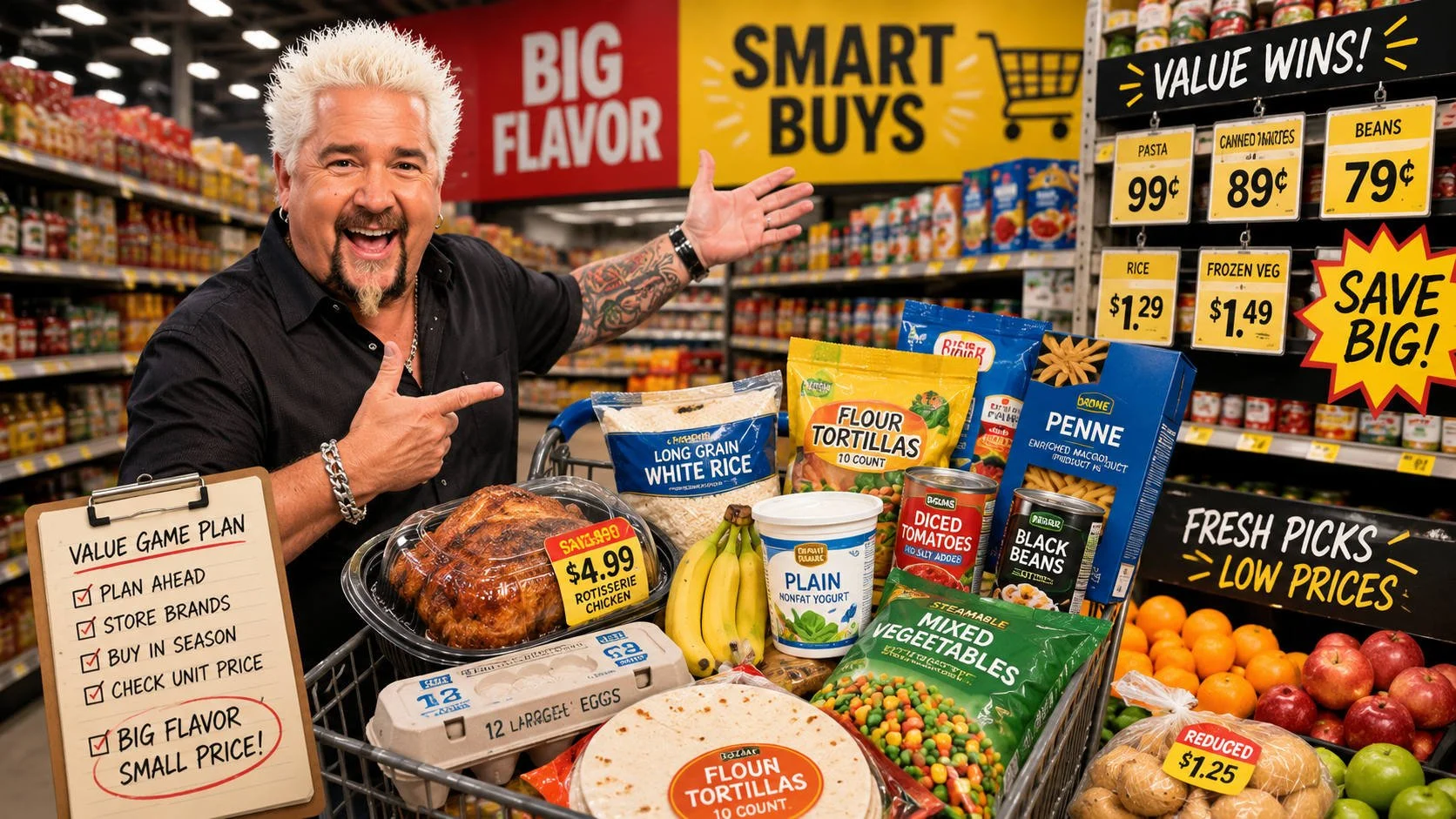
Buy the workhorses first. Rice. Pasta. Beans. Eggs. Frozen vegetables. Canned tomatoes. Plain yogurt. Potatoes. Onions. Garlic. Broth. Cheese that can be grated, melted, or eaten in front of the fridge like a raccoon in a robe.
The aisle is full of show ponies. Value lives with the donkeys. Respect the donkeys.
Guy’s Grocery Games Budget Battles Prove Substitution Is a Survival Skill
When Guy’s Grocery Games throws a budget challenge at contestants, the weak panic and the strong substitute. That is not just TV. That is the entire modern grocery experience, except instead of Guy yelling at you, it is the price of beef silently calling you poor.
USDA’s May 2026 Food Price Outlook predicted food-at-home prices would rise 3.2% in 2026, with beef and veal prices 14.8% higher in April 2026 than in April 2025. Fresh vegetables were also 11.5% higher year over year.
This is why substitution matters. A recipe is not a royal decree. It is a suggestion wearing formatting.
If chicken breast is expensive, buy thighs. If fresh berries cost the same as a minor plumbing repair, use frozen. If crème fraîche is priced like it was hand-delivered by a duchess, use sour cream or Greek yogurt. Food Network specifically notes that contestants in Budget Battle challenges may save money by using less expensive substitutes, including dried herbs instead of fresh or sour cream thinned with cream instead of crème fraîche.
This is not “cheapening” the dish. This is cooking like a person with eyes and rent.
The grocery aisle rewards shoppers who can ask, “What does this ingredient do?” Does it add fat? Acid? Crunch? Salt? Creaminess? Sweetness? Bulk? Once you know the function, you can find a cheaper replacement.
A $9 jar of roasted red pepper spread is not “necessary.” It is peppers, oil, acid, salt, and branding with a little hat on. Calm down.
Unit Price Is the Tiny Shelf Sticker That Knows You’re Bad at Math
The greatest villain in the grocery store is not inflation, though inflation is certainly standing nearby wearing a cape made of receipts. The greatest villain is the shopper’s refusal to read the unit price.
The unit price tells you what something costs per ounce, pound, gram, or other standard measure. It is the little shelf label whispering, “The bigger package is not always the better deal, genius.”
Food Network’s Flavortown guide calls out pricing tricks and says produce scales can help shoppers know whether price per pound beats prepackaged options. USDA also recommends comparing unit prices on shelves to find the best price when shopping on a budget.
This is the least glamorous advice in the world, which is how you know it works. Nobody has ever gone viral saying, “I compared oats by ounce,” because useful adulthood has terrible lighting.
But unit pricing is where value hides. Two boxes may look similar. One is 12 ounces. One is 16. One is on sale. One is “family size,” which sometimes means “we made the box bigger and trusted your brain to be busy.” Congratulations, your grocery store has turned arithmetic into a knife fight.
Read the unit price. Especially on cereal, coffee, cheese, meat, detergent, snacks, yogurt, rice, pasta, and anything that comes in multiple sizes designed to make your brain leak out of your ears.
The Cheapest Food Is the Food You Actually Use
Food waste is the dumbest subscription service in America. You pay for food, store it badly, ignore it, let it rot, then throw it away and buy more food because apparently your kitchen is a compost-themed Ponzi scheme.
The FDA says U.S. food waste is estimated at 30% to 40% of the food supply, and that wasted food was worth about $161 billion in 2010. It also says food is the largest category of material placed in municipal landfills.
This is where Guy’s Grocery Games becomes weirdly moral. Contestants get punished for forgetting ingredients, wasting opportunities, or buying things they do not use. In the real world, no judge will scold you for letting cilantro become black slime in the fridge. Worse: no one will stop you.
Food Network’s shopping lessons explicitly warn shoppers to take stock of what they already have before going to the store, so they do not buy duplicates and waste half-used ingredients.
That is value. Not the coupon. Not the sale. The eaten food.
A $2 bag of spinach you throw away is more expensive than a $4 frozen vegetable blend you actually cook. A giant container of Greek yogurt is not a bargain if the last third becomes a sour science exhibit. Bulk buying is only value if your household behaves like it has met food before.
Before shopping, open the fridge. Stare into the leftovers. Accept accountability. The wilted kale is not a surprise guest; it is evidence.
Sample Tables, Endcaps, and Other Grocery Store Booby Traps for Adults
In Guy’s Grocery Games, a surprise ingredient can be fun. In real life, the surprise ingredient is usually a sample cup of spinach-artichoke dip that somehow convinces you to buy a frozen appetizer tray large enough to feed a Little League banquet.
Food Network’s guide warns that sample tables can lure shoppers into buying foods that were never on the list, and recommends shopping full and avoiding those traps.
This is painfully accurate. A hungry shopper is just a wallet with teeth.
Endcaps are another trap. The end of the aisle screams “deal,” but it often means “placement,” not “value.” Sometimes it is a sale. Sometimes it is a corporate ambush involving chips.
Finding value means being suspicious of convenience theater. Pre-cut fruit. Pre-diced onions. Snack packs. Single-serve everything. These items are not evil, but they are charging you extra for someone else to do ten seconds of labor with a knife.
Food Network’s Flavortown advice also notes that prepped vegetables cost more and can limit how you use the ingredient.
Buy convenience when it solves a real problem. A bagged salad on a brutal weeknight may save you from ordering takeout, which is useful. But buying pre-chopped onions every week because you fear rectangles is not a strategy. It is an onion tax.
Store Brands Are No Longer Sad Little Boxes of Beige Regret
Once upon a time, store brands looked like they were designed in a witness protection program. The packaging said “CORN FLAKES” in a font last seen on a municipal tax form, and the flavor was “budget dust.”
That era is mostly dead. Store brands have gone to finishing school. Some of them are good now. Some are extremely good. Some are better than the national brands, which is embarrassing for the national brands, but they have had decades and several mascots to get their lives together.
FMI’s 2025 private brands report focuses on shopper engagement, preferences for private brand tiers, and how private brands influence buying behavior in homes. Axios also reported in April 2026 that U.S. private-label sales reached $330 billion in 2025, roughly a quarter of the market, citing Circana, as Walmart announced a major refresh of its Great Value line.
Translation: store brands are not the bargain basement anymore. They are the basement, the first floor, and increasingly the annoying rooftop bar.
The Guy’s Grocery Games lesson here is to judge by performance, not label prestige. Does the pasta hold up? Does the canned tomato taste good? Does the shredded cheese melt, or does it become orange confetti with trust issues?
Try store brands in low-risk categories first: flour, sugar, canned beans, canned tomatoes, oats, pasta, rice, frozen vegetables, vinegar, broth, sour cream, yogurt, basic cheese, and snacks for children who would eat cardboard if it were shaped like a dinosaur.
Save brand loyalty for the few things where you truly notice the difference. Otherwise you are paying extra because a tiger, sailor, leprechaun, or elderly Quaker man has successfully colonized your brain.
The Basket Trick: Buy Only What Your Arms Can Morally Defend
One of the more useful Food Network shopping lessons from Flavortown is “less is more”: contestants in limited-cart challenges often make strong dishes with only what they can carry, and the guide suggests using a basket instead of a giant cart when you only need a few things.
This is painfully practical because the giant grocery cart is not a tool. It is a void on wheels.
A large cart makes six items look lonely. Then you add chips. Then sparkling water. Then a novelty mustard. Then seasonal cookies. Then a candle, because apparently the supermarket sells emotional support wax now. Suddenly your “quick trip” costs $63 and you still forgot eggs.
Use a basket for small trips. Your biceps will become your financial advisor.
If it gets heavy, good. That is your body saying, “Perhaps we do not need three jars of salsa and a decorative pineapple.”
Value in the Produce Aisle: Buy Fresh, Frozen, or Canned Without Being Weird About It
Produce is where people perform morality. They buy fresh vegetables because fresh feels virtuous, then let them die in a drawer specifically designed to hide consequences.
Guy Fieri told Food Network he likes starting with vegetables and thinking of meals as vegetable-centric, then adding protein. That is a smart way to shop because vegetables can drive meals instead of sitting beside them like steamed little obligations.
But value in produce does not always mean fresh. Frozen vegetables are often cheaper, prepped, and ready when you are. Canned tomatoes, beans, corn, pumpkin, and artichokes can be excellent pantry anchors. Fresh is wonderful when you have a plan. Frozen is wonderful when you have a life.
The produce aisle should not be an aspirational graveyard. Buy fresh for the next few days. Buy frozen for the rest of the week. Buy canned for emergencies, soups, sauces, and the nights when your energy level is “microwave with a chair nearby.”
A head of cabbage is a value god. It lasts forever, costs little, and can become slaw, stir-fry, soup, tacos, noodles, roasted wedges, or the crunchy base of a salad that does not collapse after 45 minutes like lettuce having a nervous breakdown.
Potatoes are value boulders. Carrots are edible pencils with range. Onions are flavor infrastructure. Bananas are cheap until they become banana bread guilt. Apples are reliable. Berries are wonderful but sometimes priced like they were individually tutored.
Shop accordingly.
Value in the Meat Aisle: Stop Worshipping the Most Expensive Protein
The meat aisle is where budgets go to be humbled. People walk in planning “something simple” and leave wondering whether ribeye now includes a semester of community college.
The Bureau of Labor Statistics reported that in April 2026, the food-at-home index rose 0.7% for the month, with meats, poultry, fish, and eggs up 1.3% and beef up 2.7% for the month.
This is where Guy’s Grocery Games thinking helps. Contestants have to adapt. So should you.
Buy cheaper cuts and cook them properly. Chicken thighs have more flavor than breasts and do not dry out if you look at them with uncertainty. Pork shoulder can become tacos, sandwiches, rice bowls, soups, and leftovers that feel intentional. Ground meat can stretch with beans, mushrooms, lentils, rice, or vegetables. Sausage is seasoning disguised as protein. Eggs, when prices cooperate, are dinner. Tofu is cheap, flexible, and will not hurt you, despite what your uncle with grill opinions believes.
Also: use less meat better. A stir-fry with vegetables and a smaller amount of flavorful protein is often more satisfying than a sad meat slab beside microwaved peas. A soup with shredded chicken can feed more people than individual chicken breasts lined up like overpriced beige phone cases.
Value is not “no meat.” Value is making meat perform instead of letting it sit in the center of the plate collecting applause for having a price tag.
Value in the Pantry Aisle: Build a Flavor Toolkit, Not a Museum of Regret
The pantry aisle is dangerous because everything seems shelf-stable, and shelf-stable sounds like permission. “It won’t go bad,” you say, placing another jar of obscure chili crisp cousin into the cart. No, Derek, but your checking account will.
A value pantry has ingredients that combine well. Canned tomatoes plus pasta plus garlic plus olive oil equals dinner. Beans plus rice plus salsa plus cheese equals dinner. Tuna plus pasta plus capers plus lemon equals dinner. Coconut milk plus curry paste plus frozen vegetables equals dinner. Peanut butter plus soy sauce plus noodles equals dinner, and also proof that civilization occasionally gets something right.
A bad pantry has seven half-used sauces and no starch. That is not a pantry. That is a condiment junk drawer.
Guy’s Grocery Games constantly rewards contestants who can make something coherent from odd constraints. The home version is building a pantry where ingredients talk to each other instead of standing around like strangers at a terrible networking event.
Keep flexible flavor boosters: soy sauce, vinegar, mustard, hot sauce, bouillon or broth, canned tomatoes, garlic, onions, lemons or bottled lemon juice, dried herbs, chili flakes, peanut butter, sesame oil if you actually use it, and one or two sauces you love. Not twelve. You are not running a diplomatic summit for condiments.
The Best Grocery Value Is Meal Potential Per Dollar
Here is the actual formula, since apparently we must do math in the snack building:
Value is not price. Value is meal potential per dollar.
A $1.50 onion has high meal potential. A $6 tiny dessert cup has low meal potential, unless the meal is “standing in the kitchen experiencing regret.” A $10 pack of chicken thighs can become multiple dinners. A $10 bag of artisanal cheese puffs becomes 11 minutes of orange-fingered denial.
Consumer Reports found in a 2026 supermarket price comparison that the difference between the highest- and lowest-priced stores in each surveyed city was more than 33%, and said shopping at the right stores can meaningfully affect grocery spending.
So yes, the store matters. But the aisle decisions matter too. Every product should face trial.
Can it become more than one meal? Does it pair with what I already own? Will I cook it this week? Is the unit price good? Does it replace takeout? Is it worth the storage space? Am I buying this because I need it, or because the packaging made me feel like a better person for four seconds?
That last question alone could save America billions.
The Real Lesson of Guy’s Grocery Games: Shop Like You Have a Challenge
The genius of Guy’s Grocery Games is that every shop has a mission. Make comfort food. Make dinner under budget. Use five ingredients. Avoid certain aisles. Cook with a weird required item. Survive Guy Fieri’s cheerful grocery dictatorship.
Your weekly grocery trip should have a mission too.
Try giving yourself one challenge:
Buy three dinners using one protein.
Build a meal around what is already in the fridge.
Make one vegetarian dinner that does not taste like punishment.
Use only one basket.
Buy no ingredient that serves only one recipe.
Replace one expensive item with a cheaper substitute.
Compare unit prices in every aisle where you buy packaged staples.
This turns grocery shopping from a passive spending fog into an actual strategy. You are no longer “getting groceries.” You are assembling meals. You are buying time. You are preventing waste. You are refusing to let a supermarket trick you into spending $7 on pre-sliced mango because you apparently live in a monarchy.
Flavortown Is a Budgeting Philosophy in a Flame Shirt
Guy’s Grocery Games looks like chaos because it is chaos. But underneath the running and yelling and Guy Fieri speaking fluent exclamation point, the show teaches something deeply practical: value is everywhere if you know what to look for.
Value is in the pantry staple that saves a weeknight dinner. It is in the cheaper cut that tastes better when cooked properly. It is in the frozen vegetable that does not rot while you “plan to make a salad.” It is in the store brand that performs just as well without charging you mascot rent. It is in the unit price, the grocery list, the flexible substitution, the basket instead of the cart, and the shocking adult realization that buying food you actually eat is better than buying food that makes you feel briefly aspirational.
The grocery aisle is not a lifestyle photoshoot. It is a battlefield of price tags, hunger, marketing, and your own worst impulses wearing sweatpants.
Shop like a Guy’s Grocery Games contestant, minus the sprinting and public panic. Know the mission. Respect the budget. Use the basics. Read the unit price. Avoid novelty traps. Buy ingredients that can work more than one shift.
And when in doubt, ask the most important question in Flavortown economics:
Will this become dinner, or is it just another expensive little jar auditioning for a long, pointless death in my refrigerator door?