What Anthony Bourdain Got Right About Eating Real Food Instead of Diet Food
Diet food has the personality of a corporate wellness email. It arrives in beige packaging, whispers words like “guilt-free” and “portion-controlled,” and somehow manages to make lunch feel like a disciplinary meeting with chewing. It is food that has been engineered not only to be eaten, but to reassure you that you are behaving. Very inspiring. Very tragic. Please enjoy your 90-calorie wafer and the faint taste of office carpet.
Anthony Bourdain understood the scam.
Not because he was a nutritionist. He was not. He was a chef, writer, traveler, ex-line cook, professional cynic, and one of the great modern advocates for eating with curiosity instead of fear. He built a public life around food that was messy, local, humble, fatty, spicy, ugly, generous, and attached to actual humans. His work after Kitchen Confidential moved through shows like No Reservations and Parts Unknown, where food was rarely just fuel. It was culture, politics, memory, labor, survival, migration, pleasure, and occasionally a grilled animal part that would make a wellness influencer faint into a ring light.
Bourdain’s great lesson was not “eat whatever, consequences are fake.” That is not wisdom; that is a bachelor party with cholesterol. His lesson was better: real food is worth paying attention to, and diet food is often what happens when attention gets replaced by anxiety.
Real Food Has a Story. Diet Food Has a Marketing Department.
Real food comes from somewhere. A kitchen. A street stall. A grandmother. A line cook. A region. A market. A family. A person with a knife, a pan, and probably a backstory involving too much work and not enough praise.
Diet food usually comes from a product team.
That is the difference Bourdain kept circling. Food mattered to him because it carried context. In a Condé Nast Traveler interview, he described food, culture, people, and landscape as inseparable, saying he cared not only about delicious food but also who cooked it and why. That is the exact opposite of diet-food thinking, which strips food of origin and turns it into units: calories, macros, grams, net carbs, points, sins, swaps, “clean” labels, and other little moral ankle monitors.
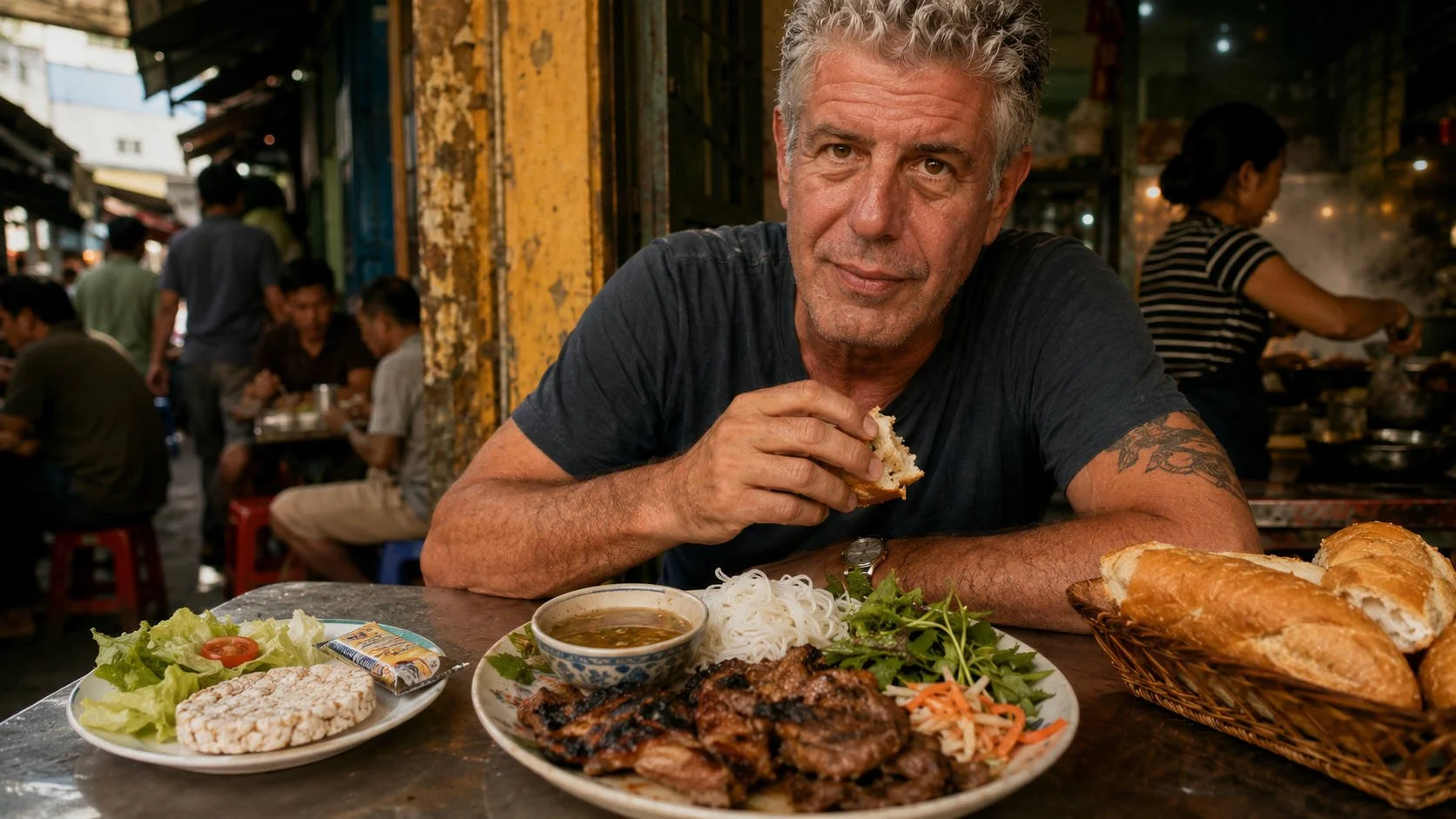
A bowl of noodles made by someone who has made it 10,000 times is real food. Beans cooked with pork fat and patience are real food. Rice, fish, pickles, stew, dumplings, tacos, grilled sardines, chicken rice, lentils, eggs, bread, soup — real food. Not necessarily fancy. Not necessarily expensive. Not always photogenic. Sometimes actively ugly, which is how you know the dish has better things to do than impress an algorithm.
Diet food asks, “How little can this be?”
Real food asks, “What does this mean?”
Bourdain Knew Simple Food Beats Fake Virtue
One of the funniest things about Bourdain’s food persona is that people remember the cobra hearts and fermented shark, but the man also loved ordinary food. His cookbook Appetites included home-food staples like tuna salad, macaroni and cheese, meat loaf, and scrambled eggs. When asked why tuna salad and mac and cheese were in the book, his answer was basically: he was a dad, and that was what he cooked at home. Glamorous? No. Human? Unfortunately, yes.
That is what diet culture still cannot emotionally process: simple food does not need to be “fixed” into a low-calorie version of itself to deserve a place on the table.
Mac and cheese is not improved by pretending cauliflower is pasta. Tuna salad is not morally elevated by removing every enjoyable ingredient until it tastes like cat food with self-esteem issues. Eggs do not need a protein-powder intervention. Soup does not need to be branded as a “detox.” Your liver is already employed. Let it work.
Bourdain’s version of simple food had fat, salt, texture, memory, and function. Diet food often removes the very things that make food satisfying, then acts shocked when people eat six “healthy” snacks afterward because lunch had the staying power of a Post-it note in a rainstorm.
Diet Food Turns Eating Into Self-Surveillance
The worst part of diet food is not always the taste, though let us be honest, many bars taste like someone compressed regret into chocolate-adjacent insulation foam. The worst part is the mental atmosphere.
Diet food trains you to watch yourself eat. To bargain. To compensate. To call one food “good” and another “bad.” To treat hunger like a character flaw and pleasure like a suspicious activity. Modern dietitians increasingly warn against labeling foods as morally good or bad because that thinking can fuel guilt, shame, and disordered patterns around eating.
Bourdain’s food world was not morally neutral in the lazy sense. He absolutely had opinions. Violent opinions. Garlic-in-a-jar opinions. Truffle-oil opinions. Airplane-food opinions. But he did not treat food as a purity test. He treated it as a way to enter the world.
That matters.
Because once eating becomes only a performance of control, you stop tasting. You stop noticing. You stop asking who cooked this, where it came from, what tradition shaped it, why it tastes like that, what it means to the person serving it. You just count. Congratulations, dinner is now a spreadsheet with chewing.
Street Food Was Bourdain’s Antidote to Diet Food Nonsense
Bourdain’s love of street food is one of the clearest examples of what he got right. He saw street food as democratic, specific, skill-based, and tied to place. At the World Street Food Congress in Singapore, he argued that the more street food is embraced across income groups, the better the world becomes. Subtle? No. Correct? Annoyingly, yes.
Street food does not generally ask to be called “guilt-free.” It does not need a wellness halo. It survives because people come back. Because the broth is good. Because the griddle is hot. Because the vendor knows one dish so well they could probably make it during a thunderstorm while arguing with a cousin.
That is real-food intelligence.
Diet food sells abstraction. Street food sells proof. You stand there. You smell it. You watch it cook. You eat it hot. It might be fried, grilled, braised, steamed, stuffed, sauced, wrapped, or served in a bowl that has seen history. It is not trying to be “light.” It is trying to be good.
And sometimes good food is lighter than you think. Sometimes it is not. That is not the point. The point is that it is honest about what it is.
“Ugly Food” Is Real Food Refusing to Dress for Instagram
Bourdain also understood that some of the world’s best food looks like it lost a fight in a swamp. Stews. Braises. Curries. Organ meats. Beans. Noodles slicked with sauce. Fish head curry. Feijoada. Charred things. Brown things. Gelatinous things. Things that do not photograph well unless the photographer has professional lighting and a deep belief in texture.
Food & Wine’s recent Bourdain-inspired celebration of “ugly food” highlights exactly this idea: visually unglamorous dishes often carry deep flavor, thrift, technique, and cultural memory. This is where real food lives. Not always in the polished plate. Often in the bowl that looks suspicious and tastes like someone’s whole family history learned to simmer.
Diet food is usually obsessed with looking clean. White packaging. Pale snacks. Smooth bars. Neat labels. Tiny portions lined up like they are trying to pass inspection.
Real food can look chaotic because life is chaotic. Chili does not need a jawline. Curry does not need to glow. Beans do not need a rebrand. If the dish tastes good and feeds people, it has already done more useful work than most “skinny” desserts ever will.
The Grandma Rule Was Really a Rule Against Food Narcissism
Bourdain’s famous “Grandma Rule” was about accepting food offered in someone’s home with gratitude and respect. Allrecipes summarizes it as a rule of humility: when someone serves you food, especially in another culture or household, you do not make the meal all about your preferences, squeamishness, or self-image. You eat graciously. You say thank you. You behave like a guest, not a Yelp review with legs.
This is a brutal antidote to diet-food culture.
Diet culture often makes the eater the center of the universe. My plan. My rules. My macros. My restrictions. My cleanse. My forbidden foods. My “I can’t.” My “I’m being good.” My “I’ll just have a bite.” My entire personality now apparently depends on the dressing being on the side.
Bourdain’s rule says: look outward. Who made this? What does it mean to them? What are you being invited into?
That does not mean ignoring medical needs, allergies, religious restrictions, or serious ethical boundaries. Do not eat something that will harm you because a dead chef once had a good line. We are not idiots. Well, not professionally.
But the spirit matters. Food is not always about optimizing yourself. Sometimes food is about receiving hospitality without turning the table into a TED Talk about your digestive preferences.
Real Food Is More Satisfying Because It Stops Apologizing
Diet food is often built on apology.
Sorry this is sweet, but it has no sugar. Sorry this is pasta, but it is secretly vegetable strings. Sorry this is ice cream, but it is mostly air and regret. Sorry this is a cookie, but it has protein, fiber, collagen, adaptogens, and the texture of roofing material.
Real food does not apologize. It balances.
A real meal has protein, fat, carbs, salt, acid, fiber, heat, crunch, and aroma in some arrangement that makes sense. It satisfies because it is not trying to impersonate another food while passing a moral background check.
Bourdain’s cooking and travel writing respected satisfaction. Not mindless excess. Satisfaction. The point of a bowl of pho, a plate of roast chicken, a taco, a stew, or a tuna sandwich is not to trick the body into accepting less. It is to feed a person.
That is why “diet versions” so often fail. They are engineered around what they remove, not what they deliver. Less fat. Less sugar. Less carb. Less calorie. Less joy. Less reason to continue chewing.
Real food asks what belongs. Diet food asks what can be taken away before the customer notices and starts crying quietly into a protein crisp.
Bourdain Got Fat Right
Bourdain did not treat fat like a scandal. Pork fat, butter, stock, skin, cheese, sausage, organ meats, demi-glace — these were part of the edible world, not demons hiding under the cutting board.
That does not mean every meal should be a confit marathon. Calm down, duck people. It means fat is a tool. It carries flavor. It creates texture. It makes vegetables delicious. It turns beans into dinner. It helps a little food feel complete instead of making you chew your way through a dry “healthy” bowl that tastes like a corporate apology.
Diet food often removes fat and then replaces satisfaction with sweeteners, starches, gums, flavorings, crunch dust, or branding. This is how you get “cheese-flavored protein snacks” that taste like a gym bag learned chemistry.
Real food uses fat intentionally. Olive oil on vegetables. Butter in eggs. Chicken skin crisped properly. A little cheese in pasta. Pork in beans. Coconut milk in curry. Tahini in sauce. Avocado if you must, though please stop acting like it invented fat in 2014.
The lesson is not “fat good, restraint bad.” The lesson is “fat has a job.” Let it do the job instead of hiring a committee of fake ingredients to impersonate it badly.
He Also Got Cooking at Home Right
Bourdain’s public persona was built around travel, but Appetites showed something important: real food at home does not have to be precious. Bon Appétit noted that the cookbook included things like scrambled eggs, tuna salad, macaroni and cheese, and other straightforward dishes, along with Bourdain’s usual strong opinions.
This is the home-cook version of his real-food philosophy.
Cook the egg well. Make the sandwich properly. Roast the chicken. Make soup. Use garlic like you have a pulse. Buy decent bread. Learn rice. Learn beans. Learn pasta. Make a vinaigrette. Stop outsourcing every meal to products that promise transformation and deliver mild sadness.
Diet food teaches dependence: buy the bar, shake, frozen entrée, low-cal dessert, low-carb wrap, portion pack, miracle noodle, guilt-free cereal, meal-replacement dust. Real food teaches competence: here is an onion, here is a pan, here is heat, here is salt, go become less useless.
A person who can make eggs, soup, beans, chicken, pasta, rice, salad dressing, and a decent sandwich is much harder to manipulate by snack marketing. Dangerous citizen. Probably owns garlic.
Real Food Is Not Always “Healthy” in the Instagram Sense
Here is where we avoid becoming annoying little Bourdain cosplayers. “Real food” does not automatically mean medically ideal. A bowl of pork belly ramen is real food. It is also not something everyone should eat daily. A steak frites meal is real food. So is a lentil soup. So is grilled fish. So is fried chicken. “Real” is not a free pass from biology, despite what certain men with podcasts and liver supplements might imply.
The point is not that all traditional, street, or homemade food is automatically healthier than packaged diet food. The point is that real food is more honest and often more satisfying. You can make actual choices around it.
Diet food often hides behind virtue. Real food shows up with its pants on.
A real bowl of rice, beans, chicken, salsa, and avocado can be filling, flavorful, and balanced. A “100-calorie snack pack” may leave you hunting for more food ten minutes later like a raccoon with a fitness tracker. A real dessert enjoyed on purpose may create less chaos than six sad “better-for-you” desserts eaten while pretending you are above cake.
What to Eat Instead of Diet Food, Bourdain-Style
Eat food with a cook behind it when you can. That cook can be you, a street vendor, a line cook, a grandmother, a cafeteria worker, a taco truck operator, or a person at a diner who knows exactly how brown hash browns should be.
Eat simple food that does its job. Eggs. Beans. Rice. Soup. Noodles. Chicken. Fish. Vegetables with oil and salt. Bread worth eating. Fruit in season. Yogurt that does not taste like a birthday candle. Cheese if you like cheese. Meat if you eat meat. Tofu if you like tofu and know how to season it, not if you are using it as a punishment rectangle.
Use flavor. Acid, herbs, spices, fat, salt, char, broth, pickles, sauces, chili, garlic, ginger, onions. Diet food hates flavor unless it comes from a packet labeled “nacho blast.” Real food builds flavor from ingredients that have not been focus-grouped into a dust.
Stop buying fake versions of foods you actually want unless the fake version genuinely satisfies you. A good lower-sugar yogurt? Fine. A protein bar that helps during a busy day? Fine. A frozen meal when life is chaos? Fine. But if the “diet” version makes you feel cheated, it is not helping. It is just delaying the inevitable snack rebellion.
The Bourdain Rule for Modern Eating
A Bourdain-inspired eating rule would not be cute enough for a wellness app, which is why it might actually help.
Eat the food. Know where you are. Respect who made it. Don’t be a coward about flavor. Don’t turn every bite into a moral referendum. Cook something simple. Say thank you. Move on.
That is not a meal plan. It is better than a meal plan.
Because most people do not need another branded system that turns lunch into a personality test. They need a better relationship with food that does not involve fear, fake purity, or pretending a chalky bar is the same as lunch.
Bourdain got that. He understood that food is too important to be reduced to diet math, and too pleasurable to be surrendered to the marketing department of a “guilt-free” brownie mix that tastes like drywall wearing cocoa powder.
Final Answer: Bourdain Chose Food Over Food Anxiety
What Anthony Bourdain got right about eating real food instead of diet food is that eating is not only about the body. It is about people, place, pleasure, memory, labor, culture, hospitality, and the occasional glorious stupidity of ordering the thing that looks terrifying and tastes incredible.
Diet food often promises control. Real food offers connection.
Diet food says, “Be careful.”
Bourdain said, essentially, “Pay attention.”
That is the difference.
Pay attention to the cook. Pay attention to the place. Pay attention to flavor. Pay attention to hunger. Pay attention to whether the food satisfies you or just advertises virtue at you. Pay attention to whether your “healthy” meal leaves you weirdly miserable and digging through the pantry like a raccoon in athleisure.
The real-food lesson is not indulgence without thought. It is eating without self-contempt.
And frankly, if the choice is between a bowl of real noodles made by someone who cares and a diet bar called Birthday Cake Protein Joy that tastes like a candle got trapped in insulation foam, Bourdain’s ghost is not even waiting for you to finish the question.