The Youth Sports Tailgate: How to Feed a Team Without Making Everyone Too Full to Play
A youth sports tailgate sounds wholesome until someone puts out cheeseburgers, pasta salad, cupcakes, chips, soda, and a tray of ribs two hours before kickoff. Then suddenly “team bonding” becomes “why is our midfield moving like they just ate Thanksgiving in shin guards?”
Tailgate culture was built for spectators. Adults in folding chairs. Coolers. Grills. Chips. Dips. A father named Dan wearing cargo shorts and guarding the burgers like he personally invented propane. Lovely. Beautiful. Deeply American. Also, absolutely not the same thing as feeding athletes who still have to sprint, cut, jump, skate, slide, tackle, dive, or otherwise act like their stomach is not full of sausage.
The youth sports tailgate needs a different mission. It should still feel fun. It should still feel communal. It should not feel like a punishment buffet curated by a sports dietitian with no friends. But it has to respect one basic fact: pre-game food is fuel, not a parking-lot eating contest.
Nutrition guidance for young athletes is pretty consistent on this: a bigger balanced meal belongs several hours before play, while food closer to game time should get lighter, more carbohydrate-focused, and easier to digest. Nationwide Children’s recommends a balanced, carbohydrate-heavy meal with some protein and low fat about 3 to 4 hours before exercise, then a lighter carbohydrate snack 30 to 60 minutes before activity. EatRight also emphasizes that young athletes need real meals with grains, lean protein, fruit, vegetables, and dairy or alternatives instead of skipping meals and hoping enthusiasm fills the gap.
So here is the tailgate rule: feed the team for the next game, not for the Instagram photo of the folding table.
The Tailgate Trap: Heavy Food at Exactly the Wrong Time
The traditional tailgate menu is wonderful if the main athletic event is sitting in a camping chair and yelling “Let’s go!” every twelve minutes. Burgers, hot dogs, pulled pork, nachos, fried chicken, creamy pasta salad, brownies, and soda all have their place in sports culture.
That place is usually after the game.
Before the game, heavy food becomes a tactical error with ketchup. High-fat foods tend to take longer to digest, and Nationwide Children’s specifically advises athletes to avoid foods high in protein or fat about one hour before a game because they may upset the stomach. Johns Hopkins similarly recommends balanced meals 2 to 3 hours before competition and easier carbohydrate snacks closer to play.
This does not mean young athletes must eat like tiny monks. Nobody is asking a 12-year-old defender to meditate over steamed rice and cucumber water while everyone else gets pizza. It means timing matters.
A cheeseburger four hours before a game may be fine for some kids. A cheeseburger 35 minutes before warmups is a digestive ambush wearing a bun.
The Youth Sports Tailgate Timeline
The easiest way to feed a team is to stop thinking in terms of breakfast, lunch, and dinner. Tournament days laugh at those concepts. Instead, think in terms of time until play.
3 to 4 Hours Before Game Time: Real Meal Window
This is when the team can eat something substantial. Not a grease festival. Not a buffet that looks like a county fair lost power. A real meal.
Good options:
Turkey or chicken sandwiches.
Rice bowls with chicken, beans, vegetables, and salsa.
Pasta with simple tomato sauce and grilled chicken.
Baked potatoes with light toppings.
Breakfast burritos with eggs, potatoes, and a little cheese if it is a morning event.
Bagels with peanut butter and banana.
Oatmeal with fruit and yogurt.
Chicken wraps with fruit.
Bean-and-rice bowls.
This is the “actual meal” window. Carbs should lead because they help fuel activity. Add some protein for staying power. Keep fat moderate. Add fruit or vegetables because bodies enjoy not being treated like engines that run only on white bread and orange drink.
2 Hours Before Game Time: Mini-Meal Window
This is where parents usually overdo it. Two hours feels like plenty of time, but it is not the moment for a giant plate.
Good options:
Half a turkey sandwich.
Mini bagel with peanut butter.
Small pasta cup.
Yogurt with granola.
Rice cup with chicken.
Banana plus pretzels.
Cheese and crackers with fruit.
Hummus and pita.
Small wrap cut in half.
The goal is enough food to prevent hunger, not enough food to make the athlete regret having a torso.
60 Minutes Before Game Time: Snack Window
Now the tailgate needs to calm down. This is not lunch anymore. This is a top-off.
Good options:
Bananas.
Applesauce pouches.
Pretzels.
Crackers.
Dry cereal.
Granola bars.
Graham crackers.
Orange slices.
Fig bars.
Small fruit smoothie if tolerated.
Nationwide Children’s recommends a high-carbohydrate snack about one hour before a game and gives examples like pretzels, crackers, fruit, granola bars, and peanut butter sandwiches. This is not the window for ribs, chili dogs, loaded nachos, or anything that requires a fork and moral courage.
15 to 30 Minutes Before Game Time: Tiny Nibble and Sips
At this point, stop pretending the tailgate table is still open for business. Offer water and maybe a few bites of something easy.
Good options:
A few pretzels.
Half an applesauce pouch.
A few crackers.
A bite or two of banana.
Water.
That is it. If a child says they are starving at this point, the answer is not “Here, eat this giant sandwich.” The answer is “We missed the real meal window, so we are doing damage control now.”
Parenting. Glamorous as always.
Team Tailgate Setup: Build a Fuel Table, Not a Buffet Trap
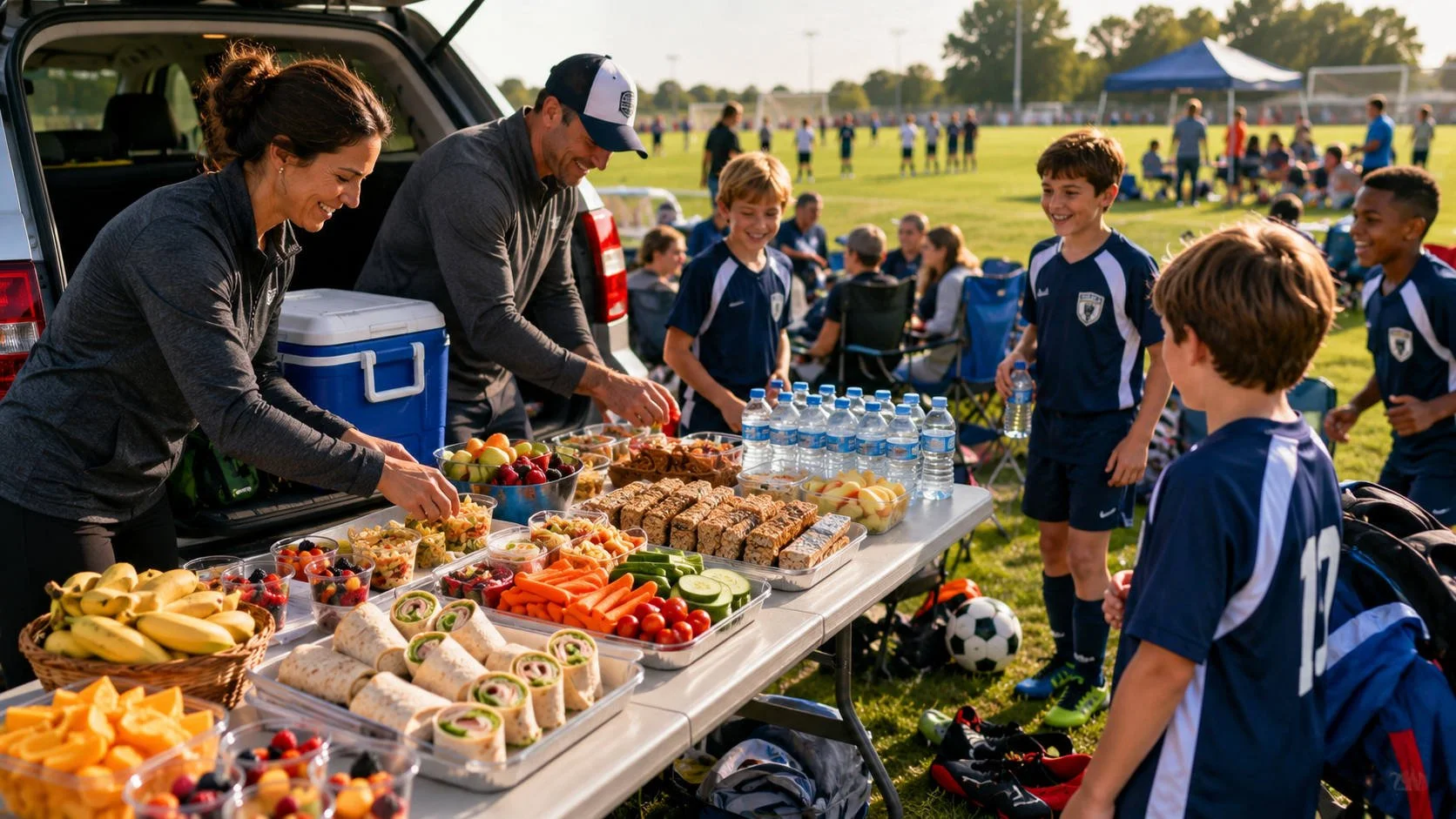
The table should not look like a Super Bowl party had children. It should be organized by timing.
Use zones:
Meal zone: sandwiches, wraps, rice bowls, pasta cups, yogurt, fruit.
Snack zone: pretzels, crackers, bananas, applesauce, granola bars, dry cereal.
Hydration zone: water, refill station, maybe sports drinks for long or hot events.
After-game zone: pizza, burgers, treats, heavier food, dessert, victory cupcakes, emotional nachos.
This prevents the classic mistake where kids eat dessert first, chips second, drink something blue third, and then ask for “real food” exactly seven minutes before warmups.
Coaches can help by setting the rule clearly: “Big food before this time. Small snacks after this time.” Children respond better to structure than to a parent whispering, “Maybe don’t eat your third brownie?” while the brownie is already halfway into history.
Best Pre-Game Team Meal Ideas
Here are team-friendly options that work better than the old “giant tray of whatever was cheapest and nearest.”
Mini Sandwich Bar
Use small rolls, slider buns, or halved sandwiches.
Options:
Turkey and cheese.
Chicken and avocado.
Peanut butter and banana.
Hummus and cucumber.
Egg salad if kept cold and not served in hot weather like a dare.
Keep condiments light and mostly on the side. A sandwich should not need a towel.
Pasta Cups
Use small containers instead of one giant tray. Pasta with tomato sauce, grilled chicken, and a little parmesan works well. Pesto pasta can work too, but keep portions smaller because pesto is rich and sneaky, like a sauce with a trust fund.
Rice Bowl Station
Rice, chicken, beans, corn, salsa, lettuce, and mild toppings. Keep hot sauce away unless you enjoy athletes discovering mid-game that jalapeños have a second act.
Breakfast Tailgate
For early games:
Bagels.
Oatmeal cups.
Bananas.
Yogurt.
Granola.
Egg sandwiches cut in halves.
Fruit.
Water.
Donuts can exist, but they should not be the foundation unless the team’s strategy is “sugar spike, collapse, ask for a sub.”
Snack Boxes
Make individual boxes with:
Pretzels or crackers.
Fruit.
Cheese stick.
Turkey roll-up.
Granola bar.
Applesauce pouch.
This works especially well for younger teams because it prevents the table from becoming a snack free-for-all where one kid eats six clementines and another kid builds a tower of chips.
Portion Control Without Being the Fun Police
Parents and coaches hear “portion control” and immediately imagine a joyless adult guarding grapes with a clipboard. Relax. Portion control just means not serving pre-game food like the athletes are preparing to hibernate.
Use smaller units:
Half sandwiches instead of full ones.
Mini bagels instead of giant ones.
Pasta cups instead of big plates.
Rice bowls in small containers.
Fruit portions already cut.
Pretzels in small bags.
Wraps sliced into halves or thirds.
The point is not to restrict kids into misery. The point is to let them eat enough without overshooting into “I feel weird” territory.
A team meal should leave athletes feeling fueled, not stuffed. “I could play now” is the target. “I need to lie down behind the bench” is a menu failure.
What Not to Serve Before the Game
Save these for after the final whistle, when the only remaining event is sitting in the car and smelling like turf:
Burgers.
Hot dogs.
Ribs.
Pulled pork.
Fried chicken.
Creamy pasta salad.
Loaded nachos.
Pizza overload.
Big burritos.
Donuts as the main meal.
Cupcakes before warmups.
Energy drinks.
Giant smoothies with nut butter, yogurt, oats, fruit, honey, and the caloric density of wet cement.
Again, none of these foods is morally evil. A burger did not ruin society. Society has done plenty of that without the burger’s help. The issue is timing.
The tailgate should not make athletes play like the parking-lot buffet is still physically attached to them.
Hydration: Water First, Sports Drinks When the Day Earns It
Hydration is where parents tend to become either too casual or too weird. On one side, a kid plays three games and drinks half a water bottle. On the other side, someone brings a sports drink for a 35-minute recreational game in mild weather like the child is crossing the Sahara with a whistle.
Water should be the default. HealthyChildren.org says water is enough for activities under an hour, while sports drinks can be useful for activities lasting longer than 1 to 2 hours or in very hot environments because they help replenish carbohydrates and electrolytes. It also makes the important distinction that sports drinks are not energy drinks; energy drinks are not recommended for kids and teens.
So the team drink table should look like this:
Lots of water.
Extra water.
More water because someone forgot theirs.
Sports drinks for long tournament days, hot conditions, or repeated games.
No energy drinks.
No soda before play unless the team’s tactical plan is “burp through the second half.”
A practical coach rule: athletes drink regularly during breaks, not only when they suddenly feel like a raisin wearing cleats.
The Food Safety Problem Nobody Wants to Discuss Until the Pasta Salad Gets Weird
A youth sports tailgate is basically a food-safety obstacle course with folding chairs. Coolers are opened constantly. Food sits out. The sun exists. Children touch everything. Someone always forgets serving utensils and suddenly 17 athletes are reaching into the grape bowl with field hands.
FoodSafety.gov says cold foods should be kept at 40°F or below, and perishable foods should not sit out longer than two hours, or one hour if exposed to temperatures above 90°F. The USDA’s food-safety guidance also warns that foods in the 40°F to 140°F “Danger Zone” can allow bacteria to multiply quickly.
So yes, the cooler matters. Not because anyone wants to be boring. Because vomiting before a tournament is a bold but ineffective team strategy.
Use two coolers:
One for drinks.
One for food.
The drink cooler will be opened every 14 seconds by children searching for “my cold one.” The food cooler should stay closed as much as possible so sandwiches, yogurt, cheese, eggs, fruit, and wraps do not become a portable biology lesson.
Food safety tailgating guidance also recommends keeping drinks in a separate cooler from food because the beverage cooler gets opened frequently, and transporting coolers in the air-conditioned passenger compartment instead of a hot trunk when possible. That is not fancy. That is common sense wearing ice packs.
The Coach’s Tailgate Rules
A coach does not need to become a nutrition lecturer. Nobody signed up for a pre-game TED Talk next to the minivan. But coaches can set simple team expectations.
Rule one: heavy food is for after the game.
Rule two: players eat a real meal early enough.
Rule three: the last hour is light snacks and water.
Rule four: no energy drinks.
Rule five: bring your own water bottle.
Rule six: tell the coach or parent organizer about allergies.
Rule seven: no mystery food experiments on game day.
That last one matters. Game day is not the time to introduce a child to spicy chickpea wraps, green smoothies, or a protein bar that tastes like chocolate drywall. Test foods at practice or normal lunch first. The stomach is not a beta-testing platform.
The Parent Sign-Up Sheet That Actually Works
Do not let the sign-up sheet become “everyone bring snacks,” because then the team gets six bags of chips, three trays of brownies, one heroic fruit parent, and no actual meal.
Use categories:
Main carb: mini sandwiches, pasta cups, rice bowls, bagels.
Protein: turkey, chicken, hummus, yogurt, cheese sticks, eggs if kept cold.
Fruit: bananas, oranges, grapes, berries, melon.
Vegetables: carrots, cucumbers, peppers, tomatoes, slaw.
Snack carbs: pretzels, crackers, granola bars, dry cereal.
Drinks: water, ice, optional sports drinks.
Food safety: coolers, ice packs, serving utensils, wipes, trash bags.
This way the tailgate becomes a team meal instead of a snack-table accident.
Tailgate Timing Example for a Noon Game
If the game is at noon, here is the sane version:
8:00 a.m. to 8:30 a.m.
Real breakfast or team meal: bagels, eggs, oatmeal, yogurt, fruit, turkey sandwiches, or rice bowls.
10:00 a.m.
Mini-meal if needed: half sandwich, yogurt, banana, pretzels, small pasta cup.
11:00 a.m.
Light snack: applesauce, crackers, pretzels, fruit, water.
11:30 a.m. onward
Sips of water. Tiny bites only if needed. No burgers. No cupcakes. No “just one hot dog.” That hot dog knows what it did.
After the game
Now the heavier tailgate can happen. Burgers, pizza, barbecue, dessert, team celebration. Food can be fun again because no one has to sprint immediately after swallowing it.
Tailgate Timing Example for a Tournament Day
Tournament days are worse because the schedule was apparently designed by a committee of unstable clocks.
Use this:
Before game one: real meal 3 to 4 hours before if possible, or a smaller breakfast plus top-off snack.
Between games with less than 90 minutes: light snacks only.
Between games with 2 to 3 hours: mini-meal.
Between games with 4 hours or more: real meal.
After final game: full tailgate meal.
This framework saves everyone from the classic tournament mistake: feeding the team like the day is over when the bracket says, “Surprise, you play again at 3:20.”
Make the Tailgate Feel Fun Without Making It Heavy
Performance-aware food does not have to be sad. It just needs better packaging.
Make fruit skewers.
Use sandwich triangles.
Pack pasta in small cups.
Serve hummus with pita chips and carrots.
Make a build-your-own rice bowl station.
Use mini bagels.
Make yogurt parfait cups.
Serve pretzels in individual bags.
Put team-color labels on water bottles if you must get cute.
Let the kids choose from approved options.
The vibe can still be festive. It just should not be “county fair before cardio.”
The Best After-Game Tailgate Is the One You Save for After
Here is the great compromise: the fun food does not disappear. It moves.
Want burgers? Great. After the game.
Want pizza? Beautiful. After the game.
Want cupcakes? Sure. After the game.
Want pulled pork sliders, chili, mac and cheese, and a cooler full of sparkling drinks? Wonderful. After the final game, when the only physical demand left is locating the car and pretending nobody smells terrible.
This is how coaches and parents keep tailgate culture without sabotaging performance. The team still gets the celebration. The athletes just do not have to carry it into warmups like a backpack full of meat.
The Youth Sports Tailgate Needs a Clock, Not a Bigger Grill
A good youth sports tailgate is not about proving your parking-lot hospitality through sheer food weight. It is about feeding young athletes at the right time, in the right portions, with the right kind of fuel, while still making the day feel communal and fun.
Big meals belong 3 to 4 hours before play. Mini-meals fit the 2-hour window. The final hour is for light, carbohydrate-focused snacks and water. Heavy foods, greasy foods, giant portions, and dessert tables belong after the game, when nobody has to run except the parent chasing a rolling water bottle across the parking lot.
Keep the drinks simple. Water first. Sports drinks when heat, duration, or repeated games justify them. No energy drinks. Keep the food safe with coolers, ice packs, separate drink and food coolers, serving utensils, and the discipline to throw away perishable food that has sat out too long.
The youth sports tailgate can still have spirit. It can still have team bonding. It can still have snacks, fruit, sandwiches, wraps, pasta cups, rice bowls, and post-game pizza.
It just cannot be a pre-game buffet so heavy the team plays like a bunch of upholstered ottomans in cleats.
Feed them. Don’t stuff them. Save the ribs for later.