The Ted Lasso After-School Snack Rule: Feed the Kid, Don’t Spoil Dinner
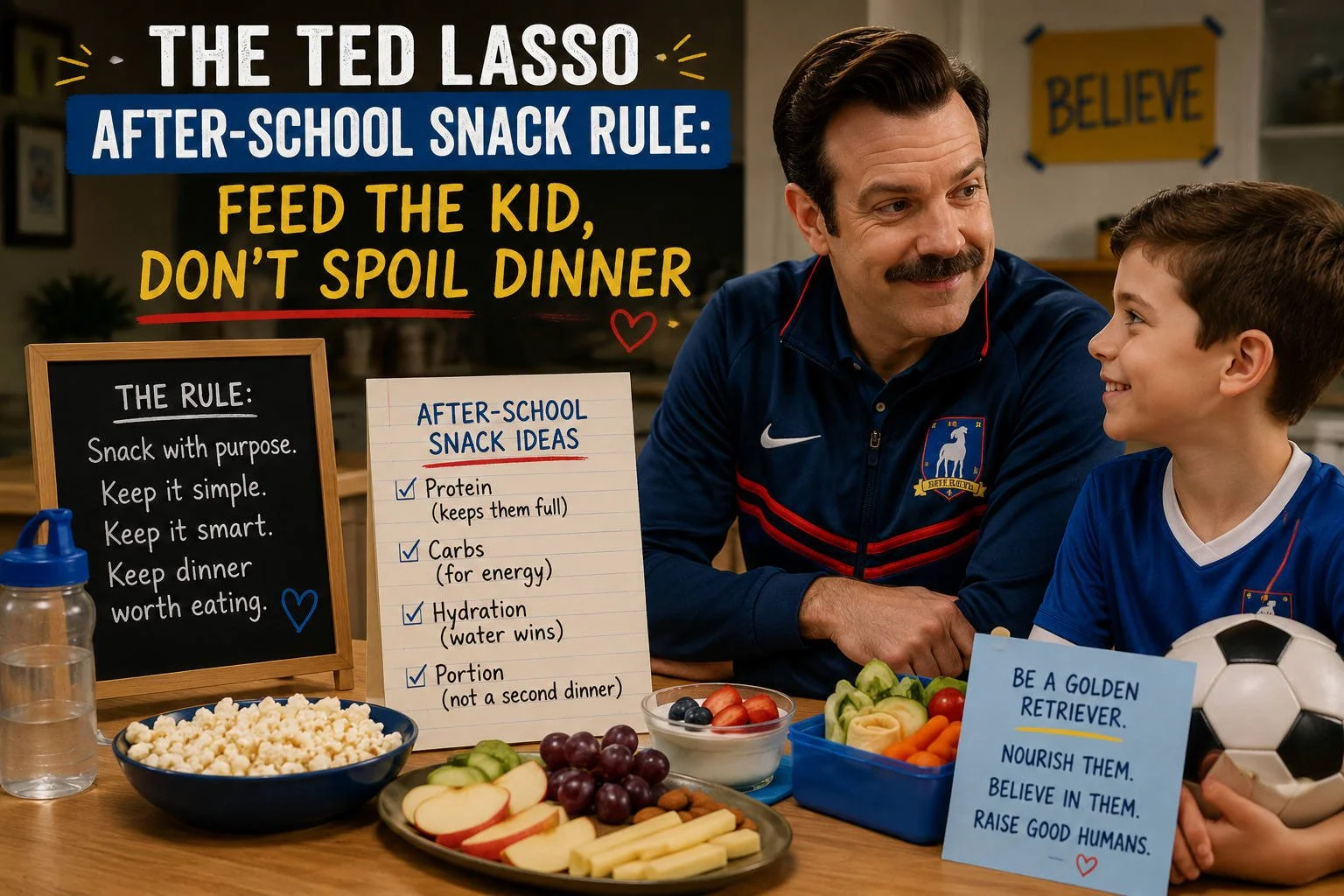
Every parent with an after-school athlete eventually faces the same sacred domestic crisis: the kid gets home from school, drops a backpack with the emotional force of a small meteor, announces they are “literally starving,” and then has practice in 42 minutes. Dinner is planned. Allegedly. There is a protein thawing somewhere. Maybe. The child now wants a snack large enough to qualify as a mortgage event.
This is where the Ted Lasso after-school snack rule comes in: feed the kid, don’t spoil dinner.
Not “starve them until dinner because family mealtime is precious.” Lovely sentiment, Captain Dickens, but children who just survived school and are about to run for 90 minutes need fuel, not a lecture about appetite management. Also not “let them inhale a full second lunch at 4:15 p.m. and then stare at dinner like you served boiled paperwork.” The snack is not the enemy. The snack needs a job.
Ted Lasso, officially described by Apple TV as an American football coach hired to manage a British soccer team despite having no experience, runs on optimism, underdog energy, and biscuits. Charming. Adorable. Nutritionally, however, biscuits alone are not a sports plan unless the sport is “emotionally supporting your boss.”
So the parent-friendly rule is this: after school, give a snack with enough carbohydrate to fuel activity, enough protein or fat to steady hunger, and a portion small enough that dinner still has a pulse.
Why After-School Sports Snacks Matter
Children are not tiny adults. They are chaotic snack furnaces with cleats. They eat lunch at school, sometimes at 10:48 a.m. because school schedules are apparently designed by people who think brunch is a personality test. Then they sit through math, science, hallway drama, and whatever emotional economy is happening at recess. By practice time, lunch is ancient history.
HealthyChildren.org notes that snacks are an important part of childhood nutrition, and that three meals plus two or three healthy snacks a day can help children meet energy needs. It also recommends consistent snack times and spacing snacks at least two hours before meals so children are hungry when healthier meal foods are offered.
That is the entire conflict in one paragraph: kids need snacks, but grazing all afternoon can wreck dinner. Beautiful. Parenting: where both things are true and somehow you are still the villain.
For young athletes, the snack becomes even more important. Nationwide Children’s says many young athletes skip snacks before after-school practice, but snacks are an important part of the athlete’s day; it recommends aiming for a snack about 30 minutes to an hour before practice when possible.
Translation: the kid should not show up to practice powered only by cafeteria pizza, resentment, and whatever they found at the bottom of their lunchbox.
The Ted Lasso Snack Rule: The Snack Is an Assist, Not the Whole Match
A good after-school sports snack is like a great pass: useful, well-timed, and not trying to be the entire game. The snack should bridge the gap between lunch, practice, and dinner. It should not become a full buffet with a side of “now I’m not hungry.”
The snack has three jobs.
First, it should take the edge off hunger. A child who is too hungry becomes dramatic. Not theater-kid dramatic. Medieval-peasant-during-a-famine dramatic.
Second, it should fuel movement. Carbohydrates matter here. This is not the time to declare war on bananas because some adult on the internet has unresolved feelings about sugar.
Third, it should leave room for dinner. Dinner is where the family can get a bigger mix of protein, vegetables, grains, dairy or alternatives, and whatever vegetable everyone agrees to pretend they like.
The rule is not “no snack.” The rule is “snack with boundaries.” Very Ted Lasso, honestly: warm, encouraging, and still requiring everyone to stop behaving like feral raccoons around the pantry.
Timing: When to Feed the Kid Before Practice
The closer the snack is to practice, the lighter it should be. This is not because food is morally superior when tiny. It is because running around with a belly full of heavy food is unpleasant, and children rarely express that quietly. They express it through cramps, complaints, and the kind of face usually seen on people reading parking tickets.
A practical timing guide:
If practice is 30 to 60 minutes away, go small and easy: fruit, applesauce pouch, pretzels, dry cereal, toast, half a bagel, a granola bar, or crackers. Nationwide Children’s recommends a snack 30 to 60 minutes before activity and advises avoiding spicy or high-fat foods right before workouts.
If practice is one to two hours away, add a little protein or fat: yogurt and fruit, apple with peanut butter, cheese and crackers, half a turkey sandwich, hummus and pita, or a smoothie.
If practice is more than two hours away, you can go more substantial: a small rice bowl, half a wrap, peanut butter and banana toast, oatmeal, or leftovers in a modest portion. Modest. Not “Thanksgiving halftime show.”
The key is not to serve a full dinner before dinner. A full meal at 4 p.m. followed by “Why won’t you eat?” at 6:30 p.m. is not a mystery. It is a scheduling crime scene.
Portion Size: The Parent Trap With Crackers
Portions are where good snacks go to become dinner assassins. A snack that starts as “some crackers and cheese” becomes 28 crackers, four cheese sticks, a yogurt, a protein bar, half a mango, and the child asking if there are noodles.
This is not hunger anymore. This is a pantry tour.
HealthyChildren.org reminds parents that their job is to offer nutritious foods at regular times, while the child’s job is to decide whether they are hungry and how much to eat; it also warns that grazing throughout the day can leave kids less hungry at mealtimes.
That gives parents a sane middle path. You do not have to become the snack police, standing by the cabinet with a whistle and clipboard. But you can plate the snack instead of handing over the entire box. The box is not a serving dish. The box is how a child discovers they can eat 900 calories of cheddar squares while making eye contact with no one.
A good default portion looks like this: one main snack plus one produce item. Yogurt and berries. Cheese and apple slices. Half sandwich and grapes. Crackers with hummus and carrots. Banana and peanut butter. Small smoothie and pretzels.
The snack should look like a bridge, not a landslide.
The Best After-School Sports Snack Formula
Here is the formula, because parents do not need 47 recipes; they need a system they can operate while signing a permission slip and locating one missing shin guard.
Use this:
Carb + protein or fat + fluid
That is it. That is the whole snack TED Talk, and mercifully no one had to wear a headset.
Carbs help with quick energy. Protein or fat helps the snack last a little longer. Fluid helps hydration, because children will run for an hour and then act shocked that bodies require water, as if biology is a new app update.
Good examples:
Banana with peanut butter.
Greek yogurt with berries.
Cheese stick with whole-grain crackers.
Half a turkey sandwich.
Apple slices with peanut butter.
Hummus with pita and carrots.
Smoothie with milk or soy milk, banana, and berries.
Pretzels with cheese cubes.
Oatmeal with cinnamon and a little nut butter.
Peanut butter and jelly half sandwich.
Nationwide Children’s lists pre-workout ideas such as fruit with string cheese, toast with peanut butter, cereal with milk, half a turkey or peanut butter sandwich, pretzels with peanut butter or cheese, and a granola bar with fruit.
See? The professionals are not recommending truffle quinoa energy spheres hand-rolled by moonlight. They are recommending normal food. Revolutionary. Someone alert the snack influencers.
What to Pack for the Car, Because Life Is Not a Pinterest Board
In an ideal world, the child comes home, washes hands, sits at the table, eats a balanced snack, changes calmly, fills a water bottle, and leaves for practice with emotional maturity.
In the actual world, someone is eating a banana in the car while you yell, “Do you have both cleats?” into the rearview mirror.
So pack for reality.
EatRight recommends a “super-snack bag” for traveling athletes with items like crackers and cheese, peanut butter and jelly sandwiches, trail mix, cut fruit, sliced vegetables with dip, and cold packs such as frozen juice boxes, water bottles, or gel packs to keep items chilled.
Car-friendly after-school sports snacks include granola bars, trail mix, pretzels, applesauce pouches, bananas, apples, shelf-stable milk boxes, peanut butter crackers, roasted chickpeas, dry cereal, mini bagels, and fruit leather. Cooler snacks include yogurt tubes, cheese sticks, turkey wraps, hummus cups, hard-boiled eggs, grapes, orange slices, and smoothies.
The important thing is having the snack before the hunger crisis, because once the child is starving, they are no longer negotiating. They are a tiny hostage-taker in soccer socks.
Hydration: Water Before the Sports Drink Parade
Water should be the default after-school drink. Yes, this is boring. So is brushing teeth, and yet civilization persists.
HealthyChildren.org says plain water and milk are the best drink choices for kids, and it notes that water needs vary by age, activity level, heat, and humidity. It also points out that sugary drinks, including many sports drinks, can add extra calories and make kids less hungry for nutritious foods.
That does not mean sports drinks are evil little neon demons. They can be useful in longer or hotter activity. HealthyChildren.org’s sports nutrition guidance says water is enough for activities under an hour, while sports drinks can help replenish carbohydrates and electrolytes during activities lasting longer than one to two hours or in very hot environments; it also says energy drinks are not recommended.
So the Ted Lasso hydration rule is: water first, sports drink when the situation earns it, energy drinks never.
A child does not need a fluorescent bottle of turbo-sugar for 38 minutes of recreational practice in mild weather. That is not hydration. That is dessert in cleats.
The Snack That Spoils Dinner: Identifying the Culprits
Some snacks are dinner spoilers because they are too big. Others are dinner spoilers because they are engineered to make children demand more of them until the kitchen becomes a snack-based hostage negotiation.
Top dinner spoilers:
A full bowl of cereal 45 minutes before dinner.
Multiple granola bars because “they’re small,” which is exactly how snack math lies.
A giant smoothie with nut butter, yogurt, milk, banana, oats, honey, and the caloric density of a brick.
Fast food on the way to practice, followed by “we’ll still eat dinner later,” a sentence no one believes.
Chips from the bag, because the bag has no bottom and apparently neither does the child.
Candy “just this once,” which somehow becomes the emotional centerpiece of the afternoon.
The fix is not banning fun snacks forever. That way lies rebellion, secret wrappers, and children treating goldfish crackers like contraband. The fix is portioning and timing.
Put the snack on a plate. Offer water. Give one planned refill if needed. Then close the kitchen until dinner unless practice runs late or the child genuinely needs more.
Look at that. Boundaries. Horrifying, but useful.
What About the Kid Who Comes Home Ravenous?
Some kids need more food. Growth spurts happen. Sports schedules are intense. Lunch may have been too early, too small, or traded for something shaped like a gummy worm. Teen athletes especially may need more substantial fuel because their bodies are doing the deeply unreasonable work of growing and sprinting at the same time.
EatRight notes that student athletes who compete after school should not “light-load” or skip lunch, and that lunch should include several food groups such as whole grains, lean protein, fruits, vegetables, and low-fat dairy. It also says kids may need a snack after practice or a weekday competition before family dinner.
So if the after-school snack is not enough, investigate lunch. Did they eat it? Did they have time? Was it enough? Was it mostly air and one heroic strawberry? Children are notorious lunch narrators. “I ate lunch” can mean “I ate the cookie and looked at the sandwich.”
For ravenous kids, use a bigger snack earlier, then make dinner slightly later or slightly lighter. Half a sandwich and fruit at 3:30 p.m., practice at 5 p.m., dinner at 7 p.m. works better than no snack, practice meltdown, then a dinner table performance titled “I’m Too Tired to Chew.”
What About the Kid Who Never Wants Dinner?
Some kids snack like royalty and then reject dinner like a tiny food critic with no mortgage. This is where parents must resist becoming short-order cooks. HealthyChildren.org advises regular meal and snack times and cautions against constant grazing because children may not be hungry when healthier meal foods are available.
The fix is not punishment. The fix is structure.
Serve the snack at a predictable time. Keep it portioned. Make sure it includes something filling but not enormous. Stop snacks at least two hours before dinner when the schedule allows. At dinner, offer the family meal. Let the child decide how much to eat from what is offered.
This is not instant magic. Children are not vending machines where you insert hummus and receive calm compliance. But over time, predictable snack structure helps dinner stop feeling like a nightly courtroom drama.
The Late Practice Problem
Late practices are where dinner planning goes to cry in the minivan.
If practice runs from 5:30 to 7:00 p.m., the normal dinner window has been kidnapped. The solution is often two-part eating: a mini-meal before practice and a lighter dinner after.
Before practice, give something more substantial but still digestible: half turkey sandwich with fruit, peanut butter toast with banana, yogurt parfait, small pasta leftovers, rice and chicken, or a smoothie plus pretzels.
After practice, dinner can be simpler: eggs and toast, soup and bread, quesadilla with fruit, chicken wrap, pasta with vegetables, rice bowl, or leftovers. Not every dinner needs to be a Norman Rockwell painting. Sometimes dinner is a reheated burrito and everyone lives.
The point is to avoid both extremes: no food until 7:30 p.m., which creates a feral child, or giant pre-practice dinner, which creates a sluggish child who regrets noodles at minute twelve.
The Warm Coach Energy Parents Actually Need
The Ted Lasso version of snack planning is not perfection. It is kindness with structure. It says: the kid is hungry for a reason. The schedule is hard. Dinner matters, but so does getting through practice without turning into a puddle of low-blood-sugar despair.
This is not about creating a flawless athlete meal plan in color-coded containers. Please put down the laminated chart unless laminating things brings you peace, in which case, congratulations on your hobby. This is about having a few reliable snacks, a consistent time, a water bottle, and a realistic understanding of your own family’s chaos level.
A good after-school sports snack does not need to be fancy. It needs to be available. It needs to be familiar. It needs to be portioned. It needs to show up before the child’s hunger becomes a weather event.
The Ted Lasso After-School Snack Playbook
The winning playbook is simple.
After school, offer a planned snack rather than letting the pantry become a free-range grazing habitat. Aim for a carb plus protein or fat. Keep the portion appropriate to the time until dinner and practice. Use water as the default drink. Save sports drinks for longer, hotter, harder activity. Avoid spicy, greasy, heavy foods right before practice unless your child’s favorite sport is complaining from the sideline.
For quick practice days, use fruit, pretzels, crackers, applesauce, toast, or a granola bar. For longer gaps, add yogurt, cheese, peanut butter, hummus, eggs, turkey, or milk. For late practices, treat the snack like a mini-meal and make dinner lighter afterward.
Most of all, remember the rule: feed the kid, don’t spoil dinner.
That is the sweet spot. Not snack denial. Not snack anarchy. Just enough fuel to help the child run, focus, and survive practice without arriving at dinner either starving or mysteriously full from “just a few crackers,” which somehow means the entire sleeve.
Ted would probably call that belief in the snack process. A parent might call it Tuesday.