The “Soccer Tournament in 90-Degree Heat” Food and Drink Plan
Summer soccer culture is a beautiful little nightmare. There are pop-up tents flapping like broken parachutes, parents hauling coolers the size of rental apartments, siblings melting into folding chairs, and athletes sprinting across artificial turf that feels like it was installed directly over a dragon’s forehead. Somewhere, a coach is yelling “hydrate!” at children who are actively ignoring both biology and common sense.
A soccer tournament in 90-degree heat is not the moment to “wing it.” Winging it is for ordering appetizers, not for feeding a player who has two games, a 40-minute break, and the survival instincts of a golden retriever chasing a ball. The goal is simple: keep food light, easy to digest, safe in the heat, and available before everyone becomes too hot, cranky, nauseous, or spiritually bonded to the concession-stand nacho machine.
And yes, this plan is practical. Not medical. Nobody here is diagnosing your child through a lunchbox. But hot-weather soccer is serious enough that adults should act like they are managing more than cleats, sunscreen, and a wagon full of chairs nobody can fold correctly. The CDC says athletes exercising on hot days are more likely to become dehydrated and develop heat-related illness, and it recommends drinking more water than usual, not waiting until thirst, pacing activity, monitoring teammates, and stopping activity if someone feels faint or weak. Delightful that “don’t keep playing while feeling like a ghost leaving your body” needs to be stated, but here we are.
Soccer Tournament Hydration Food Starts Before the First Whistle
The first mistake is treating tournament food like a surprise party. “We’ll grab something there” is how you end up feeding a midfielder a hot dog, blue sports drink, and a snow cone before asking them to press high for 60 minutes. That is not fueling. That is loading a dishwasher with fireworks.
The plan starts the night before. Dinner should be normal, familiar, and carbohydrate-friendly: pasta with chicken, rice bowls, tacos, potatoes, sandwiches, fruit, maybe a little salad if your child is not the type to treat greens like a personal betrayal. Nationwide Children’s recommends a high-carbohydrate meal and plenty of fluids the night before competition, with examples like rice bowls, spaghetti, soft tacos, lean protein, and vegetables.
The key word is familiar. Do not introduce a new curry, raw kale power bowl, gas-station sushi, or “protein pancake experiment” the night before a tournament. Save culinary self-discovery for a weekend when nobody has to sprint in public.
The Morning Meal: Feed the Athlete, Not the Instagram Caption
Tournament breakfast should be boring in the most heroic way possible. Think oatmeal with banana, toast with peanut butter, eggs with toast, a bagel with cream cheese, yogurt with granola if dairy sits well, or a turkey sandwich if breakfast rules are fake in your household. The goal is energy without gut drama.
The hot-weather appetite problem is real. When kids are hot, nervous, and running around, they often do not want a giant meal. Fine. Do not force them into a lumberjack breakfast like they are about to fell timber between matches. Give them a meal they already tolerate, then use small snacks later.
Roughly one hour before game time, keep it lighter and more carbohydrate-based. Nationwide Children’s suggests a high-carbohydrate snack about one hour pre-game, avoiding foods high in protein or fat because they take longer to digest and may upset the stomach; Johns Hopkins similarly recommends simple carbohydrate snacks 30 to 60 minutes before competition, such as applesauce pouches, pretzels, banana, graham crackers, dried fruit, or dry cereal.
Translation: this is not the hour for bacon cheeseburgers, loaded fries, or a “quick” fried chicken sandwich consumed in the parking lot like a raccoon found Apple Pay.
The Drink Plan: Water Is the Main Character, Sports Drink Is the Supporting Actor
Water should be everywhere. In the cooler. In the bag. In the player’s hand. In the parent’s hand, because parents somehow spend six hours in the sun yelling “drink!” while surviving on iced coffee and resentment.
The basic pattern is water before, water during, water after. U.S. Soccer’s Recognize to Recover program says players should drink water before, during, and after games or practices, and it recommends hydration breaks, shorter sessions, and early or late practice times when heat is an issue.
But in a 90°F tournament with repeated games, sweat, and limited recovery time, sports drinks can have a role. Johns Hopkins notes that during hot-day competition, athletes can stay hydrated and replenish available carbohydrates with sports drinks, diluted fruit juice, and electrolyte powders or tablets that are not sugar-free; Nationwide Children’s suggests sports drinks for continuous activity lasting longer than 60 minutes.
So here is the sane version: water is the default, sports drink is the tool. Use it during longer, hotter, sweatier stretches or between games when the athlete needs fluid, sodium, and quick carbohydrates. Do not replace every sip of water with neon syrup because a commercial once showed a linebacker glowing like a radioactive mango.
And energy drinks? No. Absolutely not. Those cans are not hydration. They are caffeine with graphic design. The CDC says the American Academy of Pediatrics states caffeine and other stimulants in energy drinks have no place in children’s and adolescents’ diets.
Do Not Waterboard the Child in the Name of Wellness
Hydration does not mean “drink until your stomach becomes a municipal reservoir.” More is not always smarter. A better approach is steady access, planned breaks, and paying attention to thirst, urine color, sweat level, and how the athlete feels.
The National Athletic Trainers’ Association emphasizes individualized hydration plans that account for sweat rate, sport dynamics, rest breaks, fluid access, environmental conditions, acclimatization, duration, intensity, and personal preference. In other words, the official guidance is not “everyone chug the same heroic gallon jug because TikTok Brian said so.”
Bring multiple smaller bottles instead of one giant jug that becomes warm sadness by noon. Label them. Freeze one or two partially filled bottles overnight and top them off in the morning. They become drinkable ice packs, because apparently the most useful summer parent technology is still “water, but colder.”
The Between-Game Food Rule: Small, Cool, Salty, Simple
The break between soccer games is where meal planning goes to either shine or collapse into concession-stand anarchy.
After one game in the heat, appetite often vanishes. That is normal enough to plan around. Do not shove a giant sub at a sweaty player and act surprised when they stare at it like you handed them a tax form. Offer smaller foods that are cool, salty, juicy, or easy to nibble.
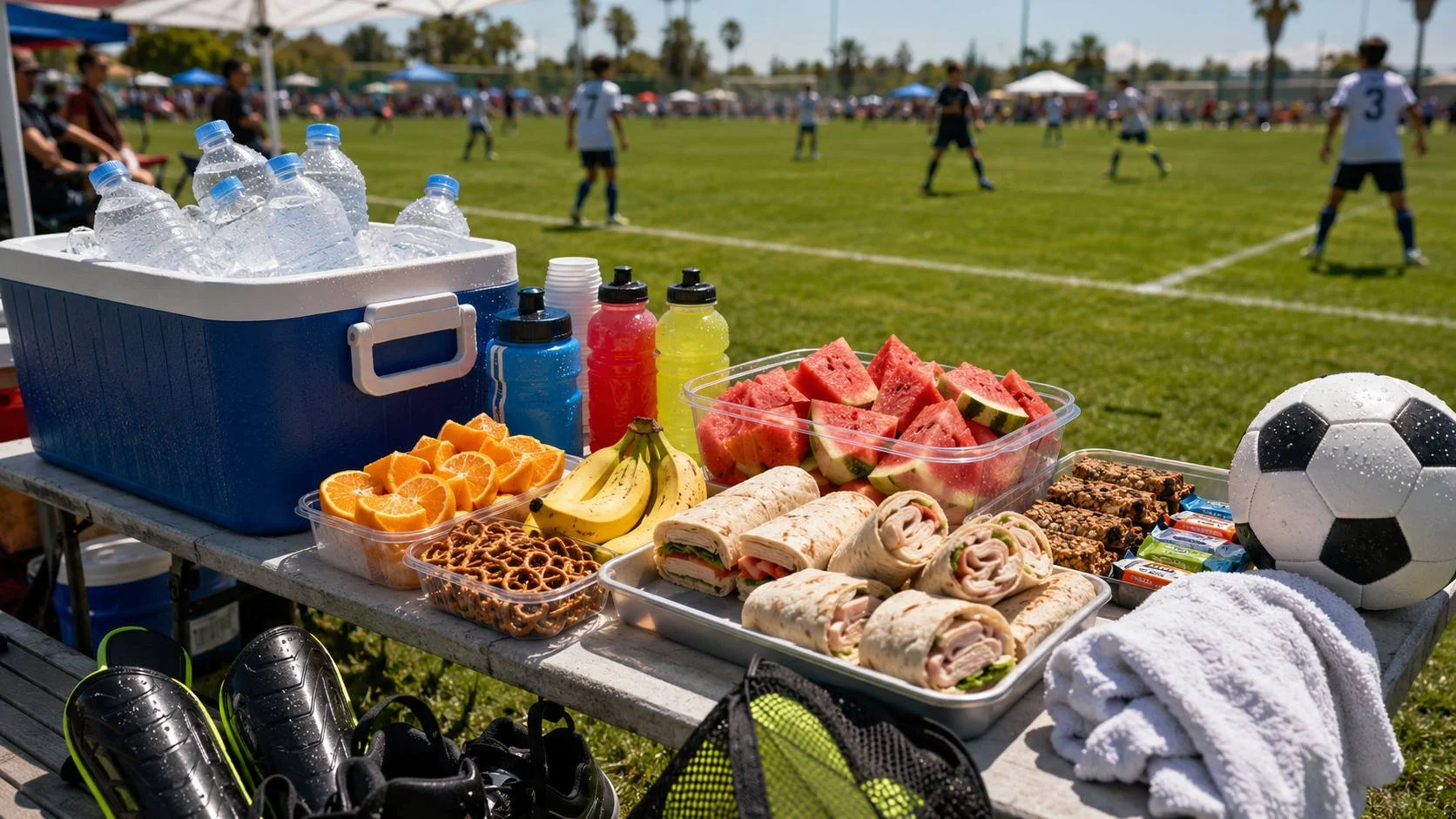
Best between-game options include applesauce pouches, banana halves, orange slices, grapes, watermelon, pretzels, crackers, dry cereal, fig bars, graham crackers, small turkey wraps, rice cakes, mini bagels, fruit gummies, and electrolyte drinks when appropriate. Johns Hopkins specifically lists applesauce, pretzels, saltines, fruit gummies, chews, gels, waffles, and similar quick snacks for competition breaks.
A good tournament snack should not require a fork, a prayer, or a digestive strategy meeting. It should be fast, familiar, and unlikely to turn into mayonnaise soup in the cooler.
The Foods to Avoid Unless You Hate Everyone
There are foods that belong nowhere near a player before a hot game. This includes greasy concession pizza, chili cheese fries, nachos with the texture of wet cardboard, giant burgers, heavy cream sauces, massive dairy bombs, and anything described as “loaded.” Loaded is what you call a baked potato, not a child about to run full field in August.
Johns Hopkins advises avoiding high-fat foods before competition because fat takes longer to digest and can make athletes feel sluggish; it also warns that high-fiber foods may contribute to gas, bloating, cramping, or diarrhea for some athletes before events.
This does not mean fiber is bad. Fiber is lovely. Fiber has done nothing wrong. It simply does not need to make its dramatic entrance 35 minutes before kickoff on a 90-degree field.
Also avoid surprise foods. If your kid has never eaten a chia-seed beet muffin before a match, tournament day is not the audition. The stomach is not a beta-testing platform.
The Cooler Strategy: Because Food Poisoning Is Not a Team-Building Exercise
The cooler is not a decorative trunk full of vibes. It is the thin insulated wall between “nice fruit and sandwiches” and “everyone regrets the ham wrap.”
FoodSafety.gov says cold foods should be kept at 40°F or below, and if foods are not kept cold, they should not sit out longer than two hours, or one hour if exposed to temperatures above 90°F. Perishable snacks like deli meats, cut fruit, vegetables, cheese, and yogurt need that same cold treatment.
The FDA gives similar outdoor food guidance: keep cold food in a cooler with ice or frozen gel packs at 40°F or below, consider separate coolers for beverages and perishables so the food cooler is opened less, and discard perishable food left out too long, especially over 90°F.
That means two coolers if possible: one “everyone opens this every four seconds” drink cooler and one “touch this and I will become a suburban thunderstorm” food cooler. Keep the food cooler shaded. Pack it full. Use frozen water bottles. Do not leave it in a hot car unless your goal is turkey roulette.
The Tournament Food Packing List That Doesn’t Require a Private Chef
Pack foods by job, not by fantasy. You need hydration, quick carbs, light protein, salt, cool foods, and emergency snacks for the sibling who will claim starvation despite eating six minutes ago.
For drinks, bring water, ice, and sports drinks or electrolyte options for longer hot stretches. Bring more than you think you need, because some bottle will be lost, spilled, abandoned near field three, or claimed by a younger sibling who “just wanted one sip” and somehow drank half.
For quick carbs, bring applesauce pouches, pretzels, crackers, bananas, orange slices, grapes, watermelon, dry cereal, graham crackers, fig bars, rice cakes, and mini bagels.
For light protein after games or during longer breaks, bring turkey wraps, chicken rice bowls, hard-boiled eggs if kept cold, cheese sticks if kept cold, Greek yogurt if tolerated and chilled, peanut butter sandwiches, hummus cups, or tuna packets if your athlete likes them and you enjoy making the tent smell like low tide.
For salty support, bring pretzels, crackers, salted rice cakes, broth in a thermos if your athlete actually wants it, or salty sandwiches. Sweat contains electrolytes, and hot tournaments are not the time to pretend sodium is a mythical villain living inside a chip bag.
The Actual 90-Degree Soccer Tournament Schedule
The night before: normal carb-forward dinner, water through the evening, no food experiments, no sleepover chaos, no “just one more episode” until midnight because apparently tomorrow’s tournament is being fueled by screen glare.
Two to three hours before the first game: breakfast or early meal with carbs and some protein. Toast and eggs. Bagel and peanut butter. Oatmeal and fruit. Turkey sandwich. Yogurt and granola if tolerated. Water.
Thirty to sixty minutes before kickoff: small snack if hungry. Banana, applesauce pouch, pretzels, graham crackers, or dry cereal. More water. No giant greasy meal. No “but the breakfast burrito looked good.” The breakfast burrito is not your friend. It is a trap with salsa.
During warmups and game: regular sips as allowed. Use hydration breaks. The CDC recommends drinking more water than usual and not waiting until thirst during hot-day activity; U.S. Soccer also emphasizes hydration before, during, and after play.
Immediately after game one: cool down, shade, water, and a small snack. Fruit plus pretzels. Applesauce plus crackers. Sports drink if it was a long, hot, sweaty game and another match is coming. Do not let the athlete vanish into a phone trance without drinking anything, because apparently scrolling is now a recovery protocol.
Between games with less than one hour: keep it small. Applesauce, fruit, pretzels, crackers, half banana, electrolyte drink if needed. The stomach does not need a full buffet while the body is still busy asking why it lives on turf.
Between games with two or more hours: add more substance. Small wrap, rice bowl, bagel sandwich, peanut butter sandwich, yogurt with granola, or chicken and rice. Keep portions sane. This is refueling, not Thanksgiving with shin guards.
After the final game: real meal with protein, carbohydrates, fluid, and salt. UChicago Medicine recommends protein after games to support repair, and Nationwide Children’s suggests a snack within 15 to 60 minutes and a balanced meal one to two hours after exercise.
Heat Changes Appetite, So Stop Taking It Personally
Parents love to panic when a kid says, “I’m not hungry.” Very understandable. You packed $83 of groceries and now the athlete is nibbling one pretzel like a Victorian orphan.
But heat, nerves, and exertion can flatten appetite. The answer is not yelling, “EAT YOUR WRAP” across a field while other parents quietly judge your sandwich management. The answer is variety and small portions.
Offer cold fruit. Offer salty carbs. Offer drinkable options. Offer familiar foods. Offer half portions. Let them graze strategically. A sweaty athlete may reject a sandwich but accept watermelon, pretzels, and a few sips of sports drink. Is it a complete culinary masterpiece? No. It is a soccer tournament, not a wellness retreat with linen napkins and a harpist named Cedar.
Parents Need a Plan Too, Unfortunately
Parents, you are also in the heat. You are also walking fields, carrying gear, assembling tents, managing siblings, finding bathrooms, and silently calculating whether the team will advance if the blue team loses by two. You need food and water too.
Bring your own bottle. Bring actual lunch. Bring salty snacks. Bring caffeine if you must, but do not let iced coffee become your entire hydration plan unless your goal is to become a trembling sideline cryptid in sunglasses.
Also bring shade. The American Academy of Pediatrics notes that humidity makes heat stress worse because sweat evaporation slows, and it points out that heat index and wet bulb globe temperature can matter more than air temperature alone; it also notes that artificial turf can raise temperature exposure for young athletes.
So yes, the 90°F day may feel worse than 90°F. Congratulations, summer has added hidden fees.
Warning Signs Are Not “Toughness Leaving the Body”
This is where the sarcasm takes a seat for two seconds, complains about the chair, and lets the grown-up paragraph speak.
Know the warning signs. HealthyChildren.org lists symptoms such as muscle cramps, dizziness, headache, nausea or vomiting, excessive sweating or cold clammy skin, drowsiness, confusion, and loss of coordination as possible heat-related warning signs in kids, and it says symptoms like these mean it is time to stop playing and get adult help.
The CDC’s athlete guidance says to stop all activity and get to a cool place if someone feels faint or weak, and to seek medical care immediately for symptoms of heat-related illness.
No sandwich, sports drink, or orange slice is a treatment plan for a player who is confused, faint, vomiting, or not acting right. That is adult-intervention time. Coaches, trainers, parents, and tournament staff need to be involved. “Walk it off” is not a heat plan. It is a phrase from the era when people thought smoking on airplanes was fine.
The Soccer Tournament Hydration Food Plan
The winning plan for a soccer tournament in 90-degree heat is not glamorous. It will not go viral unless someone drops the cooler down a hill. It is simple: hydrate early, keep food light, pack cold, use salty and carbohydrate-rich snacks between games, save heavier meals for longer breaks or after the final whistle, and do not let the concession stand become your nutrition director.
Bring water. Bring ice. Bring sports drinks for the right moments, not as a replacement for all fluids. Bring fruit, pretzels, applesauce, crackers, sandwiches, wraps, rice bowls, and safe cooler foods. Avoid greasy, heavy, unfamiliar, high-fat, high-fiber pre-game chaos. Keep perishables cold. Watch the heat, humidity, shade, turf, and the actual human beings running around in it.
Summer soccer is already ridiculous enough. You have tents, cleats, sunscreen, sweat, bracket math, and a child insisting they cannot find the water bottle currently in their hand. Do not add “forgot food and hydration planning” to the circus.
Feed them like athletes. Hydrate them like people with bodies. Pack like the sun is trying to ruin your day, because it is.