The “My Kid Has 5 Swim Events” Cooler Plan for Meet Days
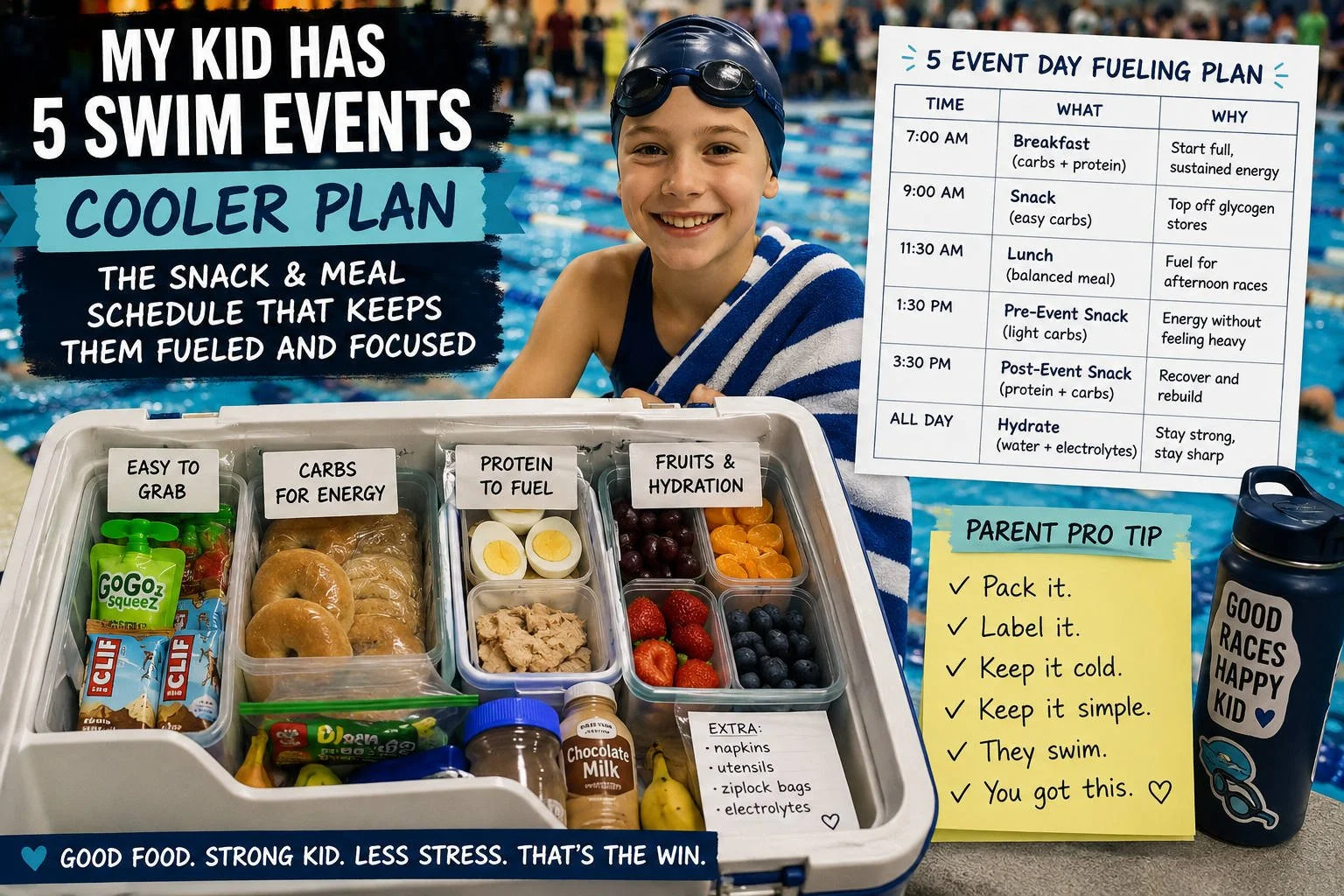
You wake up before the sun, drive to a pool that somehow smells like chlorine, wet towels, nerves, and institutional hot dogs, then spend the next six hours squinting at a heat sheet like it contains nuclear launch codes. Your kid has five events. Maybe a relay. Maybe warmups at an hour that should be illegal. Maybe their 50 free is at 9:12 and their 100 breast is at 1:47, because swim meets are apparently scheduled by a raccoon with a clipboard.
And in the middle of all this, your child needs to eat.
Not too much. Not too little. Not pizza 12 minutes before the 200 IM. Not just one granola bar and vibes. Not a blue sports drink, a ring pop, and concession-stand fries because “that’s what everyone else got.” Everyone else is not your nutrition committee, Karen. Everyone else is also wearing a parka indoors.
The good news: you do not need a professional team chef. You need a cooler plan.
Why Swim Meet Food Is So Annoying
Swim meets are uniquely irritating because they are not one game with one halftime and one obvious snack window. They are a long day of short, intense efforts separated by unpredictable gaps. Your kid races, waits, warms down, sits, gets cold, gets hungry, gets nervous, forgets where their goggles are, eats half a banana, vanishes with teammates, and then appears 11 minutes before their next event saying, “I’m starving.”
Beautiful. Very organized. Truly the Olympics of parental snack anxiety.
USA Swimming’s nutrition resources emphasize that eating well for performance is not something that begins the morning of a meet; it is part of everyday training. The USOPC fueling handout used by USA Swimming also says athletes need enough carbohydrate to maintain blood sugar and fuel muscle contraction, and that competition fueling should be practiced before race day rather than invented at 6:03 a.m. in a parking lot.
The entire cooler plan rests on one principle: feed the next event, not the emotional chaos of the whole day.
The Swim Meet Cooler Rule: Carbs First, Protein Strategically, Fat Carefully
For meet day, carbohydrates are the star. Not because protein is bad. Not because your kid should live on bagels like a small aquatic pigeon. Carbs matter because high-intensity exercise uses carbohydrate stores, and sports nutrition guidance for young athletes consistently puts carbohydrates at the center of game-day energy. The Academy of Nutrition and Dietetics says young athletes should focus on carbohydrate-rich foods for energy, spread protein through meals and snacks, use caution with high-fat foods because they slow digestion, and keep snacks lighter as competition gets closer.
Protein still matters, especially when there is a longer gap between races or after the session. It helps keep kids satisfied and supports muscle repair. But protein is not magic glitter. A turkey wrap three hours before a race? Great. A giant cheeseburger 20 minutes before a race? Congratulations, you have created a digestive anchor with ketchup.
Fat and fiber are the sneaky villains close to race time. Higher-fat foods and high-fiber foods digest more slowly, which is lovely for normal life and less lovely when your child is about to dive off a block and ask their stomach to remain professional. The USOPC fueling handout specifically warns that foods higher in fat and fiber can slow digestion and cause stomach distress if eaten too close to competition.
The Night Before: Do Not Create a Pasta Cult
The night before a meet is not the time for a heroic carb-loading ritual where your child eats a pound of spaghetti and lies on the couch like a marinara python. For most youth meets, the goal is normal, familiar, carbohydrate-rich, balanced food.
Nationwide Children’s Hospital recommends a high-carbohydrate meal and plenty of fluids the night before game day, with examples like rice bowls, spaghetti with meat sauce, or soft tacos. It also recommends getting at least seven to eight hours of sleep, which is adorable because swim families often treat sleep like a luxury add-on.
Good night-before dinners:
Chicken rice bowl with vegetables.
Turkey or bean tacos with rice.
Pasta with meat sauce and fruit.
Baked potato, chicken, and vegetables.
Stir-fry with rice.
Peanut noodles with chicken or tofu.
Avoid turning dinner into a science experiment. No new sauce. No questionable sushi buffet. No “let’s try that spicy curry place” unless you enjoy gambling with intestinal weather.
Meet Morning Breakfast: Fuel Without a Food Coma
If the first race is early, breakfast should be familiar, carbohydrate-focused, and easy to digest. The USOPC fueling guide recommends a balanced meal three to four hours before competition or a smaller meal or larger snack two hours before, then topping up with familiar easy carbs 15 to 60 minutes before competing if needed.
Real swim-parent translation:
If there are three or more hours before first race, give a real breakfast.
If there are about two hours, give a smaller breakfast.
If there are 30 to 60 minutes, give a light carb snack, not a breakfast burrito the size of a kickboard.
Good breakfast options:
Bagel with peanut butter and banana.
Oatmeal with fruit and a little honey.
Egg sandwich on toast.
Yogurt parfait with granola and berries.
Cereal with milk and fruit.
Toast, banana, and smoothie.
Pancakes with fruit if your kid already tolerates them well.
Bad breakfast options:
Greasy fast-food breakfast sandwich right before warmups.
Giant donut plus chocolate milk and panic.
Nothing, because “they said they weren’t hungry.”
A brand-new protein bar with ingredients that sound like a chemistry substitute teacher.
If your kid is too nervous to eat, try liquid or semi-liquid options like a smoothie, drinkable yogurt, applesauce pouch, or milk. The USOPC handout notes that nervous athletes may prefer liquid meals or snacks rather than solid food.
The 5-Event Snack Schedule
Here is the basic structure for a kid with five events across a long session. Adjust based on age, appetite, event length, nerves, and gaps. This is a parent tool, not scripture carved into a starting block.
Before Event 1
About 30 to 60 minutes before the first race, offer a small, familiar carb snack if breakfast was early.
Good options:
Half a banana.
Applesauce pouch.
Pretzels.
A few graham crackers.
Small granola bar.
Fruit leather.
Half a bagel.
Do not shove food into a kid who is already full. This is not foie gras swim parenting. The goal is topping off, not stuffing.
Between Events With Less Than 45 Minutes
This is not meal time. This is sip-and-nibble time.
Offer:
Water.
A few pretzels.
Applesauce pouch.
A few bites of banana.
Sports drink only if the day is long, hot, sweat-heavy, or your kid struggles to keep energy up.
This is where many parents lose the plot and hand over a full sandwich because the child said “hungry,” which in swim-meet language can mean anything from “I need calories” to “my friend has gummies and I want justice.”
Between Events With 45 to 90 Minutes
Now you can offer a real snack.
Good options:
Banana and pretzels.
Granola bar and water.
Yogurt tube and crackers.
Half turkey sandwich.
Rice cakes with nut butter.
Dry cereal and milk.
String cheese with pretzels if the next race is not too soon.
Nationwide Children’s recommends a high-carbohydrate snack about one hour before competition and avoiding high-protein or high-fat foods too close because they take longer to digest.
Between Events With 90 Minutes to 2.5 Hours
This is mini-meal territory.
Good options:
Turkey wrap.
Peanut butter and jelly sandwich.
Pasta salad with light dressing.
Rice bowl with chicken.
Bagel with cream cheese.
Greek yogurt, granola, and fruit.
Hummus with pita and fruit.
Keep portions reasonable. A mini-meal should not require your swimmer to waddle to the blocks like a carb-loaded emperor.
Between Events With 3+ Hours
Now you can feed a more complete meal.
Good options:
Turkey sandwich, fruit, pretzels.
Chicken rice bowl.
Pasta with lean protein.
Wrap with turkey, cheese, and fruit.
Bagel sandwich plus yogurt.
Rice, eggs, and fruit.
But still avoid heavy, greasy, high-fat meals if more racing is coming. Fries, pizza, nachos, and concession-stand mystery meat have their place in life. That place is generally after the racing, not before the 100 fly unless your child enjoys swimming with a stomach full of regret.
The Actual Cooler Packing List
This is the parent-friendly, “I do not want to think at 5 a.m.” version.
Carbs for Quick Fuel
Bananas.
Applesauce pouches.
Pretzels.
Graham crackers.
Dry cereal.
Mini bagels.
Granola bars.
Rice cakes.
Fruit leather.
Crackers.
Orange slices.
Grapes.
These are the little event-gap heroes. They do not ask much. They do not smell weird. They do not require a fork, a napkin, and a TED Talk.
Mini-Meal Foods
Peanut butter and jelly sandwiches.
Turkey or ham wraps.
Bagel sandwiches.
Pasta salad.
Rice bowls.
Chicken wraps.
Hummus and pita.
Yogurt parfaits.
Hard-boiled eggs if your kid tolerates them and the cooler is properly cold.
The Academy’s snack guidance for young athletes includes options like yogurt, peanut or almond butter sandwiches, turkey and cheese wraps, string cheese with pretzels, cold water, fruit, low-fat milk, and granola bars.
Protein Add-Ons
String cheese.
Greek yogurt.
Turkey slices.
Chicken pieces.
Hard-boiled eggs.
Nut butter packets.
Hummus.
Shelf-stable milk.
Protein is best in meals and longer gaps. Close to race time, do not let protein swagger in like it owns the place. It does not. It is useful, not the main character.
Hydration
Water bottles.
Extra water jug.
Low-fat milk or chocolate milk for after, if your kid likes it.
Sports drink for long, hot, sweat-heavy meets or kids who need quick carbs/electrolytes.
HealthyChildren.org, from the American Academy of Pediatrics, says water and milk are the best drink choices for kids generally, and that water supports hydration without added sugar. For young athletes, EatRight says water should remain the go-to drink for exercise under 60 minutes, while longer sessions or heavy sweating may call for sports drinks to replace fluids and electrolytes.
Emergency Foods
Extra granola bars.
Crackers.
Applesauce.
Shelf-stable chocolate milk.
Fruit snacks.
A backup PB&J.
A cash card for the concession stand, because reality exists and sometimes your cooler plan gets drop-kicked by heat sheets, delays, and a child who suddenly “can’t eat turkey anymore.”
What Not to Pack Unless You Enjoy Chaos
There are foods that seem fine until you watch them sit in a humid natatorium for four hours and slowly become biological questions.
Skip or limit:
Greasy pizza before racing.
Nachos.
Heavy fried foods.
Giant muffins right before an event.
Creamy mayo-heavy salads unless kept properly cold.
Carbonated soda.
Energy drinks.
Candy as the main snack.
Fiber bombs like giant raw veggie trays right before racing.
Spicy foods.
A suspicious smoothie that has been warm since 7:15 a.m.
The American Academy of Pediatrics has warned that energy drinks are not appropriate for children and adolescents, while sports drinks have a limited role for prolonged vigorous activity when rapid replenishment is needed. So no, your 10-year-old does not need a neon caffeine grenade because they have the 100 back later.
The Food Safety Part Nobody Wants but Everyone Needs
A swim meet cooler is not a magical safety box. It is a cold box that works only if you pack it like you have met bacteria before.
Keep perishable foods cold at 40°F or below. The University of Minnesota Extension says foods like lunch meats, cooked chicken, pasta salad, and cut fruits and vegetables need to be kept in a cooler that stays at 40°F or colder; it also recommends starting with cold food, packing plenty of ice or frozen gel packs, limiting openings, storing the cooler out of heat, and securing food in watertight containers.
The USDA food-safety rule is equally blunt: perishable food should not be left out of refrigeration for more than two hours, or more than one hour if the temperature is above 90°F. In other words, that turkey wrap cannot sit open beside a wet towel all morning and then be called “probably fine.” That is not lunch. That is microbial roulette.
Cooler setup:
Use two ice packs minimum.
Freeze water bottles and use them as ice.
Put perishables at the bottom.
Pack snacks in small bags so the cooler is not opened every seven seconds.
Keep drinks in a separate bag if possible, because kids open the drink cooler like they are mining for treasure.
Bring hand sanitizer or wipes.
Label your kid’s food if siblings are present, because siblings are snack criminals with swim caps.
The Parent Timeline for a 5-Event Meet
Here is a sample plan. Adjust to actual event times, because swim meets enjoy laughing at structure.
6:00 a.m. — Breakfast at Home
Oatmeal with banana.
Or bagel with peanut butter.
Or egg sandwich and fruit.
Water.
No experimental food. No “new high-protein pancake mix” bought at 10 p.m. by a parent possessed by optimism.
7:30 a.m. — Arrival and Warmups
Sips of water.
Maybe a few pretzels or half a banana if breakfast was light.
Do not feed a full meal at warmup unless the first race is hours away.
8:30 a.m. — Event 1
Small carb top-up if needed.
Water.
Parent attempts to film race and accidentally records ceiling for six seconds.
9:00 a.m. — After Event 1
If next event is soon: applesauce pouch or pretzels.
If next event is later: granola bar or yogurt tube.
Water.
10:15 a.m. — Before Event 2
Small familiar carb.
Nothing greasy.
Nothing that requires floss.
10:45 a.m. — After Event 2
Mini snack.
Water.
If your kid is clearly losing energy, add something with more substance: half sandwich, bagel, yogurt, or cereal.
12:00 p.m. — Longer Break
Mini-meal.
Turkey wrap, fruit, pretzels.
Or PB&J, yogurt, and water.
This is not the time for concession nachos unless racing is done or you enjoy living dangerously.
1:30 p.m. — Event 3
Small carb if hungry.
Water.
Parent says “just have fun,” while internally vibrating like a malfunctioning scoreboard.
2:15 p.m. — Events 4 and 5 Are Coming
Short gap? Small carbs and sips.
Longer gap? Half sandwich or granola bar plus fruit.
Do not panic-feed.
After Final Event
Now recovery food matters. Nationwide Children’s recommends refueling within 15 to 60 minutes after exercise when possible and having a well-balanced meal one to two hours later.
Good recovery options:
Chocolate milk and banana.
Turkey sandwich and fruit.
Yogurt parfait.
Rice bowl.
Smoothie.
Dinner with carbs, protein, and vegetables.
Post-meet pizza can happen. We are not monsters. Just do not pretend pizza is the entire recovery strategy unless your nutrition philosophy was written by a concession stand.
The “My Kid Won’t Eat” Plan
Some kids get too nervous to eat. Others say they are not hungry until they are suddenly a hollow-eyed gremlin 14 minutes before their event. Very normal. Very annoying. Very swim parent.
For nervous eaters:
Use liquid options: smoothie, drinkable yogurt, milk, diluted juice.
Use tiny portions: two bites every 20 minutes.
Use bland foods: toast, banana, applesauce, crackers.
Avoid pressure. A stressed kid being begged to eat a wrap is not fueling; it is a hostage negotiation with hummus.
The USOPC guide says athletes can train the stomach to tolerate food and fluid before competition by practicing during training weeks, starting with easily digestible foods and gradually adding more. This is deeply important. Meet day is not the lab. Practice is the lab.
The “My Kid Wants Candy” Plan
Candy is not evil. Candy is just useless as a primary strategy, like bringing a kazoo to a fire drill.
A few gummies before a race? Fine, especially if your kid tolerates them and needs quick carbs. A whole day of Skittles, sports drink, and no real food? That child is going to perform one beautiful race and then spiritually crash into the lane rope.
Use candy as a small backup, not the backbone. The backbone is carbs, fluids, and familiar mini-meals. Boring? Yes. Effective? Also yes. Parenting is mostly choosing boring things before chaos starts invoicing you.
The Cooler Plan by Race Gap
Use this when you are staring at the heat sheet like it personally betrayed you.
Race in 15–30 Minutes
Water.
A few pretzels.
Applesauce pouch.
Small piece of banana.
Maybe a few sports chews or fruit snacks if familiar.
Race in 45–60 Minutes
Granola bar.
Banana.
Crackers.
Half bagel.
Fruit and water.
Race in 1–2 Hours
Half sandwich.
Yogurt and cereal.
Bagel with nut butter.
Cheese and pretzels.
Fruit plus crackers.
Race in 2–4 Hours
Turkey wrap.
PB&J.
Rice bowl.
Pasta salad.
Bagel sandwich.
Yogurt parfait.
Racing Done
Balanced meal.
Carbs plus protein.
Fluids.
Something enjoyable because they are a child, not a spreadsheet in goggles.
The Best Swim Meet Foods Ranked by Parent Sanity
Bananas: cheap, portable, effective, and biodegradable. Basically the swim parent’s golden retriever.
Applesauce pouches: excellent for nervous kids and short gaps. Also makes your child look like a toddler astronaut, but fine.
Pretzels: salt, carbs, crunch, no drama.
PB&J: undefeated, unless allergies are involved.
Turkey wraps: good mini-meal, easy to portion.
Greek yogurt: useful protein, but needs the cooler to actually do its job.
Bagels: sturdy carb bricks of hope.
Granola bars: fine, but test them first. Some are basically candy in a hiking costume.
Chocolate milk: good post-race or post-session option if tolerated.
Sports drinks: useful in long, hot, sweat-heavy meets, but not needed for every 25-yard splash festival.
Final Verdict: Pack the Cooler Like the Heat Sheet Is Trying to Hurt You
A kid with five swim events needs a plan, not a snack avalanche. The goal is steady energy, calm digestion, hydration, and enough familiar food that your swimmer does not become either starving or stuffed at the worst possible moment.
Pack quick carbs for short gaps. Pack mini-meals for long gaps. Add protein when there is time to digest. Keep greasy foods away from pre-race windows. Keep perishables cold like you have personally declared war on food poisoning. Bring more water than you think you need. Bring wipes, bags, and a backup snack for the teammate whose parent packed one sad apple and a dream.
Most importantly, practice the plan before the big meet. Race day is not the time to discover that your child hates the “performance muffin” you lovingly made at midnight while questioning your identity.
Swim meets are already chaos. The cooler does not need to join the rebellion.
Feed the next race. Hydrate steadily. Keep snacks familiar. Save the fries for after.
And when your kid appears from behind the team area wearing someone else’s parka, holding wet goggles, and asking what they should eat before Event 4, you will not panic.
You will open the cooler like a seasoned chlorine warrior and hand them exactly what they need.
Probably pretzels.
It’s pretzels all the way down.