Anthony Bourdain’s Street Food Lesson: Why the Best Meal Is Often the Cheap One
Anthony Bourdain did not spend his career teaching people that expensive food is bad. That would be dumb, and Bourdain, for all his chaos-goblin swagger, was not dumb. He respected great restaurants, great chefs, great technique, and the kind of kitchen labor that turns ordinary ingredients into something that makes a grown adult briefly stop talking, a miracle rare enough to deserve funding.
But Bourdain’s real street food lesson was this: price is not the same thing as meaning.
The best meal is often the cheap one because cheap food has to answer to the people who actually live there. It has to be fast, repeatable, satisfying, affordable, and good enough for regular customers to come back when there is no novelty, no concierge recommendation, no mood lighting, no sommelier named Étienne explaining volcanic minerality like a hostage reading from a wine bottle.
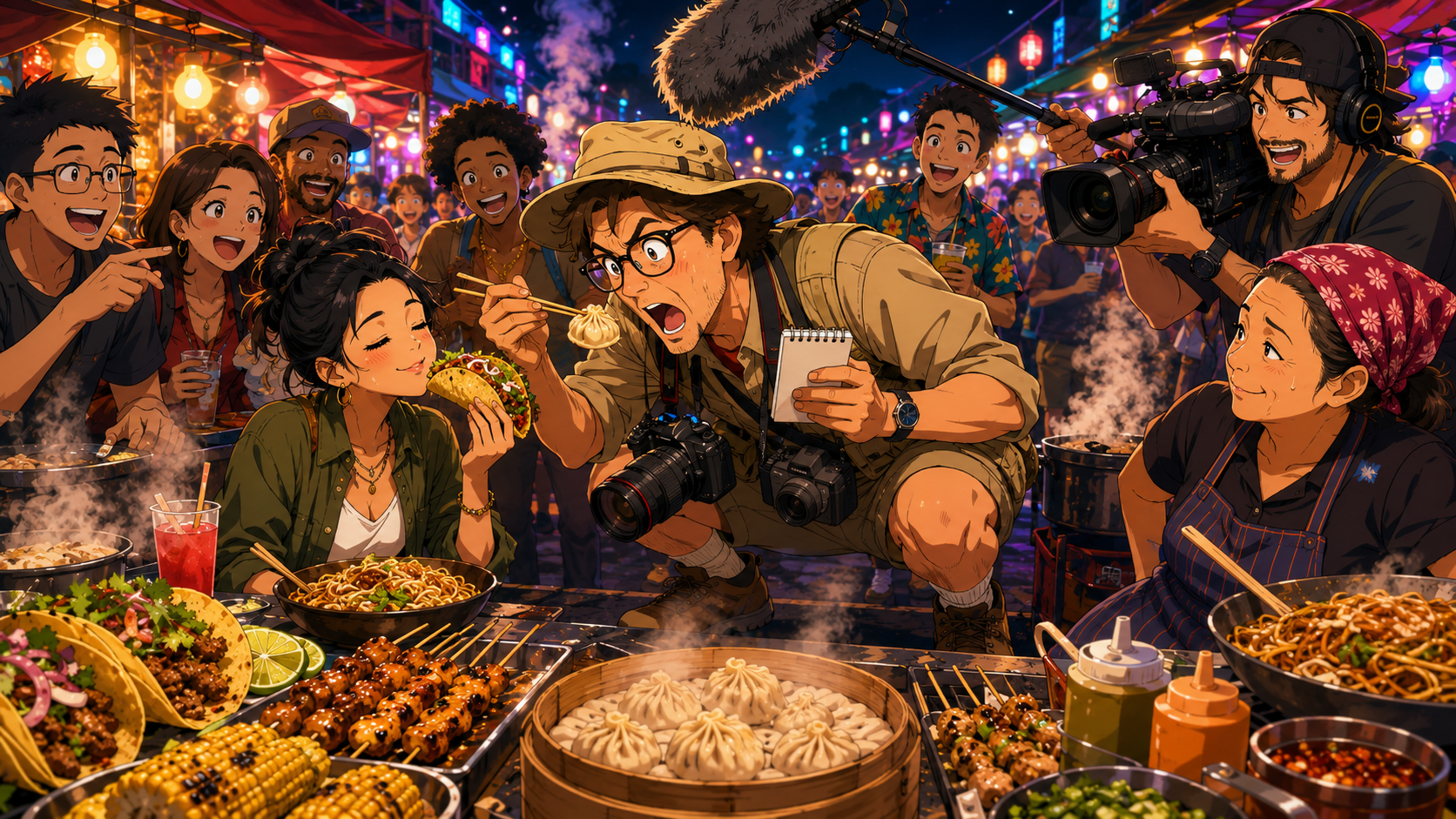
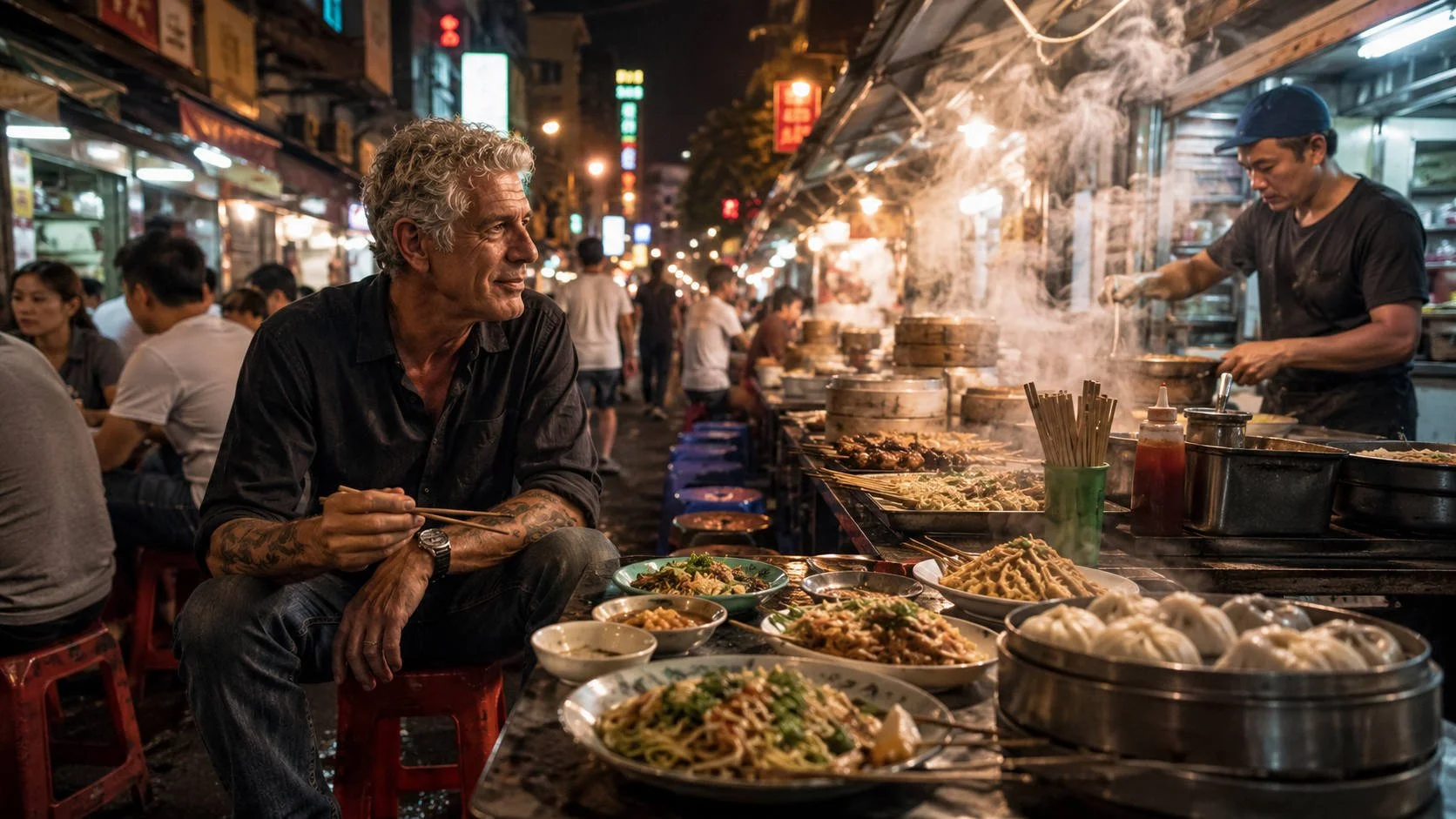
Street food, hawker food, market food, noodle stalls, taco carts, plastic-stool restaurants, barbecue shacks, curry counters, dumpling stands—these are not “lesser” food. They are food without the decorative nonsense. Food with rent due. Food with a line of hungry people who will absolutely abandon you if your broth gets lazy.
Bourdain understood that better than almost anyone on television. Parts Unknown won a Peabody Award, and Peabody described the show as more than a culinary travelogue because Bourdain’s appetite led into stories about people, place, and culture. There’s the whole key, sitting there like a perfect bowl of noodles: the food was never just food. It was a door. Cheap food just happened to be one of the best doors because everyone used it.
Bourdain’s Real Lesson Was Not “Eat Weird Stuff, Look Cool”
Some people watched Bourdain and learned the wrong lesson. They saw the tattoos, the cigarettes, the profanity, the offal, the street stalls, the black T-shirt, and decided the point was to become a haunted leather jacket with chopsticks.
No. Sit down, Motorcycle Tapas Guy.
The point was not to perform bravery by eating something unfamiliar and then making a face for the camera. The point was humility. Bourdain’s best work treated eating as a way to shut up and enter someone else’s world. Not dominate it. Not rank it. Not convert it into “content.” Enter it.
That is why cheap food mattered. A cheap meal often strips away the useless theater that makes travelers act like auditors. You sit on the stool. You accept the bowl. You watch what everyone else is doing. You eat. You learn.
It is very difficult to remain a precious little aristocrat when you are sweating over soup beside a motorbike.
Cheap Food Has to Be Good Because It Has No Costume
Fine dining can use distraction. Big plate, tiny food. Tiny spoon. Server monologue. Foam behaving suspiciously. A smear that looks like the chef dragged a beet through a legal dispute. Expensive restaurants can build atmosphere so dense that customers start tasting the lighting.
Street food has fewer hiding places.
A taco stand cannot whisper its concept at you for nine minutes. A noodle stall cannot dim the lights until the broth seems profound. A hawker does not have the luxury of serving “a meditation on regional memory” when 40 people are waiting with exact change and no patience for garnish philosophy.
The food has to work immediately.
That is why the cheap meal can be better. It is brutally accountable. If the chicken rice is dry, people go next door. If the pho is flat, locals do not return. If the dumplings are weak, the line evaporates. No one owes loyalty to a bad street vendor because the chairs are “atmospheric.” The atmosphere is traffic and steam. Good luck, chef.
FAO describes street foods as ready-to-eat foods and drinks sold by vendors in public places, often clustered near workplaces, schools, hospitals, railway stations, and bus terminals; it also notes they are generally inexpensive compared with formal-sector food and sometimes even cheaper than home-cooked food. Translation: this is not lifestyle snacking. This is infrastructure with chili sauce.
Bourdain Understood the Power of the Repeated Dish
The best cheap meals are often made by people who cook one thing, or a small handful of things, over and over until the dish becomes less a recipe than a nervous system.
This is the opposite of the restaurant that serves sushi, burgers, tacos, poke, ramen, and “global small plates” because the owner got frightened by commitment. Street food tends to specialize. One stall does grilled pork. Another does fish soup. Another does noodles. Another does skewers. Another does dumplings. They are not trying to be everything. They are trying to be necessary.
Repetition matters. The cook learns heat, timing, fat, dough, broth, smoke, texture, and rush-hour rhythm in a way no innovation lab can fake. The cheap meal is often better because it has been edited by thousands of hungry customers. Not focus-grouped. Not “elevated.” Edited by survival.
That is why the phrase “hole in the wall” is often used badly. The hole is not the point. The wall is not the point. The point is the person inside who has made the same food so many times that your expensive fusion restaurant should quietly take notes and stop putting kimchi on fries like it invented Korea.
The $6 Obama Bún Chả Meal Was the Whole Philosophy in One Plastic Stool Scene
One of Bourdain’s most famous cheap-meal moments came in Hanoi in 2016, when he ate bún chả with President Barack Obama at a small restaurant. Explore Parts Unknown noted that the two ate bún chả and drank beer, with a total bill of $6, which Bourdain paid.
That scene worked because the setting did more than any banquet hall could. A sitting U.S. president, a famous chef, grilled pork, noodles, herbs, beer, plastic stools, fluorescent light, Hanoi noise. No imperial dinner table. No carved ice sculpture. No diplomatic food coffin under a silver dome.
Just a cheap meal doing what cheap meals do best: making status look ridiculous.
The dish did not become important because Obama ate it. It was already important. Obama and Bourdain just sat down inside its world for a moment. That is the correct order. The street food is not elevated by the famous person. The famous person is humbled by the street food.
A shocking development for celebrity culture, which generally believes food begins existing once someone verified points a phone at it.
Singapore Hawker Centers Prove Cheap Food Can Be World-Class Without Wearing a Tuxedo
Bourdain returned often to Singapore as a model of serious street-food culture. Singapore’s hawker centers are not random chaos; they are organized food ecosystems where vendors serve everyday meals to everyone from workers to families to tourists with sunscreen and bad walking shoes.
UNESCO inscribed Singapore’s hawker culture on its Representative List of the Intangible Cultural Heritage of Humanity in 2020, describing hawker centres as “community dining rooms” where people from diverse backgrounds gather over meals throughout the day.
That phrase, “community dining rooms,” is doing a lot of work. A hawker center is not just a cheap place to eat. It is the opposite of the exclusive restaurant fantasy. Everyone is there. The food is local, multicultural, affordable, direct, and practical. You do not need a reservation six weeks in advance, a blazer, or the emotional resilience to hear someone describe foam.
Bon Appétit reported that Bourdain appeared at Singapore’s World Street Food Congress in 2013 and supported Singapore’s regulated hawker-center model as a possible answer for places where hygiene and regulation are serious concerns. That is important because Bourdain’s love of street food was not some idiot romance about danger. He was not saying, “Eat mystery meat beside an open sewer because authenticity.” He understood that cheap food and food safety are not enemies. They just require systems that do not crush the vendors into paste.
Cheap Food Is Often Better Because It Is Close to Daily Life
Expensive restaurants often cook for occasions. Street food cooks for Tuesday.
That difference matters.
Occasion food has pressure. Anniversary dinner. Birthday dinner. Big travel splurge. The meal has to justify itself. Everyone is tense because the bill is already sitting in the future like a small financial predator. If the dish is merely good, disappointment arrives wearing perfume.
Cheap daily food has a different job. It has to feed people who are going back to work, school, home, the bus, the train, the next shift. It has to belong to the city. It has to fit the rhythm.
Street food often appears where daily life already gathers—markets, transit hubs, schools, workplaces—which is why it can teach you more about a place than a hotel restaurant with beige international pasta and a Caesar salad that tastes like it has never met Rome. FAO specifically notes that street foods fill the need for food where people work or congregate.
That is Bourdain’s travel lesson in plain clothes: follow the daily hunger. Not the luxury hunger. Not the guidebook hunger. The commuter hunger. The student hunger. The night-shift hunger. The vendor-feeding-the-neighborhood hunger.
That is where the real menu is.
Cheap Food Removes the Performance Anxiety
Fine dining can turn eating into theater, and not always good theater. Sometimes it is just dinner forced to wear a monocle.
Cheap food gives you permission to be normal. You point. You pay. You sit. You slurp. You sweat. You spill a little. Nobody presents the fish sauce like a relic. Nobody asks whether you detect hay, wet stone, or the chef’s childhood loneliness in the broth.
This does not mean cheap food is simple-minded. It means the complexity is in the food, not the choreography.
A bowl of noodles can contain migration, poverty, adaptation, weather, empire, family, agriculture, technique, and personal memory. It just does not announce itself with a tasting-menu font and a server saying, “Chef invites you to begin with the sea.” Chef can invite me to begin with a spoon and some honesty, thank you.
Bourdain’s genius was noticing that the cheapest table in town might have more truth than the most expensive one.
Street Food Is Not “Authentic” Because It Is Poor. Stop Being Weird.
Here is where people get stupid.
Cheap food is not automatically morally superior. Poverty is not seasoning. A plastic stool is not a sacrament. A vendor is not more “real” because they are exhausted. If your love of street food depends on romanticizing someone else’s difficult working conditions, congratulations, your personality needs a health inspection.
Bourdain’s better lesson was respect, not fetish. Cheap meals are often great because they are built from skill, tradition, utility, speed, and local demand—not because hardship magically makes soup taste better.
A $2 meal can be sublime. It can also be bad. An expensive restaurant can be soulless. It can also be extraordinary. Price does not decide. The work decides. The care decides. The customers decide. The culture decides.
The cheap meal just has one advantage: it is usually less insulated from reality. If it fails, people do not return. If it succeeds, it becomes part of the neighborhood’s bloodstream.
The Best Cheap Food Usually Has Three Things: Turnover, Focus, and Pride
If you want to eat cheaply in the Bourdain spirit without spending your vacation chained to a bathroom, look for three things.
First: turnover. Busy stalls are good because food moves. Hot food cooked fresh in front of you is usually safer and better than sad lukewarm trays sitting around like leftovers from a municipal hearing. WHO street-food safety material notes that billions of people eat street food daily, but food safety depends on handling, hygiene, and preparation practices.
Second: focus. The stall doing one thing well is often a better bet than the place serving every food known to geography. A short menu is a beautiful thing. It says, “We know what we are.” A long menu says, “We fear commitment and own too many freezers.”
Third: pride. You can see it. Clean station. Organized prep. Ingredients treated like they matter. A cook who moves with rhythm. A vendor who cares about the line, the sauce, the char, the broth, the rice, the cut, the wrapper, the garnish. Pride is not expensive. But it is visible.
Bad food is often careless. Cheap bad food is still bad. Do not eat it just because it looks “local.” That is not cultural openness. That is stomach-based gambling.
Bourdain Was Also Right About Markets
One of the most practical Bourdain-style travel moves is brutally simple: go early to local markets. Markets show you what people buy before restaurants turn ingredients into performance. Produce, fish, meat, herbs, noodles, spices, breakfast stalls, workers eating before the day swallows them.
Quote websites widely attribute to Bourdain the advice to get up early and visit local produce markets, especially in Latin America and Asia, for cheap, authentic, fresh food stalls. The exact internet quote ecosystem is a swamp, but the advice itself matches the entire arc of his work: go where food is being bought, cooked, and eaten before tourism puts on its little hat.
Markets also teach humility because you will not understand everything. Good. Not understanding everything is healthy. It keeps you from becoming the kind of traveler who says, “I did Bangkok” after eating pad Thai in a hotel.
You did not “do” anything, Chad. You had noodles near a concierge desk.
The Cheap Meal Often Has Better Context
Food tastes different when it belongs where you are.
A bowl of pho on a low stool in Vietnam has weather, noise, exhaust, herbs, morning light, and local rhythm around it. The same bowl in an airport food court under LED lighting beside a charging station has to fight for its life.
That does not mean food only matters in its place of origin. Diaspora food is real food. Immigrant restaurants are not second-class. Some of the best cheap meals in the world happen far from where the dish began. But context matters. The room matters. The pace matters. The people around you matter.
Bourdain made television out of that idea. He used meals as social geography. Who eats here? Why? When? What does it cost? Who cooks it? Who gets excluded? Who profits? Who remembers?
That is why the best cheap meal can feel bigger than the plate. It is not just delicious. It is connected.
Cheap Does Not Mean Small
Another reason cheap meals win: abundance.
A street meal often gives you the full architecture of satisfaction: starch, protein, sauce, acid, heat, herbs, crunch, broth, smoke. Not one sculpted bite on a ceramic comma. Actual food. Food designed for hunger, not applause.
This is why many expensive restaurants have to work so hard to create satisfaction. They have to sequence 12 courses because each one is the size of a postage stamp with trauma. Street food solves this by feeding you. Radical strategy. Someone tell fine dining.
A great cheap meal knows the body exists. It does not treat hunger like a vulgar inconvenience. It does not say, “Here is a translucent radish representing memory.” It says, “Here is pork, noodles, herbs, broth, chili, and a plastic stool. Try not to cry into the bowl.”
Michelin Eventually Admitted the Obvious
Even the institutions eventually noticed that great food does not always wear a tablecloth.
Michelin’s Singapore guide includes a street-food category, and its 2025 Bib Gourmand selection honored 89 eateries, including hawker stalls and neighborhood spots serving good food at accessible prices. Hawker Chan’s own history notes that chef Chan Hon Meng’s soya sauce chicken received a Michelin star in Singapore in 2016, turning a humble hawker dish into one of the world’s most famous cheap fine-food examples.
Now, Michelin recognition is not the final word. Please do not replace your taste buds with a tire-company guide. But it did puncture the lazy fantasy that excellence always lives inside expensive rooms. Sometimes excellence is under fluorescent lights, sweating over a chopping board, selling lunch for less than a cocktail.
Michelin did not make hawker food important. It just showed up late wearing a suit and wrote down what locals already knew.
The Cheap Meal Teaches You to Trust Other Measures of Value
A tasting menu teaches you to notice technique. Street food teaches you to notice life.
Watch the line. Watch the cook. Watch the regulars. Watch the condiments. Watch whether people eat quickly, silently, happily, aggressively. Watch whether the food is made to order. Watch whether the vendor handles money and food with the same glove, because that is less “authentic” and more “intestinal roulette.”
The best cheap food trains your senses. It makes you less dependent on hype. Less impressed by nonsense. More likely to ask the correct questions.
Does it smell good?
Is it fresh?
Are people returning?
Does the vendor specialize?
Is the heat right?
Is the sauce alive?
Is the food moving?
Does this taste like someone cares?
These are better questions than “Is this famous?” or “Did a magazine say it was essential?” or “Can I photograph it before it collapses emotionally?”
Bourdain’s Lesson for Travelers: Don’t Chase Cheapness, Chase Usefulness
The goal is not to spend the least money possible. That is how you become the person walking past a great local meal to save 80 cents on a protein bar you brought from home like a joyless financial squirrel.
The goal is to find food that matters at its price.
Sometimes that means a $3 taco. Sometimes a $6 bowl of bún chả. Sometimes a $5 hawker plate. Sometimes a $12 lunch special from an immigrant-owned restaurant in a strip mall that has better cooking than half the “chef-driven concepts” currently terrorizing reservation apps.
Cheap food is often best because the price lets you eat widely. You can try more things. Take more chances. Fail occasionally without financial heartbreak. If one snack is weird or bad, fine. You are out a few dollars, not the GDP of a small island.
Expensive meals make people defensive. Cheap meals make people curious.
Curiosity was Bourdain’s whole machine.
The Anti-Bourdain Mistake: Turning Street Food Into a Checklist
There is one very modern way to ruin Bourdain’s lesson: turn it into a checklist of “must-eat” stalls and then sprint through them like a caffeinated stamp collector.
That is not eating. That is achievement disorder with chili oil.
Bourdain’s shows worked because he sat down. He talked. He listened. He let meals breathe. He let people be more interesting than the dish. The food was the beginning of the conversation, not the trophy.
So do not travel like a food app with legs. Eat the famous thing if you want. But also eat the thing next to your hotel because the line looks good. Eat breakfast where workers eat. Eat late-night soup. Eat the market snack. Eat the dish your taxi driver mentions. Eat what a local friend tells you to eat, even if it looks ugly and photographs like a plumbing accident.
Especially then.
When the Expensive Meal Is Worth It
Bourdain’s street-food lesson should not become reverse snobbery. Reverse snobbery is still snobbery, just wearing cheaper shoes and pretending that makes it virtuous.
Expensive meals can absolutely be worth it when they pay for skilled labor, rare ingredients, better wages, thoughtful sourcing, complex technique, hospitality, and an experience you will actually remember. The problem is not expensive food. The problem is expensive nonsense.
A $300 tasting menu can be profound. It can also be a hostage situation with tweezers.
A $3 noodle bowl can be transcendent. It can also be mediocre noodles made by someone who has spiritually left the building.
The point is not cheap versus expensive. The point is honesty versus performance.
Street food often wins because it has less room for lying.
How to Eat Like Bourdain Without Cosplaying Bourdain
You do not need to smoke, curse theatrically, wear black, or develop a tragic gravel voice. Please don’t. The world has enough men doing Bourdain karaoke at bars while mispronouncing “nuoc cham.”
Eat like Bourdain by doing this:
Be curious without being performative.
Respect the people cooking.
Do not treat cheap food like a zoo exhibit.
Go to markets.
Eat where locals eat, but use common sense.
Order the thing the place is known for.
Accept that you will not understand every ingredient.
Do not make every bite about yourself.
Tip or pay fairly where appropriate.
Do not bargain down someone already selling you dinner for pocket change.
And most importantly, let the meal teach you something beyond whether you personally liked it.
That is the adult version. Less cinematic, more useful. Tragic for anyone hoping to become a travel icon by eating soup in sunglasses.
The Best Meal Is Often Cheap Because the Best Food Is Usually Close to the Ground
Anthony Bourdain’s street food lesson endures because it is annoying and true: the best meal is often the cheap one.
Not always. Often.
Cheap food is often close to daily life. It is specialized. It is accountable. It is made for repeat customers, not just tourists. It has high turnover, practical wisdom, cultural memory, and fewer opportunities to hide mediocrity behind lighting and adjectives.
A cheap meal can put you closer to a city’s working rhythm than any luxury restaurant. It can teach you who lives there, what they crave, what they can afford, what they preserve, what they improvise, and what they refuse to let die.
Bourdain did not love street food because it was cheap in some shallow bargain-hunter way. He loved it because it was alive.
And that is the lesson.
The best meal is often the one with no tablecloth, no reservation, no concept statement, no edible flower trembling on top like it has student debt. Just smoke, broth, rice, noodles, bread, spice, oil, heat, hands, memory, and a cook who has done this ten thousand times and still cares.
That is not “cheap” food.
That is food with the marketing removed.
Which, unfortunately for everyone charging $19 for a deconstructed taco foam, tends to taste better.