
The Cobra Kai Weight-Class Reality Check: Eating for Training Without Crash Dieting
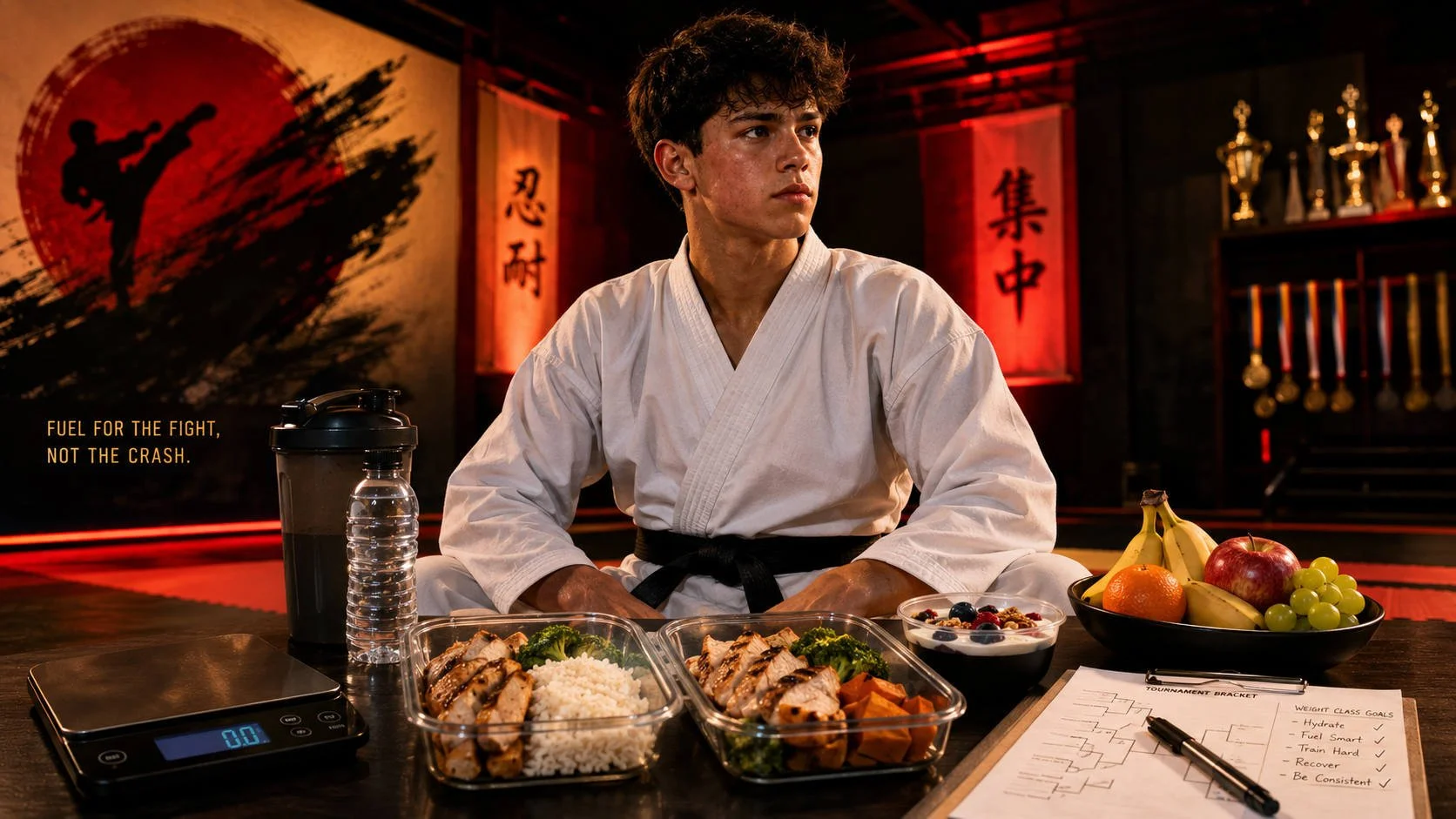
Martial arts culture is excellent at many things: discipline, respect, footwork, humility, getting punched in the stomach by someone half your size, and giving suburban teenagers the confidence to say things like “sensei” with a straight face.
It is also, unfortunately, excellent at creating weird pressure around weight.
Weight classes exist for a reason. Nobody wants a 95-pound beginner fighting a human refrigerator named Trevor who has been “working on his low kick.” In combat sports, weight divisions are meant to make competition safer and fairer. Great. Lovely. Civilization briefly enters the dojo wearing a belt.
Then the scale becomes a little demon shrine.
A kid wants to “make weight.” A teen wants to “fight lighter.” A parent hears another parent say their child “cut three pounds” and suddenly everyone is pretending dehydration is strategy. A coach says, “You’d be better at the lower class,” and now lunch has become a suspicious object. Congratulations. The sport that was supposed to teach discipline has accidentally introduced a child to nutritional paranoia wearing shin guards.
This is the Cobra Kai weight-class reality check: the goal is not to starve, sweat, or suffer your way into a lower division. The goal is to train well, recover well, grow if you are still growing, compete at a realistic weight, and not turn food into the villain. Netflix’s final Cobra Kai season centers on the Sekai Taikai world tournament, but real martial arts students do not need television-drama energy around weigh-ins. They need steady habits, sensible meals, and adults who do not act like the scale is a sacred scoreboard.
Weight-Class Sports Make Food Weird Fast
Combat sports are weight-sensitive because size can matter. In grappling-heavy sports like wrestling, judo, and BJJ, body mass can affect leverage, pressure, and control. In striking sports like karate, taekwondo, boxing, and kickboxing, reach, speed, power, and weight divisions all create competitive incentives. This is not imaginary. The problem is when a useful competition structure becomes an excuse for bad food behavior with a motivational quote taped to it.
The American Academy of Pediatrics warns that weight pressure starts young and that athletes in weight-sensitive sports sometimes use extreme methods to lose or gain weight, which can cause serious health problems. The AAP specifically flags fasting, restricting fluids, laxatives, diuretics, stimulant medications, excessive sweating, sauna use, and vomiting as warning-sign behaviors.
So no, “just sweat it out” is not a plan. It is dehydration cosplay. It is the nutritional equivalent of duct-taping a check-engine light and calling the car fixed.
The Cobra Kai Problem: Toughness Gets Confused With Underfueling
Martial arts loves toughness. Fair. You need some. Sparring is not pickleball with pajamas.
But toughness is not skipping breakfast before two hours of kicking drills. Toughness is not training dizzy. Toughness is not refusing water because the weigh-in is tomorrow. Toughness is not a 13-year-old eating half a rice cake and pretending that is “discipline.” That is not discipline. That is an eating disorder’s intern orientation.
Rapid weight loss is common in young combat athletes, with research reporting prevalence ranges from 25% to 80% in youth combat sport athletes and even higher in some older groups. Reported symptoms during rapid weight loss include headaches, dizziness, nausea, hot flashes, nosebleeds, fatigue, muscle pain, disorientation, and increased heart rate. So yes, the body does send feedback. It just does not use a cute push notification.
A tired, underfed athlete is not sharper. They are just easier to hit.
Crash Dieting Makes You Worse at the Thing You’re Dieting For
Crash dieting feels productive because the scale moves quickly. This is how it tricks people. The number drops, and everyone acts like the athlete has achieved enlightenment instead of mostly losing water, gut contents, and possibly the will to exist.
The National Athletic Trainers’ Association says unsafe weight management practices can compromise athletic performance and harm health, and it notes athletes often try to lose weight by not eating, cutting nutrients, engaging in unsafe weight-control behaviors, or restricting fluids because of pressure from sport, coaches, peers, or parents. NATA recommends gradual body-composition changes, no excessive restriction, sufficient energy and nutrients year-round, and private guidance from qualified professionals.
That is the boring truth. Crash dieting may help you win the weigh-in. It may also help you lose the match because your legs feel like old noodles and your brain is running on fumes and resentment.
A lower weight class is not automatically an advantage if you arrive weak, flat, irritable, dehydrated, and thinking about sandwiches mid-round.
REDs: The Fancy Name for “Your Body Is Mad Because You Didn’t Feed It”
Relative Energy Deficiency in Sport, or REDs, is what happens when an athlete does not have enough energy available for both training and normal body function. The IOC defines REDs as negative health and performance outcomes caused by low energy availability, which means inadequate energy intake relative to exercise expenditure. The 2023 IOC consensus also notes that low carbohydrate availability, mental health, and effects in male athletes are increasingly recognized parts of the REDs picture.
Translation: if the body does not get enough fuel, it starts cutting services.
Not “Netflix subscription” services. Important services. Recovery. Hormones. Bone health. Immune function. Mood. Training adaptation. Growth in young athletes. The body becomes a tiny exhausted city shutting off streetlights because the mayor tried to run a marathon on lettuce.
For parents, signs to take seriously include repeated fatigue, dizziness, irritability, obsession with weight, skipping meals, injuries that linger, stress fractures, menstrual changes, poor sleep, declining performance, fear of eating around weigh-ins, or a child suddenly talking about food like it is an enemy combatant.
Kids and Teens Should Not Be Cutting Like Pros
Adult professional fighters sometimes manipulate weight with medical teams, dietitians, long planning periods, and still plenty of risk. A middle-school karate student is not a UFC fighter. They are a growing human who may still leave wet towels in the hallway and believe cereal is a food group. The standards are different because the stakes are different.
The AAP says gradual weight loss is best for young athletes, recommending no more than 1.5% of total body weight or 1 to 2 pounds per week, and says parents should talk with a pediatrician to determine whether weight loss is even appropriate. It also states that, except in sports requiring mandatory weigh-ins, a child’s coach should not be discussing weight or weight loss.
Let that last sentence walk around the dojo with a megaphone.
If your child’s coach is casually prescribing weight loss, body comments, sweat cuts, or “just don’t eat after lunch” strategies, that is not elite coaching. That is a red flag wearing a black belt.
The Steady Food Rule: Eat for Training First
For martial arts students, the first job of food is to support training. Not aesthetics. Not the fantasy of being “leaner.” Not the sacred Instagram jawline. Training.
The Academy of Nutrition and Dietetics advises young athletes to focus on carbohydrates for energy, spread protein throughout the day for growth and muscle repair, use caution with high-fat foods before competition because they slow digestion, and hydrate early and consistently. It also says water should be the go-to drink for exercise under 60 minutes, with sports drinks saved for longer or more demanding sessions.
For karate, taekwondo, judo, BJJ, MMA, wrestling, and kickboxing, that means the basic plate should not be complicated:
Carbs for fuel.
Protein for repair.
Fruits and vegetables for micronutrients.
Healthy fats for normal body function.
Fluids because dehydration is not a personality.
This is not glamorous. It will not go viral. Nobody is making a montage where Miguel dramatically eats oatmeal and a turkey sandwich while thunder cracks over the Valley. But this is the stuff that keeps athletes training consistently instead of becoming a dramatic little heap beside the heavy bag.
Martial Arts Weight Loss Food: What Actually Helps
The best “martial arts weight loss food” is not a detox tea, fat burner, or some beige powder sold by a man with veins in his forehead. It is normal food arranged consistently enough that the body trusts you.
A training meal should usually include a carbohydrate, a protein, and color.
Good examples:
Rice bowl with chicken, eggs, tofu, beans, or beef plus vegetables.
Turkey or tuna sandwich with fruit and yogurt.
Oatmeal with milk, banana, and nut butter.
Eggs with toast and fruit.
Noodles with lean protein and vegetables.
Greek yogurt with granola and berries.
Bean burrito with salsa and fruit.
Salmon, potatoes, and vegetables.
Chicken stir-fry with rice.
For athletes trying to move slowly toward a healthier competition weight, the most practical changes are boring and effective: fewer liquid calories, more protein at meals, more fruits and vegetables, planned snacks instead of snack raids, consistent breakfast, and less late-night grazing after training. Revolutionary? No. Better than sweating in a trash bag like a haunted burrito? Absolutely.
Before Practice: Do Not Show Up Empty
A martial arts class can include warmups, footwork, pads, sparring, drills, sprawls, throws, conditioning, and the occasional sensei who believes burpees build character because apparently character hates everyone.
Do not show up empty.
If practice is two to three hours away, eat a normal meal: rice and chicken, pasta with meat sauce, sandwich and fruit, eggs and toast, or a burrito bowl. If practice is 30 to 90 minutes away, choose a lighter snack: banana, granola bar, toast, applesauce pouch, yogurt, crackers, pretzels, or a small smoothie.
High-fat foods right before training are not ideal because they slow digestion. That means fries, pizza, burgers, heavy cream sauces, and giant pastries are better left for after training or non-training windows. The Academy of Nutrition and Dietetics specifically warns that greasy, fried, high-fat foods can leave young athletes feeling tired and sluggish before competition.
Translation: the pre-practice cheeseburger is not “fuel.” It is a stomach anchor with sesame seeds.
After Practice: Recover Like You Want to Improve
Training breaks the body down. Recovery builds it back up. This is apparently hard to remember because the post-practice instinct is often either “eat nothing because I’m trying to lose weight” or “eat everything in the kitchen while standing up like a raccoon with a belt rank.”
After training, aim for carbs plus protein within a reasonable window. This helps restore energy and support muscle repair.
Good post-training options:
Chocolate milk and a banana.
Rice and eggs.
Chicken wrap.
Greek yogurt and granola.
Smoothie with fruit and yogurt.
Turkey sandwich.
Tuna rice bowl.
Leftovers with rice or potatoes.
Tofu stir-fry.
This is especially important for kids and teens, because they are not just recovering from training. They are also growing bones, organs, muscles, hormones, and the ability to remember where they put their mouthguard. Their energy needs are not optional background music.
Tournament Week: Keep It Boring, Please
Tournament week is not the time to reinvent food. It is not the time to go low-carb because someone on the internet said glycogen is “water weight.” It is not the time to try a new supplement called Shred Dragon Elite because a guy at open mat said it made him “feel dry.” Nobody should want to feel dry unless they are laundry.
For most martial arts students, tournament week should look like normal training food, slightly cleaner and more predictable:
Regular meals.
Carbs at meals.
Protein spread through the day.
Plenty of fluids.
Moderate fiber close to competition if the stomach gets nervous.
No new foods before competition.
No dehydration tricks.
No skipping dinner.
No panic weigh-ins every 17 minutes.
The NATA position statement says body-composition data should be handled like confidential medical information and that dietary needs should be discussed privately with trained nutrition and weight-management experts. It also says coaches, peers, and family members should not be the ones providing weight-management advice or participating in body-composition monitoring.
In plain dojo English: stop making the team scale a public altar.
Tournament Day: Eat to Fight, Not to Impress the Scale
If weigh-ins are same-day or close to competition, crash dieting becomes even more ridiculous because there is little time to refuel. You are not gaming the system. You are entering the ring with less gas in the tank and calling it strategy because your coach owns a sauna.
A tournament-day plan should be familiar and digestible.
Three to four hours before competing:
Bagel with eggs.
Oatmeal with fruit and milk.
Rice bowl with chicken.
Turkey sandwich and fruit.
Pancakes with yogurt if tolerated.
One to two hours before:
Banana.
Granola bar.
Applesauce.
Pretzels.
Toast with honey.
Small smoothie.
Between matches:
Water.
Sports drink if the day is long or sweat-heavy.
Fruit.
Pretzels.
Crackers.
Half sandwich if there is a long break.
After competing:
Full meal with carbs, protein, fluids, and something enjoyable because martial arts should not turn children into solemn broccoli monks.
If You’re Close to a Weight Class, Ask Three Questions
Before anyone talks about “making weight,” ask:
Can the athlete compete safely at their natural weight?
Is the lower class worth any trade-off in energy, mood, recovery, growth, and performance?
Is this plan being guided by a qualified medical or nutrition professional?
If the answer to number three is “Coach Dave says he did it in college,” close the meeting. Coach Dave also thinks knee pain is weakness and owns five shaker bottles that smell like abandoned yogurt.
For young athletes, AAP guidance is clear: weight changes should be gradual, medically appropriate, and discussed with a pediatrician when significant loss is desired.
For adults, a slow approach still wins most of the time: modest calorie deficit, sufficient protein, enough carbs to train, strength work, sleep, hydration, and tracking trends rather than scale tantrums. If you need to lose more than a small amount, plan months ahead, not Thursday night with a hoodie and bad ideas.
The “Do Not Do This” List
Do not cut water.
Do not use saunas or sweat suits to make weight.
Do not spit into a bottle like a tragic cowboy.
Do not use laxatives, diuretics, stimulants, or vomiting.
Do not skip meals all day and then binge at night.
Do not weigh a child publicly.
Do not praise kids for “looking lean.”
Do not make body comments disguised as coaching.
Do not reward under-eating as toughness.
Do not punish hunger.
Do not let the scale overrule performance.
AAP and youth combat-sport research both flag dehydration, fluid restriction, sauna use, vomiting, laxatives, diuretics, and excessive sweating as unsafe or concerning weight-loss methods, especially for growing athletes.
The scale does not care whether your kidneys are annoyed. Your body does.
The Parent’s Job: Protect the Kid From the Weird Adults
Parents are not supposed to become food police. That creates its own little disaster franchise. The parent’s job is to create structure, protect health, and keep the adult nonsense out of the child’s lunchbox.
That means:
Keep regular meals at home.
Pack tournament food.
Ask the coach what the weigh-in policy is.
Ask whether the school encourages cutting weight.
Refuse unsafe tactics.
Watch mood, energy, growth, and performance.
Call the pediatrician if weight loss becomes a focus.
Get a sports dietitian involved if competition weight becomes complicated.
If your child starts saying things like “I can’t eat carbs,” “I need to be lighter,” “I feel guilty eating,” “I’ll just skip dinner,” or “I need to sweat this out,” do not applaud the discipline. Investigate the pressure.
The AAP specifically says young athletes in weight-sensitive sports may put their bodies through extremes to change weight, and that those methods can actually hurt performance and increase injury or medical complications.
The Coach’s Job: Coach Skills, Not Lunch Shame
A good martial arts coach teaches timing, balance, defense, distance, composure, and respect. A bad one turns every body into a project.
Coaches should not casually prescribe diets, comment on bodies, tell kids to skip meals, or romanticize cuts. If weight categories matter, the process should be private, medically informed, age-appropriate, and boring enough that no one makes a TikTok about it.
The best dojos make food boring in the healthiest way: eat enough, hydrate, train hard, sleep, recover, compete where your body belongs, and improve your skills because technique is still legal, apparently.
A lower weight class does not check a kick. A dehydrated athlete does not magically sprawl better. A hungry teenager does not gain wisdom. They gain crankiness and a worse gas tank.
A Simple Training-Day Meal Template
Here is the non-crazy version.
Breakfast:
Oatmeal with fruit and milk.
Or eggs, toast, and fruit.
Or yogurt, granola, and berries.
Lunch:
Rice bowl, wrap, sandwich, or leftovers with protein and vegetables.
Pre-practice snack:
Banana, granola bar, crackers, yogurt, toast, or smoothie.
Dinner after practice:
Carbs plus protein plus vegetables.
Snack if still hungry:
Milk, yogurt, fruit, peanut butter toast, cereal, cottage cheese, or leftovers.
This is not a diet cult. This is eating like a person who plans to train again tomorrow.
The Best Weight Class Is the One You Can Train In
The best weight class is not always the lowest one. It is the one where the athlete can train consistently, recover well, feel mentally stable, stay hydrated, grow normally if they are young, and compete with actual energy instead of performing karate on emergency battery mode.
The Cobra Kai universe thrives on rivalry, pressure, tournaments, drama, and teenagers making decisions that require adult supervision with a fire extinguisher. Real martial arts should be better than that.
Eat for training.
Manage weight slowly, if it is appropriate at all.
Keep kids out of weight-cut culture.
Use qualified professionals, not locker-room folklore.
Treat food as fuel, recovery, culture, family, and normal life—not as a moral test with a side of steamed sadness.
Because the goal is not to win the weigh-in.
The goal is to step onto the mat strong, focused, hydrated, and ready.
Very radical. Very old-school. Almost like discipline means doing the sensible thing repeatedly instead of suffering theatrically for a number on a scale.