The “McDonald’s After the Game” Recovery Meal Reality Check
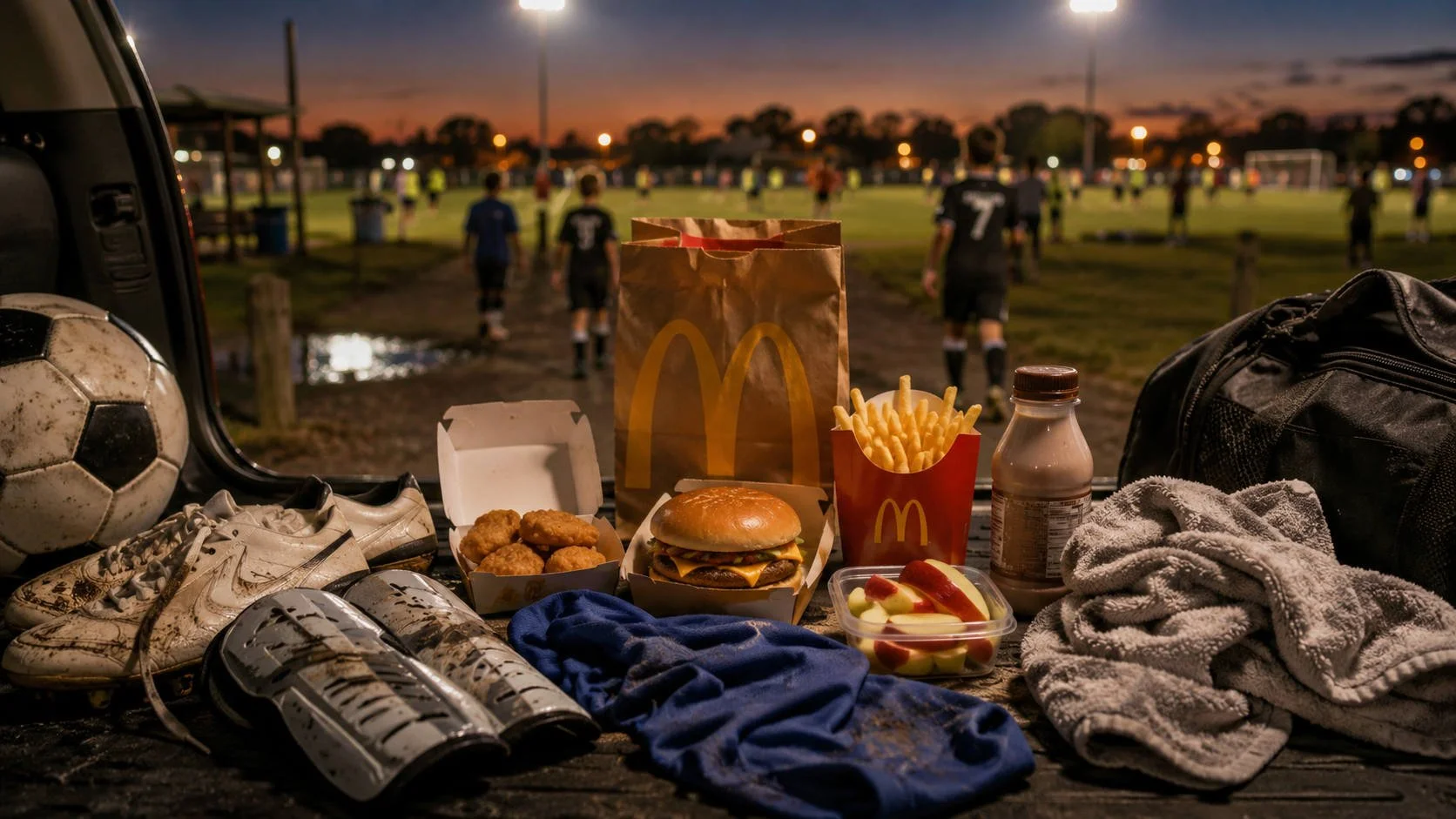
There is a sacred sports tradition older than compression sleeves and more powerful than any halftime speech: the whole team going to McDonald’s after the game. Win? McDonald’s. Lose? McDonald’s. Tournament ended in a tie because bracket logic was invented by goblins? McDonald’s. Someone’s parent says, “We’ll just stop somewhere quick,” and suddenly twelve sweaty athletes are in line ordering like they have just survived a shipwreck.
And honestly? Fine.
McDonald’s after the game is not a moral collapse. It is not a nutritional felony. It is also not a magical recovery center staffed by golden-arched sports dietitians. It is fast food. It can give you calories, carbohydrates, protein, salt, fluids, and morale. It can also give you a 1,170-calorie combo meal, a soda the size of a traffic cone, and the kind of post-game food coma normally associated with Thanksgiving and poor planning. McDonald’s lists a Big Mac Meal at 1,170 calories with 30 grams of protein and 158 grams of carbohydrates, which is either a recovery meal or a nap application, depending on the athlete and the situation.
So this is the reality check: McDonald’s can work after a game or workout if you order like someone who understands the assignment. The assignment is not “punish yourself with lettuce” and it is not “consume fries until your cleats become decorative.” The assignment is carbs, protein, fluids, and enough common sense to avoid turning recovery into a deep-fried group project.
What Recovery Actually Wants, Before the Drive-Thru Gets Involved
After a hard game or workout, the body is not asking for purity. It is asking for basics. Carbohydrates help replenish glycogen, protein helps repair and rebuild muscle, and fluids help replace what got sweated out while everyone pretended yelling “mark up!” counted as strategy. EatRight says that after a workout or competition, athletes should focus on getting carbs and protein into the body, and it recommends trying to eat within about an hour after an intense workout.
This is why the post-game McDonald’s stop is not automatically ridiculous. A burger has protein and carbs. Fries have carbs and sodium. Milk has fluid and protein. Apple slices exist, quietly, like the one responsible cousin at the family reunion. The problem is not that McDonald’s has nothing useful. The problem is that the useful parts are sitting next to shakes, giant combos, extra sauces, and soda refills, because fast food menus are basically decision fatigue with cheese.
The goal is not to make McDonald’s “healthy,” a word so abused it should be placed in witness protection. The goal is to make the meal functional.
McDonald’s After Workout: The Good, the Bad, and the Very Sauce-Dependent
The good news: McDonald’s has convenient protein. A regular hamburger has 250 calories, 12 grams of protein, and 30 grams of carbs. A cheeseburger has 300 calories, 15 grams of protein, and 31 grams of carbs. A McDouble has 390 calories, 22 grams of protein, and 32 grams of carbs. That is not elite dining, but it is not nutritionally empty either, despite what the guy drinking chalky protein sludge from a shaker bottle might say while chewing air.
The better news: the menu gives you portion choices. You can order one sandwich, not a meal. You can get small fries instead of medium. You can choose milk or water instead of soda. You can add apple slices. McDonald’s lists small fries at 230 calories with 31 grams of carbs, medium fries at 320 calories, and apple slices at 15 calories with 4 grams of carbs, which means the side choices range from “useful carb refill” to “tiny fruit gesture, but at least it tried.”
The bad news: the menu is extremely good at making small decisions multiply like rabbits in a parking lot. A sauce here, a shake there, a “make it a meal” because the cashier asked in a tone that felt legally binding. Suddenly the post-game recovery meal has become a calorie parade wearing ketchup.
The Big Mac Reality Check
A Big Mac is not evil. It is a sandwich, not a curse from a Scottish play. McDonald’s lists the Big Mac at 580 calories, 25 grams of protein, 45 grams of carbs, and 34 grams of fat. That means it does bring protein and carbs, but it also brings more fat than some simpler burger options, which may or may not be what an athlete wants right after a hard effort.
Compare that with a Quarter Pounder with Cheese: 520 calories, 30 grams of protein, 42 grams of carbs, and 26 grams of fat. In plain English, the Quarter Pounder gives more protein with fewer calories and less fat than the Big Mac. Horrifying development: the less theatrical burger may be the better post-game choice.
This does not mean nobody should ever order a Big Mac. Sometimes the team tradition is the team tradition, and denying yourself the thing you actually want can lead to eating three “better” things and then still wanting the Big Mac, which is how adults accidentally invent buffet psychology. But if the question is “which burger does a better recovery job?” the Quarter Pounder or McDouble often makes more sense.
The McDouble Is the Little Recovery Workhorse Nobody Respects
The McDouble is not glamorous. It does not have a jingle. It does not appear in post-game photos looking proud next to a trophy. But as a practical McDonald’s after workout order, it is weirdly useful.
At 390 calories with 22 grams of protein and 32 grams of carbohydrates, it gives a decent protein hit without requiring the athlete to eat a burger the size of a couch cushion. Add small fries and water, and you get a meal with protein, carbs, salt, and fluid. Add apple slices or milk if the athlete needs more. Is this a perfect sports nutrition plate? No. It is McDonald’s, not an Olympic dining hall with a quinoa sommelier. But it is coherent.
The McDouble is especially useful for athletes who are hungry but not “I could eat the goal net” hungry. Younger athletes, smaller athletes, or adults doing a normal gym session do not always need the full combo-meal landslide.
The Nuggets Question: Recovery or Shared Table Chaos?
Chicken McNuggets occupy a strange post-game role. They are easy to share, easy to count, easy to dip, and easy to accidentally eat in numbers normally reserved for lottery picks. McDonald’s lists a 4-piece Chicken McNuggets order at 170 calories, 9 grams of protein, 10 grams of carbs, and 10 grams of fat, while a 10-piece has 410 calories.
Nuggets can be useful as part of a meal, but they are not a complete recovery plan unless you add carbs and fluids. Nuggets plus small fries plus milk is a more complete setup than nuggets alone. Nuggets plus two sauces and a soda is also a meal, technically, in the same way a folding chair is technically furniture.
Watch the sauce trap. Sweet ’N Sour sauce adds 50 calories and 11 grams of carbs per packet, Honey Mustard adds 60 calories, and Creamy Chili sauce adds 110 calories, because apparently condiments have been bulking.
One sauce? Fine. Three sauces? You are no longer dipping nuggets. You are hosting a condiment conference.
Chocolate Milk Is Not the Same Thing as a Chocolate Shake, Professor Dessert
Chocolate milk has a reputation as a convenient recovery drink because it combines fluid, carbs, and protein. EatRight includes low-fat chocolate milk among post-workout options, noting that liquid choices can help with rehydration while also providing carbs and protein.
McDonald’s reduced-sugar low-fat chocolate milk jug has 130 calories, 9 grams of protein, and 18 grams of carbs. That is a sensible post-game add-on. A small McDonald’s chocolate shake has 520 calories, 12 grams of protein, and 85 grams of carbs. That is not “basically chocolate milk.” That is dessert wearing a fake mustache and trying to sneak into the recovery meeting.
Can an athlete have the shake? Of course. Life is short and sports are full of emotional damage. But call it what it is: a treat. If the goal is recovery without a sugar-and-calorie avalanche, the chocolate milk jug is the grown-up in the room.
The Soda Problem: Fast Carbs, Zero Protein, Maximum Chaos
A soda after a hard game can provide quick carbs and fluid, but it does not bring protein, and it can turn a reasonable meal into a sugar-heavy one fast. This is not a sermon. It is arithmetic with bubbles.
If the athlete already has a burger and fries, water or milk often makes more sense than soda. If the athlete played a long, hot tournament game, sweated like a sprinkler, and needs quick carbs, a sports drink or soda may be situationally useful, but it still does not replace the protein-and-food part. The recovery plan is not “large Coke and vibes.” That is just hydration cosplay.
For most after-game stops, use this boring but effective rule: water first, milk if useful, soda if intentional. Not soda because it came with the combo and apparently the cup was assigned by destiny.
The “Small Add-On” Strategy That Saves the Meal
The best McDonald’s after-game order is often not about finding the perfect entrée. It is about fixing the meal’s weak spot.
If the order is mostly protein and fat, add carbs. Example: nuggets plus small fries or apple slices.
If the order is mostly carbs, add protein. Example: fries plus milk, or a cheeseburger instead of fries alone.
If the order is huge, reduce the side. Example: Quarter Pounder with apple slices and water instead of a full medium fries-and-soda combo.
If the athlete is still hungry, add milk before adding another fried item. McDonald’s 1% Low Fat Milk Jug has 100 calories and is described as a low-fat milk option with calcium and vitamins A and D. It is less exciting than fries, yes, but so is most good decision-making.
The magic is not in ordering the “healthiest” thing. The magic is in adding what is missing without turning the meal into a tray-based avalanche.
Good McDonald’s After-Game Orders for Real People
For a lighter post-game meal, a cheeseburger, apple slices, and milk gives protein, carbs, fluid, and a little fruit without requiring a nap in the backseat. The cheeseburger alone has 300 calories and 15 grams of protein; apple slices add 15 calories; the 1% milk jug adds 100 calories.
For a more substantial athlete, a McDouble with small fries and water is a practical classic. The McDouble brings 390 calories and 22 grams of protein, while small fries add 230 calories and 31 grams of carbs. This is the kind of order that says, “I played hard,” not “I have made the drive-thru my legal guardian.”
For a bigger recovery meal, a Quarter Pounder with Cheese, small fries, and water or milk is more protein-forward than a Big Mac meal and less chaotic than accidentally ordering the whole menu. The Quarter Pounder with Cheese has 520 calories and 30 grams of protein, while small fries add 230 calories.
For a younger athlete, the 4-piece or 6-piece McNuggets Happy Meal with milk and apple slices is at least portion-controlled by design. McDonald’s lists the 4-piece McNuggets Happy Meal with kids’ fries, 1% milk, and apple slices at 395 calories, and the 6-piece version at 475 calories.
The Orders That Pretend to Recover You While Quietly Body-Slamming Your Evening
The full Big Mac Meal has recovery ingredients in the same way a couch has wood: technically, somewhere in there, sure. But at 1,170 calories with 30 grams of protein and 158 grams of carbs, it may be more than many people need after a normal game or workout. It might fit a large, highly active athlete after a hard day. It might also be three hours of sluggishness in a paper bag.
The Quarter Pounder with Cheese Meal is similar: McDonald’s lists it at 1,110 calories with 35 grams of protein and 155 grams of carbs. Again, that may be reasonable for some hungry athletes after a long, intense effort, but it is not automatically the “smart” choice just because there is protein hiding in the burger like a responsible adult trapped at a bachelor party.
The Daily Double Meal Deal is another example of menu math getting rowdy: Daily Double, 4-piece nuggets, small fries, and a small Coca-Cola add up to 1,090 calories before sauces, and McDonald’s notes sauces add 30 to 110 calories each. That is not a snack. That is a committee.
After a Light Workout, You May Not Need the Full Golden-Arches Banquet
Not every workout earns a combo meal. Sorry. Brutal news for the elliptical community.
If the workout was short, light, or mostly skill-based, the body may not need a huge recovery meal. A smaller order or regular dinner at home may be enough. EatRight’s recovery advice emphasizes carbs and protein after intense workouts, which is different from saying every 35-minute lift requires a ceremonial Quarter Pounder and fries.
For general readers searching “McDonald’s after workout,” this distinction matters. A hard soccer game, long run, tournament day, heavy training session, or two-a-day practice changes the equation. A casual gym session followed by “I deserve a shake because I saw a dumbbell” is a different equation entirely, and the calculator is laughing.
Parents: You Are Allowed to Be Practical Without Being a Food Cop
For parents, the post-game McDonald’s trip is often about more than food. It is team bonding. It is convenience. It is a reward. It is also sometimes the only thing standing between your child and a complete hunger-based personality collapse.
Do not turn the drive-thru into a courtroom. You do not need to cross-examine a 12-year-old about macros while they are still wearing shin guards. But you can set guardrails.
Try: sandwich plus water or milk. Nuggets plus apple slices. Small fries instead of medium. One sauce. No giant shake unless it is clearly dessert. Eat the meal, drink something, then have a better dinner or breakfast later. This is parenting, not hostage negotiation with barbecue sauce.
UChicago Medicine’s guidance for young athletes emphasizes hydration, carbohydrate-rich meals before activity, and protein after games for repair; that is the useful framework, not “never let a child eat fries or they will forget algebra.”
Adults: Stop Using “Recovery” as a Coupon for Overeating
Adults are worse than kids because adults know the vocabulary. We say “I need recovery carbs” while ordering fries, a shake, and a McFlurry with the solemnity of a person rehabbing for the Olympics. Then the workout was 42 minutes of moderate effort and one set of curls performed near a mirror for emotional reasons.
McDonald’s after workout can be fine. But be honest about the workout and the meal. If you are trying to lose weight, a full combo may erase the calorie deficit you thought you created. If you are training hard and struggling to eat enough, McDonald’s may be an easy way to get calories in. Context matters. Annoying, yes. But true.
Use the menu like a tool. Not a confession booth. Not a reward vault. Not a place where every side dish is automatically justified because your smartwatch congratulated you.
The Real McDonald’s Recovery Rule
Here is the rule:
Order protein. Add carbs. Choose fluids. Control the extras.
Protein: burger, nuggets, McCrispy, milk, or another protein-containing item.
Carbs: bun, fries, apple slices, milk, or, if needed, a drink.
Fluids: water first, milk when useful, sports drink or soda only when intentional.
Extras: sauces, shakes, large fries, desserts, and giant combos are where the meal either stays practical or becomes a tray-sized ambush.
Also remember that McDonald’s menu values vary by serving size, preparation, region, and product changes; McDonald’s says its nutrition information is based on standard formulations and average values, and that variation should be expected. So use the nutrition calculator or app if precision matters, because nothing says “post-game fun” like doing math in a parking lot while someone asks for extra ketchup.
McDonald’s Is Not the Villain, and It Is Not the Coach
The McDonald’s after-the-game tradition is not going away, and honestly, it does not need to. Teams bond over food. Parents need convenient options. Athletes get hungry. Sometimes the nearest realistic recovery meal is under golden arches, next to a highway, with one parent yelling “Who ordered the nuggets?” into a bag.
The mistake is pretending McDonald’s is either poison or performance cuisine. It is neither. It is a fast-food menu with some useful recovery pieces and some spectacular ways to overdo it.
A smart McDonald’s after workout meal gives you protein, carbohydrates, fluids, and maybe a little fruit, while keeping the extras under control. A chaotic one gives you a massive combo, three sauces, a shake, and the false belief that “post-game” means calories have entered a legal gray area.
So go after the game. Eat with the team. Enjoy the fries if you want them. Just build the order like someone who plans to feel human later.
Because recovery is not about being perfect. It is about giving your body what it needs without letting a drive-thru speaker talk you into a full edible parade.