The Hunger Games Is Still the Best Movie Franchise About Starving the Poor for Entertainment
Hollywood loves inequality the way a cat loves a cardboard box: constantly, stupidly, and with no real plan once it gets inside. Every few years, a prestige drama or dystopian franchise discovers that rich people have too much and poor people have too little, then presents this revelation like it personally invented poverty between lunch and a notes meeting.
And yet, somehow, The Hunger Games still does it better.
Not because it is subtle. It is not subtle. Panem is about as subtle as a guillotine at brunch. The country is literally named after panem et circenses, the Latin phrase meaning “bread and circuses,” or food and entertainment used to pacify public discontent. Merriam-Webster defines it as sustenance and entertainment provided by government to appease the public, which is basically the Capitol’s entire LinkedIn bio.
That is the genius. The Hunger Games does not tuck food inequality into the background like a sad garnish. It puts hunger in the title, shoves bread into the plot, turns feasting into propaganda, and makes child murder a televised content strategy. Finally, a franchise brave enough to ask: what if inequality was sponsored, broadcast in HD, and catered?
Panem Is a Food System With a Murder Arena Attached
The basic setup remains brutally efficient. Panem is a future society made of a wealthy Capitol and twelve impoverished districts. Katniss Everdeen lives in District 12, the poorest district, and the Capitol keeps the districts obedient by forcing each one to send a boy and girl to fight to the death on live television. Scholastic describes the series as a story about survival, sacrifice, government control, media, power, and resistance, because apparently “state-sponsored teen slaughter pageant” needed a few discussion-guide keywords.
The food inequality is not decorative. It is structural. District 12 mines coal and starves. District 11 grows food and starves. The Capitol does nothing useful and eats like the buffet has diplomatic immunity.
That is how Panem works: the districts produce, the Capitol consumes, and everyone is told this is peace. A normal dystopia gives you surveillance cameras. Panem gives you surveillance cameras, a hunger economy, and a televised bloodsport where the poor compete for survival while the rich discuss outfits.
Very efficient. Deeply evil. Horribly on brand.
The Hunger Games Understands Hunger as Control
The franchise’s smartest idea is that hunger is not just a condition. It is a leash.
Katniss does not become interesting because she is “strong female protagonist,” that phrase Hollywood keeps flattening until it sounds like a protein bar. She becomes interesting because she knows food at the bone level. She hunts because her family needs to eat. She trades in the black market because the official economy is a joke wearing boots. She volunteers for Prim because in Panem, childhood is just unpaid risk management.
The book’s tesserae system makes this even clearer: poorer kids can take extra food rations in exchange for entering their names more times in the reaping. The movies streamline some of this, because blockbuster pacing has apparently declared war on explaining policy, but the underlying point survives. Hunger makes the poor gamble with their children.
That is not just villainy. That is administrative villainy. The worst kind. The kind with paperwork.
Bread Is Not a Symbol. It Is a Weapon With Yeast.
Peeta Mellark being the baker’s son is one of those details that sounds almost too obvious until you realize obvious is exactly the point. The boy associated with bread becomes the emotional center of a story about hunger. Subtle? No. Effective? Annoyingly.
Bread in The Hunger Games is food, charity, memory, debt, class marker, and political message. When Peeta gives Katniss bread before the Games, it is not just a cute sad-boy bakery moment. It is survival. It is the difference between continuing and collapsing. It is also the kind of act Panem cannot tolerate, because authoritarian systems hate unsanctioned kindness almost as much as they hate teenagers with archery skills.
The Capitol wants food to flow downward only as spectacle or reward. You get bread if you obey. You get food if your district wins. You get a feast in the arena if the Gamemakers need everyone to kill each other in one convenient location.
Panem does not feed people. It manages access to food. There is a difference, and it is the difference between dinner and dictatorship.
The Capitol Feast Scenes Are the Franchise Saying, “Yes, This Is Disgusting”
The Capitol’s food culture is intentionally repulsive. The citizens are not just well-fed. They are theatrically stuffed. They live in a world of banquets, stylists, parties, and tiny edible luxuries while the districts scrape by. It is wealth inequality rendered as frosting.
The Catching Fire party scene is still one of the franchise’s sharpest food moments: Katniss and Peeta see Capitol citizens using a drink to make themselves vomit so they can keep eating. There it is. The entire class system in one revolting little party favor.
District people risk death for grain and oil. Capitol people purge for dessert capacity.
That is not a metaphor. That is an indictment wearing eye shadow.
And before anyone says, “Well, it’s exaggerated,” yes. Congratulations. You have discovered satire. The whole point is to make the moral ugliness impossible to miss, then watch everyone miss it anyway because the dresses were pretty.
The Hunger Games Makes Food Inequality Visual
A lot of stories talk about inequality. The Hunger Games shows it through plates.
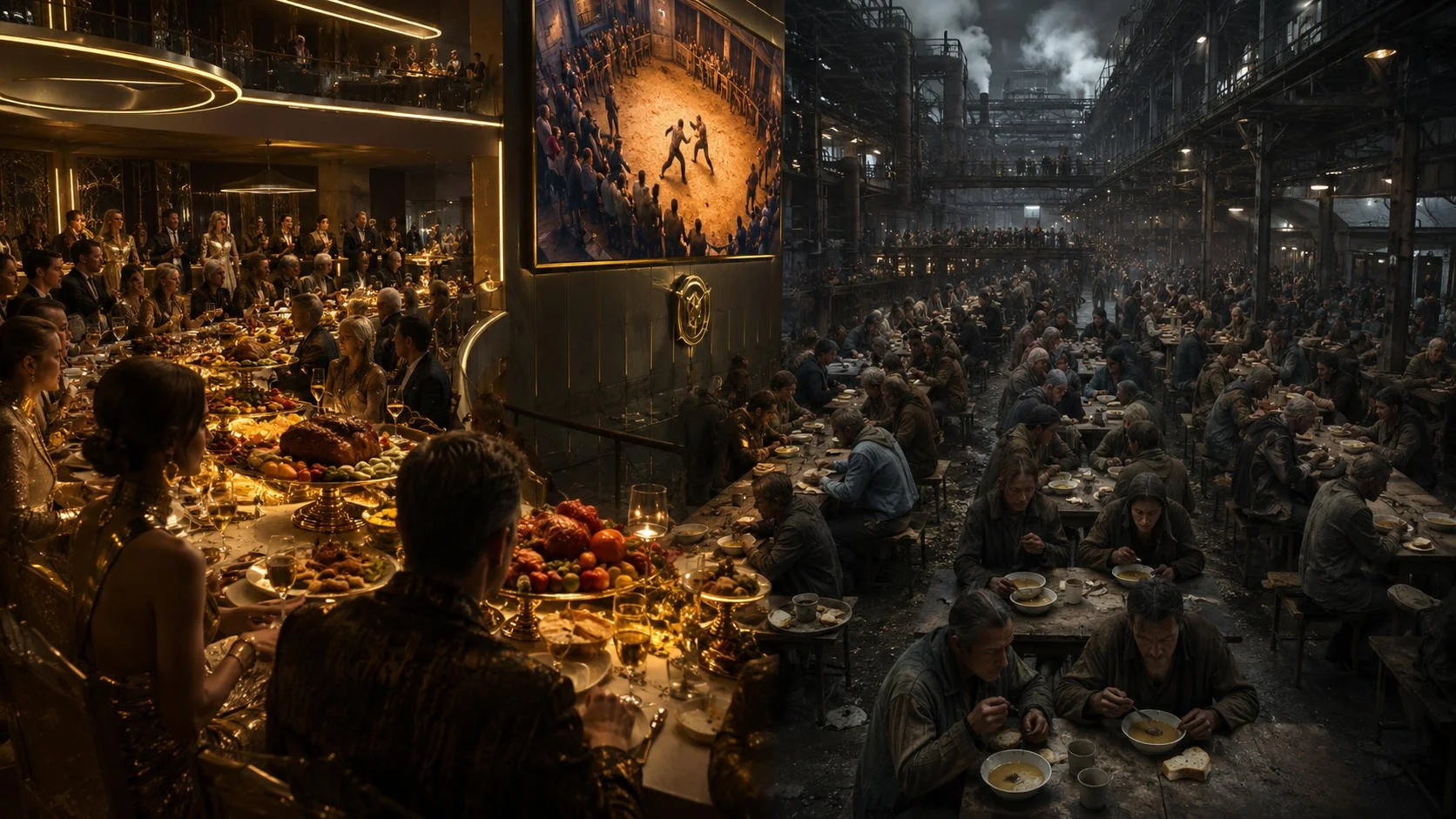
District 12 is gray, cold, hungry, underfed, and suspicious of abundance. The Capitol is colorful, excessive, manicured, and fed past the edge of sanity. The train to the Capitol is one of the first major shocks because suddenly Katniss is surrounded by food that should not exist in that quantity for two kids being shipped to their probable deaths.
This is where the franchise understands cinema. Food inequality is not just a statistic. It is sensory. It is the difference between stale bread and jeweled desserts. Empty bowls and banquet tables. Hunting illegally and wasting legally. Starvation in work clothes and gluttony in couture.
The Capitol’s wealth is not impressive. It is obscene. It has the vibe of a society that looked at suffering and said, “Can we plate this with garnish?”
The Games Are Basically a Reality Show About Resource Scarcity
Suzanne Collins has said the idea for The Hunger Games came while channel surfing between reality TV and actual war coverage, with the two blurring together in an unsettling way. In a Scholastic Q&A, she also said the trilogy deals with severe poverty, starvation, oppression, and the effects of war.
That origin matters because the Hunger Games themselves are not just violence. They are scarcity turned into content.
The arena is a controlled food environment. Water matters. Supplies matter. Sponsors matter. The Cornucopia is not just a cool central set piece; it is a death trap shaped like a warehouse. Tributes die because they need supplies, and the audience gets to call it drama instead of policy.
This is what reality competition does in its sleaziest form: manufacture deprivation, then sell people’s reactions back to the audience. Only Panem skips the pretense. No immunity necklace. No rose ceremony. Just children killing each other near a pile of backpacks while Caesar Flickerman does vibes management with blue hair.
The Poor Are Forced to Perform Gratitude for Scraps
One of the nastiest parts of Panem is that the districts are expected to be grateful for the system that starves them.
The Capitol does not merely exploit the districts. It demands ceremony. Reapings. Parades. Interviews. Victory Tours. Districts must dress up their own trauma and send it back to the Capitol with a smile, like a hostage video with better lighting.
Food works the same way. A victor’s district receives food. The winner’s family is elevated. The system creates the illusion that survival is available if someone from your district is entertaining enough to not die.
This is not generosity. It is hunger-based lottery capitalism with murder confetti.
It tells poor people: your suffering is unfortunate, but if one of your children becomes marketable in a death arena, maybe your community gets extra grain. Inspirational. Someone get this into a TED Talk immediately.
The Capitol Is Not Hungry, So It Has the Luxury of Being Stupid
The Capitol citizens are not all cartoon monsters, which makes them worse. They are mostly comfortable people trained not to think too hard. They love the Games because the Games have been packaged as tradition, punishment, spectacle, patriotism, and entertainment. Also, there are snacks.
That is the “bread and circuses” machine functioning perfectly. Feed the privileged, distract them with spectacle, and make sure the suffering class remains distant enough to be aesthetic instead of alarming.
The Capitol citizens can cry over a tribute’s interview and still watch that tribute die. They can admire Katniss’s dress and ignore her hunger. They can turn Peeta and Katniss into a romance brand while the regime turns both into disposable bodies.
This is not because they lack information. It is because they have insulation. A full stomach is excellent soundproofing.
Real-World Hunger Makes Panem Less Fictional Than It Should Be
Here is where the satire gets rude enough to leave the page.
The UN’s SOFI 2025 report estimated that about 673 million people experienced hunger in 2024, or 8.2% of the global population. The same report found hunger remained above pre-pandemic levels and continued rising in much of Africa and western Asia.
In the United States, USDA data showed 13.7% of households, about 18.3 million households, were food insecure at some point in 2024. Among households with children, the rate was 18.4%. USDA also estimated that 47.9 million people lived in food-insecure households in 2024.
So yes, The Hunger Games is dystopian. But its central premise—some people waste food while others are structurally denied it—is not exactly science fiction. It is Tuesday with worse costumes.
The Capitol’s crime is not that food exists. Food should exist. Food is good. Shocking development, alert the think tanks. The crime is distribution: abundance for the insulated, insecurity for the useful, spectacle for everyone.
The Franchise Works Because It Refuses to Make Hunger Inspirational
A lesser franchise would turn hunger into motivational wallpaper. Poor but noble. Starving but spiritually rich. Thin but photogenic. Very awards-season. Very “poverty has taught us what really matters,” said from a production trailer with catered sushi.
The Hunger Games mostly avoids that nonsense. Hunger in Panem is ugly. It makes people desperate. It divides neighbors. It forces children into risk calculations. It makes Katniss practical, suspicious, and emotionally armored. It does not make her pure. It makes her alive.
That matters. Food inequality does not create charming hardship. It creates fear. It creates exhaustion. It creates resentment. It creates black markets, compromises, shame, and impossible choices. Panem understands that scarcity is not a character-building workshop. It is a political weapon.
Even the Franchise’s Success Is Bitterly Funny
There is something bleakly perfect about The Hunger Games becoming a massive entertainment franchise about a society that turns suffering into entertainment. The movies have grossed billions globally; Lionsgate described Sunrise on the Reaping as the sixth installment in a $3.3 billion box-office franchise, scheduled for release worldwide on November 20, 2026.
This is not a criticism of liking the franchise. The movies are good. The books are good. Katniss is compelling. The worldbuilding works. The archery scratches a very specific “what if trauma had aim?” itch.
But it is funny in the way capitalism is always funny right before you want to walk into the sea. A story about commodified suffering became a wildly profitable media property. The anti-spectacle spectacle sold tickets. The critique of branding got branded. Panem got a marketing plan.
The Capitol would absolutely have sold Mockingjay popcorn buckets. Do not pretend otherwise.
Why It’s Still the Best Food Inequality Franchise
Other dystopias have inequality. The Hunger Games has food inequality as the operating system.
The title is hunger. The hero hunts. The love interest bakes. The poor trade risk for rations. The rich vomit to keep eating. The arena weaponizes scarcity. The government uses food as reward, punishment, pacifier, and propaganda.
That is not a theme. That is architecture.
Food is everywhere because power is everywhere. Who eats? Who works? Who wastes? Who watches? Who gets fed only after someone dies beautifully enough on television?
This is why The Hunger Games still beats every sleek streaming dystopia where rich people wear linen in bunkers and poor people live under blue lighting. Panem’s food politics are direct, visual, and mean. It does not need a 47-minute monologue about inequality. It shows a starving district, cuts to a Capitol banquet, and lets the audience sit there feeling like maybe the popcorn in their lap just filed a complaint.
The Real Villain Is Not Just Snow. It’s the Menu.
President Snow is evil, obviously. The man looks like he would poison a christening if it helped his approval ratings. But Snow is not the whole system. He is the face. The system is bigger and nastier.
The system is the reaping bowl.
The system is the ration.
The system is the Capitol feast.
The system is making the poor compete for food while the rich compete for novelty.
The system is turning hunger into entertainment and calling it order.
Snow is the villain because he understands the system and protects it. But the deeper horror is that the system has many helpers: hosts, stylists, sponsors, Peacekeepers, viewers, officials, and comfortable people who would rather talk about dresses than deprivation.
Which, regrettably, is not the least realistic thing ever filmed.
The Hunger Games Is About Food, But Also About Who Gets to Be Human
Food inequality in The Hunger Games is not only about calories. It is about dignity.
The Capitol eats for pleasure, identity, and status. The districts eat for survival. That split defines who gets to be fully human. Capitol citizens get preferences. District citizens get needs. Capitol citizens get cuisine. District citizens get rations. Capitol citizens get entertainment. District citizens become entertainment.
That is why Katniss’s defiance is so powerful. She refuses to be consumed. Not literally, although give the Capitol twenty more years and they would probably launch Tribute Tapas. She refuses to let her body, grief, love, hunger, and survival be turned neatly into state messaging.
The berries matter because they interrupt the script. The flowers for Rue matter because they interrupt the script. The bread matters because it interrupts the script. Any act of care in Panem is political because the system is designed to make care inefficient.
The Franchise Still Hits Because the Joke Is on Us
The uncomfortable thing about The Hunger Games is that the Capitol is not just “them.” It is also us when we treat suffering as content. Us when we consume inequality as aesthetic. Us when we watch crisis footage between ads for meal delivery. Us when hunger becomes a statistic so large it stops sounding like people.
The franchise’s brilliance is that it does not let viewers feel too clean. Yes, we identify with Katniss. Everyone wants to be Katniss. Nobody wants to admit they might be a Capitol extra clapping with a snack in hand.
But the whole machine depends on spectatorship. The Games need viewers. The Capitol needs people willing to enjoy the show and ignore the bodies. The franchise keeps asking the same rude question: what are you willing to watch if someone packages it well enough?
Terrible question. Excellent franchise.
Final Verdict: Panem Ate and Left No Crumbs, Because the Districts Never Got Any
The Hunger Games is still the best movie franchise about starving the poor for entertainment because it understands that food inequality is not a side effect of tyranny. It is one of tyranny’s favorite tools.
Panem feeds the Capitol, starves the districts, televises the punishment, and calls the whole thing civilization. Bread becomes debt. Feasts become propaganda. Hunger becomes discipline. Entertainment becomes sedation. The poor become performers in their own oppression, and the rich become fans with full stomachs and very stupid hair.
That is why the franchise still works. It is not just about archery, love triangles, revolution, or Jennifer Lawrence making survival look unfairly cinematic. It is about a world where food tells you exactly who matters.
And sure, that world is fictional.
Mostly.