
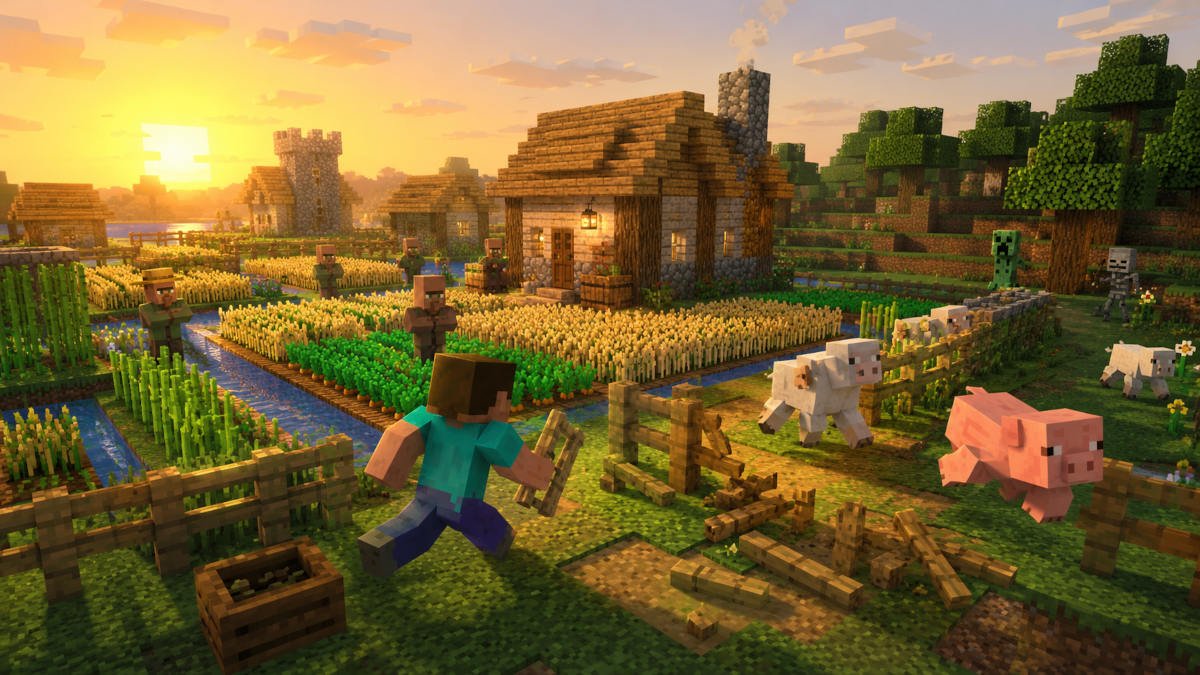
Minecraft begins the way all great civilizations begin: alone, confused, punching a tree with your bare hand like a policy analyst who has finally snapped.
Then night falls, a skeleton starts committing archery crimes from the darkness, your hunger bar begins looking suspiciously empty, and suddenly agriculture stops being a peaceful cottagecore fantasy and becomes the foundation of society. Not because wheat is beautiful. Not because carrots are spiritually healing. Because without food, you cannot sprint, heal, explore, mine, fight, or continue your brave blocky journey of digging directly downward like an idiot with a pickaxe.
This is what Minecraft farming gets weirdly right about food security. Civilization is not marble columns, stock markets, or some city councilman cutting a ribbon in front of a parking garage. Civilization is food that shows up reliably, water that does its job, fences that keep disasters from walking into the pantry, and a low-grade anxiety that says, “Maybe one loaf of bread is not enough for tomorrow.”
In other words: wheat, water, fences, and mild panic. Congratulations, we solved society. Please enjoy your dirt hut.
Minecraft Understands That Hunger Is Not a Vibe
Minecraft does not treat food like a lifestyle accessory. Food is not a brand identity. Food is not a sad desk salad photographed next to a laptop. Food is the thing standing between you and becoming a dramatic little corpse next to your unfinished cobblestone staircase.
Minecraft’s official health guide explains that the ten drumsticks next to your health bar show your hunger level; eating refills them, and once you reach nine or more drumsticks, your health begins regenerating automatically. So yes, the game’s message is subtle: eat or get humbled by a spider with legs like a furniture accident.
This is already more honest than half of modern food discourse. Minecraft does not say, “Listen to your entrepreneurial wellness journey.” It says: you are hungry, your body is worse now, fix it.
That is food security at its crudest and most useful. Food is not decoration. Food is capacity. It determines whether you can move, heal, build, fight, and keep going. Amazing. A block game understands the link between nutrition and survival better than any app trying to sell you a 400-calorie “detox bowl” that tastes like shredded lawn clippings.
The First Rule of Civilization: Make Bread Before You Become a Statistic
Minecraft farming starts with the most ancient human realization: wandering around grabbing random food is fine until the landscape stops cooperating and a zombie ruins your evening.
The official Minecraft bread page lays out the holy process of block-based civilization: till dirt near water, plant seeds, wait, harvest wheat, and craft three wheat into bread. Farming, hoes, seeds, wheat, and bread were added very early in Minecraft’s history, in February 2010, because even a game about mining diamonds and fighting exploding green nightmares knows bread comes before interior decorating.
This is the genius. Minecraft teaches food security by making farming boringly essential. You do not build a farm because you are a whimsical little dirt poet. You build a farm because tomorrow exists, and tomorrow is rude.
Foraging is beginner behavior. Farming is planning. Bread is not just food; it is a portable policy solution with crust.
Wheat Is the Starter Pack for Not Dying Like a Moron
Minecraft’s wheat system is hilariously simple and somehow profound, which is rude, frankly. The official wheat page describes the classic process: plant seeds in tilled, irrigated farmland, wait, and harvest wheat. It also notes wheat can be found in chests, taken from village farmland, crafted from hay bales, and obtained in trades.
That is food availability in one tidy little blocky loop. You need a source. You need production. You need the patience not to eat your seed stock, which is where many players and several civilizations emotionally trip over a bucket.
Minecraft quietly teaches that food security is not “having food once.” Having one apple is not food security. It is a snack with delusions of governance. Food security means you can produce again. And again. And again, until your little farm becomes boring enough to trust.
Boring is good. Boring is civilization’s favorite flavor. Exciting food systems usually involve words like “shortage,” “collapse,” “price shock,” or “why is the bread aisle empty and why is everyone suddenly interested in powdered milk?”
Water Is Infrastructure, Not Decoration
Minecraft does not let you just fling seeds into dust and demand abundance like a motivational speaker in a blazer. Crops need the right conditions. Minecraft’s official seed guide says seeds generally require farmland, irrigation with water, and access to light before they grow through stages and become harvestable.
There it is: water is not a vibe feature. It is infrastructure.
A Minecraft farm without water is just optimism arranged in rows. It looks like agriculture, but it is actually a dirt-themed disappointment. Add water and suddenly the land becomes productive. Shocking revelation: crops enjoy not being in a dehydration documentary.
This is one of the cleanest food-security lessons in the game. Production depends on resources. Land alone is not enough. Seeds alone are not enough. Labor alone is not enough. You need water, light, access, timing, and protection. Basically, farming is a group project where nature does not answer emails.
Fences Are the First Government
At some point, every Minecraft farmer learns the same humiliating lesson: if you do not build boundaries, the world will walk directly into your plans.
Minecraft’s official fence writeup says fences are extremely good at keeping areas separated; players and mobs generally cannot jump over them, which makes fences useful for keeping hostile entities out of your base and keeping animals in pens for breeding and harvesting.
That is governance, baby. Ugly little wooden sticks doing the work of laws.
A fence says: this wheat is not for you, zombie. This cow is not free-range in the emotional sense. This farm is a managed system, not an all-you-can-trample buffet for whatever nightmare spawned under a tree.
Food security is not only about growing food. It is about protecting the conditions that allow food to exist. A field that gets trampled, raided, eaten, burned, or exploded by a creeper is not a farm. It is an anecdote.
And yes, this is why civilization invented fences, walls, barns, storage, property norms, pest control, and eventually zoning meetings, which are just creepers in khakis.
Food Security Is Not “Food Exists Somewhere, Good Luck”
The real world defines food security in a way Minecraft accidentally makes playable. The World Bank, using the 1996 World Food Summit definition, says food security exists when all people, at all times, have physical and economic access to enough safe and nutritious food that meets their dietary needs and preferences for an active, healthy life. It breaks food security into four dimensions: availability, access, utilization, and stability.
Minecraft gives you a child-sized version of this, which is apparently what adults needed all along.
Availability: do you have food sources?
Access: can you actually get to them without being murdered by a skeleton?
Utilization: can you turn wheat into bread, raw food into cooked food, crops into meals, and not poison yourself like a raccoon with inventory slots?
Stability: will the food still be there tomorrow, next week, after a mining trip, or after you spent two in-game days building a roof that looks like a shoebox wearing a hat?
The game makes this obvious because if your food system fails, you feel it immediately. No committee. No white paper. No 92-page report called Strategic Nutritional Resilience Roadmap 2040. Just hunger, weakness, panic, and a chicken you are suddenly looking at very differently.
Access Matters, Because Food Behind Danger Is Not Food
In Minecraft, food existing somewhere does not mean you are food secure. A village farm 900 blocks away is not a pantry. A cow across a ravine is not dinner; it is a lawsuit with hooves. A chest full of bread inside a dungeon is not relief; it is bait with mossy cobblestone.
This is what the real world means when it talks about access. The World Food Programme explains that food access can be blocked by failed crops, unaffordable market prices, conflict, disasters, distance, and social barriers. Food can exist in the world while people still cannot reliably obtain it, because apparently “food nearby but unreachable” is humanity’s favorite cruel little design flaw.
Minecraft gets this in its primitive block-brain way. You can have crops, but if they are not near your base, protected, lit, stored, and reachable, then congratulations, you own a theory of dinner.
This is why experienced players build farms close to shelter. Not because it is cute. Because access is everything. A farm across a monster-infested field is less “self-sufficiency” and more “meal prep with ambushes.”
Surplus Is the Difference Between a Farm and a Prayer
Your first Minecraft bread feels heroic. Your fiftieth loaf feels like civilization.
That is the progression. One harvest keeps you alive. Repeated harvests create surplus. Surplus lets you explore, mine, trade, breed animals, survive mistakes, and spend too much time making your base symmetrical because the human mind is a cursed little decorator.
Food security requires stability over time, not just one good day. The World Bank says stability means people should not risk losing food access because of sudden shocks or cyclical problems such as weather, political instability, unemployment, or rising food prices.
Minecraft has a simplified version of shocks: night, mobs, travel, bad planning, falling into caves, forgetting coordinates, and the deeply respected tradition of sprinting everywhere until your hunger bar files a complaint.
Surplus is what lets you absorb stupidity. Store bread. Store potatoes. Store carrots. Store cooked meat. Store enough food that one bad expedition does not turn your base into a memorial for poor planning.
A pantry is just confidence with shelves.
Livestock Is Food Security With Legs and Terrible Judgment
Wheat is not only bread. It is also animal management, because Minecraft understands the tragic truth that if you hold food, livestock will follow you like influencers following bad advice.
Minecraft’s official wheat page says wheat attracts nearby cows, sheep, goats, and mooshrooms, and it can be used to breed those animals. Wheat is also used in bread, cake, cookies, hay bales, villager trades, and composting.
This is where Minecraft gets smarter than “grow crop, eat crop.” Wheat becomes part of a system. It feeds you directly. It helps multiply livestock. It supports trade. It contributes to compost. It is not just a crop; it is infrastructure with gluten.
Food security is stronger when food sources connect. Crops feed people. Crops feed animals. Animals provide meat, milk, eggs, wool, leather, and other useful goods depending on the mob. The farm becomes a network, not a decorative patch of optimistic dirt.
This is also why fences matter. Without fences, your livestock wanders away like it has remembered an appointment. With fences, you get supply management. Horrifying phrase, useful concept.
Diversify, Because Bread Monotheism Is How You Become Sad
Bread is great. Bread is reliable. Bread is the Minecraft early-game king. But living on one food source forever is fragile and boring, like a civilization founded entirely on toast.
Minecraft nudges you toward diversity: wheat, carrots, potatoes, beetroot, melons, pumpkins, animals, fish, mushrooms, berries, and whatever suspicious stew is supposed to be, spiritually. The exact menu depends on biome, luck, effort, and how much you enjoy being menaced by skeletons while gardening.
Real food security also depends on more than calories. The World Bank’s food utilization dimension includes nutrient intake, preparation, diet diversity, feeding practices, and how the body uses food. WFP similarly notes that food use includes hygienic preparation, clean water, nutrient absorption, seed use, livestock fodder, and reducing losses.
Minecraft simplifies nutrition because nobody wants Steve to develop a micronutrient deficiency halfway through enchanting boots. But the principle survives: a resilient food system is not one sad crop clinging to relevance.
If your entire food plan depends on a single wheat field, one creeper can turn your civilization into a gluten-based tragedy.
Storage Is Civilization’s Anxiety Drawer
Minecraft teaches storage almost immediately because inventory space is finite and your pockets are full of rocks like a toddler with economic ambitions.
Food storage matters because production and consumption happen at different times. You harvest now. You eat later. You cook now. You explore later. You build a chest because apparently dumping bread, bones, seeds, rotten flesh, and three doors into your personal inventory is not a long-term national strategy.
Real food-security systems obsess over stocks, supply chains, markets, post-harvest loss, transport, and emergency reserves for the same reason Minecraft players build chests full of bread: the future is unreliable and frequently has teeth.
WFP points out that food availability can be affected by transport links, import costs, conflict, seeds, fertilizer, and market access, while food use includes reducing post-harvest losses and using crops and fodder properly.
Minecraft does not give you moldy grain, flooded warehouses, or refrigerated logistics, because it is a video game and not a punishment simulator for agricultural economists. But it does give you the basic lesson: produce food, store food, protect food, use food before panic does the menu planning.
Villages Prove Food Systems Are Social, Unfortunately
Minecraft villagers are deeply annoying little economic units who hum, wander into danger, sleep in each other’s beds, and somehow still understand farming as a community system.
Bread can be obtained through farmer villager trades, and wheat can be traded with farmer villagers for emeralds, which means Minecraft’s food economy eventually moves beyond subsistence into exchange.
There it is: markets. Society’s way of making food both more efficient and more irritating.
Villages show that food security is not just “I have bread.” It is networks. Farmers, trades, storage, transport, protection, and shared space. A village farm is a tiny public food system, which is adorable until a zombie outbreak turns it into a municipal failure review.
Minecraft’s villages also teach the most important political lesson of food systems: if nobody protects the people who produce food, everyone gets hungry and then acts surprised. Classic.
Minecraft Makes Food Security Feel Simple Because It Deletes the Worst Parts
To be clear, Minecraft is not a realistic farming simulator. It is a charming block world where wheat grows quickly, animals breed because you waved lunch at them, and nobody has to argue with an insurance company about crop failure.
Real food insecurity is driven by forces much nastier than “forgot to place torches.” WFP identifies conflict, extreme weather, and economic shocks as key drivers that often overlap. It also reported that 673 million people experienced hunger in 2024, while 319 million people faced acute food insecurity in 67 countries with WFP operations and available data.
Minecraft removes land ownership disputes, drought, crop disease, fertilizer costs, supply-chain fragility, labor exploitation, debt, war, climate instability, grocery monopolies, and the kind of bureaucratic meeting where someone says “resilience framework” while a farmer considers violence.
So no, Minecraft does not capture the full horror show. It captures the skeleton. Grow food. Secure water. Protect production. Store surplus. Diversify supply. Maintain access. Do this before disaster, not after the creepers have converted your wheat into a crater.
That is not everything. But it is a pretty good start for a game where pigs have no survival instincts and doors are optional for too many beginners.
The Mild Panic Is the Point
The funny thing about Minecraft farming is that it becomes peaceful only after it is terrifying.
At first, you farm because hunger is chasing you. Later, you farm because you want abundance. Eventually, you farm because the farm itself becomes proof you have moved from survival to stability. The panic becomes planning. The planning becomes routine. The routine becomes civilization.
That emotional arc is food security in miniature. Stability is not the absence of risk. Stability is having systems that make risk less stupidly fatal.
A good Minecraft farm says:
I can eat today.
I can eat tomorrow.
I can travel and come back.
I can breed animals.
I can trade.
I can survive a mistake.
I can stop murdering every passing chicken like a desperate poultry bandit.
This is progress.
What Minecraft Farming Actually Teaches
Minecraft farming is not a policy textbook, which is wonderful because policy textbooks have the erotic energy of wet cardboard. But it teaches a few useful food-security lessons with brutal clarity.
Build close to water. Put food production near where people actually live. Protect crops and animals. Store more than you need for one day. Diversify your food sources. Do not eat your entire seed stock unless you enjoy rebuilding civilization from grass punches. Keep livestock contained. Light the area. Prepare before leaving home. Understand that food is not just something you consume; it is a system you maintain.
Also, never trust a creeper near infrastructure. This applies more broadly than it should.
Civilization Is a Wheat Field With Boundaries
Minecraft farming proves civilization is just wheat, water, fences, and mild panic because that is what survival becomes when you strip away the speeches, branding, and nonsense.
Wheat gives you calories. Water gives you production. Fences give you protection. Panic gives you planning. Together, they turn a hungry idiot in a dirt hole into a functioning society with bread in a chest and cows trapped behind a moral compromise made of oak.
Minecraft gets food security right because it makes the system visible. You do not survive because food magically appears. You survive because you build the conditions for food to appear again and again.
That is the whole lesson. Grow the wheat. Irrigate the field. Fence the animals. Store the bread. Diversify the pantry. Prepare before nightfall.
Civilization is not complicated at first. It is a farm that works when the zombies arrive.
And frankly, that is still more coherent than half the real world’s food policy, but sure, let’s keep pretending the block game is the childish one.