The 25th Amendment often appears in a political argument as shorthand for “someone should stop the president.” Its actual machinery is narrower and more demanding.
Section 4 addresses a president’s inability to discharge the powers and duties of the office. It requires the vice president’s participation, together with specified additional actors. Congress has an important role if a transfer is contested, but an opposition majority cannot simply initiate a no-confidence vote and take over the presidency.
That distinction matters when discussion turns to Donald Trump, a frightening military order or the consequences of an election defeat. A constitutional procedure can be explained without treating an unpopular decision as a medical diagnosis or alleging private Cabinet deliberations that the public record has not established.
The vice president is indispensable
The constitutional text sets out the initial route: the vice president and a majority of the principal officers of the executive departments, or a majority of another body Congress has provided by law, transmit a written declaration of presidential inability to the designated congressional officers.
The vice president then assumes the powers and duties as Acting President. The word “acting” is consequential. Section 4 transfers the exercise of presidential authority through an inability procedure; it does not itself remove the president from office.
The Congressional Research Service’s explanation places the vice president at the center of the mechanism. Even the alternative body contemplated by the amendment does not dispense with that participation.
This is why a congressional demand to invoke the amendment, however forceful, is different from an invocation. The first expresses a position. The second requires the specified institutional action and written declaration.
Congress enters a contested process
The president can transmit a written declaration that no inability exists. Section 4 then provides an opportunity for the vice president and the relevant majority to contest that assertion within four days.
If they do, Congress decides the issue. The amendment specifies an assembly requirement within 48 hours when Congress is not in session and a 21-day decision period whose starting point depends on the circumstances stated in the text.
Continuing the vice president as Acting President through that congressional determination requires the specified two-thirds vote in both houses. Otherwise, the president resumes the powers and duties.
Those are separate stages. A diagram that jumps from a Cabinet disagreement to permanent removal would erase the president’s response, the possibility of dispute and Congress’s eventual threshold.
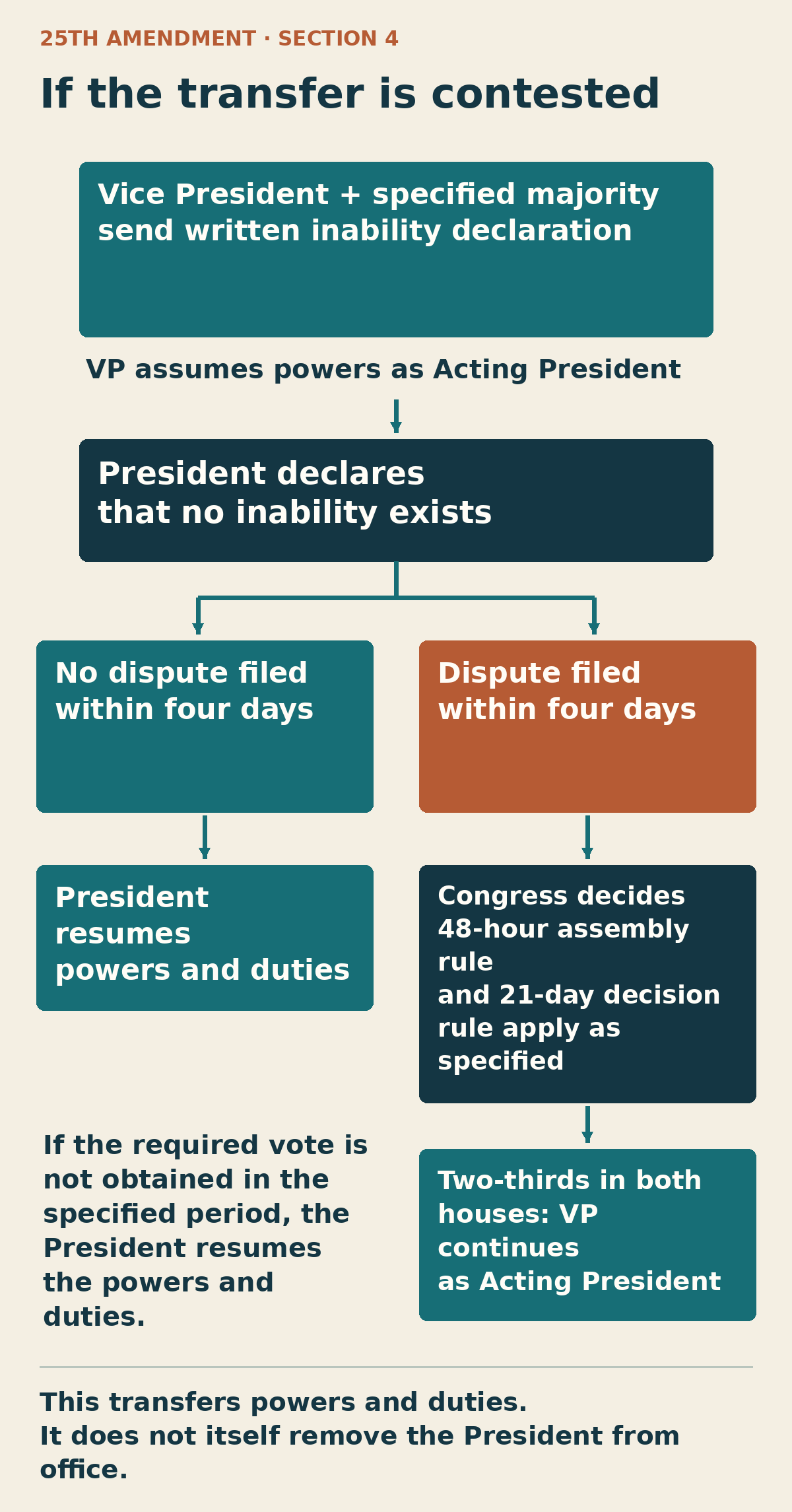
The vice president and the specified majority must initiate the written declaration. If the president later declares that no inability exists, the vice president and the relevant majority have a four-day period to contest it. A contested return goes to Congress under the amendment’s assembly and decision rules; the two-thirds requirement applies in both houses to continuing the vice president as Acting President.
“Cabinet” is not simply everyone with Cabinet rank
The amendment uses the phrase “principal officers of the executive departments.” The CRS report explains why that is more specific than a president’s informal list of advisers with Cabinet status.
Its discussion of legislative history also addresses acting department heads and recess appointees. That history is relevant, but it should not be promoted into a definitive ruling on every hypothetical dispute about membership or eligibility.
A responsible explanation therefore identifies the constitutional category and the actual officials relevant to a real case. It does not assume that any eight politically prominent people constitute the required majority, or that a current count can be borrowed from an older article without checking the legal and factual setting.
Incapacity, impeachment and an unlawful order are different questions
Section 4 concerns inability to discharge presidential powers and duties. Impeachment and removal follow a different constitutional process. A policy dispute or loss of political support does not, by itself, establish the inability Section 4 requires.
Military orders raise another distinct issue. The public nuclear-command framework discusses presidential authorization and the military’s obligations concerning lawful orders. Those obligations do not become irrelevant because no Section 4 declaration has been made.
Equally, invoking the amendment in public debate does not establish that officials have begun its process. Claims about an actual transfer should be tied to the required declaration and subsequent institutional actions. Speculation about a president’s condition cannot substitute for them.
The useful question is therefore not whether the amendment could express the public’s alarm. It is who would have to act, what they would have to declare and what would happen if the president contested it. That is a substantial constitutional mechanism, with a very different shape from a parliamentary vote of no confidence.