Democrats won control of both chambers in the midterm elections, Reuters reported on November 4. That changes the political outlook for Donald Trump’s Iran war. It does not immediately replace the members who can cast Congress’s votes.
The regular congressional term change comes on January 3, 2027. Until that boundary, the outgoing Congress retains its authority. The incoming majority can make plans, announce priorities and exert political pressure; it does not acquire the outgoing members’ votes on election night.
This leaves a consequential interval. Trump may face a different Congress in January while still dealing with the present one before then. A decision about military action during those weeks would have to be assessed against the authorities, funding and effective restrictions that actually apply at that time.
The plans are already public. In a November 4 statement, Senator Lisa Blunt Rochester said lawmakers intended to rein in the Iran war when Congress returned. An intention to act is different from an enacted restriction, an operative court order or evidence that an operation has stopped.
Congress has real tools: legislation, funding decisions and oversight. Their effects depend on the instrument, its wording, the votes, any required presentment and implementation. The election result is therefore the start of a new institutional contest, rather than its legal conclusion. To understand whether Congress can constrain a particular operation, identify what it has actually done and when that action takes effect.
Winning an election does not immediately change the membership
The Twentieth Amendment sets the end of House and Senate terms, and the beginning of their successors' terms, at noon on January 3. It separately addresses the annual meeting of Congress, allowing a different meeting date to be set by law.
Those provisions are easy to compress into “the new Congress meets in January,” but the distinction matters. The election, the term change and the calendar for congressional business are different events.
An incoming majority may gain political influence before its members take their seats. It cannot cast the outgoing Congress's votes. Meanwhile, the current members do not lose their constitutional powers because an election has occurred or because some will soon leave office.
This gives the weeks after the midterms a particular significance. A change in the next Congress can alter expectations without immediately changing the institution that would have to pass a restriction now.
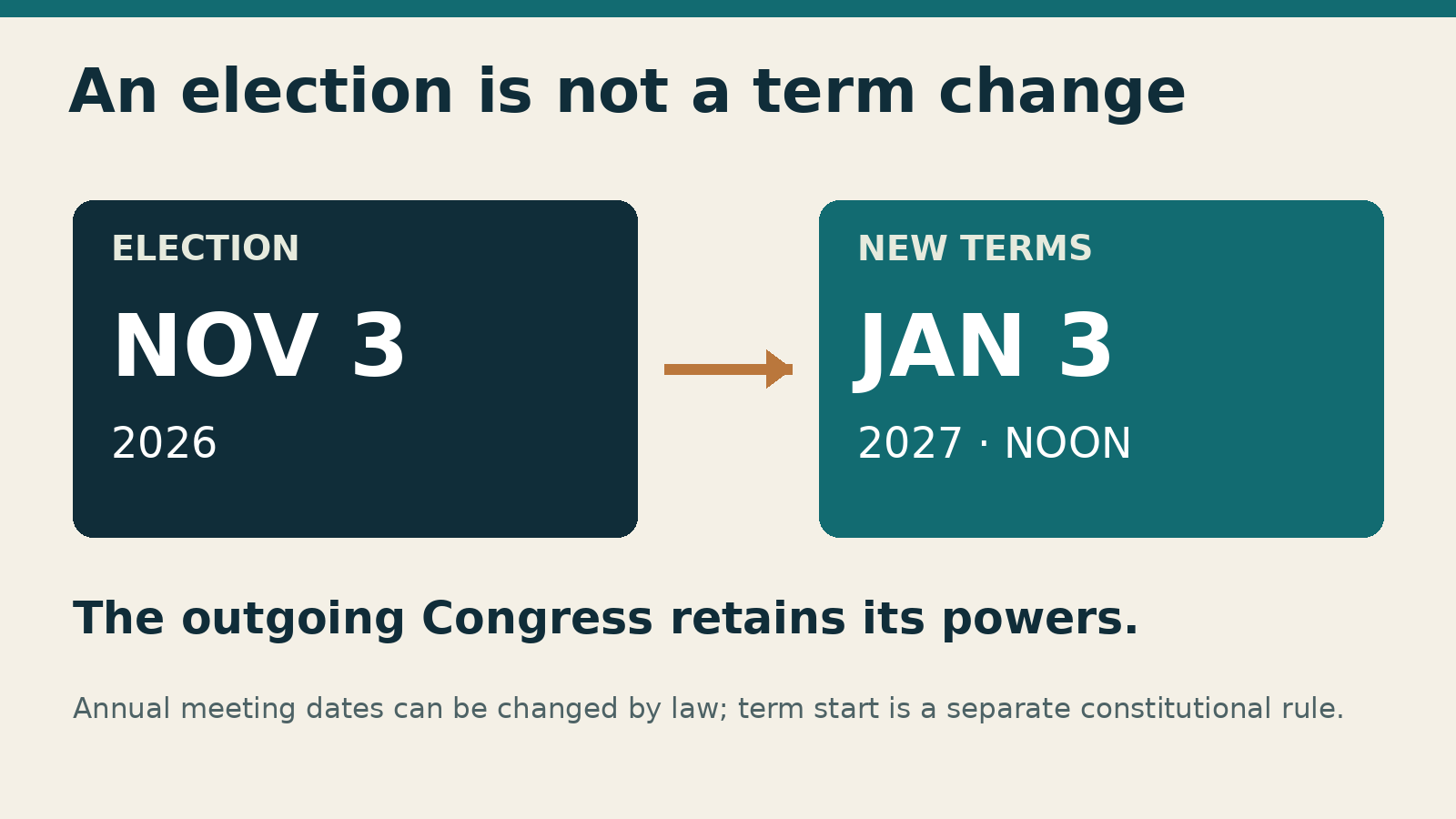
The annual meeting date can be changed by law. That is separate from the constitutional beginning of the new terms.
What the War Powers Resolution requires
The reporting provision in 50 U.S.C. 1543 requires a report within 48 hours in specified circumstances involving the introduction of U.S. armed forces. It is part of a statutory framework for congressional involvement, rather than a substitute for every other question about authority.
The termination provision in 50 U.S.C. 1544 generally requires the relevant use of forces to end within 60 calendar days after a report under section 1543(a)(1) is submitted or required, whichever is earlier. The statute specifies exceptions, including a declaration of war, a specific authorization or an extension enacted by Congress.
The additional period of up to 30 days is tied to a written presidential determination and certification about unavoidable military necessity for the safety of forces during prompt withdrawal. That is a withdrawal-safety provision, not an automatic allowance to fight for 90 days.
Applying those provisions to an ongoing conflict can produce disputes about what counts as hostilities, which operations are covered and when reporting was required. A new presidential letter does not, simply by existing, settle or lawfully restart every disputed clock.
The September presidential notification concerning Iran illustrates the difference between receiving an account of operations and accepting the executive's legal interpretation. The President reports action and asserts authority. Receiving that account does not settle whether the executive's legal interpretation is correct.
Why the form of the vote matters
A concurrent resolution and a bill can both express congressional opposition, but they travel through different constitutional processes.
The Constitution's presentment provisions govern legislation sent to the President. A bill or joint resolution can face a veto; overriding one requires two-thirds support in each chamber. A concurrent resolution is not presented in that way.
Section 1544 still contains language directing removal when Congress acts by concurrent resolution. The constitutional difficulty of enforcing that mechanism after INS v. Chadha is discussed in Congressional Research Service analysis. The ruling casts doubt on that legislative-veto mechanism; it did not strike down the entire War Powers Resolution.
The administration has made its objection explicit. Its September 15 policy statement on H.Con.Res.93 argues that concurrent resolutions lack legal force and invokes Chadha. That states the executive's legal position; it is not a court ruling resolving the Iran dispute.
A war-powers vote therefore has to be understood through the measure itself: what passed, in which chamber, and what legal effect it could have.
Three Iran measures with different outcomes
The 2026 record supplies useful examples of how easily separate proceedings can blur together.
H.Con.Res.86: The Senate's June 23 floor record records agreement by 50–48. Its enrolled text is a concurrent resolution. It was not a joint resolution presented for presidential signature or veto.
H.Con.Res.93: The House passed it on September 15 by 220–204. A September 16 version records referral in the Senate. Those records establish those actions; the referral document alone cannot establish that no later action occurred.
H.Con.Res.89: The Senate's September 24 floor record records failure by 49–50. That outcome belongs to measure 89, rather than to the different resolution that passed the House nine days earlier.
The administration's July 30 statement on S.J.Res.181 adds another distinction: it said advisers would recommend a veto if the joint resolution were presented. A statement of future intent is not an actual veto.
Funding is a separate source of leverage
Congress's control of spending creates tools beyond a standalone resolution opposing hostilities. The effects depend on the wording of a restriction, the funds already available and the process required to adopt it.
CRS's account of the War Powers Resolution describes Congress's funding power alongside recurring disputes over reporting, hostilities and enforcement. Those disputes do not erase congressional authority; they help explain why a vote and its practical effect can diverge.
Ordinary appropriations do not automatically authorize a war. Section 1547 sets specific conditions for inferring authorization from an appropriation provision. Funding and specific authorization are related questions with different requirements.
A proposed funding limitation may itself need to become law and encounter a veto. That does not mean every form of congressional leverage requires a successful veto override. Oversight, the handling of future appropriations and bargaining over legislation can operate differently. Their practical strength must be assessed individually.
The 2020 Iran war-powers veto-override vote offers a historical illustration of the difficulty: the Senate voted 49–44, short of the two-thirds requirement. It is an example of one failed override, rather than a forecast of the next Congress's votes.
What would show Congress changing the outcome
A meaningful assessment starts with the text and status of a specific measure. Has it passed one chamber or both? Does it require presentment? Does it restrict funds, direct removal or request information? What exceptions does it contain, and when would it take effect?
Those questions are more revealing than treating an election win as an immediate stop button or a failed vote as proof that Congress has no influence. Neither shortcut explains the tools available to the current Congress or its successor.
The midterms can change who will hold power next. Preventing or constraining a particular operation requires that power to be translated into an effective action, on a timetable that matters. The interval between an election result and effective congressional action is the practical issue to watch.