NASA’s Swift observatory has reentered after nearly 22 years. A commercial rescue effort did not raise its orbit.
NASA’s updated confirmation places Swift’s reentry on November 4, 2026, at 7:39 a.m. EST over North Sumatra, citing the U.S. Space Force. The rescue vehicle had reentered weeks earlier. They were separate spacecraft with separate endings.
The rescue spacecraft was called LINK
Katalyst Space’s LINK mission launched on July 3 to attempt the servicing operation. The plan depended on getting another spacecraft close enough to capture Swift and raise its orbit safely.
The operation did not reach that outcome. NASA’s September lessons report describes problems with communications and orientation control that led to the mission being scaled back. The agency’s involvement formally ended on September 3.
That is an important distinction from a successful rendezvous being assumed to mean a completed rescue. Getting into the neighborhood, demonstrating parts of a mission and actually securing and boosting another spacecraft are different achievements.
The boost was not completed. Partial demonstrations and useful lessons do not change that result.
What the operator says went wrong
Katalyst’s September 25 account attributes the loss of two reaction wheels to an electrical-power fault. Those wheels help control a spacecraft’s orientation.
According to the operator, the workaround consumed propellant, leaving insufficient fuel for safe capture and the intended boost. That is the contractor’s explanation of its mission, rather than an independent forensic analysis of all the telemetry.
The fuel problem illustrates why “still functioning” and “able to finish the assignment” can diverge. A spacecraft may recover enough capability to perform some work while losing the margin required for its most demanding operation. Here, the operator’s account identifies that margin as a limit on the rescue.
LINK reentered on September 25. Swift remained in orbit until November 4. Confusing those dates can make a late-September report sound like the telescope itself had already fallen.
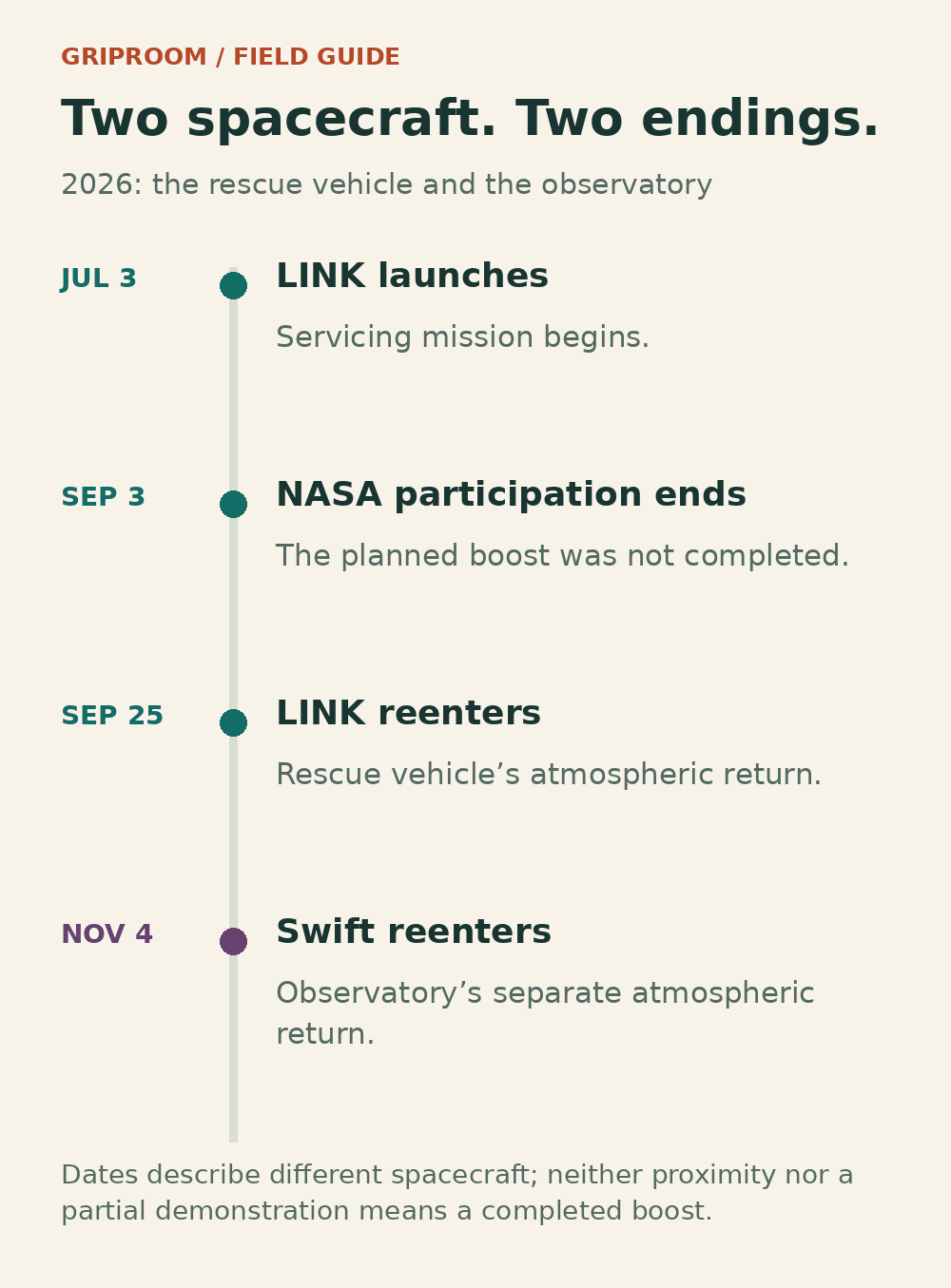
September’s reentry belonged to LINK; Swift remained in orbit until November.
The two-spacecraft timeline begins with LINK’s July 3 launch. NASA’s participation ended September 3; LINK reentered September 25. Swift’s separate reentry followed November 4. The unsuccessful boost belongs to the servicing mission, while the November confirmation records the observatory’s later atmospheric return.
Why the Sun appears in a reentry story
NASA’s explanation connects increased solar activity with enhanced atmospheric drag. A low-orbit spacecraft encounters traces of atmosphere; greater drag drains orbital energy. Without an effective way to raise the orbit, that loss brings the spacecraft lower.
This is a mechanism involving the upper atmosphere and orbital motion. It does not require a collision story or imply that sunlight directly knocked the telescope out of the sky. Nor does one mission’s ending establish a timetable for every other satellite.
Swift’s intended two-year prime mission became more than two decades of scientific observations. Extending that record was the rescue’s objective.
The mission’s scientific record is also why the rescue should be understood as an effort to preserve further observing time. Losing future observations matters even after a telescope has greatly outlived its original design period.
What the confirmation does—and does not—establish
NASA expected most of Swift to burn up; some components might survive. Neither a specific surviving piece nor its ground impact is confirmed by that statement.
NASA first posted its article November 2, then updated it November 4 for confirmation. Its URL’s older future tense is obsolete.
Swift’s ending contains both an unusually long scientific success and an unsuccessful attempt to prolong it. Keeping those two facts together gives the rescue its proper stakes without rewriting the result.