A U.S. passport does not exempt a traveler from the new declaration for flights arriving from abroad. Returning Americans are among the people required to attest that they have not been in the Democratic Republic of the Congo during the previous 21 days.
The CDC requirement also covers a U.S. flight connection on the way to another country. You do not have to be arriving from DRC for the paperwork to apply.
he flight determines who gets the question
The amended order, issued October 28 and published October 30, applies to international flights departing for the United States from November 3, 2026, at 11:59 p.m. Eastern Standard Time. It is stated to remain effective through December 18 at 11:59 p.m. EST, unless amended or rescinded earlier.
Its scope includes crews and cargo aircraft as well as ordinary passenger travel. It excludes an overflight that does not land at a U.S. airport. A purely domestic flight is outside this particular international-arrival requirement.
Think about the U.S.-bound leg when reading the rule. An American flying home from London falls within the paperwork requirement. So does a traveler connecting through a U.S. airport en route elsewhere. The obligation is wider than travel from an outbreak country.
That does not mean those two travelers are presumed to have visited DRC. It means the airline must obtain the relevant declaration before allowing boarding.
A connection and a travel history are separate tests
There are two different connections to keep straight: connecting through the United States brings the flight within the order, while an earlier airport connection inside DRC can affect whether the traveler can truthfully make the declaration.
The actual CDC form counts physical presence in DRC, including an airport stop even if the traveler stayed on the aircraft. Passing through without leaving the airport does not automatically remove that part of the itinerary from consideration.
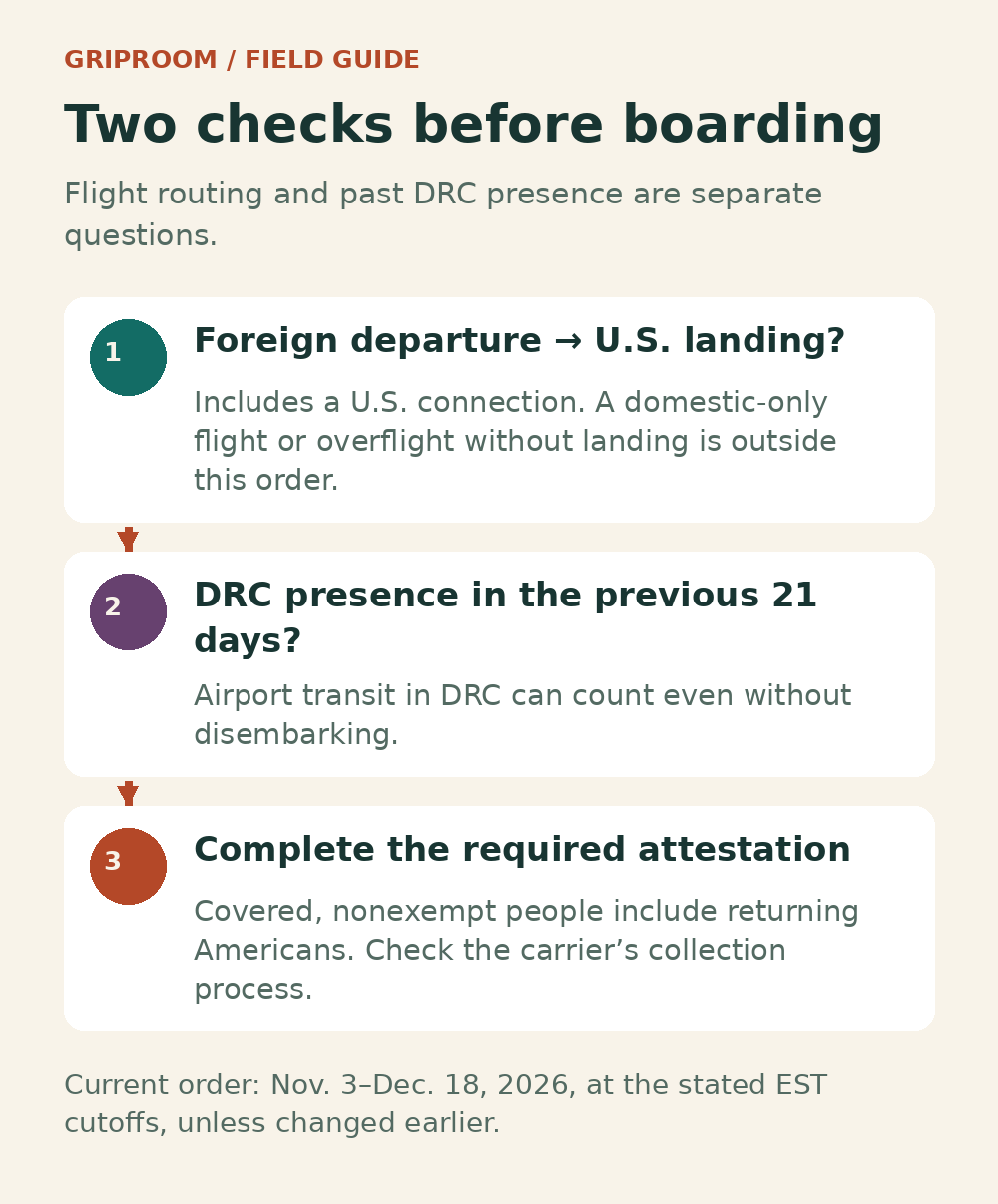
Nationality alone does not settle whether the international-flight paperwork applies.
First check whether the flight departs a foreign country for a U.S. landing, including a connection. Then check the traveler’s previous DRC presence. A traveler can be required to complete the form despite never having visited DRC; an airport stop in DRC can matter even without leaving the aircraft. These are different questions, rather than competing interpretations of one rule.
For a recent DRC visitor, changing the departure city does not erase the travel history. Ask the airline how the restrictions apply before attempting to travel. The order contains limited exemptions, including specified authorized medical transport and individual CDC exemptions; they are not a general workaround.
Children need coverage, too
The form calls for a separate attestation for each individual. A parent or another authorized representative may act for a child. An authorized representative can also act in other permitted circumstances, including when a traveler cannot act on their own behalf.
The practical distinction is between who is covered and who can sign. Allowing an adult to sign does not create a blanket exemption for everyone under 18.
The form’s printed OMB expiration date of March 31, 2027, is also a different date from the order’s stated December 18 endpoint. A form’s administrative approval date should not be used to extend the travel restriction. Check for a later order if your departure is near or after the current endpoint.
What to do before leaving for the airport
Airlines and aircraft operators provide and collect the attestation. The CDC’s traveler FAQ says to ask your carrier how it handles the process. A carrier may collect it digitally, so do not assume an identical printed handout appears at every airport.
Review the complete itinerary, the traveler’s recent countries and any airport stops. Make sure each person’s declaration is covered, including children. If you cannot truthfully make the attestation, resolve that with the carrier before the boarding gate; the requirement is not satisfied by signing whatever keeps the queue moving.
The airline must deny boarding when a covered, nonexempt traveler lacks the required attestation. Signing a false statement carries legal consequences. This is a declaration about travel history, rather than a test result or a certification that someone cannot be ill.
CDC says the overall risk to the American public and travelers remains low. Its guidance also distinguishes DRC-related measures from other restrictions involving Uganda and South Sudan. Anyone with recent travel in affected areas needs the current country-specific guidance as well as this form.
For most readers, the useful correction is straightforward: nationality alone does not settle the paperwork. Check the flight, check the travel history, and confirm the carrier’s collection process before departure.