
AST SpaceMobile wants more control over the journey from satellite factory to orbit. Its November 6, 2026 announcement targets Blacklift operations in late 2028, carrying up to five BlueBird satellites per mission. Outside launch providers remain part of the plan.
This is a proposal to change how a network gets built, not a new phone feature arriving this week.

A factory still needs transport
Producing a satellite and delivering it to a useful orbit are separate jobs. A network operator can make progress on one while depending on another company’s launch schedule for the other.
AST’s Blacklift page describes a dedicated vehicle designed around its own spacecraft. It presents ownership of launch capacity as a way to coordinate deployment and expand its business. Those are objectives, rather than operating results.
The strategic question is whether bringing another operation inside the company ultimately makes the whole system easier to run. Ownership can change who sets a schedule. It does not remove the need to meet it.
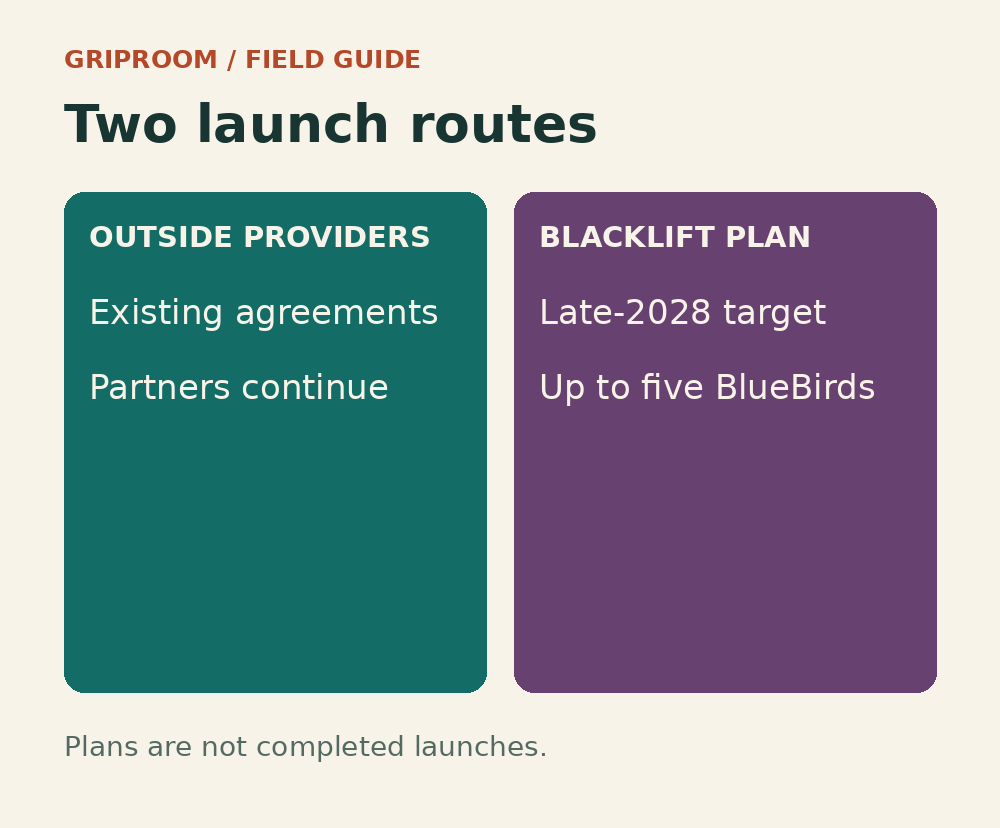
AST describes complementary routes.
The company proposes an in-house launch route alongside outside providers. Both serve satellite deployment; the new vehicle is intended to complement the existing route.
There are two different kinds of dependency to consider. A company can rely on a supplier’s capacity, or it can rely on its own ability to create and operate that capacity. Vertical integration changes the problem rather than making execution disappear.
Firefly supplies a starting point
Firefly’s announcement describes a deal exceeding $1.3 billion for engines, a manufacturing license and engineering support. It will supply 27 Miranda engines and nine vacuum-variant Vira engines for the first three rockets, while retaining ownership of its engine intellectual property.
The counterparty also describes extensive testing and technology derived from its existing engines. That matters to the starting point; it does not demonstrate a completed Blacklift flight, payload delivery or repeated launch operation.
“Flight heritage” is worth reading closely whenever a new vehicle is announced. The relevant question is which component or architecture has that history, and what the newly integrated vehicle still has to demonstrate.
What the agreement buys
AST separates approximately $800 million in upfront license consideration, $250 million for initial engines and $250 million for engineering support. The upfront consideration includes cash and shares. AST also plans a new U.S. engine-manufacturing facility. These categories buy different things.
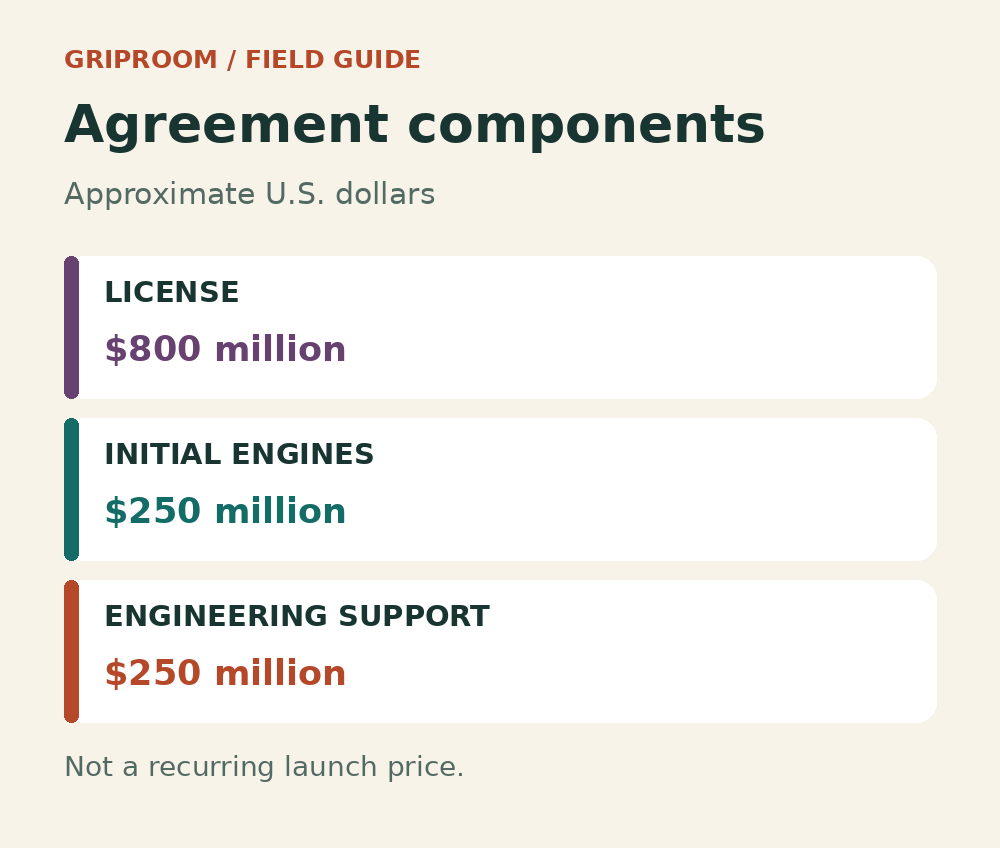
Different purchases, not one launch cost.
The announced license, engine and support amounts explain the agreement’s scale. They are not a complete rocket-development budget or a recurring launch price.
Dividing the entire agreement by the first three rockets would produce arithmetic, but not a dependable estimate of normal launch economics. A license can support future manufacturing; an initial engine order and a period of assistance have different purposes.
For the same reason, an announced investment does not demonstrate a saving. To assess the eventual economics, readers would need evidence about what the operation costs and what it reliably delivers.
Watch execution, then the service
The planned November 12 unveiling is separate from the later launch target. A presentation can make a design easier to understand; it cannot substitute for an integrated vehicle’s tests and actual missions.
For satellite-to-phone customers, there is another distinction. A rocket announcement does not establish which network service is available to a particular subscriber. AST’s network FAQ addresses carrier relationships and service separately; a customer still needs the relevant carrier’s actual offer.
Blacklift is an attempt to solve a real category of dependency: a satellite business needs transport. Its value will become clearer when the company turns the plan, licensed technology and support into an operating launch capability.