What Ted Lasso Biscuits Reveal About Food as Emotional Labor
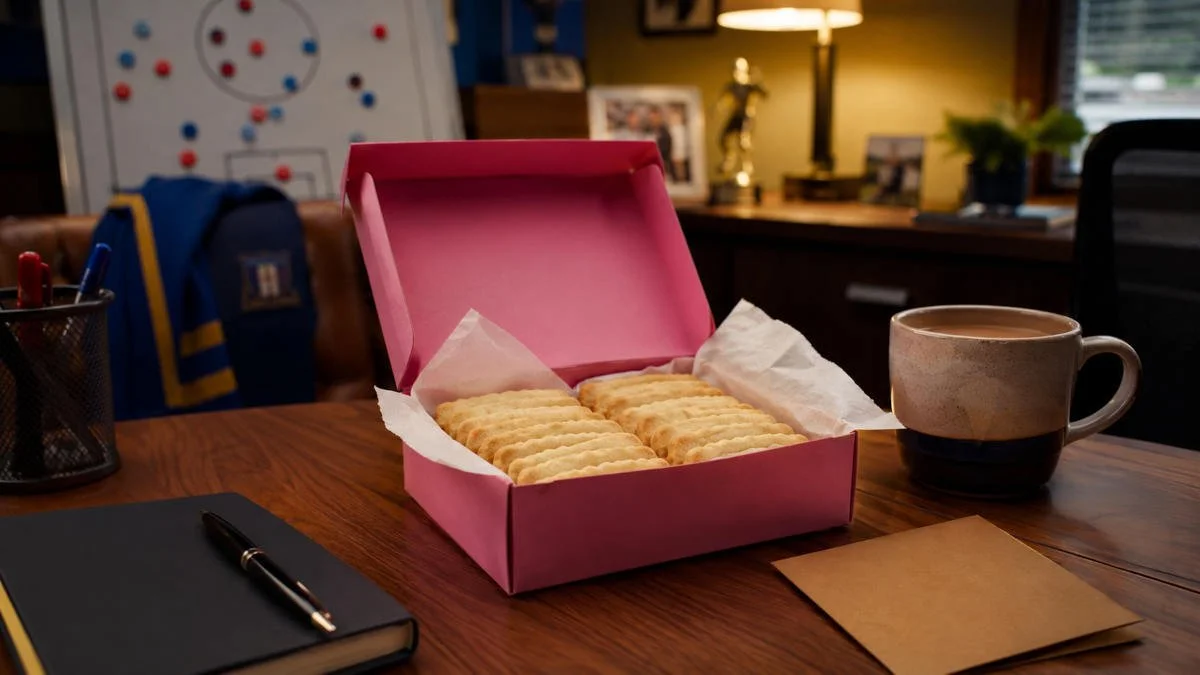
A pink box of shortbread should not have this much psychological weight. It should sit quietly, be buttery, ruin someone’s attempt at moderation, and leave crumbs on a desk like a civilized carbohydrate.
But in Ted Lasso, the biscuits are not merely biscuits. They are diplomacy. They are workplace strategy. They are emotional surveillance with powdered sugar. They are what happens when a mustached American golden retriever in human form decides the best way to soften a hostile boss is not through power, leverage, or institutional competence, but through baked goods. Naturally, it works, because this show was created before we all agreed kindness had become suspicious.
The “biscuits with the boss” ritual begins early in the series, when Ted Lasso, freshly installed as the wildly underqualified American coach of AFC Richmond, starts bringing Rebecca Welton a little pink box of biscuits every morning. Rebecca initially treats him like a walking HR incident in khakis, which, fair. Then she eats one. Then she wants more. Then the biscuits become a daily ritual, because apparently the path through betrayal, grief, and corporate sabotage is paved with butter.
Ted Lasso’s Biscuits Are Not a Snack. They Are a Siege Weapon.
Ted brings Rebecca the biscuits as a gift, but the gift is doing a lot of suspiciously competent work. It is not just “here, have a cookie.” It is “I see you, I thought about you, I made this for you, and I will keep showing up even if you continue treating me like an emotional support fungus.”
That detail matters. If Ted bought the biscuits, the gesture would still be nice. But homemade biscuits are a different animal. Store-bought says, “I remembered.” Homemade says, “I rearranged my time, ingredients, kitchen, sleep, and dignity to make you feel considered.”
That is food as emotional labor: not just feeding someone, but reading them, anticipating them, softening them, managing the room, and making the relationship easier to inhabit. Tiny cookies, enormous agenda. Very normal. Not at all the sort of thing that makes every office birthday cake feel like a labor relations document with frosting.
Emotional Labor, Because Apparently Even Cookies Need a Sociology Degree
The term “emotional labor” was coined by sociologist Arlie Hochschild to describe the management of feelings as part of paid work. It originally referred to jobs where people have to regulate their emotions for customers, clients, bosses, coworkers, or the general public, which is why flight attendants smile while people behave like luggage with opinions.
The internet has since expanded the phrase to mean everything from remembering birthdays to pretending not to hate your friend’s boyfriend to silently noticing there is no toilet paper in the house because apparently you are the Minister of Domestic Continuity. Helpful? Sometimes. Overused? Absolutely. Language has been through enough.
But Ted’s biscuits are interesting because they sit right on the border. This is not private domestic care. Ted is doing it at work, for his boss, as part of his broader job of transforming the emotional culture of AFC Richmond. Nobody put “bake morale cookies for emotionally barricaded owner” in his contract, but the biscuits absolutely help him manage workplace feeling.
They are leadership, manipulation, hospitality, and care in one pink box.
The Biscuits Are Ted’s Soft-Power Strategy
Ted does not arrive at AFC Richmond with tactical credibility. He barely understands the sport he has been hired to coach, which is generally frowned upon in professional athletics, much like hiring a dentist who learned teeth from cartoons.
So he builds influence another way. He learns names. He asks questions. He notices people. He creates rituals. The biscuits are his most visible move: a daily, repeatable act that says, “I am here, I am consistent, and I will keep showing up even if you treat me like a Midwestern virus.”
That is the emotional intelligence of the biscuits. They are not dramatic. They are not a grand speech. They do not demand immediate intimacy. They simply appear every morning. Reliability is the whole trick.
Food is good at this because it bypasses the part of the brain that wants to argue. You can reject advice. You can resist optimism. You can mock sincerity. But a good biscuit just sits there being delicious like a tiny edible lawyer making Ted’s case.
Rebecca Eats the Biscuit Before She Trusts the Man
Rebecca’s relationship with Ted starts as sabotage. She hires him because she wants AFC Richmond to fail, not because she believes a Kansas football coach has secretly cracked the code of English soccer. Ted is not her chosen leader. He is her weapon.
That is what makes the biscuits so annoying to her. They are inconveniently sincere.
Rebecca can dismiss Ted as naïve. She can underestimate him. She can treat his friendliness as buffoonery. But the biscuits become evidence of attention. He has made something for her. Not publicly. Not performatively. Not in front of the team. Just quietly, repeatedly, in private.
This is how food becomes emotional leverage without becoming openly coercive. Ted does not say, “Trust me.” He gives her a reason to feel, against her own strategic interest, that he might be safe.
Horrifying. A man weaponized consistency. Someone alert HR, or possibly the bakery.
Food as Care Is Never “Just Food”
The fantasy of Ted’s biscuits is that care looks effortless. The box appears. The biscuit tastes good. Rebecca’s morning is improved. The audience smiles. Nobody has to watch Ted wash a mixing bowl at 5:42 a.m. like a haunted Pillsbury monk.
But the labor is the point.
Even simple shortbread requires planning. Butter has to soften. Ingredients have to exist in the house, which already makes the whole thing more organized than most adult lives. The dough has to be mixed, chilled, cut, baked, cooled, boxed, transported, and presented. Then the kitchen has to be cleaned, because baking is just making joy by briefly destroying a room.
That is what food care always hides. The final product is cute. The work behind it is planning, shopping, timing, baking, packaging, remembering preferences, and doing it again tomorrow because apparently affection has a production schedule.
So when Ted makes biscuits, he is not just being quirky. He is performing care through foodwork. Adorable? Yes. Sustainable? Please ask the dishes.
The Biscuits Are Also a Little Manipulative, Because Kindness Is Not Automatically Pure
Here is the part where we ruin the cozy blanket with a sociology stain.
Ted’s biscuits are kind. They are also strategic. These things can coexist, because humans are not motivational posters with knees.
Ted wants access to Rebecca. He wants conversation. He wants daily contact. He wants to build trust with the person who controls the club. The biscuits are a low-pressure way to get in the room and stay there. They sweeten the encounter, literally and politically.
That does not make Ted evil. It makes him socially competent, which is somehow more frightening.
Food has always worked like this. Bring muffins to a meeting and suddenly everyone is less eager to admit the project is on fire. Bake for a neighbor and you have opened a channel. Make soup for a sick friend and you have said something emotionally enormous without saying anything that requires eye contact.
Food is care. Food is communication. Food is also a tiny bribe wearing crumbs.
Rebecca’s Pleasure Is Also Performance
The behind-the-scenes lore makes the biscuit situation even funnier. The biscuits used on set were not always the buttery miracle Rebecca appeared to experience onscreen. Hannah Waddingham has joked that some early versions were not exactly life-changing, which means she had to perform transcendent cookie joy while eating something that may have tasted like drywall’s more ambitious cousin.
That is perfect. In the show, Rebecca is overwhelmed by Ted’s biscuits. In real life, the actress had to act like dry little desk bricks were portals to emotional healing.
So now we have emotional labor about fictional emotional labor inside a show about emotional labor.
Television: a normal industry where people pretend to enjoy fake cookies so we can feel something at home.
Ted Lasso Makes Care Look Masculine Without Making It Pathetic
One reason the biscuit ritual lands so hard is that Ted’s care is not coded as weakness. He bakes. He notices. He nurtures. He asks how people are. He shows up with treats. He creates emotional safety in a workplace full of bruised egos and men who communicate mostly through grunting, insults, and hamstring injuries.
And the show does not present this as embarrassing. It presents it as leadership.
That is quietly radical in a sports story, where male authority usually arrives wearing a whistle and the emotional range of a parking cone. Ted’s biscuits say: attention is strength. Warmth is strategy. Care is work. Also, butter helps.
Does the show occasionally turn kindness into a scented candle with dialogue? Absolutely. Sometimes Ted Lasso is so earnest it feels like being hugged by a LinkedIn post. But the biscuits work because they are specific. They are not “be kind” in the abstract. They are “make the thing, bring the thing, sit with the person, repeat.”
The Pink Box Is Packaging, and Packaging Matters
The pink box is not incidental. It makes the gesture feel ceremonial. Ted does not hand Rebecca a loose biscuit in a napkin like a man distributing evidence. He presents the biscuits in a small, neat box. The container turns the food into a ritual object.
That is another food-as-care lesson. Presentation is emotional labor too. The box says: I thought about this. I prepared this for you. I did not simply shovel baked matter into your office.
People pretend presentation is superficial until someone brings soup in a washed-out salsa jar and suddenly everyone understands class politics, intimacy, and mild disgust.
The packaging makes the biscuits feel personal, private, and daily. Rebecca is not just eating shortbread. She is receiving a tiny morning ceremony from the least cynical person in the building, which must be incredibly annoying when your entire plan depends on bitterness.
The Ritual Matters More Than the Biscuit
The biscuits are powerful because they repeat.
A one-time gift is nice. A daily ritual rewires expectations. Rebecca begins to anticipate the box. The meeting becomes part of the rhythm of the workplace. Ted creates an emotional checkpoint with flour and sugar, because apparently he is one cardigan away from becoming organizational therapy.
This is why food rituals matter. Coffee with a coworker. Family dinner. Birthday cake in the break room. Soup when someone is sick. A snack packed for a child. These gestures create continuity. They tell people, “You are expected. You are remembered. There is a place for you.”
That sounds sentimental because it is. Unfortunately, sentimentality is sometimes just truth wearing a cardigan.
Food as Emotional Labor Can Heal, But It Can Also Exhaust
The danger of celebrating Ted’s biscuits too much is turning them into another standard nobody asked for.
Great, now every decent person is supposed to bake daily shortbread for their emotionally unavailable boss? Wonderful. Another unpaid task. Another invisible ritual. Another way to prove care through effort until your kitchen looks like a war zone and your personality becomes “reliable provider of snacks.”
Foodwork can create connection, but it can also become oppressive when one person is expected to do all the remembering, shopping, cooking, presenting, and emotional smoothing. This happens constantly in families, offices, friend groups, and anywhere someone has accidentally become the unpaid Commissioner of Everyone’s Feelings.
That is the shadow side of the biscuit. Ted’s ritual is charming because he chooses it freely and uses it with purpose. It would be less charming if everyone simply expected him to bake forever because “that’s just what Ted does.”
Care becomes exploitation the moment the recipient forgets it costs anything.
The Show Knows Food Opens Doors Words Cannot
Ted is talkative. Very talkative. Weaponized anecdote talkative. The man could turn a weather comment into a five-minute story about a substitute teacher and a raccoon. But the biscuits do something his words cannot.
They give Rebecca an experience before an argument. She tastes care before she believes in it. The biscuit gets past her defenses before Ted does.
That is what food often does. It communicates without requiring confession. A casserole after a funeral says, “I cannot fix this, but you still need to eat.” A packed lunch says, “I thought about your day before it began.” A shared dessert says, “We are not done with each other yet.”
Ted’s biscuits say, “I know you do not trust me. I will be here anyway.”
Deeply unfair. Very effective. Butter should be regulated.
Ted Lasso Biscuits Became Merchandise Because Capitalism Was Listening
Naturally, the biscuits did not stay inside the show. Viewers wanted recipes. Food sites tested versions. Brands played with the idea. Fans started baking them at home, because the modern audience cannot see a fictional carb without turning it into a weekend project.
This is both ridiculous and inevitable.
The biscuits became shorthand for the show’s whole emotional promise: sweetness, effort, optimism, and repair. A fan making the biscuits at home is not just baking shortbread. They are trying to access the feeling of the show, which is basically therapy if therapy came in a pink box and had a suspicious amount of butter.
Capitalism saw emotional healing and immediately asked whether it could be sold by the pint, the batch, the tin, or the limited-edition gift set. Of course it did. Capitalism would monetize a hug if it could find a barcode placement.
Why the Biscuits Still Matter
The biscuits remain one of Ted Lasso’s most durable symbols because they are the whole show in miniature.
They are optimism with labor behind it. They are care with strategy inside it. They are food as connection, food as persistence, food as emotional repair, food as workplace culture, food as a tiny daily rebellion against cynicism.
Ted Lasso does not win Rebecca over by being right. He wins her over by being present. The biscuits are proof of presence. Annoying, delicious, repetitive proof.
That is why the ritual works. It turns kindness into something material. Not vague kindness. Not slogan kindness. Not “we value our people” printed on a corporate poster next to a stock photo of a handshake. Real kindness, made early, boxed carefully, and delivered consistently.
Final Verdict: The Biscuits Are Buttered Emotional Infrastructure
Ted Lasso’s biscuits reveal that food is rarely just food, because apparently we are all trapped in a species that turned snacks into attachment theory.
The biscuits show how feeding someone can become emotional labor: noticing what they need, creating comfort, smoothing tension, building trust, and doing it again before anyone applauds. They show how care can be generous and strategic at the same time. They show how small rituals can soften hard people, not with lectures, but with consistency.
They also show the cost. Someone has to bake. Someone has to remember. Someone has to clean the pan. Someone has to keep choosing the gesture instead of merely enjoying the credit for being “thoughtful,” that most dangerous of reputational baked goods.
Ted’s biscuits are not magic. They are work.
But they are the kind of work the show believes in: deliberate, humble, repetitive care that says, “I see you, I brought something, and I’ll come back tomorrow.”
Terrible news for cynics. Excellent news for shortbread.