
The final weeks before launch have a different history. And the box on the shelf may be less reassuring than it looks.
Our estimate: approximately 6% probability that Rockstar or Take-Two announces, by November 19, 2026, a delay beyond that date for GTA 6’s initial U.S. release on PS5 or Xbox Series X|S, as of October 24, 2026.

Editorial illustration generated with AI; not a GTA VI screenshot.
A release date is supposed to answer a simple question: when can I play? With GTA 6, it also becomes a test of character. Do you trust the calendar? Do you book the day off? Or do you keep one eye on Rockstar’s website, waiting for a polite statement that ruins your November?
Our call is that the date holds against another official postponement. The strongest reason is less glamorous than a trailer: the small set of comparable Rockstar launches looks different once the games get this close to release. The last few weeks deserve their own history.
We have no verified outside percentage for precisely this announcement, deadline and information date, so there is no honest market gap to quote. A forecast about whether the game actually arrives can have different rules from one about whether Rockstar announces a delay. That difference matters before anyone starts comparing numbers.
The calendar has changed the question
There are 26 days between October 24 and November 19. That changes what we need to know.
“Rockstar sometimes delays games” is true but incomplete. A project can move while it is still a season on a planning slide. It can also move after stores have a firm date and players have started rearranging their lives. Those are different moments, with different choices left.
We looked at seven new Rockstar-published console games from the PS3 and Xbox 360 era onward: GTA IV, Midnight Club: Los Angeles, Red Dead Redemption, L.A. Noire, Max Payne 3, GTA V and Red Dead Redemption 2. Each initially launched in the United States on both console families, or their successors. Ports, remasters, handheld games, expansions and online components were left out.
The test was specific: what happened to firm dates still standing 26 days before their then-announced target? We included any such target even if it was later missed. In that seven-game set, we found no official postponement inside the final window. Each game reached its surviving date.
That finding does not turn Rockstar into a Swiss watchmaker. It tells us where the earlier slippage happened. Midnight Club’s move from October 7 to October 21, 2008, was reported on September 4—33 days before the old date. Red Dead Redemption’s April 27 target moved to May 18 in Take-Two’s March 3, 2010 results, 55 days out.
Both belong in a history of delays. Neither belongs in a count of dates that failed after surviving to the final 26 days. Counting them there would be like judging a flight’s chance of cancellation after boarding by including flights cancelled last week.
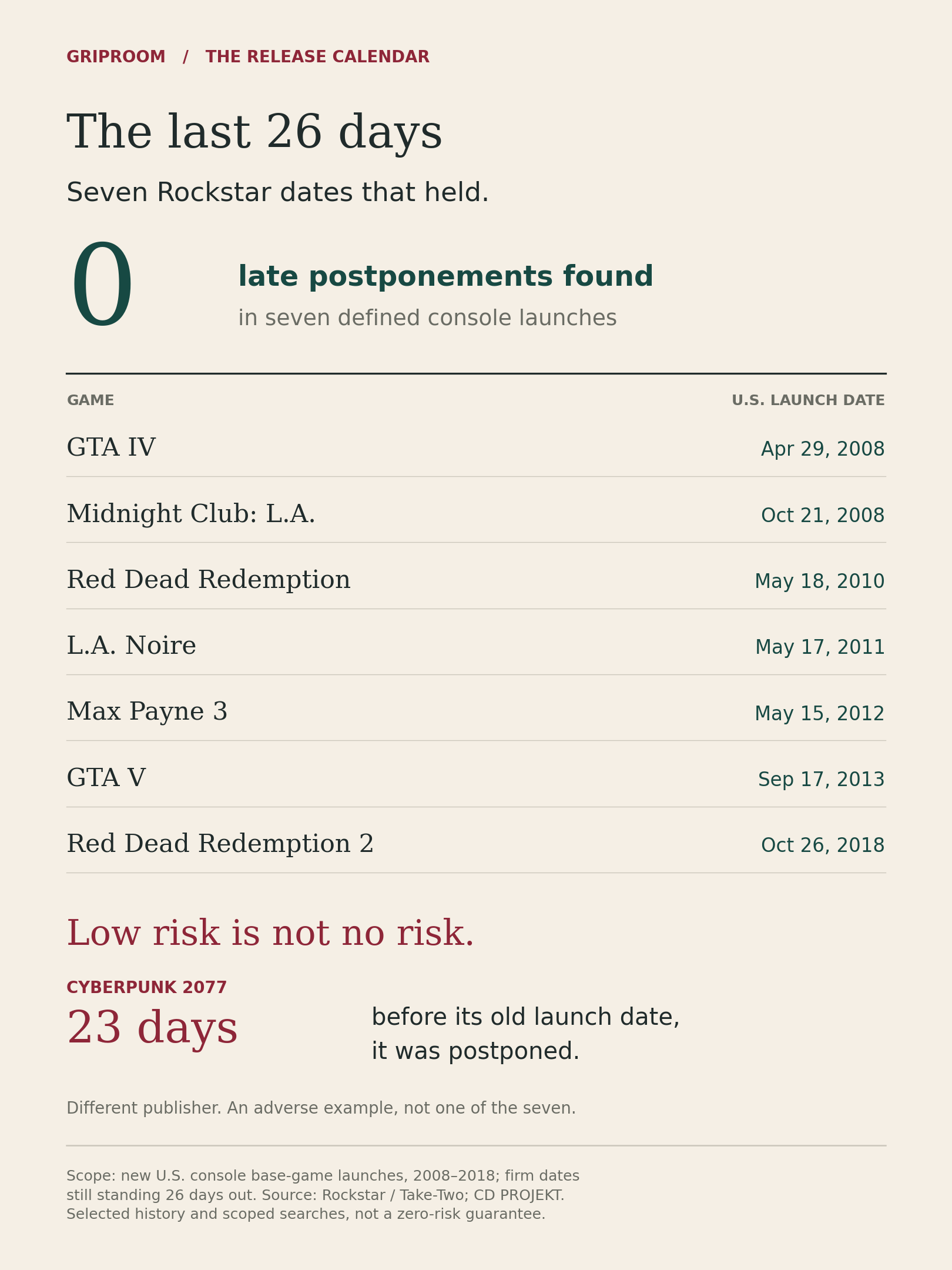
Seven launches, seven surviving dates. Our defined 2008–2018 comparison set; a small historical sample, not a guarantee. Source: Rockstar and Take-Two announcements and financial reports.
Why six, rather than zero?
Seven games are a useful check on an intuition. They are a terrible excuse for certainty.
They share a publisher. Their technology, scale and development teams differ. L.A. Noire was developed outside Rockstar, while a racing game is hardly a perfect twin for a sprawling GTA. Our search also cannot promise that every temporary change in every old announcement has survived online.
So we leave room for an event the small sample has not shown. Adding a modest allowance for an unseen late failure to the seven observations gives a starting judgment of about 6.25%. We round that to 6%. That is our estimate, not a machine discovering a hidden law of game development.
Using different small-sample allowances gives roughly 3% to 11%. Treating one historical case as a missed late postponement pushes the result to about 19%. Those are tests of our assumptions, not statistical confidence limits. The lesson is that a low estimate is defensible; a claim of near-perfect precision is not.
The current public evidence fits the low-risk reading. Take-Two’s preorder announcement still lays out a November 19 console launch and a November 12 preload. The U.S. PlayStation listing carries the same launch date. These are concrete steps toward selling and delivering the game.
They are also largely one story told through several shop windows. Repeating the date on another page does not create another finished build. We have not treated every trailer, store listing and corporate statement as a separate vote of confidence.

A fictional studio after hours. AI-generated editorial illustration.
The box is not the lock
There is one small detail worth keeping in mind when someone says the launch must already be nailed down: the physical box contains a download code.
Take-Two says so in the preorder release. A box can look like the most solid object in the argument. It has corners. It can sit on a shelf. But it does not establish that a final game build has been pressed onto a disc and sent around the world.
That weakens one comforting argument for certainty. It does not prove that Rockstar is preparing to delay anything. The absence of a disc is a distribution choice, not a distress signal. Still, anyone building a theory around an irreversible manufacturing deadline needs to check what is actually being manufactured.
The same care applies to November 12. Preloading is scheduled for that day; it has not happened yet. If it begins as planned, that will be useful new evidence. Today, it is a future milestone printed in a plan.

The reassuring weight of a box. AI-generated concept image.
The strongest objection has a familiar date
The best reason to resist an easy “of course it ships” answer is Cyberpunk 2077.
On October 27, 2020, CD PROJEKT announced a move from November 19 to December 10. The old launch was only 23 days away. The company pointed to final testing across nine hardware versions and the difficulty of distributed work.
That case is awkward for anyone who treats a final-month delay as impossible. It is also too convenient to use carelessly. Cyberpunk was another publisher’s game, under different platform and working conditions. One famous failure cannot tell us how often GTA 6 will fail. It can tell us that public confidence and private technical trouble are able to occupy the same building.
For GTA 6, the live danger would be a serious late problem that cannot be fixed, contained or accepted in time. A problem affecting only the initial U.S. PS5 or Xbox release could be enough for our forecast. We have not found verified evidence of such a blocker in the material reviewed.
There is another possibility that delay arguments often skip: a game can arrive on time and still need work. Meeting the date does not promise a flawless launch. Patches, rough edges and unhappy players would not, by themselves, make this forecast a YES.
One console is enough
The two-console launch creates a wrinkle. If Rockstar officially moved the initial U.S. Xbox release beyond November 19 while keeping PS5 on schedule, our delay forecast would count as a YES. The reverse would count too. A successful launch on one platform would not cancel a postponement on the other.
That is why a PlayStation store page can support the public plan without settling the whole question. It speaks to one side of a launch that has two relevant doors. We do not have private approval records for either.
There is a limit in the other direction. News about a later PC version would not satisfy this call. Nor would a problem with an online mode, while the initial console base game remained on schedule. Before reacting to a dramatic new headline, check which product and platform actually moved.
Watch the action, not the nerves
The next useful signals are specific. Does the preload begin? Does the official platform plan change? Is there attributable evidence of a critical problem? Does Rockstar actually announce a postponement?
A rumour repeated by ten accounts remains one rumour wearing ten jackets. A quiet day on social media does not diagnose a build. More advertising supports the public launch plan, but it does not let us inspect certification records we do not have.
We would raise the estimate for credible, specific evidence of a release-blocking problem or an official change to the delivery plan. Verified final approval on both console families would push the other way. Neither private fact has been established here.
Our answer is therefore clear: another official delay looks unlikely. The remaining risk is real enough to respect and too small, on the evidence we have, to make dread the main forecast.
This call resolves on an official Rockstar or Take-Two announcement made by November 19 that pushes either initial U.S. console release beyond that date. An explicit postponement to an unspecified date counts. PC timing, GTA Online, a local outage or a silent failure to release do not. A permanent cancellation alone is a separate outcome. Rockstar’s official notices control, followed by Take-Two’s investor records; unresolved conflicts stay unresolved.
Keep November 19 on the calendar. Just resist the urge to frame it.
Sources
Rockstar/Take-Two: GTA VI preorder and delivery plans, June 24, 2026.
PlayStation: U.S. GTA VI listing, checked October 24, 2026.
Shacknews: Midnight Club moves to October 21, September 4, 2008.
Take-Two: Red Dead Redemption revised schedule, March 3, 2010.
CD PROJEKT: Cyberpunk release-date change, October 27, 2020.