
Brown and Acton have polling leads. Ohio’s turnout history reveals the catch in the comeback story.
ESTIMATE AS OF OCTOBER 23, 2026
Two statewide contests, one electorate. Editorial illustration.
Sherrod Brown got 117,250 more votes than Kamala Harris in Ohio in 2024.
He still lost.
That is a useful place to begin Ohio’s latest comeback story. Brown has already shown he can reach beyond his party’s presidential vote. The state does not hand out Senate seats for most improved.
Now he is back, facing Republican Jon Husted in a special Senate election. Fellow Democrat Amy Acton is running against Vivek Ramaswamy for governor. Several polls show both Democrats ahead. Together, they offer a tempting picture: two victories, one red state, a very different morning after.
Our estimate is a 52% chance that Democrats win both races on November 3. We put their separate chances at 63% for Senate and 66% for governor, based on information available October 23.
We lean toward a Democratic sweep. The reason to take it seriously is the polling. The reason to keep your feet on the floor is Brown’s last result.
Winning these two offices would be a major Democratic success. It would not, by itself, mean control of Ohio’s legislature or a permanent change in the state’s political loyalties. Ohio can elect two Democrats without signing a lifetime membership form.
There is a real Democratic opening
Start with the evidence that makes the comeback plausible.
In Marist’s October survey, Brown led Husted 48% to 44% among likely voters. Acton led Ramaswamy 50% to 43%.
Then Fox’s survey found Brown ahead 52% to 47% and Acton ahead 50% to 48%.
Those results tell a useful story. Both polls put Democrats in front, but the governor’s race looks much tighter in Fox’s numbers. Acton’s seven-point Marist lead is encouraging for Democrats; it is a poor excuse to stop reading.
Republicans also have favorable evidence. An earlier co/efficient poll put Husted ahead by one point and Ramaswamy ahead by two. Those results remain part of our assessment.
The case for a sweep rests on the combined evidence, with room for the polls to be wrong. A lead in a survey is an advantage to assess, rather than votes already sitting in a box.
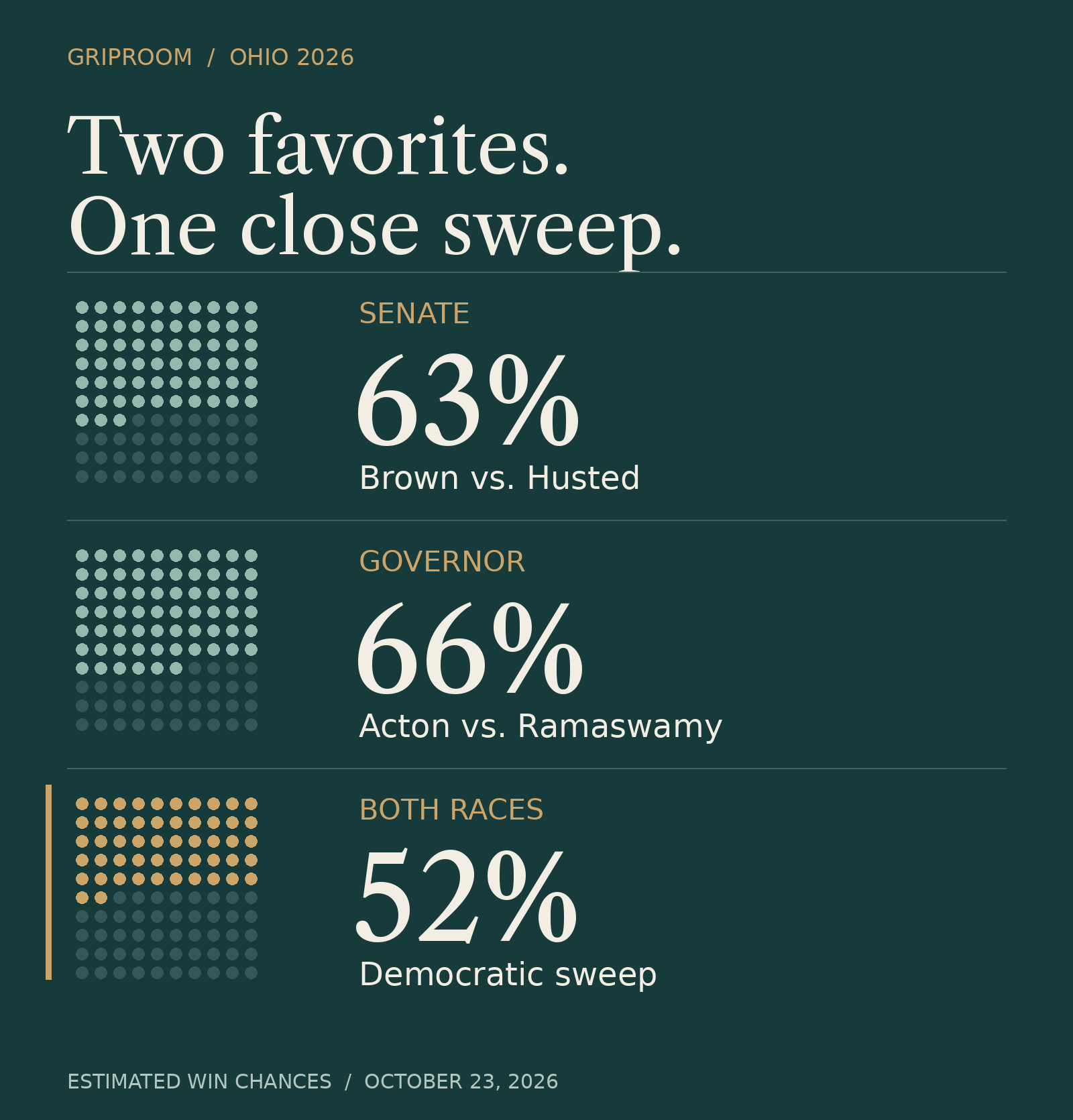
Our win estimates as of October 23. Each grid has 100 dots. These are overlapping outcomes, not vote shares.
Two races, one weather system
There is a catch when two favorites share the same ballot.
Multiply 63% by 66% and you get about 42%. That would be the chance of both winning if the races had nothing to do with each other.
But Brown and Acton are largely asking the same electorate to turn up. They are exposed to the same late political mood, the same turnout surprises and some of the same polling blind spots.
Imagine the surveys are missing a group of Republican voters who will show up in November. That mistake could hurt both Democrats together. A stronger Democratic turnout could help both together.
Think of two boats on the same lake. Different boats, different captains, same weather.

Two contests can rise or fall with the same electorate. Editorial illustration.
Our forecast allows for that shared risk, bringing the sweep estimate to 52%. It also leaves room for a split result. Voters can like Brown without liking Acton, or the other way around.
The important detail is that a sweep needs two victories, while one Republican win is enough to break it. Neither candidate gets to borrow the other’s winning margin.
The turnout shortcut has a problem
This is where Brown’s 2024 loss gets interesting.
One attractive argument for Democrats is that Trump will not be on the ballot. Perhaps some of his voters stay home, while more motivated Democrats show up. Change the crowd and the result changes.
That can happen. But “a different electorate” needs more detail than it usually gets.
We tested one part of the argument. Using county returns checked against MIT Election Data and Science Lab records, we kept each county’s 2024 Democratic and Republican Senate preferences fixed. Then we changed the counties’ shares of the statewide vote to match previous midterms.
In plain English: give each county the same taste in candidates it had in 2024, but change how much of the state’s vote it supplies.
Using the 2022 county pattern barely moved Brown’s margin: an improvement of about 0.04 percentage points. Using 2018’s pattern helped more, by about 1.36 points. He still trailed in both exercises.
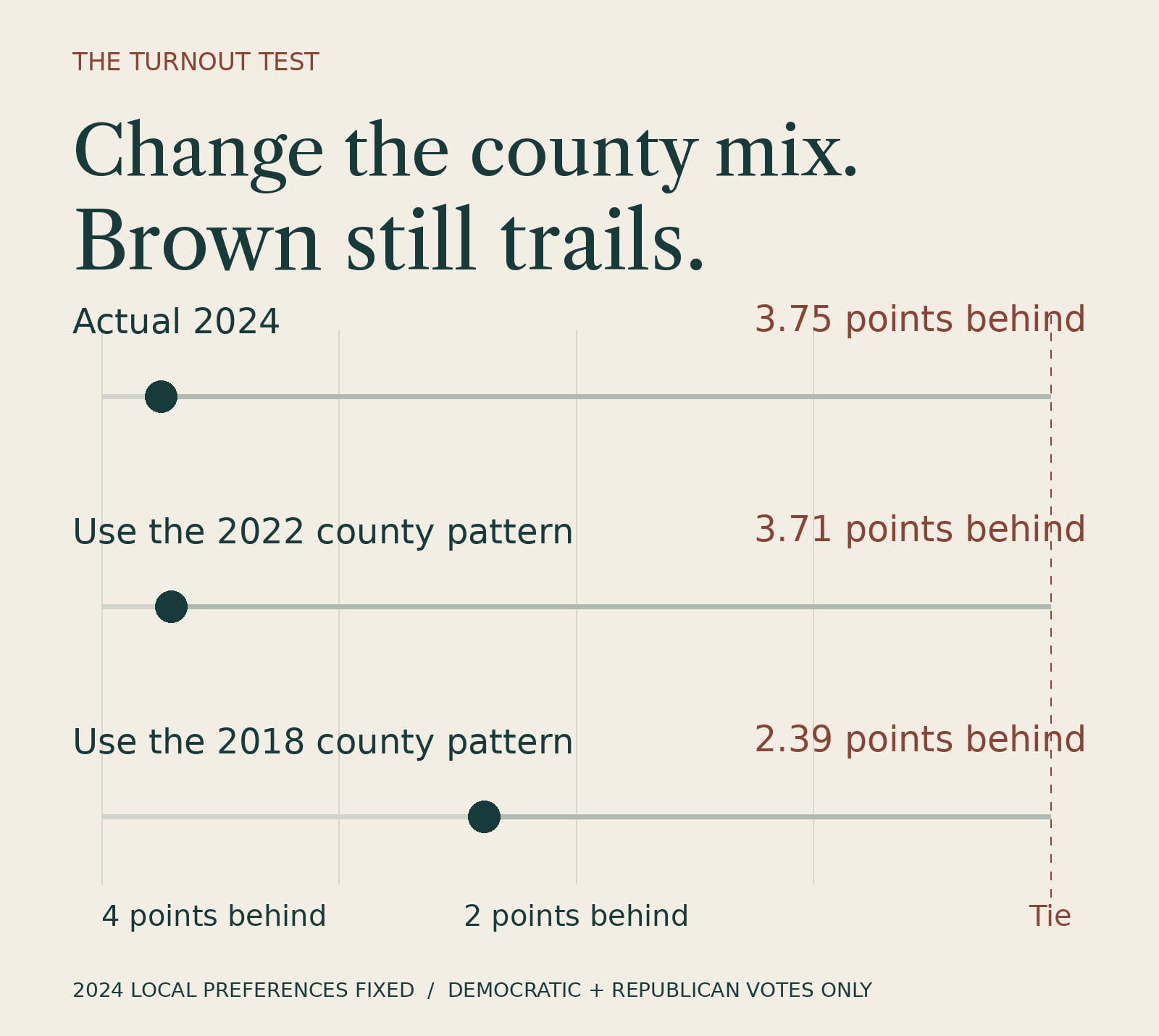
A geography test, not a 2026 prediction. Each county keeps its 2024 Senate preferences; only its share of statewide two-party turnout changes. Historical weights come from the documented county-results compilation.
This does not mean turnout cannot save Democrats. More people can vote within a county, different people can vote, and people can change their minds. Our test holds those changes out of the picture on purpose.
Think of a county as a roomful of voters. Making the room smaller does not tell you which people leave. If departures are balanced, the party split can stay much the same. If one side loses far more people, the result can change sharply. A county’s weight and the choices inside it are separate moving parts.
It shows that borrowing the county turnout pattern of a past midterm does not, on its own, finish the job. A persuasive comeback story needs changes inside counties too.
Brown’s extra votes in 2024 offer another warning. He collected more votes than Harris, while Bernie Moreno collected fewer than Trump. Those totals do not tell us which individuals switched sides, skipped a race or chose another candidate. They show the difference between running ahead of your party and running far enough ahead to win.
The server farm is not a party registration form
Data centers offer a smaller version of the same trap: a broad grievance can look like a ready-made political coalition.
In Suffolk’s Ohio survey, nearly three-quarters opposed tax incentives for data centers. That sounds like a huge pool of potential protest votes.
But only about four in ten backed a permanent ban on future data centers, while 45% opposed one. And just 2.6% named AI data centers as their most important issue.
Those are three different questions: should the industry get tax breaks, should new centers be banned, and does it matter most when you vote?

Industry and the neighborhood next door. An imagined landscape, shown as an editorial illustration.
A voter can resent a subsidy, oppose a ban and still vote Republican. Ohio does not issue party loyalty cards with its electricity bills.
This matters because an appealing issue story can quietly get counted twice: once when it helps explain a poll result, then again as an extra reason to raise a candidate’s chances. We give data-center opposition no separate numerical bonus.
The interesting question is whether dissatisfaction changes a vote. The size of the complaint alone cannot answer it.
That makes the wording of a poll question surprisingly important. Someone saying “stop the tax break” has not necessarily said “stop the building,” much less “change the governor.” A forecast that treats all three answers as the same has skipped the most interesting part of the story.
Republicans do not need a miracle
The strongest Republican case is simple: the Democratic leads are smaller than the mistakes polls can make.
Our weighted polling picture gives Brown a lead of about 3.5 points and Acton about four. Before turning those leads into win chances, we subtract two points from each Democratic margin to allow for Republican support the polls may be missing.
That is a judgment informed by past polling errors. It is not a law of Ohio politics. Raise that correction from two points to about 2.3, and our sweep estimate drops below 50%. The same evidence can produce a different favorite with a modest change in assumptions.
There is also news the big surveys cannot settle. Governor Mike DeWine criticized Ramaswamy’s ad featuring Acton’s mother while keeping his endorsement. Major polls discussed here finished before or near the controversy. Their results do not measure its later effect.
A political rebuke can be real without turning into a lost vote. We have added no automatic backlash bonus.
Early voting is another place to resist easy stories. Ohio’s party labels reflect partisan-primary history, rather than revealing someone’s general-election choice. More early ballots can also mean people voted sooner, rather than that more people will vote overall.
If someone who usually votes on Tuesday turns up early instead, the state still gets one ballot from that person. Earlier arrival changes the queue, not necessarily the guest list. Finding a real turnout advantage means looking for additional participation, with comparisons that account for changes in when and how people vote.
The next useful clues are fresh surveys using different methods and turnout comparisons that account for those differences. A dramatic headline is easier to find. It is less useful.
The call is a narrow Democratic sweep
Our first research pass put the sweep chance at 57%. Broader polling coverage and a larger allowance for Republican strength brought it to 52%. That is our call: Democrats are slightly more likely than not to win both Ohio contests.
To count as a sweep, they must win the Senate special election and the governor’s race held November 3. We use the official results; a close count can take longer than election night.
Brown’s last campaign showed that Democrats can build support beyond their presidential ticket and still fall short. This time, both he and Acton have polling evidence of a path through. The finish requires turning that support into two wins, in the same state, on the same day.